
Duck with Orange Sauce | Anatra all'Arancia
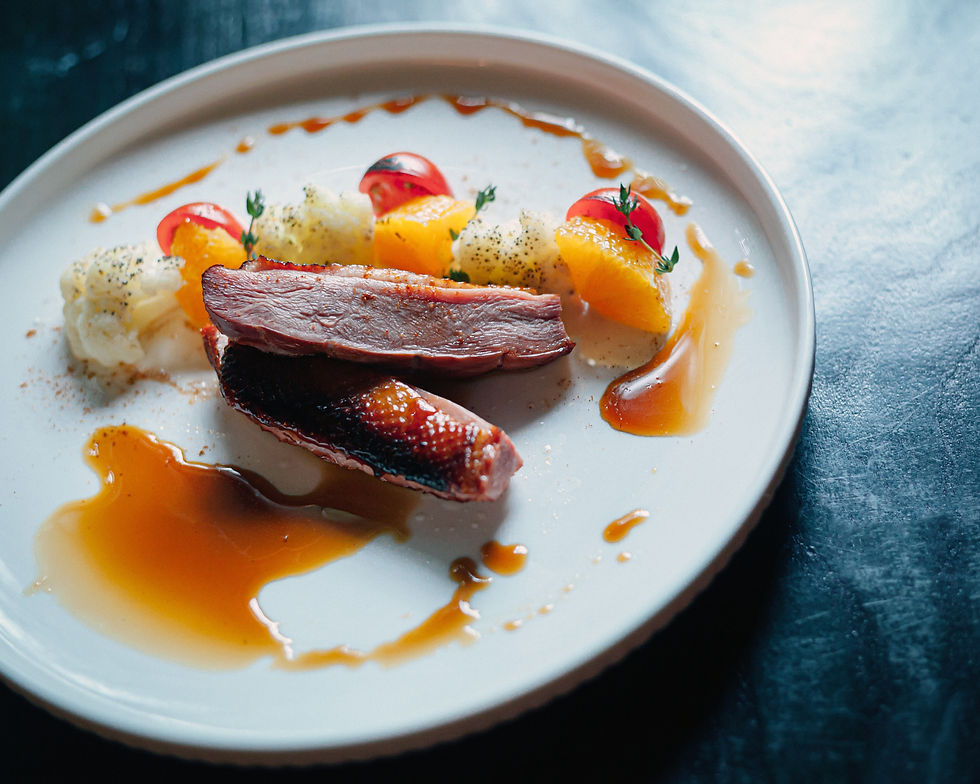
Anatra all'Arancia is the dish everyone assumes is French. It is not, or at least it was not first. Long before canard a l'orange appeared in a Paris kitchen, Tuscan cooks were roasting ducks and dressing them with the juice of bitter oranges, and they had a name for it: papera alla melarancia. The melangolo, the bitter orange of Renaissance gardens, grew in Florence as an ornament and a medicine, and its sour juice did for roast waterfowl what vinegar did for other meats. It cut the fat.
That is still the argument of the dish. Duck is a fat bird with a thick fat layer under the skin, and it needs something sharp to keep the palate awake to the last slice. The sauce is not a sweet orange syrup. It is a gastrique: sugar taken to amber caramel, stopped with vinegar, then loosened with orange juice and the roasting juices until it is glossy, savoury and only just sweet, with zest blanched twice, because orange peel simmered straight into a sauce turns it bitter for good. Both the whole roasted bird and the pan seared breast are given below, with the same sauce.
Yield: 4 servings. Prep: 30 minutes, plus 12 to 24 hours dry brining. Cook: 2 hours 15 minutes for the whole duck, or 25 minutes for the breasts. Rest: 20 minutes. Difficulty: intermediate to advanced. Course: secondo. Region: Tuscany, with a long detour through France.
The Story
The paper trail begins in Renaissance Tuscany, where the bitter orange was a garden tree and a kitchen acid rather than a fruit to eat out of hand. Cookery manuscripts of the fifteenth and sixteenth centuries in Florence and Siena describe waterfowl, duck and goose alike, finished with the juice of melangoli, sometimes with sugar and spices, sometimes with nothing but the juice and the dripping. The Tuscan name, papera alla melarancia, predates any French equivalent, and it describes the technique still used: render the fat, then acidulate the juices beneath the bird.
The bridge to France runs through Caterina de' Medici, who left Florence in 1533 to marry the future Henry II and travelled north with her own cooks and her own habits at table. How much of French cuisine she founded is argued over, and the honest answer is less than the legend claims. What is not in doubt is that Florentine cooking of that generation already used citrus, sugar and vinegar together as savoury seasoning, and that duck with orange entered the French repertoire afterwards rather than before.
The dish then went quiet in Italy while it became a monument in France, and it came home changed. Pellegrino Artusi included a duck with orange in the book that taught unified Italy to cook, and post war restaurant kitchens took the French version back with its apparatus attached: the caramel, the strained fond, the blanched zest. What is served in Florence today is a return journey, an Italian idea that acquired French discipline abroad and came back with the same sour orange at its centre.
Ingredients
For the duck
Whole duck, 5 to 5 1/2 lb (2.3 to 2.5 kg), or 4 duck breasts of 7 oz (200 g) each
Coarse sea salt, 1 tbsp (18 g), for the dry brine
Granulated sugar, 1 tsp (4 g), for the dry brine
Freshly ground black pepper, 1 tsp (2 g)
Orange, 1, halved, for the cavity
Fresh thyme sprigs, 4
Bay leaves, 2
Garlic cloves, unpeeled, 3
For the orange gastrique sauce
Granulated sugar, 3 tbsp (38 g)
Water, 1 tbsp (15 ml), for starting the caramel
White wine vinegar, 3 tbsp (45 ml)
Freshly squeezed orange juice, 1 1/4 cups (300 ml), from 4 to 5 oranges
Duck or veal stock, unsalted, 1 1/2 cups (360 ml)
Dry white wine, 1/3 cup (80 ml)
Roasting juices, defatted, all of them
Cold unsalted butter, cubed, 2 tbsp (28 g)
Fine sea salt, to taste
For the blanched orange zest
Oranges, unwaxed, 2, for the peel only
Granulated sugar, 1 tbsp (13 g)
For finishing
Orange segments, membrane removed, from 1 orange
Aged red wine vinegar, a few drops, for correcting the sauce
Flaked sea salt, a small pinch per plate
Freshly ground black pepper, to taste
Preparation
Dry brine the duck a day ahead
Mix the coarse salt with the sugar and the pepper. Pat the bird dry inside and out, rub the mixture over the skin and a little into the cavity, then leave it uncovered on a rack in the refrigerator for 12 to 24 hours, because skin that starts dry ends crisp. For breasts, half the mixture and 6 hours. Do not rinse it off.
Prick the skin without cutting the meat
With a paring knife tip or a skewer, pierce the skin at close intervals over the breast, thighs and flanks, holding the point almost flat so it passes through skin and fat and stops above the muscle. Forty or fifty punctures is not too many, each an escape route for fat that bastes the bird on its way down. Go deeper and juice runs out instead.
Start the roast low and render the fat
Heat the oven to 300°F (150°C). Put the halved orange, thyme, bay and garlic in the cavity, set the duck breast up on a rack in a roasting tray and give it 1 hour 30 minutes. Very little colour happens here and that is correct: you are melting the fat out from under the skin, not browning it. Spoon the fat from the tray twice and turn the bird onto each flank at the end.
Raise the heat and crisp the skin
Pour off the fat, leaving the dark meat juices behind, and lift the oven to 425°F (220°C). Return the duck breast up for 20 to 25 minutes, watching from 15, because the skin turns taut, dark amber and crisp in a short window and burns in the same one. The breast should read 160°F (71°C), the thigh joint 175°F (79°C).
The cold pan route for duck breasts
Score the skin in a wide diamond pattern without reaching the meat, and season. Lay the breasts skin side down in a cold dry heavy pan over low to medium low heat: the fat renders before the skin can seize, and over 12 to 15 minutes it flows out while the skin flattens and browns. Pour it off as it collects, then turn them for 2 to 3 minutes only, to 130°F (54°C).
Rest the meat properly
Move the duck to a warm board, cover it loosely and leave it 20 minutes; breasts need 6 to 8. Fibres that contracted in the heat relax and reabsorb the juice they pushed to the surface, and the temperature keeps climbing out of the oven. Never cover it tightly, which traps steam against the skin.
Blanch the orange zest twice, then candy it
Peel the two oranges with a vegetable peeler, taking only the coloured layer, and cut the strips into fine julienne. Cover them with cold water, bring to the boil, drain, cover again and repeat. Bitterness lives in the pith and in water soluble compounds, which two changes of water carry away while the aromatic oils stay behind. Simmer the drained zest 5 minutes with the sugar and 3 tablespoons of water.
Build the caramel and stop it with vinegar
Wet the sugar with the tablespoon of water in a heavy saucepan and set it over medium heat without stirring. Let it melt and colour, swirling once or twice, until it is the shade of an old copper coin and smells faintly toasted. Off the heat, pour in the vinegar at arm's length, because it hisses and throws acrid steam, then stir over low heat until the caramel dissolves.
Reduce the sauce and finish it with the roasting juices and butter
Add the wine and reduce it by half, then the orange juice, reduced by two thirds until syrupy, then the stock, simmered and skimmed until the sauce coats a spoon. It should read savoury first and sweet a distant third; correct with a few drops of aged red wine vinegar, never sugar. Let the tray juices settle, pour off the fat and add the dark liquid beneath, then whisk in the cold butter off the heat and stir in most of the zest.
Plating
Carve in the right order: legs off first at the hip joint, then the knife down either side of the breastbone to lift each breast off whole before slicing it on a slight angle. A leg and a few slices make one serving, which is how a 5 lb (2.3 kg) bird feeds four. Keep the board juices for the sauce.
Warm the plates more than you think, because duck fat sets on a cool plate and turns from glossy to waxy within a minute: 140°F (60°C) is a requirement, not a refinement. Spoon a pool of sauce off centre, lay the sliced breast across it skin side up and never under, and set the leg alongside. Sauce over the skin destroys the crispness two hours of rendering built.
Finish with a tangle of the candied zest, two or three orange segments to one side and flaked salt on the skin. For a contorno the classic answer is bitter or starchy: braised chicory, black cabbage, or potatoes roasted in the duck fat you poured off.
Professional Technique
The gastrique is the technical heart of this recipe and it is a sequence, not an ingredient list. Sugar taken to amber caramel develops hundreds of new aromatic compounds, bitter and nutty and faintly burnt, and those give the sauce its depth against a fat bird. Adding vinegar to hot caramel stops the cooking before the sugar turns acrid and dissolves the hardened sugar into an acid base that will not recrystallise. Sugar stirred into juice can never taste the same, because no caramel formed.
The second technique is the divorce of fat rendering from meat cooking. The fat layer between skin and muscle liquefies well below the temperature that browns skin, so 90 minutes at 300°F (150°C) empties it almost entirely, while a hot oven from the start sets the outside and traps the fat beneath, which is how you arrive at flabby skin over a greasy breast. The cold pan start for breasts is the same principle at a smaller scale.
Texture and Moisture Control
Three textures have to arrive together: skin that shatters, moist breast meat, and leg meat past resistance into tenderness, which is why a duck is harder to roast than a chicken. The legs are worked muscle full of collagen, and collagen converts to gelatin only above roughly 160°F (71°C) held over time, so the thighs need 175°F (79°C), while the lean breast dries beyond 160°F (71°C). The long low stage settles the conflict.
Skin crispness is purely a matter of water. Skin cannot crisp until the moisture bound in it is gone, which is why the dry brine matters as much as the oven: salt pulls water to the surface and uncovered refrigeration evaporates it. Steam reverses this in moments, which is why the bird rests loosely covered and never under tight foil.
The sauce has a window of its own. Body comes from reduction and from gelatin in the stock, not from starch, and the final cold butter is an emulsion rather than a thickener, butterfat suspended in the acid reduction, which gives the shine and the weight on a spoon. Hold it below a simmer, because one boil splits it.
Professional Mise en Place
This dish is mostly waiting punctuated by short bursts of attention, so organise it with only the crisping, the resting and the butter at the end.
Equipment and tools
Roasting tray with a rack that lifts the bird clear of the fat
Heavy saucepan, pale inside so you can read the caramel colour
Fine mesh sieve and a clear jug for separating the fat
Probe thermometer, and a heavy dry pan for the cold start breast route
Prepared ahead
Duck dry brined and pricked, 12 to 24 hours ahead, uncovered on a rack
Zest blanched twice and candied, up to 3 days ahead, kept in its syrup
Sauce base reduced with the stock, up to 2 days ahead, refrigerated
Orange juice squeezed and segments cut on the day, kept cold
Service setup
Sauce base warm at the back of the stove, butter cubed and cold beside it
Roasting juices settling in a jug so the fat can be poured off
Plates in a warming drawer at around 140°F (60°C), never cool
Chef Tips
Buy the duck with the fat on and do not trim it. All of it renders out during the low stage, and what you pour off is the best cooking fat in any kitchen.
Use a mixture of juices. Sweet orange alone leans pretty and one dimensional, and two tablespoons of bitter orange juice, or a squeeze of lemon with a little grapefruit, restores the sourness the melangolo brought. Bottled juice is a false economy here.
Judge the caramel by colour and smell, never by the clock, since the gap between amber and burnt is perhaps 20 seconds. Measure the vinegar out beside the stove first, so you can stop it the instant it is right.
Use a probe thermometer. Duck punishes guesswork, and the 15 degree gap between a good breast and a good thigh cannot be read from the outside.
Common Mistakes
Roasting hot from the start. The skin sets before the fat beneath it has melted, so the fat stays put and the skin turns leathery. The long stage at 300°F (150°C) is the difference between good and bad roast duck.
Pricking too deep. Punctures should pass through skin and fat only. Reach the muscle and every hole becomes a route for juice to leave the breast over two hours of roasting.
Letting the caramel go dark. Past deep amber it turns acrid and nothing later will cover it. Stop it with the vinegar while it still smells sweet, and if it catches, start again rather than rescue it.
Simmering unblanched zest in the sauce. Raw peel releases bitter flavonoids straight into the reduction and the sauce is lost. Two changes of boiling water is a five minute insurance policy.
Boiling the sauce after the butter. The butter is an emulsion held by temperature and agitation, and one boil leaves an oily slick no whisking recovers. The pan comes off the heat first.
Wine Pairing
Carmignano DOCG: The most fitting bottle here, since this small zone west of Florence has had French grapes blended into its Sangiovese since Medici times. The cabernet fraction gives a dark berry and herbal edge that meets the caramel and the orange head on, while firm acidity and a dusty tannin cut through rendered duck fat.
Chianti Rufina DOCG: The coolest and highest of the Chianti subzones, and the altitude shows as sharper acidity and a mineral sour cherry profile. Acidity is the working tool against fat and Rufina has more of it than almost any Chianti, while its savoury tomato leaf and orange peel notes land on the gastrique.
Alto Adige DOC Pinot Nero: Pinot Noir with duck is one of the oldest agreements in European cooking, and the Alpine Italian version is precise and fragrant. Light tannin and high acidity leave the sauce room to speak, while the red fruit and blood orange character echoes the citrus rather than colliding with it.
Nebbiolo d'Alba DOC: Nebbiolo without the weight or the cellar demands of its famous neighbours. High acidity with dry grippy tannin is what dissolves fat on the palate, and the dried rose, tar and orange peel aromatics mirror the candied zest almost exactly.
Cerasuolo d'Abruzzo DOC: The choice for warm weather or for the pan seared breast, and a serious rose rather than a light one. Made from Montepulciano with brief skin contact, it has red cherry fruit and a faintly bitter almond finish, with enough acidity for the vinegar in the gastrique.
Storage & Reheating
Store the meat and the sauce separately, always. Carved duck keeps in an airtight container in the refrigerator for 3 days and keeps better on the bone, so leave the legs whole. The sauce keeps 4 days in a sealed jar and will set to a light jelly if your stock was good. Strained duck fat keeps 2 weeks refrigerated and 3 months frozen.
Reheat by dry heat, never in liquid: skin side up on a rack in a 400°F (200°C) oven for 8 to 10 minutes, so the skin recrisps and the meat warms through before it dries out, where a microwave does the reverse. Rewarm the sauce separately over low heat and, if it has split, whisk in a teaspoon of cold butter off the heat.
The legs freeze well and the breast does not: cooked legs sealed with a little of their own fat hold 2 months, and the sauce freezes as long, finished with fresh butter after thawing. Frozen breast slices go grey and grainy.
Nutrition
Per serving, based on 4 servings of one leg plus sliced breast with sauce:
Calories: 690 kcal
Total Fat: 44 g
Saturated Fat: 15 g
Trans Fat: 0 g
Unsaturated Fat: 27 g
Cholesterol: 175 mg
Sodium: 620 mg
Total Carbohydrates: 24 g
Fiber: 1 g
Total Sugars: 20 g
Added Sugars: 12 g
Protein: 45 g
Lactose: 0.3 g
Principal micronutrients: iron, zinc, selenium, phosphorus, vitamin B12, niacin, vitamin B6, vitamin C from the orange juice and zest
These figures are estimates, and the fat number depends almost entirely on how thoroughly the rendered fat is poured out of the tray.


Comments