
Italian Sardinian Almond Amaretti | Amaretti Sardi alle Mandorle
Updated: 7 days ago

Soft-centered Sardinian almond amaretti with a delicate cracked crust, citrus aroma, and traditional festive character.
Region: Sardinia, Italy Difficulty: Intermediate Yield: 22 to 24 amaretti Prep Time: 25 minutes Resting Time: 30 minutes Bake Time: 14 to 18 minutes Total Time: About 1 hour 15 minutes
The Story
Amaretti Sardi are Sardinian almond cookies with a crisp, lightly cracked exterior and a moist, chewy center. Unlike dry northern amaretti, the Sardinian style depends on a softer almond paste and often includes a small proportion of bitter almonds or bitter almond aroma to sharpen the flavor.
Almond sweets are deeply rooted in Sardinian festive cooking, particularly for weddings, baptisms, saints’ days and family celebrations. Their apparent simplicity makes ingredient quality more important: fresh almonds, controlled egg white and restrained citrus create a cookie that tastes of almond rather than sugar.
The key technical point is dough moisture. Egg whites vary in size and almonds vary in oil content, so the final spoonful of egg white should be judged by texture, not added automatically.
Ingredients
2 1/2 cups finely ground blanched almonds (250 g); 1 1/4 cups granulated sugar (250 g); finely grated zest of 1 lemon; 2 large egg whites, about 2 oz (60 g), added gradually; 1/4 teaspoon bitter almond extract, optional; 1/2 cup powdered sugar (60 g) for coating; 22 to 24 whole blanched almonds for finishing.
Preparation
Step 1

Combine the ground almonds, granulated sugar, and lemon zest. Rub the zest into the sugar and almonds with your fingertips to release the citrus oils.
Step 2

Lightly beat the egg whites only until fluid. Add about three quarters to the almond mixture and mix, then add the remainder a teaspoon at a time until the dough is tacky, cohesive, and able to hold a ball without spreading.
Step 3
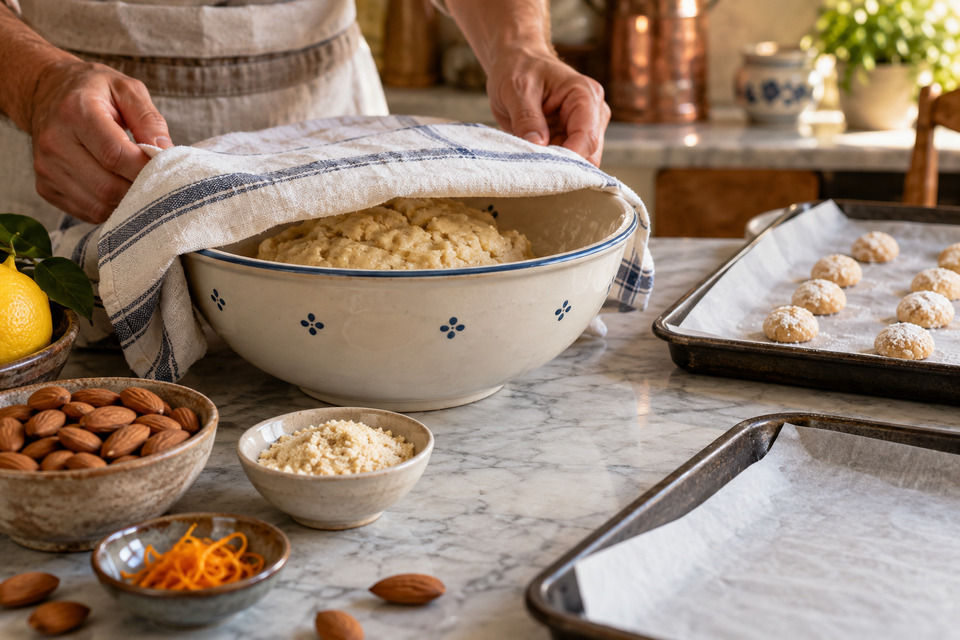
Rest the dough for 30 minutes at cool room temperature. This gives the almond meal time to absorb moisture and makes shaping cleaner.
Step 4

Heat the oven to 325°F (165°C). Line two baking sheets with parchment. Portion the dough into 1-inch (2.5 cm) balls, roll generously in powdered sugar, and place them 2 inches (5 cm) apart.
Step 5

Press one whole almond lightly into each cookie. Do not flatten aggressively; the characteristic crackled surface develops as the cookie expands.
Step 6
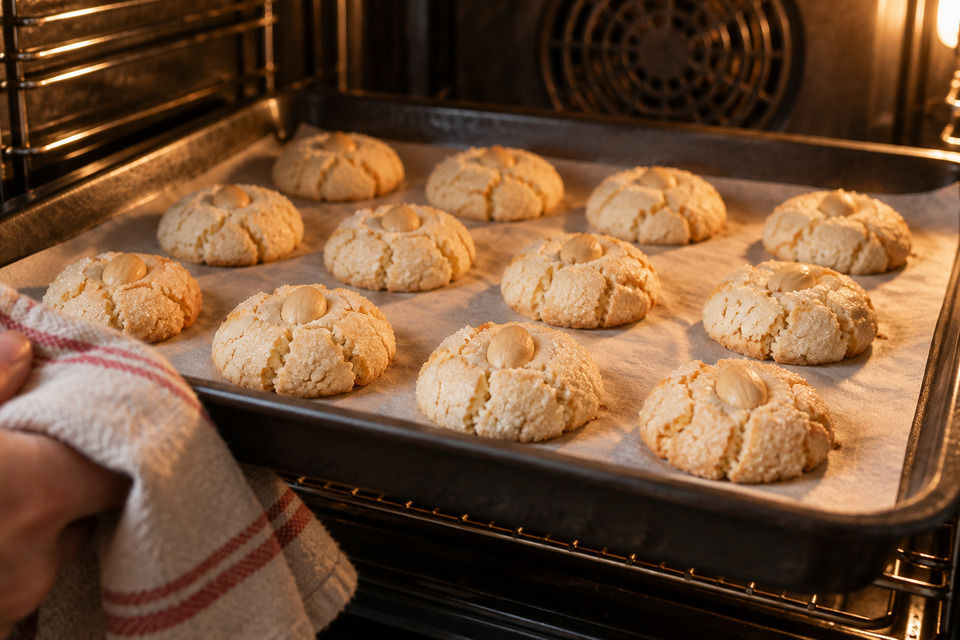
Bake for 14 to 18 minutes. The cookies should remain pale with lightly golden edges and visible surface cracks. The centers should still feel slightly soft when removed from the oven.
Step 7
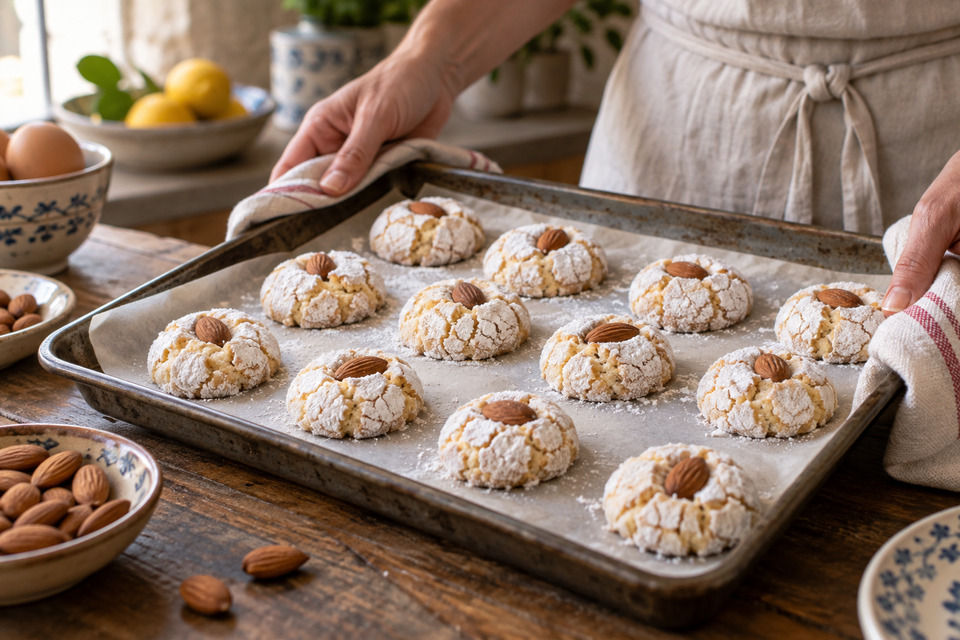
Cool completely on the tray before moving. The center sets as the cookies cool and should remain chewy rather than dry.
Plating
Serve at room temperature with coffee after a meal or as part of a Sardinian pastry assortment. Their almond aroma is strongest once fully cool. For a clean presentation, stack two or three on a small plate without additional sauce or cream.
Professional Technique
Pulse almonds in short bursts if grinding at home. Continuous processing releases oil and can turn the mixture greasy.
Add egg white gradually. A dough that slumps before baking is too wet; a dough that splits when rolled is too dry. The correct paste is soft, slightly sticky and cohesive.
Bake by color and surface behavior rather than by a single fixed time. Sardinian amaretti should not become uniformly brown.
The texture of Sardinian amaretti depends on the relationship between almond particles and egg white. Finely ground almonds absorb moisture quickly and create a smoother cookie, while a slightly coarser grind produces a more rustic interior. Both can be correct, but the dough must remain cohesive enough to hold a rounded shape before baking.
Sugar does more than sweeten the cookie. It limits moisture loss, helps produce the thin crust and contributes to the contrast between the crisp exterior and chewy center. Reducing sugar heavily can make the amaretti taste more “healthy,” but it also changes spread, browning and shelf life in ways that move the result away from the traditional texture.
Bitter almond character should remain subtle. Historically, bitter almonds or apricot kernels could provide the aromatic note associated with amaretti, but modern home baking is better served by a measured amount of food-grade bitter almond extract. The goal is a faint marzipan-like lift, never a medicinal aroma.
Resting the mixed dough is particularly useful when using commercial almond flour. The flour hydrates during the rest and the dough becomes easier to portion. If the mixture still feels loose after 30 minutes, chilling it briefly is preferable to adding extra almond flour and changing the recipe ratio.
Powdered sugar coating is not cosmetic only. As the outside dries and expands, the sugar layer splits into a visible network of cracks. Rolling the balls generously and avoiding excessive flattening encourages this classic appearance while protecting the pale interior from too much direct heat.
A finished amaretto should feel light for its size and release from the parchment once cool. If it remains glued to the paper, the center may be underbaked or the dough may have contained too much egg white. If it becomes hard throughout, the bake was too long or too hot.
Oven humidity also affects amaretti. A very humid kitchen or an oven that retains steam can delay crust formation, leaving the cookies sticky even when the centers are cooked. Baking one tray at a time in the center of the oven gives the most predictable airflow. If two trays are used, rotate them only once and do it quickly so the oven temperature does not collapse.
Cookie size must be consistent because a few grams change the balance between crust and center. Small amaretti dry quickly and become crisp throughout; larger pieces stay chewier. For the texture described here, portion roughly 0.8 to 0.9 oz (22 to 25 g) each. A small scale is more reliable than a spoon when producing a full tray.
The whole almond pressed into the top should sit only partly inside the dough. Pushing it too deeply compresses the center and can create a dense spot underneath. A light press anchors the almond while allowing the cookie to expand naturally around it during baking.
After cooling, evaluate one cookie before storing the batch. The crust should break cleanly and the center should pull slightly rather than crumble. If the center is too wet, return the remaining cookies to a low oven for a few minutes. If they are already too dry, an airtight container will soften them slightly overnight, but the original chew cannot be fully restored.
Almond quality changes during storage, so buy nuts from a source with good turnover and keep unused almonds sealed away from heat. Because amaretti are mostly almond and sugar, even slight rancidity is obvious after baking. Fresh nuts smell sweet and clean when broken; stale nuts taste flat or paint-like and should not be used.
If the dough is prepared in advance, refrigerate it tightly covered for no more than one day. Bring it back toward cool room temperature before portioning so the exterior does not crack excessively from being too stiff. Shape only what will be baked, because pre-rolled balls dry at the surface and do not expand as evenly.
For gift boxes, let the cookies cool for several hours before packing. Residual warmth creates condensation in sealed containers and softens the powdered-sugar crust. Once fully cool, separate layers with parchment and avoid mixing them with moist pastries that transfer humidity.
Amaretti Sardi succeed when almond remains the dominant flavor and the center stays tender. Precise moisture, pale baking and restrained citrus preserve the character of a traditional Sardinian almond sweet.
Texture and Moisture Control
Add egg white gradually because almond meal absorbs moisture differently from batch to batch. Bake only until the edges are lightly golden and the center remains soft; carryover heat finishes the structure as the cookies cool.
Professional Mise en Place
Weigh almonds, sugars, and egg whites before mixing; line the trays, portion the whole almonds, and prepare the powdered-sugar coating before shaping.
Chef Tips
Use fresh almonds; rancid almond oil is immediately noticeable in a recipe this simple.
Keep lemon zest fine so it perfumes the dough without leaving fibrous pieces.
For deeper traditional bitterness, use a very small amount of bitter almond extract rather than increasing it until artificial.
Dust heavily with powdered sugar before baking for a clear crackled contrast.
Common Mistakes
Adding all the egg white at once.
Grinding almonds until oily.
Overbaking until the center becomes dry.
Flattening the cookies too much before baking.
Using excessive bitter almond flavoring.
Wine Pairing
Malvasia di Bosa DOC — Its oxidative almond, dried-fruit and saline character mirrors the cookie’s toasted-nut profile and Sardinian identity.
Vin Santo del Chianti Classico DOC — Nutty oxidative notes and concentrated sweetness stand up to the dense almond paste without becoming cloying.
Moscato di Scanzo DOCG — Floral spice and red-fruit sweetness provide contrast to almond and lemon while remaining dessert-level sweet.
Storage & Reheating
Store fully cooled amaretti in an airtight container at room temperature for 5 to 7 days. Separate layers with parchment. Do not refrigerate, which can dull the aroma and make the exterior tacky. Freeze well wrapped for up to 1 month and thaw sealed at room temperature.
Nutrition
Approximate per cookie: 125 calories; 3 g protein; 15 g carbohydrates; 7 g fat; 0.6 g saturated fat; 1.5 g fiber; 12 g sugars; 8 mg sodium; 0 mg cholesterol.


Comments