
Italian Sicilian Cannoli | Cannoli Siciliani

A cannolo is two opposite things held together for a few minutes. The shell is dry, brittle and fried. The filling is ricotta, which is mostly water. Sicily never tried to reconcile them. It built a shell strong enough to survive the cheese and kept the two apart until the moment of eating.
Everything technical here comes back to that shell: how the dough is mixed, how thin it is rolled, and how hot the oil is when it goes in. Get those three right and the rest of the recipe is assembly.
Yield: 12 cannoli. Prep: 40 minutes. Rest: 1 hour for the dough, overnight for the ricotta. Frying: 25 minutes. Total: about 2 hours plus the draining. Difficulty: advanced. Course: dolce. Region: Sicily, from Caltanissetta to Palermo and Catania.
The Story
Cannoli come from the middle of the island rather than the coast. Caltanissetta makes the oldest claim and the claim is credible, because the town sits inside the old sugar growing belt and its convent kitchens had cane sugar and sheep milk ricotta within walking distance of each other. The Arab centuries gave Sicily that sugar, along with citrus and the whole vocabulary of candied fruit, and a fried sweet filled with sweetened fresh cheese belongs to that inheritance and to no northern Italian tradition at all. The name is plain enough: canna is a cane, cannolo the small tube, because the first shells were wrapped and fried on lengths of river cane cut to length. Metal tubes arrived much later and changed nothing about the method.
For centuries the cannolo was a Carnival sweet and nothing else, and the reason is dairy rather than religion. Sheep lamb in autumn, the milk follows through winter and spring, and sheep milk ricotta is at its best in exactly the weeks when the calendar allowed indulgence before Lent. The convents made them in quantity. Until the nineteenth century the nuns of the Sicilian interior were the professional pastry kitchens of the island, and the recipes that survive in Palermo and Catania today were written down in those kitchens. The version available in every month of the year is modern and it depends on cow milk ricotta and refrigeration. Any Sicilian over sixty will tell you that the cannoli of February taste different from the cannoli of August, and they are correct, because the milk is different.
The island argues about the finish rather than about the shell. Palermo presses the open ends into candied orange or into zuccata, the candied squash that almost nobody outside Sicily has tasted, and dusts the whole thing heavily with confectioners sugar. Catania and the eastern coast reach for chopped Bronte pistachio instead and often fold chocolate into the ricotta. Messina makes them smaller and eats two. What no serious Sicilian pastry shop will do is hand you a cannolo that was filled before you asked for it. The ricotta goes in while you stand there, and a shop displaying filled cannoli in a case is telling you everything you need to know about it.
Ingredients
Quantities are for 12 shells of about 4 inches (10 cm). You will need 12 metal cannoli tubes, or six and two rounds of frying.
For the shells
All purpose flour, 2 cups (250 g)
Granulated sugar, 2 tbsp (25 g)
Unsweetened cocoa powder, 2 tsp (4 g)
Ground cinnamon, 1/4 tsp (0.5 g)
Fine sea salt, 1/2 tsp (3 g)
Lard, cold and diced, 3 tbsp (40 g)
Marsala Superiore, 1/2 cup (120 ml)
White wine vinegar, 1 tsp (5 ml)
Egg yolk, 1
Egg white, 1, for sealing the seam
For frying
Peanut oil, or sunflower oil, about 6 cups (1.4 l)
For the ricotta filling
Sheep milk ricotta, 1 lb 5 oz (600 g) weighed before draining
Confectioners sugar, 3/4 cup (90 g)
Ground cinnamon, 1 small pinch
Finely grated orange zest, from 1/2 orange
For finishing
Unsalted pistachios, shelled and chopped, 1/3 cup (40 g)
Candied orange peel, diced small, 1/4 cup (45 g)
Dark chocolate, 70 percent, chopped fine, 1/4 cup (45 g), optional
Confectioners sugar, for dusting
Preparation
Step 1

Whisk the flour, sugar, cocoa, cinnamon and salt together, then rub in the cold lard with your fingertips until the mixture looks like coarse meal. Add the egg yolk, the vinegar and the Marsala a little at a time, gathering rather than stirring. Knead firmly for 8 minutes: unlike a pastry dough this one wants to be worked, and it should finish smooth, tight and slightly shiny. Wrap it and rest it at room temperature for at least 1 hour.
Step 2

Cut the dough in four and keep three pieces covered. Take each one down through a pasta machine to about 1/16 inch (1.5 mm), thin enough to read newsprint through. Work in stages and let the sheet relax if it fights back. Cut ovals of roughly 4 by 5 inches (10 by 12 cm) and stack them between sheets of paper under a cloth. Dough left uncovered skins over in minutes and then splits on the tube.
Step 3

Oil the metal tubes lightly. Lay an oval with the long axis across the tube and roll it around, loosely, so the dough touches the metal without gripping it. Brush a thin line of egg white on the dough where the two edges meet, press them together, and keep the egg white off the metal, since it glues the shell to the tube and the shell breaks on removal. Press the overlap firmly. A seam that opens in the oil is a shell lost.
Step 4

Bring the oil to 350 to 360°F (175 to 180°C) and check it with a thermometer rather than by eye. Lower in two or three tubes at a time and fry for about 2 minutes, turning once, until the surface is blistered and an even deep gold. Lift them out, drain on a rack, and slide the tube out while the shell is still warm, holding it with a cloth. Let the oil come back to temperature before the next batch.
Step 5
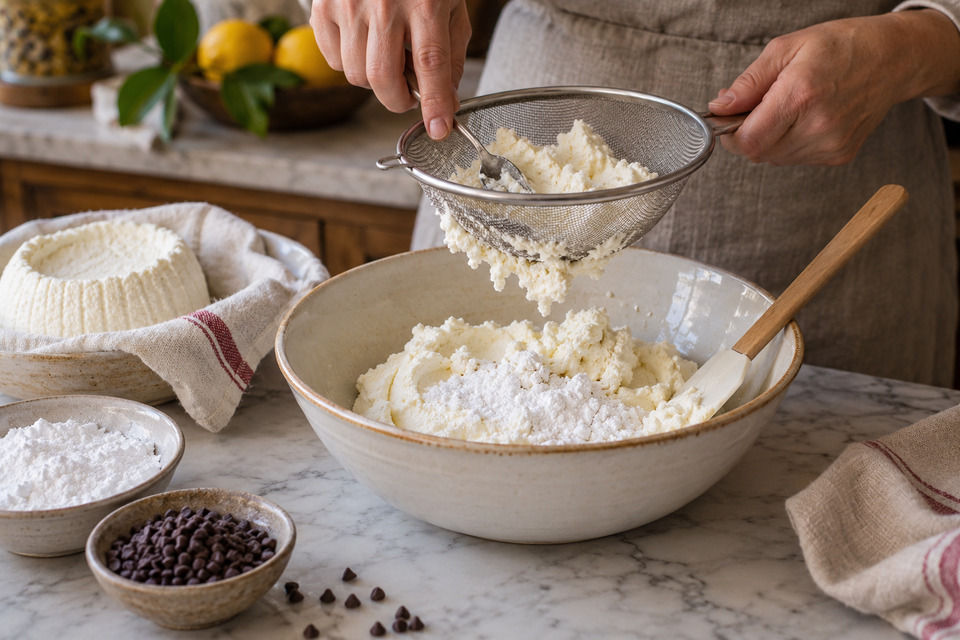
Set the ricotta in a fine sieve over a bowl the day before, cover it, weight it lightly and refrigerate overnight. Discard the whey, which will be a surprising amount. Pass the drained cheese through the sieve with a spatula, then fold in the confectioners sugar, the cinnamon and the orange zest with a spoon. Never whisk or use a machine: aerated ricotta collapses and weeps within the hour. Rest it covered and cold for 2 hours, then check the texture again.
Step 6

Fill only at the moment of serving and only into shells that are completely cold. Load the ricotta into a piping bag with a plain 1/2 inch (12 mm) tip, hold the shell upright, and pipe from one end until the filling reaches the middle, then turn it and pipe from the other. Working from both ends fills the centre without forcing air through and without splitting the shell from the inside. Finish flush with the rim, not domed.
Step 7

Press each open end lightly into the chopped pistachio or the candied orange, one at each end if you want both, and add the chocolate here if you are using it. Dust the shell with confectioners sugar through a fine sieve, sparingly, just before the plate leaves your hands. Serve at once: a filled cannolo has perhaps 15 minutes of good life and the first 5 are the best.
Plating
One cannolo per person on a cold plate, two if the cannoli are small or the meal was light. Never a warmed plate: heat is the enemy of both halves of this dessert, softening the shell from below and loosening the ricotta. Lay it slightly off centre rather than straight across the middle, and turn the more generously garnished end towards the diner.
The garnish should announce the filling and not bury it. Pistachio at one end, candied orange at the other, a light dusting of confectioners sugar over the shell, and nothing else on the plate. No sauce, no coulis, no mint. If you are serving several, a single small bowl of coffee alongside is the Sicilian habit and it is a better accompaniment than anything you could pipe onto the plate.
Professional Technique
The whole craft of this dessert sits in the cialda, the fried shell, and the dough is engineered for two properties that normally exclude each other: it must stretch without tearing when rolled paper thin around metal, and it must shatter rather than bend once fried. Lard and acid together deliver both. The fat coats the flour proteins and interrupts the gluten network, which produces the friability, the clean break under the teeth. The acid, and Marsala or wine vinegar both supply it, slackens that same network just enough to let the sheet extend under the roller instead of springing back.
How the dough is wrapped matters as much as how it is made. It goes around the tube loosely, barely touching the metal, because a shell rolled tight has nowhere to go when the water inside it turns to steam. That steam is the leavening: it lifts the thin layers apart from within and leaves the blisters that define a good cannolo, and it can only do so if there is slack in the wrap.
The oil temperature is the third variable and it is not negotiable. Around 350 to 360°F (175 to 180°C) the surface sets fast enough to trap the steam, and the shell inflates, colours and dries in roughly 2 minutes. Cooler, and the dough sits absorbing fat instead of setting: the shell comes out heavy, pale and greasy with no blisters at all. Hotter, and the outside browns in under a minute while the inner layers are still raw and damp, which is the shell that looks perfect and goes soft an hour later. Keep a thermometer in the pot and fry small batches.
Texture and Moisture Control
Fresh ricotta carries a great deal of whey and that water is the largest single threat to the finished pastry. Overnight draining under a light weight removes a surprising share of it and concentrates the fat and the flavour. The difference shows within minutes of filling: undrained ricotta runs at the ends and pushes moisture into the shell wall.
Sugar works against you here. It dissolves into the ricotta and draws further water out of the curd by osmosis, which is why a filling that was perfect when mixed can turn slack two hours later. That is the reason to sweeten it and then rest it cold rather than judging the texture straight away. If it has loosened, drain it briefly again and do not add sugar to thicken it.
The shell moves in the opposite direction. Fried, dried and full of open structure, it pulls moisture out of the air, so it must cool completely and then stay sealed and dry. A shell left uncovered in a humid kitchen loses its crack before meeting any cheese at all. Judge them by sound: two good shells tapped together click, and a dull note means one has already gone.
Professional Mise en Place
This dessert has a long lead in and a very short finish: nearly everything is done the day before, and the last operation takes 30 seconds per plate.
Equipment and tools
Twelve metal cannoli tubes, lightly oiled, plus a clean cloth for removing them
Pasta machine, an oval cutter of about 4 inches (10 cm), a deep pot and a frying thermometer
Fine sieve for the ricotta, a second small one for dusting sugar
Piping bag with a plain 1/2 inch (12 mm) tip, and a cooling rack
Prepared ahead
Ricotta drained overnight, then sieved and sweetened and rested cold, on the day
Dough mixed and rested, up to 1 day ahead and kept refrigerated
Shells fried and cooled completely, up to 2 days ahead in a sealed tin
Pistachio chopped, candied orange diced, chocolate chopped, held dry and separate
Service setup
Shells in a sealed tin away from the stove and from any steam
Piping bag filled and kept on ice, or refrigerated between orders
Garnishes in small dry bowls within reach of the plating bench
Plates cold, sugar sieve loaded, nothing filled until the order is called
Chef Tips
Buy sheep milk ricotta if you can, from somewhere that sells out. It is tangier, denser and far less watery than the cow milk version, and it is the flavour Sicilians mean by ricotta. With cow milk ricotta, drain a full 24 hours rather than overnight.
Fry a single test shell before committing the batch. In 2 minutes it tells you whether the dough is thin enough, whether the oil is right and whether the seam holds, and a failure costs one oval instead of twelve. Adjust on the evidence of that shell, not on the recipe.
Use the Marsala you would drink. It is the only aromatic in the dough, and cheap cooking Marsala tastes of caramel and little else. A Superiore gives the shell the faint nuttiness that makes people ask what is in it.
Fry the shells a day ahead deliberately. Cooled and sealed in a tin they are as good on the second day as on the first, and it leaves you one job at the end of the meal instead of two.
Common Mistakes
Rolling the dough too thick. Above 1/16 inch (1.5 mm) the steam cannot lift the layers, so the shell fries dense and hard instead of blistered, and it tastes of fried dough rather than pastry. If you cannot read print through the sheet, give it another pass.
Using undrained ricotta. Cheese straight from the tub is wet, it slumps out of the ends and it softens the shell from inside within minutes. Overnight in a sieve is not optional and no amount of sugar corrects it.
Whipping the filling. A mixer or a whisk aerates ricotta, and aerated ricotta collapses and weeps. Fold the sugar in with a spoon and stop as soon as it looks even.
Brushing egg white onto the tube. Egg white on the metal welds the shell to it and the shell cracks as the tube comes out. Keep it strictly on the overlap of the dough.
Filling in advance. A filled cannolo starts losing its crack the moment the ricotta touches it. Shells and filling live apart until the order is called, and no trick changes that.
Wine Pairing
Sweetened fresh cheese, fried pastry and citrus need answering at once: real sweetness for balance, real acidity to keep the palate moving. Sicily supplies both. Pour small, and cold.
Malvasia delle Lipari DOC: The most complete answer on the list. Dried on mats in the Aeolian sun, it brings apricot, dried fig and a resinous note, and crucially it keeps a lively acidity under the sugar. That acidity cuts the frying fat and lifts the ricotta instead of weighing it down, while the dried fruit runs alongside the candied orange.
Marsala DOC: The bottle already in the dough, and so the most logical glass beside it. Ask for a Superiore Dolce and serve it cool. Its oxidative walnut and caramel depth echoes the nuttiness the Marsala gave the shell, while the fortified alcohol and saline finish scour dairy fat off the palate. Sweet enough to sit level with the filling, dry enough not to cloy.
Moscato di Noto DOC: A gentler pairing from the Val di Noto, to pour when the cannoli are finished with pistachio rather than chocolate. Its orange blossom and elderflower aromatics meet the orange zest in the filling directly. Sweetness is moderate and structure light, so it refreshes between bites instead of competing with an already rich dessert.
Moscato di Siracusa DOC: Fuller and more honeyed than its neighbour from Noto, with candied citrus peel and a touch of spice. That extra weight is what you want when chocolate has been folded into the ricotta, since cocoa flattens a delicate wine. Serve at around 50°F (10°C) so the honey does not turn heavy.
Storage & Reheating
Store the two halves separately and never assembled. Empty shells keep 3 days in an airtight tin at cool room temperature, layered with paper, as far from the stove as the kitchen allows. Never refrigerate empty shells: the humidity of a refrigerator softens them faster than open air does.
Sweetened ricotta keeps refrigerated in a sealed container for 2 days, and should be drained briefly and stirred smooth again before use since it will have released a little whey. Unsweetened drained ricotta keeps 3 days. The filling does not freeze: it separates on thawing and comes back grainy.
A slightly soft shell can be brought back with 4 minutes in a 300°F (150°C) oven and then cooled completely. A filled shell cannot be recovered by any method, so eat the leftovers from service the same evening.
Nutrition
Per cannolo, based on 12 servings:
Calories: 340 kcal
Total Fat: 18 g
Saturated Fat: 8 g
Trans Fat: 0 g
Unsaturated Fat: 9 g
Cholesterol: 40 mg
Sodium: 130 mg
Total Carbohydrates: 33 g
Fiber: 1 g
Total Sugars: 16 g
Added Sugars: 12 g
Protein: 9 g
Lactose: 2 g
Principal micronutrients: calcium, phosphorus, vitamin A, vitamin B12, riboflavin, selenium
These figures are estimates. Oil absorption varies with frying temperature, and the whey drained from the ricotta is discarded rather than eaten.


Comments