
Italian Trieste Style Salt Cod with Potatoes and White Wine | Baccalà alla Triestina
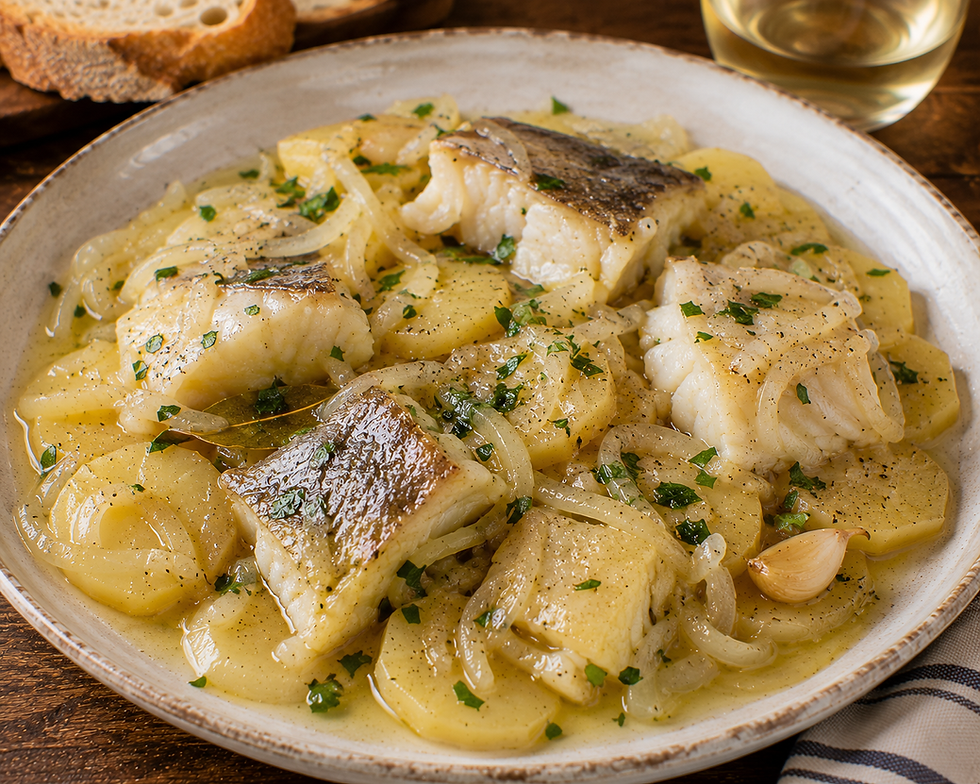
Baccala alla Triestina is the salt cod of a city that never cooked like the rest of Italy. Trieste spent centuries as the sea port of the Habsburg empire, and its kitchen answers to two masters: the Adriatic in front of it and the Central European interior behind. No tomato, no chilli, no olives. Salt cod, waxy potatoes, garlic, parsley, dry white wine and olive oil, cooked slowly in a wide pan until the potatoes give up enough starch to bind it all together.
What separates it from every other Italian salt cod preparation is restraint. The cod is not creamed as in Venice, not stewed with onion and milk as in Vicenza, not fried in batter as along the Tyrrhenian coast. It is layered with potato and cooked low enough that the flakes stay whole. Cod that has broken into threads was cooked too hot, and no amount of parsley will hide it.
Yield: 4 main course servings. Desalting: 36 to 48 hours. Prep: 30 minutes. Cook: 50 minutes. Rest: 15 minutes. Difficulty: intermediate. Course: secondo. Region: Friuli Venezia Giulia, Trieste.
The Story
Trieste ate salt cod because Trieste was a port, not because it was near cod. The fish arrives from Norway and Iceland, reaching the Adriatic through the same networks that carried coffee, sugar and spices into the Habsburg free port after 1719. Salted and stacked in barrels, cod travelled where fresh fish could not, and in a Catholic city with a long calendar of lean days it became the fish of Friday, Lent and Christmas Eve. The dish built around it belongs to the quarters behind the old harbour.
The potato is the Central European half of the plate. Trieste sits on the edge of the Karst, looking inland towards Slovenia and Austria, and potatoes entered its cooking earlier than they did further south. Elsewhere in Italy salt cod meets polenta; here it meets potato, cooked in the same pan rather than served beside it. The white wine is the Adriatic half. The stony hills of the Carso and the Collio, a few kilometres from the sea, have made sharp mineral whites for centuries, and in Trieste those wines went into the pan as readily as into the glass.
Ingredients
For the salt cod
Dried salted cod, thick centre cut fillet, 2 lb (900 g) before desalting
Cold water, for the desalting, about 4 quarts (3.8 liters) per change
Bay leaf, 1
Black peppercorns, 6
For the pan
Waxy yellow potatoes, 1 3/4 lb (800 g)
Extra virgin olive oil, 1/2 cup (120 ml)
Garlic cloves, thinly sliced, 4
Yellow onion, very finely chopped, 1 small
Dry white wine, 1 1/4 cups (300 ml)
Strained poaching water or light fish stock, 1/2 cup (120 ml)
Flat leaf parsley, chopped, 1/3 cup (15 g)
Fine sea salt, to taste, added only at the end
Freshly ground black pepper, 1/2 tsp
For finishing
Extra virgin olive oil, 2 tbsp (30 ml)
Flat leaf parsley, chopped, 2 tbsp (6 g)
Lemon zest, finely grated, from 1/2 lemon, optional
Country bread, thick slices, 4, for serving
Preparation
Step 1

Rinse the surface salt off, cut the fillet into three or four large pieces and cover them by three inches of cold water in a deep container. Refrigerate, changing the water completely every 6 to 8 hours for 36 hours, up to 48 for a very thick loin. Pour the old water away each time. A raw corner should taste seasoned, not salty.
Step 2

Drain and rinse the pieces, then put them in a wide pan with fresh cold water to cover, the bay leaf and the peppercorns, and bring it slowly towards a simmer. The moment the surface trembles, drop the heat until it stops moving and hold for 10 to 12 minutes. Never let it boil. Lift the pieces out and reserve half a cup of strained poaching water.
Step 3

Cool the pieces until you can handle them, pull off the skin and break the flesh into large flakes the size of a walnut, using your fingers rather than a fork. Run a fingertip through each one: salt cod keeps fine pin bones near the collar and along the centre line. Keep the flakes generous.
Step 4
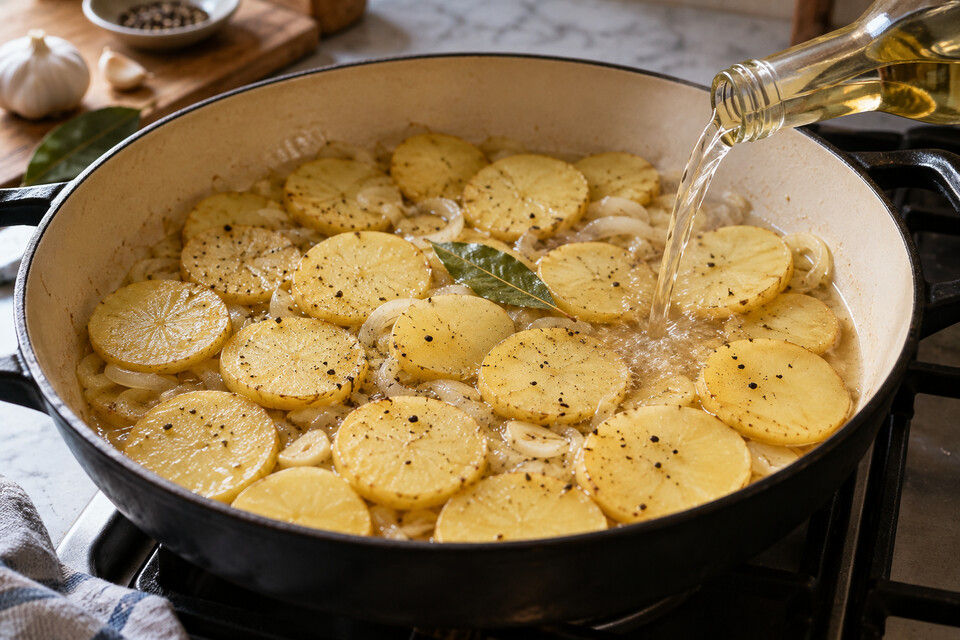
Peel the potatoes and cut them into even slices a generous quarter inch thick, about 6 mm, so they cook at the same rate. Do not rinse them and do not hold them in water: the surface starch is the only thickener this recipe has, since it uses no flour.
Step 5

Set a wide heavy pan or an earthenware tegame over low heat with the 1/2 cup of oil. Add the garlic and onion and cook very gently for 8 to 10 minutes, stirring often, until the garlic is sweet and the onion translucent with no colour on either. Browned garlic turns bitter, and in a dish this plain it has nowhere to hide.
Step 6

Add the potato slices and turn them through the oil until coated, then cook over low heat for about 5 minutes, turning once or twice with a wide spatula rather than stirring. They should soften at the edges without colouring. This contact with fat before any liquid keeps the slices intact later.
Step 7
Pour in the wine, raise the heat to a steady gentle bubble and cook uncovered for 4 to 5 minutes, until it has reduced by a third and no longer smells of raw alcohol. That rawness does not cook off under the lid, so give it another minute if you still catch it.
Step 8

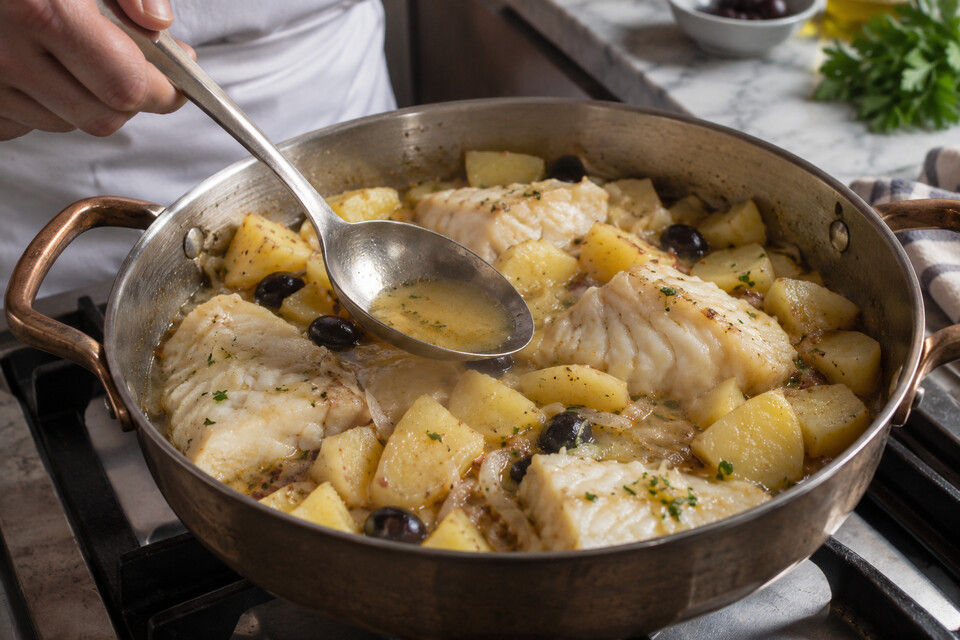
Add the flaked cod between the potato slices rather than piling it on top, then the poaching water, the pepper and two thirds of the parsley. Bring it barely to a simmer, cover and cook over the lowest heat for 25 to 30 minutes, shaking the pan by the handle every few minutes. Never use a spoon: it breaks the flakes.
Step 9

Uncover and look at the liquid. It should be cloudy and slightly thickened, coating the potatoes rather than sitting under them. If it is watery, cook uncovered 3 to 5 minutes more, spooning it over the top; if it has gone dry, add a spoonful of warm stock. Taste, and salt only if it needs it.
Step 10
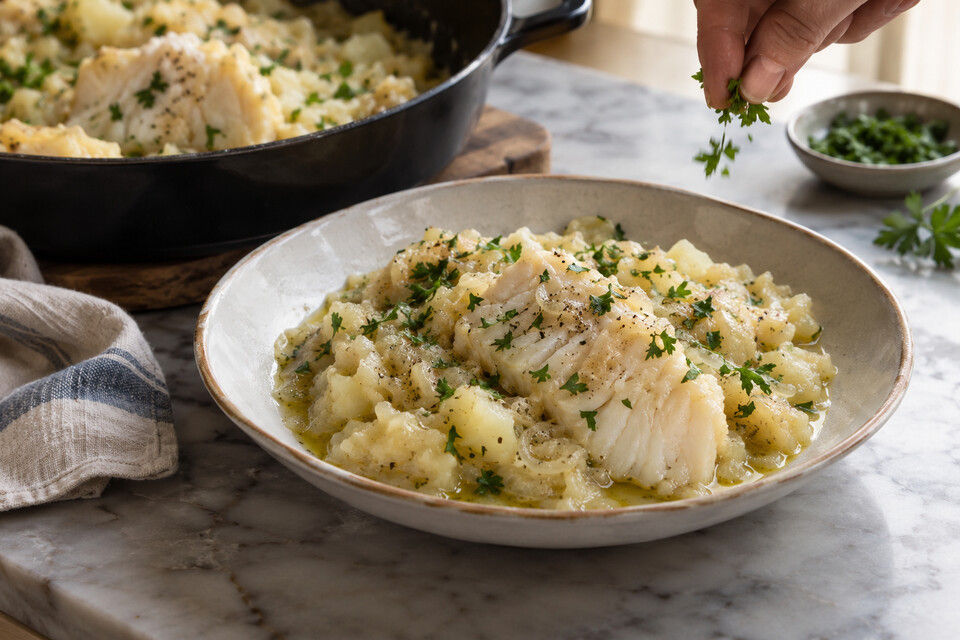
Slide the pan off the heat, cover it again and let it stand 15 minutes: the flakes reabsorb liquid and the flavours settle. Scatter the remaining parsley, grind over more pepper and pour the finishing oil across the surface in a thin stream. Toast the bread while the pan rests.
Plating
This is a pan dish and it should look like one. Use warm shallow bowls rather than plates, since the bound liquid needs somewhere to sit and olive oil turns dull the moment it cools. Serve with a wide spoon, lifting from the bottom so each portion carries potato, cod and liquid in the proportion they cooked in.
Four or five potato slices and a good handful of large flakes per bowl, the cod sitting visibly on and between the potato rather than buried underneath. Spoon the cloudy pan liquid over, add the finishing oil at the table while it is still bright, then the last of the parsley. The accompaniment is bread and nothing else, thick slices of country loaf, plain or grilled. Polenta belongs with the Vicenza version, not this one.
Professional Technique
Everything technical here begins with the fact that salted cod and dried cod are different products, and confusing them ruins the dish before the pan is lit. Baccala is split cod preserved in salt, which pulls water out of the flesh osmotically while leaving the fibres relatively soft. Stoccafisso is cod dried in cold Norwegian air without salt, which removes far more water and leaves a hard board of protein. Stoccafisso needs three to four days of soaking purely to rehydrate; baccala needs a shorter soak with a different purpose, the removal of salt. This recipe wants baccala, and the timings are not interchangeable.
Desalting works by diffusion along a concentration gradient. Salt moves outwards only while the surrounding water holds less salt than the flesh does, and the speed depends on how steep that difference is. Once the water has taken up salt the gradient flattens and the exchange slows to a stop, which is why the water must be poured away and replaced rather than topped up. Each change restores a steep gradient and restarts the movement. Cold matters too: at room temperature bacteria multiply in flesh that has lost its preservative. Thirty six hours with changes every 6 to 8 hours suits a thick centre cut; a thin tail piece can be ruined in twenty.
As the salt leaves, water moves back in and the fibres regain structure, the second half of what the soak achieves. Properly desalted cod is plump and slightly springy rather than stiff, and that recovered structure is what lets it hold large flakes through half an hour under a lid. The binding then comes entirely from the potato, whose starch granules swell in the liquid and thicken it, which is why the slices are never rinsed and why flour, which would give a dull opaque sauce, has no place here. Temperature protects all of it: cod protein contracts and expels moisture above about 176°F (80°C), so poach and braise both stay below a simmer. Past that point the flakes shorten and split into dry filaments.
Texture and Moisture Control
Three textures have to reach the table intact: cod in large moist flakes, potato slices soft but holding shape, and a liquid thick enough to coat without being a sauce. They fail for the same reason, heat. The cod goes stringy if either stage boils. The potato collapses if it is stirred rather than shaken, or if it met liquid before its few minutes in oil. The liquid stays thin if the slices were rinsed.
Moisture control is mostly the lid and the last five minutes. Covered, the pan loses almost nothing and the potatoes cook in a nearly saturated atmosphere. Uncovered at the end, evaporation concentrates the liquid and lets the starch work. Judge it on the back of a spoon rather than by the clock: it should leave a thin film and run slowly. The dish tightens further during the rest, so stop while it looks slightly looser than you want. Serve it warm rather than hot, around 150°F (65°C), where the olive oil smells best, and add the finishing oil off the heat.
Professional Mise en Place
Equipment and tools
Deep container for desalting, holding 4 quarts (3.8 liters)
Wide shallow pan for poaching and a slotted fish spatula
Heavy wide saute pan or earthenware tegame with a tight lid
Mandoline or a steady knife for even potato slices
Fine mesh sieve for straining the poaching water
Prepared ahead
Cod desalted over 36 to 48 hours, finishing on the day
Cod poached, flaked and boned, up to 1 day ahead, refrigerated
Poaching water strained and reserved in a sealed container
Garlic sliced and onion chopped, up to 4 hours ahead
Parsley chopped no more than 1 hour ahead so it stays green
Service setup
Potatoes sliced at the last moment, never held in water
Wine measured and at room temperature beside the pan
Bowls warming, finishing oil and parsley within reach
Bread sliced and ready to toast during the rest
Chef Tips
Buy a thick centre cut and look at it first. An even piece desalts evenly, which matters more than the price. Ask how long it has been in salt: cod salted many months ago is drier and wants the full 48 hours.
Taste a raw sliver from the thickest part after 36 hours. It should read as seasoned fish, pleasant on its own. Still sharply salty, give it two more changes of water and test again. Gone bland, shorten the poach and go easy on salt later.
Choose the potato deliberately. Waxy yellow varieties hold their slices and still release enough starch to bind the pan. Floury baking potatoes disintegrate within twenty minutes into a puree, while very waxy salad varieties stay firm and give up almost nothing, so the pan never thickens.
Use a wine you would drink, and enough of it. A crisp dry white from Friuli or the Carso is the register: unoaked, high in acidity, no residual sugar. Cooking wine and old open bottles bring a stale note this dish cannot hide. Pour the rest at the table.
Common Mistakes
Topping up the soaking water instead of changing it. Salt leaves the fish only while the water around it is less salty than the flesh, so once that water is loaded the exchange stalls. Pour it away and refill, every 6 to 8 hours.
Soaking at room temperature. Cod that has given up its salt has given up its preservative, and a warm kitchen spoils it before the soak ends. The container stays refrigerated throughout.
Treating stoccafisso and baccala as the same thing. Unsalted air dried stoccafisso needs three to four days to rehydrate; salted baccala needs a shorter soak to lose salt. Swap the timings and you get either a hard dry fish or a bland waterlogged one.
Boiling the cod at any point. Above roughly 176°F (80°C) the proteins contract and squeeze out moisture, and the flakes split into dry filaments. Poach and braise both stay below a simmer.
Stirring the pan with a spoon. Every pass breaks cod flakes and potato slices, and after three or four the dish is a mash. Shake the pan by the handle instead.
Rinsing the sliced potatoes. The starch on the cut surfaces is the only thickener here. Wash it off and the liquid stays watery however long you reduce it, and flour added to compensate gives a pasty sauce.
Wine Pairing
Collio Friulano DOC: The local answer and the one a Triestine reaches for. Friulano has a broad texture and a low acid pear and almond character that sits against the olive oil and the potato starch, where a leaner wine would vanish. Its faintly bitter finish picks up the garlic, and there is weight enough to meet salt cod without oak.
Ribolla Gialla Collio DOC: The sharper choice from the same hills, better if your pan came out rich. High acidity and a stony bite cut through the oil and reset the palate between spoonfuls. Its citrus peel and white flower aromatics run alongside the parsley and the zest, and with no perceptible sweetness it never softens the savoury edge.
Lugana DOC: Turbiana grown on clay gives a rounder, slightly creamy white with moderate acidity, and that roundness is what works here. It matches the texture of potato bound by its own starch instead of fighting it, while keeping enough acidity to stop the dish feeling heavy. Its almond and white peach notes stay quiet beside fish cooked half an hour in wine.
Verdicchio di Matelica DOC: Grown inland at altitude, this is the most saline and driving Verdicchio, with a firm citrus attack and a long bitter almond close. The salinity meets the residual saltiness of the cod on its own terms rather than masking it, and the acidity clears the olive oil. A good bottle stays present against the garlic.
Trento DOC: A metodo classico brut for anyone who wants bubbles with a slow cooked dish. The mousse and high acidity scrub olive oil from the palate better than any still white, and the bread and hazelnut notes from the lees echo the toast alongside. Choose a non vintage brut rather than a long aged riserva, which would overwhelm the fish.
Storage & Reheating
The finished dish keeps well and improves overnight, which is unusual for cooked fish and comes down to the potato starch holding everything together. Cool it within two hours, then refrigerate in a shallow airtight container, in a single layer, for up to 2 days. Desalted raw cod keeps refrigerated for 2 days, or frozen in portions for 2 months with no real loss.
Reheat in a wide pan over low heat with 2 tablespoons of water or light stock, covered, shaking occasionally and never stirring, for about 10 minutes until warm through. It must not reach a simmer, because a second hard heating is what finally breaks the flakes. Finish with fresh parsley and oil, since both fade in the refrigerator. Freezing the cooked dish works for up to 1 month, but the potato turns grainy as its starch retrogrades, so freezing the desalted cod instead is the better habit.
Nutrition
Per serving, based on 4 main course portions:
Calories: 585 kcal
Total Fat: 30 g
Saturated Fat: 4.5 g
Trans Fat: 0 g
Unsaturated Fat: 25 g
Cholesterol: 95 mg
Sodium: 780 mg
Total Carbohydrates: 39 g
Fiber: 4 g
Total Sugars: 3 g
Added Sugars: 0 g
Protein: 42 g
Lactose: 0 g
Principal micronutrients: vitamin B12, vitamin C, iodine, selenium, phosphorus, potassium, magnesium
These figures are estimates and exclude the bread. Sodium is the least predictable value, since it depends almost entirely on how thoroughly the cod was desalted and how much salt, if any, was added at the end.


Comments