
Italian Fennel Lemon Butter | Burro al Finocchietto e Limone
Updated: Sep 11

Burro al Finocchietto e Limone is a finishing butter built on two aromatic materials that behave in almost opposite ways. Wild fennel carries anethole, the sweet anise smelling molecule that dissolves readily in fat and stays there. Lemon carries limonene and citral, held in microscopic oil glands inside the coloured outer layer of the peel. Both of these things want to live in butter. Lemon juice, by contrast, does not. That single distinction is the whole discipline of this recipe.
The preparation looks trivial: soften butter, fold in chopped finocchietto and grated zest, season, roll, chill. What separates a butter that slices like marble and melts into a glossy film from one that weeps cloudy liquid on the plate is moisture management and temperature control. Butter already contains roughly sixteen percent water held inside a fat continuous emulsion. Every drop of juice you add pushes that emulsion toward its breaking point, and the failure shows up later, on a hot fillet of sea bass, as a puddle of whey next to a slick of separated fat.
Used correctly, a single cold coin of this butter placed on grilled fish off the heat does the work of a sauce. It seasons, it gives gloss, it delivers a wave of fennel and citrus aroma as it melts, and it disappears cleanly. That is the standard this recipe is written to.
Serves 16 as a finishing portion of 1 tablespoon (14 g). Prep: 20 minutes. Chill: 2 hours. Total: 2 hours 20 minutes.
The Story
Finocchietto selvatico is not a cultivated herb in Sicily. It is a landscape. Foeniculum vulgare grows unplanted along the roads and field margins of the whole island, on the terraces above Palermo, along the coast road toward Trapani, in the volcanic soils around Etna. Sicilians harvest the tender green fronds in spring, before the plant runs to seed and turns woody, and the harvest is genuinely free: you pull over, you cut, you go home. The aroma is sweeter and more resinous than the fronds of the cultivated bulb fennel sold in markets, because the wild plant concentrates more anethole and more fenchone in its leaves.
The most famous use is pasta con le sarde, the Palermo dish of bucatini with fresh sardines, raisins, pine nuts and saffron, where the fennel is boiled first and its green cooking water is then used for the pasta so nothing aromatic is lost. The same herb goes into sausage in the countryside around Castelvetrano, into the wild greens boiled for minestre in the interior, and into the brine of some Sicilian table olives. Fennel pollen, the intensely perfumed yellow dust collected from the flower heads in late summer, is harvested in small quantities in Sicily and in central Italy, notably in Tuscany, where it is sold by the gram and treated closer to saffron than to a herb.
The lemon half of the pairing comes from the same geography. The citrus belt of the Conca d'Oro outside Palermo, the groves around Siracusa that produce the Femminello Siracusano, and the lemon terraces of the Sorrento peninsula all developed around fruit grown for perfume and preserve as much as for juice. Italian cooks have always known that the best of a lemon is in its skin. The zest goes into the dish; the juice, very often, goes into the water for washing greens or is used the moment before service, never mixed into fat and left to sit. This butter is a small formalisation of a rule that Sicilian home cooks follow by instinct.
Ingredients
Main Components
Unsalted butter of high fat content, 8 oz (225 g), tempered to 65°F (18°C)
Wild fennel fronds or tender fennel fronds, finely chopped, 1/4 cup (15 g)
Finely grated lemon zest from unwaxed lemons, 1 tbsp (6 g)
Fine sea salt, 1/2 tsp (3 g), or to taste
Additional Ingredients
Freshly ground white pepper, 1/4 tsp (0.5 g)
Fennel pollen, 1/4 tsp (0.5 g)
Unwaxed lemons for zesting, 2 medium, about 7 oz (200 g) total
Optional Components
Fresh lemon juice, 1 tsp (5 ml), strictly optional and added drop by drop only if the butter is to be used within 24 hours
Parchment paper, 2 sheets of about 12 by 16 inches (30 by 40 cm), for rolling the log
Preparation: Base Components
Start with the fennel, because it is the only component that needs time. Wash the fronds in plenty of cold water to remove road dust and grit, then dry them completely. Completely is not an exaggeration: spin them in a salad spinner, then spread them on a clean towel for fifteen minutes. Any surface water that goes into the bowl becomes free water inside the finished butter, and free water is exactly what you are trying to keep out. Once dry, strip the feathery leaves from the tougher stalks, discard the stalks, and gather the fronds into a tight pile.
Chop with a sharp knife, in a single decisive series of cuts, immediately before mixing. A dull blade crushes the leaf cells rather than severing them, which releases chlorophyll and moisture and turns the fennel dark and bruised within minutes. You want a bright green, dry, loose chop, not a wet paste. Do not use a food processor: the blade speed generates heat and the herb oxidises against the plastic wall of the bowl.
Now the lemons. Wash and dry them, then zest with a fine rasp grater using light pressure and a quarter turn of the fruit after each pass. You are removing only the coloured flavedo, which is where the oil glands sit. The white albedo underneath contains no aroma and a great deal of bitterness, and once it is in the butter there is no way to take it out. Zest directly over the mixing bowl so the fine spray of oil released by the grater lands in the fat rather than evaporating into the kitchen. Finally, cut the butter into 1/2 inch (1 cm) cubes and let it come to 65°F (18°C), the point at which it is pliable under a spatula but still matte and cool to the touch.
Preparation: Assembly
Work the tempered butter in a wide bowl with a flexible rubber spatula until it is uniformly smooth, pressing and smearing it against the side of the bowl rather than beating it. The goal is a plastic, homogeneous mass with no lumps and no incorporated air. Resist the stand mixer. Whipped butter looks appealing in the bowl but its aerated structure gives inconsistent portion weights, melts unevenly on hot food and accelerates the oxidation of the herb, so a butter that tasted bright on Monday tastes flat and hay like on Wednesday.
Add the salt and white pepper first and fold them through, because salt needs contact time to dissolve into the aqueous phase of the butter and distribute evenly. Then add the lemon zest and fold again, spreading the butter thin across the bowl and gathering it back on itself, eight or ten times. Add the chopped fennel last, in two additions, folding gently so the fronds are dispersed rather than compacted into green streaks. If you are using fennel pollen, sprinkle it from a height across the surface so it lands as a fine dust; dumped in one spot it forms concentrated pockets that taste medicinal.
Scrape the bowl down thoroughly and fold four or five more times to bring the material from the cold outer edge into the centre. Then check the temperature by touch. If the mass has turned shiny and is starting to look greasy at the edges, it is warming past the safe range and the emulsion is beginning to loosen. Refrigerate it for five to ten minutes and continue only when it looks matte again. Taste at this stage, not later from the refrigerator, because cold suppresses your perception of salt, acid and aroma by a wide margin and will lead you to overseason.
Preparation: Finishing
If and only if the butter will be used within a day, this is the moment for the optional teaspoon of lemon juice. Add it one drop at a time from the tip of a spoon, folding after each drop, and stop the instant you see any glossy wetness on the surface of the mass. If beads of liquid appear, the emulsion has taken on more water than it can hold and no amount of further mixing will fix it. For anything that has to keep, leave the juice out entirely and rely on zest alone. You lose nothing: the aroma of lemon is in the peel oil, while the juice contributes mainly acidity and water.
Turn the butter onto a sheet of parchment, shape it roughly into a cylinder about 1 1/2 inches (4 cm) in diameter with the spatula, and fold the near edge of the paper over it. Press a ruler or the back of a sheet tray against the paper along the length of the log and pull the lower sheet toward you while holding the ruler steady. This compacts the butter and drives out trapped air, which is what gives you a dense log with no holes in the cross section. Twist both ends of the parchment in opposite directions like a sweet wrapper and roll the ends under.
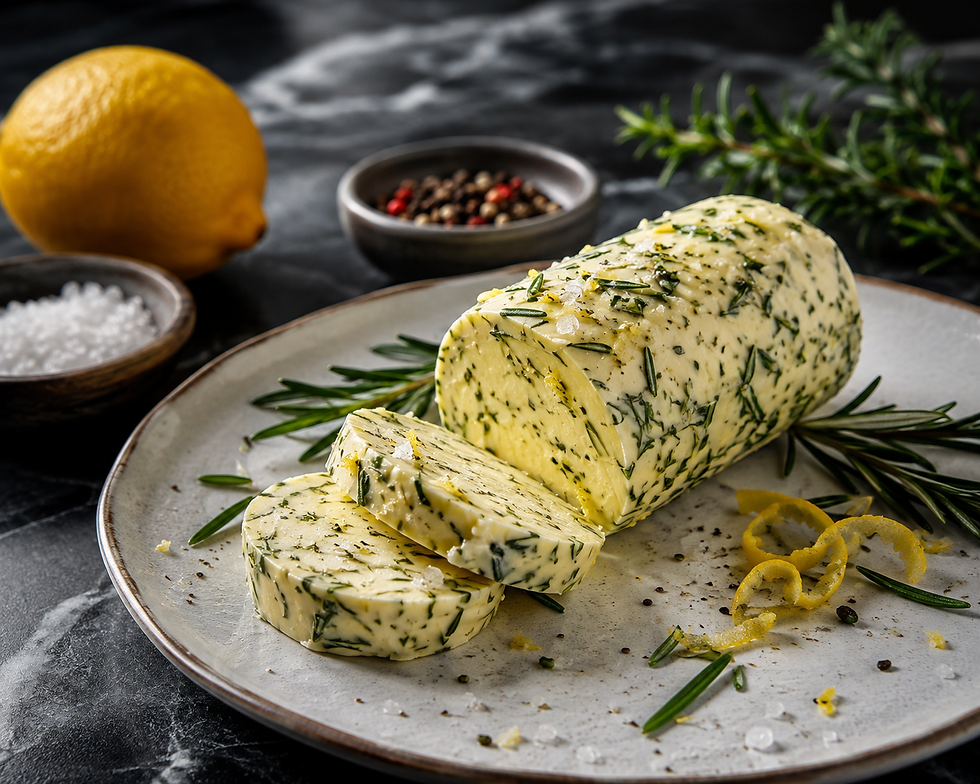
Refrigerate at 38°F (3°C) for at least 2 hours, or until the log is firm all the way to the core. To portion, unwrap only as much as you need and cut coins about 1/4 inch (6 mm) thick with a thin knife that has been dipped in hot water and wiped completely dry. Wipe the blade between every slice. A wet blade drags smeared butter across the cut face and ruins the clean edge. Return the unused portion of the log to the refrigerator immediately; do not let it sit out while you finish plating.
Final Plating and Presentation
This butter is at its best on fish, and the way it reaches the plate matters as much as the way it was made. Grill, roast or pan cook the fillet to your target internal temperature, then move the pan off the heat and let it stand for thirty seconds so the surface drops below the point where butter would break and fry. Place one cold coin on the hottest part of the fillet, usually just off centre over the thickest section, and let the residual heat do the melting. It should take about twenty seconds and produce a clear, glossy, faintly green slick that runs down the sides of the fish rather than pooling on the plate.
For a whole grilled sea bass or a branzino al sale, slide two coins under the fillets once the fish is opened at the pass, so the butter melts into the cavity and perfumes the flesh from the inside. For langoustines or prawns split lengthways, a small disc on each half, set under a hot salamander for a few seconds, is enough. For swordfish, a fish with dense, lean muscle that dries easily, the butter functions as both sauce and moisture, so be a little more generous.
Keep the garnish minimal and honest. A few reserved fennel fronds, dry and untouched, laid beside the fish are enough to declare the aroma. If you want more citrus lift at the table, grate a little fresh zest over the plate at the last second rather than squeezing lemon over the fish, which floods the butter with water and dulls everything you built. Warm the plates: a cold plate arrests the melt halfway and leaves the guest with a pale lump of solid fat instead of a sauce.
Professional Technique
The reason this butter works is that both of its aromatic systems are soluble in fat. Anethole, which accounts for the great majority of the volatile profile of wild fennel, is a phenylpropene with almost no affinity for water and a very strong affinity for triglycerides. Once folded into butter it is effectively stabilised: the fat phase holds it, protects it from evaporation and releases it gradually as the butter melts on hot food. The oils in lemon flavedo behave the same way. Limonene, citral and the minor terpenes sit inside spherical glands just under the surface of the coloured peel, and when the rasp grater ruptures those glands the oil goes straight into the fat you are working over.
Lemon juice belongs to a different world. It is roughly ninety percent water, carrying citric acid at a pH near 2.3, and it brings neither limonene nor citral in any meaningful quantity. Butter is a water in oil emulsion: about eighty two percent fat, sixteen percent water and two percent milk solids, with the water existing as microscopic droplets trapped inside a continuous fat phase and stabilised by phospholipids and partly crystalline fat. Adding free water to that structure means asking the fat crystal network to trap droplets it has no capacity for. The excess water coalesces into larger and larger pockets, and the acid destabilises the residual casein and phospholipid film that was holding the small droplets in place. The butter impazzisce, in the Italian kitchen expression: it goes mad. In practice it weeps a cloudy liquid in the wrapper, the cut face turns granular, and on hot fish it separates visibly into a watery ring and an oily slick.
This is also why the acid is added last and drop by drop when it is added at all, and why the whole operation stays cool. Below about 70°F (21°C) the fat crystal network is still intact and can absorb a small shock. Above it the network softens, the emulsion loses its scaffolding, and even correctly dried herbs will start to release liquid into the mass. The professional habit is simple: build the aroma with zest and herb, build the seasoning with salt, and treat every millilitre of water as a liability to be justified.
Texture and Moisture Control
A correctly made log has three textures, each at its own temperature. Straight from the refrigerator at 38°F (3°C) it is firm and cuts cleanly, with a cross section that is dense, matte and evenly flecked with green. At cool room temperature, around 65°F (18°C), it is spreadable and creamy, the state you want for crostini and for warm bread. On contact with food above 130°F (54°C) it melts to a glossy, unified liquid with no visible separation. If any of those three states is wrong, the fault is almost always moisture or temperature during mixing, not the proportions of the recipe.
The controllable sources of water are three: surface water on the fennel, juice from the lemon, and condensation. The first is solved by drying the fronds properly and chopping them dry. The second is solved by leaving the juice out. The third is the one people forget: a log taken from the refrigerator into a humid kitchen collects condensation on the cold parchment, and that water migrates into the cut face every time you unwrap it. Portion what you need, rewrap, and put it back. In a busy service, cut all your coins at once on a cold tray and hold them covered rather than returning to the log repeatedly.
Watch the surface of the butter while you mix as your main instrument. Matte means the fat crystal network is intact and the emulsion is holding. Shiny means fat is beginning to melt free and you are close to breaking it. Beads of visible liquid mean you have already gone too far for that batch: chill it hard for twenty minutes, fold it back together gently, and accept that it will be a butter for immediate use rather than for keeping. Air is the fourth variable, and less obvious. An aerated butter has a larger surface area exposed to oxygen inside the log, so the green fennel fades to khaki faster and the citrus aroma flattens within a couple of days.
Professional Mise en Place
Because this butter is entirely a preparation of dry goods and cold fat, all of the work can be scheduled away from service. Organise it so that nothing aromatic is cut more than a few minutes before it goes into the bowl, and so that no portion of the finished log spends time at ambient temperature.
Equipment and Tools
Fine rasp grater for zesting, sharp enough to take flavedo without reaching the pith
Thin bladed chef knife, freshly sharpened, reserved for the herbs
Wide, shallow mixing bowl, chilled, and a flexible rubber spatula
Salad spinner and clean cotton towels for drying the fennel
Parchment paper and a ruler or straight sided sheet tray for rolling the log
Instant read thermometer, and a small scale accurate to 1 g for the fennel pollen
Advance Preparation Steps
Wash, dry and stem the fennel fronds up to 4 hours ahead, holding them loosely wrapped in a dry towel in the refrigerator
Cube the butter and leave it to temper to 65°F (18°C), about 45 minutes in a 70°F (21°C) kitchen
Zest the lemons no more than 15 minutes ahead, because grated zest loses its volatile oils quickly once exposed
Mix, roll and chill the log at least 2 hours before service, and ideally the day before
Cut and weigh service coins on a cold tray, cover, and hold at 38°F (3°C)
Serving Setup
Hold the tray of cut coins on ice at the pass, covered, within reach of the fish station
Warm the plates to about 140°F (60°C) so the butter melts fully rather than stalling
Keep a small container of reserved dry fennel fronds and a whole lemon for grating to order
Keep a separate board and knife for butter only, so raw fish and strong aromatics never touch it
Label the log with the date and the flavour, since several compound butters look identical once wrapped
Chef Tips
Taste the butter at cool room temperature before you roll it. Cold blunts salt and aroma, and a butter that tastes correct straight from the refrigerator will taste aggressively salty once it melts on hot fish.
Save the fennel stalks you stripped off. They are too fibrous for the butter but excellent laid under a whole fish in the roasting tray or thrown on the coals under a grill, where they echo the same aroma from below.
If you cannot find wild fennel, use the fronds from cultivated bulbs and lift them with a slightly larger pinch of fennel pollen rather than by adding more fronds. More frond means more water and a duller green.
Freeze the log whole rather than as coins if you are keeping it more than a fortnight. A whole log has far less surface exposed to freezer air, and you can cut the portions from frozen with a hot knife.
Common Mistakes
Pouring in the lemon juice: this is the single most common failure and the reason the butter weeps. Juice is water and acid, and butter has no room for either. The water overloads the fat crystal network until droplets coalesce and run out of the log, while the acid attacks the phospholipid film stabilising the emulsion. Build citrus aroma from zest, which is pure oil, and if you want acidity at all, add a few drops at the very end and use the butter the same day.
Zesting into the pith: pressing hard on the grater takes the white albedo along with the coloured peel, and albedo is bitter, fibrous and completely free of aroma. Use light pressure, rotate the fruit after every pass, and stop as soon as you see white appear. A batch contaminated with pith cannot be corrected, because the bitterness is distributed through the fat.
Mixing warm butter: above roughly 70°F (21°C) the fat crystals that hold the emulsion together begin to melt, the mass turns shiny and greasy, and any water present is released. The result slices badly and separates on the plate. Temper to 65°F (18°C), work quickly, and put the bowl back in the refrigerator for ten minutes the moment the surface stops looking matte.
Melting the coin over direct heat: dropping the butter into a hot pan still on the flame splits it immediately and browns the milk solids, which replaces the fresh fennel and citrus profile with a nutty, cooked one. Take the pan off the heat, give it thirty seconds to fall below frying temperature, then place the cold coin on the fish and let residual heat melt it gently.
Wine or Beverage Pairing
The pairing problem here is specific. You have butterfat coating the palate, a green anise aroma that can clash with oak or with overt tropical fruit, a distinct citrus peel bitterness, and usually a lean white fish underneath. What you want is a white with real acidity to cut the fat, enough body to stand up to it, a saline or mineral finish that mirrors the sea, and no wood. Sicilian and southern Italian whites answer all four conditions, which is unsurprising given where the fennel grows.
Grillo Sicilia DOC: the natural first choice, from the same island as the finocchietto. Grillo has ripe citrus and a distinct green herbal edge with a saline, almost briny finish, and its acidity is firm enough to clear butterfat between bites. Choose an unoaked version from the Trapani side, where the wines stay taut rather than broad, so nothing competes with the anethole.
Etna Bianco DOC: Carricante grown on volcanic soil gives an unusually high natural acidity and a stony, almost flinty tension that keeps the butter feeling light on the palate. Its restrained white peach and lemon peel aromas run parallel to the zest in the butter rather than fighting it, and the saline finish is a natural fit for grilled sea bass or amberjack.
Vermentino di Gallura DOCG: the granite soils of northern Sardinia produce a Vermentino with citrus, wild Mediterranean scrub aromatics and a faintly bitter almond finish. That bitter note is the key to the pairing, because it recognises and balances the pith bitterness carried by lemon zest instead of leaving it exposed.
Cirò Bianco DOC: Greco Bianco from Calabria, dry and unadorned, with lemon, dried herb and a clean mineral cut. Its relatively light body makes it the right partner when the butter sits on something delicate such as red mullet or sole, where a richer wine would flatten the fish entirely.
Fiano di Avellino DOCG: the choice when the dish is richer, for example swordfish or langoustines with a generous portion of butter. Fiano has more weight and a waxy, hazelnut and smoke tinged texture that matches butterfat, while its acidity stays lively and its slightly resinous aromatic profile sits comfortably alongside fennel and fennel pollen.
For an alcohol free option, a chilled infusion of fennel seed and lemon peel, lightly sweetened and served over ice, repeats the aromatics of the butter exactly and has enough perceived freshness to reset the palate between mouthfuls. Sparkling mineral water with a wide strip of lemon peel dropped in, no juice, works on the same principle.
Storage and Make Ahead Options
Wrapped tightly in parchment and then in an airtight container, the log keeps 5 days at 38°F (3°C) when made without lemon juice. With the optional juice included, use it within 24 hours: the added water shortens its life both microbiologically and structurally. Butter also absorbs odours readily, so keep the log away from cut onion, fish and strong cheese, and never store it uncovered on a refrigerator shelf.
For longer storage, freeze. A whole log wrapped in parchment, then in a freezer bag with the air pressed out, keeps 2 months at 0°F (minus 18°C) with very little loss of aroma. Cut coins freeze too but fade faster because of the exposed surface, so freeze them only if you need portions ready to go, and lay them flat on a tray in a single layer before bagging. Thaw the log overnight in the refrigerator, never on the counter, and never in a microwave.
Avoid cycling the butter between soft and firm. Each cycle coarsens the fat crystals, the texture becomes grainy on the cut face, and the emulsion holds water less well every time. A coin that has already melted onto a hot plate or into a pan is finished and should never go back to the log. The most efficient make ahead approach is to build the butter the day before service, chill it overnight, cut all the coins in the morning, and hold them covered on a cold tray for the day.
Nutrition Information
Per serving of 1 tablespoon (14 g), based on 16 servings per 8 oz (225 g) log:
Calories: about 103
Total Fat: 11.6 g
Saturated Fat: 7.3 g
Trans Fat: 0.5 g, naturally occurring in dairy fat
Unsaturated Fat: 3.5 g, of which about 3.0 g monounsaturated and 0.5 g polyunsaturated
Cholesterol: 31 mg
Sodium: about 118 mg, from the added sea salt
Total Carbohydrates: 0.2 g
Fiber: 0.1 g
Total Sugars: 0.1 g
Added Sugars: 0 g
Protein: 0.2 g
Lactose: less than 0.1 g, present only in traces in butterfat
Micronutrients: vitamin A about 350 IU, vitamin E about 0.3 mg, vitamin K about 1 mcg, calcium about 4 mg, potassium about 8 mg, plus small amounts of vitamin C and flavonoids from the lemon zest and carotenoids from the fennel fronds
Allergens: contains milk. Free from gluten, egg, soy, nuts, fish and shellfish as written, though it is very often served on fish and shellfish, so declare the finished dish accordingly. Values are estimates calculated from standard composition tables and will vary with the fat content of the butter and the exact quantity of salt used.
About the Recipe
This recipe exists to make one idea concrete: that the aroma of a lemon lives in its skin and the aroma of fennel lives in its oil, and that both belong in fat rather than in water. It sits in the Italian tradition of preparations that do a great deal with very little, in the same family as the salted anchovy butter of the north and the herb oils of the coast. In a professional kitchen it earns its place because it turns a plain grilled fillet into a finished dish in twenty seconds without a saucier, and because it holds for days without losing what makes it worth making.
Summary
Burro al Finocchietto e Limone is a cold emulsion of high fat butter, dry chopped wild fennel and finely grated lemon zest, seasoned with sea salt, white pepper and a measured pinch of fennel pollen, rolled into a log and chilled until it slices clean. Every technical decision follows from one fact: anethole and citrus peel oils dissolve in fat, while lemon juice is water and acid that will break the emulsion and make the butter weep.
Dry the herb completely, zest without touching the pith, temper the butter to 65°F (18°C), fold rather than whip, and keep the surface matte throughout. Roll tight, chill for at least 2 hours, and portion with a hot dry knife. Serve a cold coin on hot fish off the heat, on warmed plates, with no lemon squeezed over the top. Keep it 5 days refrigerated or 2 months frozen, and pair it with a taut, unoaked southern Italian white.




Comments