
Traditional Italian Aosta Valley Beef Braised in Red Wine | Carbonade Valdostana
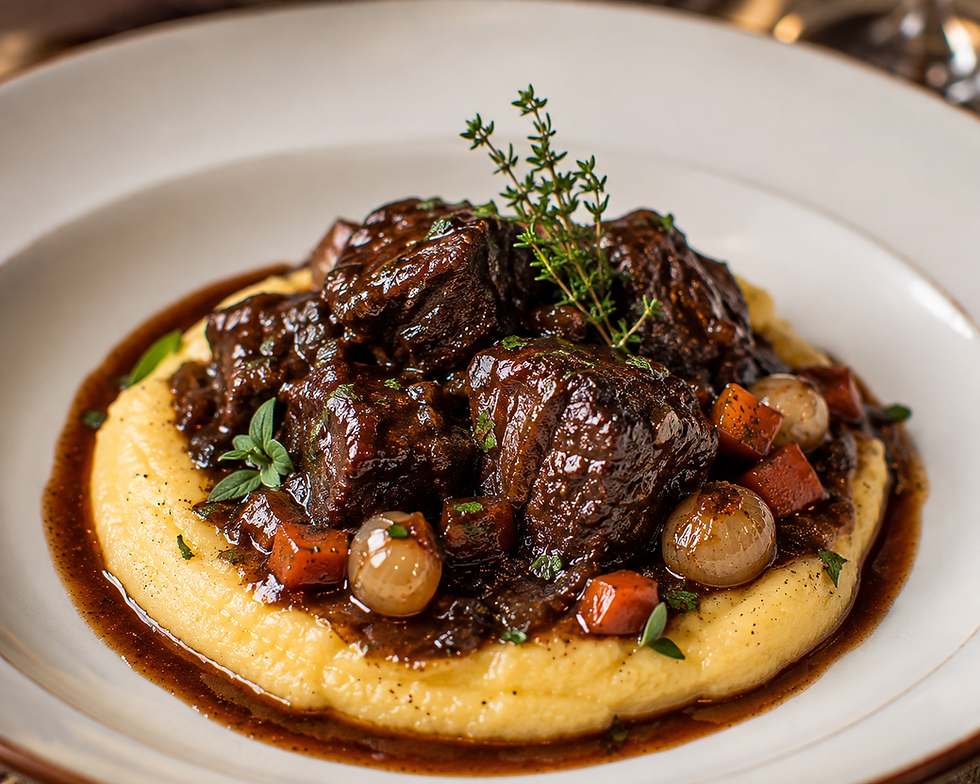
Carbonade valdostana looks like any other beef braised in red wine, and it is not. The weight of onion almost equals the weight of meat, the onions are the entire sauce rather than a background flavour, and there is no flour thickening, no tomato and no stock. The onions collapse over two or three hours and become the gravy themselves.
The other difference is what never happens: there is no violent browning. The meat is dusted with flour, set into the softened onions, sealed for barely a minute and covered with wine. A carbonade must arrive dark, glossy and completely tender, with no crust and no roasted edge, and every Alpine spice in the pot depends on that restraint to be heard.
Yield: 4 servings. Prep: 30 minutes. Cook: 2 hours 45 minutes. Rest: 20 minutes. Total: about 3 hours 35 minutes. Difficulty: intermediate. Course: secondo. Region: Valle d'Aosta, the Dora Baltea valley and the high Alpine villages.
The Story
The Aosta Valley is the smallest region in Italy and the highest, a glacial trench running from Ivrea to the foot of Mont Blanc. Its cooking was shaped by altitude and isolation: long winters, pasture instead of arable land, butter instead of olive oil, cheese as a staple, and meat that had to be made to last. The name carbonade points either to the charcoal burners of the lower woods or, more likely, to the old Savoyard word for meat cooked over coals.
Its real origin is preservation. The carbonade of two centuries ago was made with carne salata valdostana, beef packed in salt with garlic, bay and juniper in a wooden tub for weeks, so a November slaughter could be eaten in March. That meat came out firm and aggressively salty, and it needed exactly what the carbonade gives it: long moist cooking and a mass of sweet onion and wine against the salt. The spices were not decoration either. Cloves, cinnamon and nutmeg came over the Great St Bernard pass and were used freely in a valley where they arrived more easily than in the plains below.
Fresh beef has replaced the salted meat, but the onion, the wine and the polenta have not moved. The valley grows Petit Rouge, Fumin and Cornalin on terraces above eight hundred metres, and the bottle that goes in the pot goes on the table. Polenta concia, beaten with butter and young Fontina until it ropes, is part of the dish and not a side.
Ingredients
For the beef
Beef shoulder or chuck, or top rump, 2 1/4 lb (1 kg)
All purpose flour, 3 tbsp (24 g)
Fine sea salt, 1 tsp (6 g)
Freshly ground black pepper, 1/2 tsp (1 g)
For the onion base
Yellow onions, thinly sliced, 2 lb (900 g), about 5 medium
Unsalted butter, 4 tbsp (57 g)
Fine sea salt, 1/2 tsp (3 g)
For the braise
Valle d'Aosta dry red wine, 2 1/2 cups (600 ml)
Whole cloves, 3
Cinnamon stick, 1 small piece, about 1 inch (2.5 cm)
Freshly grated nutmeg, 1/4 tsp (0.5 g)
Juniper berries, lightly crushed, 6
Bay leaves, 2
Fresh rosemary, 1 small sprig
Fine sea salt and black pepper, to taste at the end
For the polenta concia
Water, 5 cups (1.2 litres)
Stone ground cornmeal, 1 1/4 cups (200 g)
Fine sea salt, 1 1/2 tsp (9 g)
Unsalted butter, 3 tbsp (43 g)
Young Fontina Val d'Aosta, cubed, 5 oz (140 g)
Grated Parmigiano Reggiano, 1 oz (28 g), optional
For finishing
Unsalted butter, cold, 1 tbsp (14 g)
Freshly ground black pepper, to taste
Flat leaf parsley, finely chopped, 1 tsp, optional
Preparation
Step 1
Trim and cut the beef. Remove only the hard outer sinew and thick surface fat, leaving the internal seams of connective tissue, because that collagen makes the braise glossy. Cut either into thin slices about 1/3 inch (8 mm) thick, the older way in the valley, which need around two hours, or into cubes of 1 1/4 inch (3 cm), which want closer to three.
Step 2
Stew the onions in butter. Slice them as thinly as you can and weigh them: 2 lb (900 g) against 2 1/4 lb (1 kg) of meat, and that near parity is the defining measurement of the dish. Melt the butter in a heavy casserole over low heat, because butter and not oil is what makes a carbonade taste Valdostan. Add the onions with the half teaspoon of salt, cover, and cook 25 to 30 minutes until slack and pale gold with no browning.
Step 3
Flour the meat and seal it briefly. Toss the beef in the flour and shake off every loose speck so each piece carries a thin dusting. Push the onions aside, raise the heat to medium and add the meat in one layer. Turn the pieces 60 to 90 seconds in total, just until the flour sets and the surface goes from raw red to pale grey. You are sealing, not browning: a crust would bring a roasted note and a chewy edge.
Step 4
Add the wine and the spices. Stir the onions back through the meat, pour in the wine and bring it to a bare simmer. Add the cloves, cinnamon, nutmeg, juniper, bay and rosemary, the signature of a carbonade more than the wine is. Simmer uncovered 4 or 5 minutes so the raw alcohol lifts off, then taste: it should smell sweetly spiced and still of wine.
Step 5
Braise very slowly, covered. Turn the heat as low as it goes and put the lid on. The surface should barely tremble, one bubble every second or two. Cook 2 hours for slices, 2 1/2 to 3 hours for cubes, stirring gently every 30 minutes. Add no stock and no water: the onions and the wine give all the liquid a covered pot needs. If the level drops below the meat, lower the heat and add a little wine.
Step 6
Judge when it is done. The meat is ready when a piece pressed with a spoon yields with no resistance and starts to fall into its grain, not when the clock says so. By then the onions will have vanished and the sauce should be dark mahogany, bound with no trace of flour paste. If still loose, uncover and simmer 10 minutes. Lift out the bay, rosemary, cinnamon and cloves.
Step 7
Make the polenta concia. Bring the water to a boil with the salt, rain in the cornmeal while whisking, then lower the heat and cook 40 to 45 minutes, stirring and scraping the sides: stone ground cornmeal needs the full time to lose its raw edge. When it pulls cleanly from the pot, beat in the butter, then the Fontina, until it ropes.
Step 8
Season, rest and finish. Season only now, because three hours of reduction concentrate whatever went in at the start. Add salt a pinch at a time, grind in pepper, and let the pot stand off the heat with the lid ajar 20 minutes so the meat reabsorbs liquid and the fat rises to be skimmed. Swirl in the cold butter for shine.
Plating
Serve in deep plates warmed to around 140°F (60°C), because the sauce is rich with butter and rendered collagen and turns dull below serving temperature. Spread a ladleful of polenta to the width of the plate with the back of the spoon rather than mounding it, lay the meat over one side so part of the yellow stays visible, then spoon the sauce across the join. That contact is the point of the dish.
Finish with a grind of black pepper and, if you like, the smallest scatter of parsley. Nothing else: no cheese over the meat, no oil, no herb sprig standing up in it. Allow about 6 oz (170 g) of meat a head and bring the rest of the sauce to the table in a jug.
Professional Technique
What defines carbonade valdostana, and separates it from every other beef braised in red wine, is that the thickening is done entirely by onion and the meat is deliberately never browned. Both decisions come out of the dish's origin in salted mountain beef.
Take the onion first, because the quantity is structural rather than a matter of taste. Two pounds of onion against two and a quarter pounds of meat is close to parity by weight. Onion is about ninety percent water and much of the rest is pectin and soluble sugar. Sweated slowly under a lid until the cell walls give way, then held at a bare simmer for hours in an acidic wine environment, that pectin dissolves and the onions become a suspension carrying the wine and the rendered gelatin. That is the sauce. The three tablespoons of flour are far too little to thicken 2 1/2 cups of wine and exist only to protect the surface of the meat.
The refusal to brown follows from the same history. A carbonade descends from carne salata valdostana, beef buried in salt in a wooden tub for the winter. Salted meat arrives at the pan wet from its soaking and deeply seasoned, and it will not take a sear in any case. More to the point it does not want one: the purpose was to soften cured meat and moderate its salt with sweet onion and wine, and a crust works against both. So the meat was floured and set gently into the onions, and that is still done with fresh beef because the result tastes right. The identity of the dish is dark, soft and uniform, with no Maillard bitterness competing with cloves and cinnamon.
Texture and Moisture Control
The target is uniform softness with no dry fibre, and the control is temperature. Hold the pot between 180°F and 190°F (82°C to 88°C), which on a domestic burner means the lowest setting and a bubble every second or two. At a real simmer the fibres contract faster than the collagen can turn to gelatin, and the meat goes stringy and never fully recovers. Expect a tight stage around the 75 minute mark: that is maximum fibre contraction, and the cure is another hour at the same temperature, not more heat.
Moisture is managed by the lid alone. A closed pot recirculates what the onions release and holds the level steady for three hours, while an uncovered one loses it to the air and invites the stock that dilutes the suspension into thin grey gravy. The final rest does the rest: off the heat with the lid ajar the fibres relax and draw liquid back in, the fat separates upward to be skimmed, and cold butter swirled in afterwards emulsifies into gloss. Polenta concia waits for no one, so time it to finish with the braise.
Professional Mise en Place
This dish has a long unattended middle and a short busy end, so make the braise a day ahead and leave only the polenta and the finishing at service.
Equipment and tools
Heavy cast iron casserole with a tight lid, 5 quart (5 litre)
Sharp slicing knife or a mandoline for the onions
Heavy saucepan and a long wooden spoon for the polenta
Kitchen scale, since the onion to meat ratio is measured and not judged
Small ladle for skimming and a warmed sauce jug
Prepared ahead
The whole braise, up to 2 days ahead, cooled and refrigerated
Onions sliced and held covered in the refrigerator, on the day only
Beef trimmed and cut, seasoned 30 minutes before cooking
Whole spices measured into one small dish
Fontina cubed and left at room temperature so it melts evenly
Service setup
Braise warming over the lowest heat, fat skimmed and salt corrected
Cold butter cut and ready for the final swirl
Polenta timed to finish with the braise, held covered 10 minutes at most
Deep plates at 140°F (60°C) and the sauce jug warmed with them
Pepper mill and a tasting spoon within reach of the pot
Chef Tips
Make it the day before. Carbonade improves after a night in the refrigerator: the onion suspension sets, the spices settle into the meat, and the fat lifts into a solid layer you remove with a spoon in seconds.
Use a wine you would drink. Two and a half cups is a lot of liquid for a kilo of beef and nothing in the pot hides it, so a harsh or oxidised bottle goes straight onto the plate. Anything jammy, oaky or off dry is wrong here.
Weigh the onions rather than counting them. Five medium onions can mean anything between 1 1/4 lb and 2 1/2 lb, and a carbonade short of onion will not thicken however long it cooks. If you are short, stew another in butter and add it late.
If a finished carbonade has come out salty, the cure is not water: stir in a knob of butter and serve more unsalted polenta with it.
Common Mistakes
Searing the meat hard. A dark crust brings roasted bitterness and a chewy surface into a dish whose identity is uniform darkness and softness, and it buries the spices. Seal the floured beef 60 to 90 seconds until pale grey, and stop.
Cutting the onion quantity. The onion is the thickener, not a seasoning. Halve it and no amount of time gives a bound sauce, which is when cooks reach for cornstarch and lose the dish.
Browning the onions instead of stewing them. Caramelised onions taste roasted and stay intact for hours; stewed onions taste mild and dissolve. Low heat, lid on, 30 minutes.
Adding stock or water. The onions and the wine supply everything a covered pot needs. Anything else dilutes the suspension into the thin grey gravy that is the commonest failure.
Seasoning at the beginning. The volume falls by about a third over the braise and every early grain of salt concentrates with it. Season lightly at the start and properly at the very end.
Wine Pairing
Valle d'Aosta Petite Rouge: The valley's workhorse grape and the bottle that most often goes into the pot as well as onto the table. Its tannin is fine and moderate rather than gripping, which suits meat carrying no seared crust, and its bright red fruit and peppery lift answer the cloves and juniper. There is acidity enough for the butter in the sauce and the polenta.
Valle d'Aosta Enfer d'Arvier: Petit Rouge from the scorched terraces of Arvier, with more concentration and a stony austerity behind the fruit. That mineral firmness stands up to three hours of reduced wine and dissolved onion without adding sweetness, and its dried herb and violet aromatics sit alongside the cinnamon.
Valle d'Aosta Cornalin: The most structured of the valley reds and the choice when the beef has been cubed and braised the full three hours. Denser tannin, darker fruit and a resinous edge that meets the juniper head on, with the weight for a sauce thickened by two pounds of onion. It keeps notable acidity for so dark a wine, which stops the Fontina flattening it.
Valle d'Aosta Premetta: An unusual pale Alpine red, almost a dark rosé in the glass, for anyone who finds a structured bottle too much beside butter and cheese. Almost no tannin, high acidity, a floral strawberry and white pepper profile, and served cool at 55°F (13°C) it refreshes between mouthfuls.
Ghemme DOCG: When nothing from the valley is available, cross into upper Piedmont rather than going south. Nebbiolo on glacial soils below Monte Rosa, high in acidity and firmly tannic, with a tar, rose and dried fruit character that has the cool climate austerity the dish wants. Its tannin has the grip for the gelatin in the sauce, and five or six years of age sit well with the spices.
Storage & Reheating
Cool the casserole to room temperature within about two hours, then refrigerate it covered and in its liquid for up to 4 days. The fat sets into a firm disc overnight that doubles as a seal, so leave it until you reheat. Never strain the meat from the sauce, because the onion suspension is what stops it drying out.
Reheat over the lowest heat with the lid on for 20 to 25 minutes from cold, adding a little wine if the sauce has set too firm. Do not boil it and do not microwave it on full power: both contract fibres that have already given up their collagen, and the meat goes dry in minutes. Taste for salt again once hot.
For the freezer, portion it with plenty of sauce into airtight containers and freeze up to 3 months. It thaws well because the sauce is an onion suspension rather than a starch bound gravy. Polenta concia does not keep once beaten with cheese, though polenta set firm in the pan can be cut into slabs and fried in butter the next day.
Nutrition
Per serving, based on 4 servings including the polenta concia:
Calories: 890 kcal
Total Fat: 44 g
Saturated Fat: 23 g
Trans Fat: 1 g
Unsaturated Fat: 18 g
Cholesterol: 195 mg
Sodium: 980 mg
Total Carbohydrates: 58 g
Fiber: 5 g
Total Sugars: 11 g
Added Sugars: 0 g
Protein: 62 g
Lactose: 2 g
Principal micronutrients: iron, zinc, vitamin B12, selenium, niacin, calcium, phosphorus, potassium
These figures are estimates. Most of the alcohol evaporates over the long braise while the sugars and acids of the wine remain, and the final sodium depends on the seasoning at the end and on how salty the Fontina is.




Comments