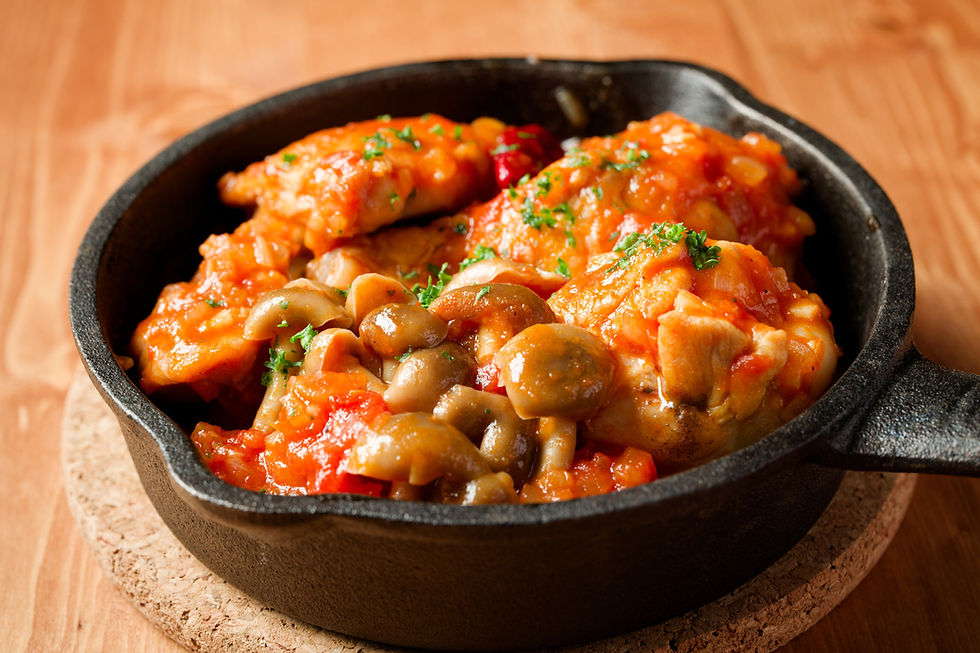
Italian Hunter Style Rabbit | Coniglio alla Cacciatora
Updated: Oct 24

Alla cacciatora means the hunter's way, and it names a situation rather than a recipe: an animal brought home at dusk, and a shelf holding wine or vinegar, garlic, rosemary, olives and whatever tomato was put up in August.
This version is built on farmed rabbit, which is what almost everyone cooks. Wild rabbit and hare carry a strong iron and mineral flavour that the vinegar and the rosemary exist to tame. Farmed rabbit carries almost none of it, so the hunter's full dose of acid corrects nothing: it buries a delicate meat under sourness.
The acid here is measured instead: a thirty minute vinegar bath before the meat sees heat, then dry white wine reduced hard in the pan, and nothing after. The rosemary goes in whole and comes out, the garlic stays in its skin.
Yield: 4 servings. Prep: 30 minutes. Marinade: 30 minutes. Cook: 1 hour 10 minutes. Rest: 10 minutes. Total: about 2 hours 20 minutes. Difficulty: intermediate. Course: secondo. Region: central Italy, from Tuscany through Umbria, Marche and Lazio.
The Story
Cacciatora cooking belongs to the hills of central Italy and to an economy of time. A man walking back at dusk with rabbit in the bag arrived in a kitchen where dinner was already late. Whatever was within arm's reach went into the pan, and every element of the formula is something a rural pantry always had: a demijohn of wine, the vinegar that wine became, rosemary outside the door, garlic on a hook, olives in brine, tomato preserved from August.
Rabbit rather than hare is the version that spread furthest, because rabbit was the one animal a family did not need to hunt. Coniglio was kept in hutches in every farmyard from the Apennines to the coast and killed as needed, the cheapest meat in the house, which is why rabbit recipes are so dense across central and southern Italy.
The tomato is the one part that is not old. Cacciatora existed long before tomato reached rural cooking in quantity, and the older versions are white: wine, vinegar, herbs, garlic, sometimes anchovy, no red at all. That version survives in parts of Tuscany, and knowing it explains why tomato here is a supporting weight rather than a sauce.
Ingredients
For the rabbit and the marinade
Whole rabbit, cut into 8 pieces, 3 lb (1.35 kg)
White wine vinegar, 3 tbsp (45 ml)
Cold water, 2 cups (475 ml)
Rosemary sprig, 1
Garlic cloves, lightly crushed, skin on, 2
Fine sea salt, 1 tsp (6 g)
Freshly ground black pepper, to taste
For the braise
Extra virgin olive oil, 3 tbsp (45 ml)
Pancetta, cut into small lardons, 2 oz (55 g)
Garlic cloves, whole, skin on, lightly crushed, 4
Rosemary sprigs, 2
Fresh sage leaves, 4
Bay leaf, 1
Dry white wine, 1 cup (240 ml)
Canned peeled tomatoes, crushed by hand and drained, 1 cup (240 g)
Tomato paste, 1 tsp (6 g)
Light chicken stock, warm, 1 cup (240 ml)
Dried red chilli, small, whole, 1
Fine sea salt, 3/4 tsp (5 g)
Freshly ground black pepper, to taste
For finishing
Taggiasca or Gaeta olives, pitted, 1/3 cup (55 g)
Salted capers, rinsed, 1 tbsp (10 g)
Flat leaf parsley, chopped, 1 tbsp
Rosemary leaves, very finely chopped, 1/4 tsp
Extra virgin olive oil, 1 tbsp (15 ml)
Coarse salt and freshly ground black pepper, to taste
To serve
Grilled country bread, 4 thick slices, rubbed with garlic
Or soft polenta, 2 cups (475 ml) cooked
Preparation
Jointing the rabbit
Ask the butcher for a whole rabbit in eight pieces, or do it with a heavy knife: two front legs, two hind legs, the saddle cut across into three, the ribcage split in two. Keep the liver and kidneys chilled and separate.
The thirty minute vinegar bath
Combine the cold water and vinegar in a bowl wide enough for one layer, add the rosemary sprig and crushed cloves, and submerge the rabbit for exactly 30 minutes at room temperature. Do not extend it. Rinse briefly, dry thoroughly by pressing rather than wiping, and season only once dry.
Rendering the pancetta and browning the meat
Render the olive oil and pancetta over medium heat for about 5 minutes, until the lardons are golden but not crisp, then lift them out. Raise the heat to medium high and brown the rabbit in two batches, never crowding the pan, about 4 minutes a side. The pan should end with a dark fond, nothing black.
Building the aromatic base
Lower the heat and add the four whole cloves in their skins, the rosemary sprigs, sage, bay leaf and whole chilli. Warm them for 2 minutes, turning the garlic once: the skins keep the cloves from scorching and let them sweeten. Stir in the tomato paste and cook 1 minute, until it darkens.
Deglazing with wine and reducing
Pour in the white wine all at once, raise the heat to a strong simmer and scrape the base of the pan until the wine has reduced by a good half and no longer smells sharp, about 5 minutes. On a dish that already carries acid from the bath and the tomato, unreduced wine is what tips it into sourness.
The braise
Add the drained crushed tomatoes and cook 3 minutes, until they cling to the pan. Return the rabbit and pancetta with any juices, pour in the warm stock and season. The liquid should come two thirds up the meat. Cover with the lid ajar, drop the heat until the surface barely moves, and cook 45 to 55 minutes.
Checking doneness and resting
Rabbit is cooked at 160°F (71°C) at the thickest part of the hind leg, away from bone, and the real test is meat that gives cleanly to a spoon while still holding to it. Do not push it towards falling apart: once it collapses it is dry. Rest it loosely covered 10 minutes.
Finishing the sauce
Fish out the rosemary, bay leaf, chilli and garlic, squeezing the soft pulp from two cloves back into the pan. Add the olives and capers and simmer uncovered 4 to 5 minutes, until the sauce coats a spoon. Off the heat swirl in the raw olive oil, then the parsley and rosemary. Salt if flat, never more vinegar.
Plating
Use a warm shallow bowl at about 140°F (60°C). A hind leg and a piece of saddle make a portion, with the leg set upright against the saddle rather than laid flat so the plate has height. Spoon the sauce around the meat and partly over the saddle, leaving the browned top of the leg visible: a braise buried under sauce loses the one cue that says the meat was browned first.
Lift a few olives and capers out so they do not sink, and set the grilled bread beside the bowl, never underneath, where it turns to paste. Finish with chopped parsley and a turn of pepper, nothing else: no cheese, since pecorino on a tomato and vinegar braise flattens the acidity the dish is built around.
Professional Technique
To cook cacciatora well you have to know what problem it was invented to solve. The hunter's kitchen had no control over its raw material. An animal taken in the field had run, had been stressed at the moment of death, had not been hung or aged, and arrived with dark working muscle full of iron and myoglobin. That flavour is powerful and, to a palate expecting it, wonderful, but it is insistent and faintly metallic. The three fixed elements of the style are three corrections applied to it.
Acid, wine or vinegar, does the chemical work: myoglobin derived compounds linger on the palate as a low metallic note, and acidity gives the tongue a competing signal that shortens that finish. Rosemary works aromatically instead, because camphor and pinene are volatile and resinous and occupy the same aromatic space as gaminess, so a whole sprig steaming under a lid masks the muskiness rather than removing it. Garlic, cooked in its skin until sweet, does the third job, replacing the savoury depth all that correcting strips away.
Apply that to a farmed rabbit and every correction is aimed at a target that is no longer there. Farmed rabbit lives without running, is slaughtered young at around 11 to 12 weeks, and has pale fine grained muscle with a fraction of the myoglobin of wild game. Its flavour is delicate and faintly sweet, closer to a good chicken thigh than to hare. Hit it with the hunter's full dose of vinegar and the acid has nothing strong to push against, so it pushes against the rabbit: the palate reads sourness first and meat second. Keep the wine, because reducing it turns most of its acidity into glycerol sweetness and concentrated fruit, and cut the standing vinegar back to a brief bath and not a drop after it.
That bath matters, because thirty minutes and twelve hours are not one operation at two lengths, they are two different things. Acid denatures protein, unfolding the coiled chains, and it works from the outside in. In 30 minutes at three tablespoons of vinegar to two cups of water it reaches one or two millimetres, and in that thin layer the effect is what you want: surface proteins loosen so the meat takes seasoning and gains a more tender bite, residual blood and off odours rinse away, and the exterior pH drops enough to hold moisture through browning. Overnight the denatured layer reaches deep into the muscle, the unfolded proteins cross link and squeeze out the water they were holding, and the meat turns mealy and chalky, irreversibly.
Texture and Moisture Control
Rabbit is the leanest common meat in the Italian repertoire, around 8 per cent fat against roughly 20 per cent in pork shoulder, with very little collagen in the legs and almost none in the saddle. That removes both safety nets a braise relies on: no fat melting out to lubricate the meat, and no collagen turning to gelatin to fake juiciness in muscle that has lost its water. The window between perfect and dry is about ten minutes, and the pancetta is there to put some fat back.
Browning therefore matters more here than in a fatty braise, and it needs a bone dry surface. Maillard browning wants the surface above about 300°F (150°C), and water evaporating off wet meat pins it at 212°F (100°C) until it has gone, which is why damp rabbit greys. The crust also slows moisture loss, and its fond is what the wine dissolves into a sauce with no gelatin of its own.
Then liquid level and temperature do the rest: two thirds up the meat, never submerged, and the surface barely moving at around 185°F (85°C). A rolling simmer makes the fibres contract and wring out water, and with no fat to compensate the meat goes stringy within minutes.
Professional Mise en Place
The braise has one inflexible timing element, the thirty minute bath, and everything else organises around it. Cook the dish to the point of resting, hold it, and finish to order.
Equipment and tools
Wide heavy braising pan with a lid, 11 to 12 in (28 to 30 cm)
Heavy chef's knife or cleaver, plus a boning knife
Instant read probe thermometer, essential on meat this lean
Slotted spoon, wooden spoon, fine mesh sieve
Wide bowl for the bath, tray lined with paper towels
Prepared ahead
Rabbit jointed into 8 pieces, up to 1 day ahead, covered and cold
Tomatoes crushed by hand and drained, up to 1 day ahead
Olives pitted, capers rinsed, up to 2 days ahead
Braise cooked to the end of braising, refrigerated up to 2 days
Stock measured and warm, herbs picked, before browning
Service setup
Rabbit and sauce rewarming over low heat, covered
Olives, capers and herbs separate, added at the finish
Bowls warm at about 140°F (60°C), bread grilled to order
Raw finishing olive oil and a peppermill within reach
Liver and kidneys, if used, seared at the last second
Chef Tips
Do not fight to make every piece finish together. Front legs are ready in about 35 minutes, the saddle in about 30, the hind legs need close to 55. Pull each piece as it comes right and hold it warm under foil, because bringing a hind leg to tenderness always costs you the saddle.
Use a white wine you would drink and make sure it is genuinely dry: Vermentino, Trebbiano, any crisp unoaked Tuscan white. The grape matters less than the absence of residual sugar, because the wine reduces by half and any sweetness concentrates into a jammy note against the capers.
With a wild rabbit or a hare, reverse the acid logic: double the vinegar, extend the bath to 2 hours, add a splash of red wine alongside the white, and expect about 1 hour 30 minutes of braising.
Save the liver and kidneys as a separate luxury: slice, season and sear them hard for 40 seconds a side until pink inside, then plate them at the last moment. Never braise them with the rest, since they go grainy and bitter and push that bitterness into the sauce.
Common Mistakes
Marinating the rabbit overnight in vinegar. Thirty minutes works on the surface and improves the meat. Twelve hours denatures protein all the way through, forces out water and leaves a mealy texture no braising will repair.
Browning wet meat. Surface water holds the meat at boiling point until it evaporates, so the rabbit greys instead of browning and the pan never builds the fond that becomes the sauce.
Adding the wine and the tomato together. Tomato drops the pan temperature and adds liquid, so the alcohol and hard acidity never cook off. Reduce the wine by half on its own first.
Drowning the rabbit in liquid. Fully covered, the meat poaches rather than braises, the upper surfaces lose their colour and the sauce stays thin. Two thirds up, lid slightly ajar.
Cooking it until it falls off the bone. That is the target for pork shoulder and the wrong one for rabbit, which has almost no collagen and is dry by the time it collapses.
Correcting the finished sauce with more vinegar. By then the acidity is set and more only sharpens it. A flat braise needs salt, or the sweet garlic pulp squeezed back in.
Wine Pairing
Chianti Classico DOCG: The home region bottle and the most complete answer. Sangiovese brings high natural acidity that meets the vinegar and the tomato head on instead of being flattened by them, and its tannin is fine grained rather than heavy, so it does not bully a pale lean meat. Its dried herb and sour cherry register sits alongside the rosemary.
Cesanese del Piglio DOCG: Lazio's own red and a precise match for the herbal side of the dish. Cesanese is medium bodied with soft tannin and a black pepper and wild scrub aromatic that picks up the rosemary and the chilli. Its acidity is moderate rather than searing, which suits a version with the acid dosed down.
Rossese di Dolceacqua DOC: The lightest red here and the right choice when the rabbit itself is the point. Pale, low in tannin, scented with rose and dried Mediterranean herbs, it sits beside farmed rabbit without covering its faintly sweet flavour, with acidity enough for the capers.
Cerasuolo d'Abruzzo DOC: A serious rosato from Montepulciano grapes and underrated with tomato braises. It carries real extract and a tannic grip unusual in a rosé, something to hold against the rendered pancetta fat, while its sapid finish works with the olives.
Vernaccia di San Gimignano DOCG: The white option, and a Tuscan one, for anyone who wants to stay with the wine that went into the pan. Its structure is firmer than most Italian whites and it finishes on a bitter almond note that runs alongside the olives, with acidity for the pancetta fat.
Storage & Reheating
This braise improves overnight, with a caveat: the improvement belongs to the sauce, which deepens, not to the meat, already cooked to its limit and only drier with more heat. Cool the pan to room temperature within 2 hours, then refrigerate the rabbit in its sauce, covered, up to 3 days.
Rewarm on the stove, never in a microwave, which drives water out of lean muscle faster than anything else. Put rabbit and sauce into a pan over low heat with 2 to 3 tablespoons of warm stock, cover, and bring it up slowly over about 12 minutes. If the sauce goes loose, reduce it alone.
It freezes better than most poultry braises, because the meat is protected by the liquid around it. Freeze it fully submerged in its sauce up to 3 months and thaw overnight. Add the olives, capers and fresh herbs only after thawing, since olives go bitter in the freezer.
Nutrition
Per serving, based on 4 servings, sauce included and bread or polenta excluded:
Calories: 510 kcal
Total Fat: 27 g
Saturated Fat: 7 g
Trans Fat: 0 g
Unsaturated Fat: 19 g
Cholesterol: 155 mg
Sodium: 890 mg
Total Carbohydrates: 8 g
Fiber: 2 g
Total Sugars: 4 g
Added Sugars: 0 g
Protein: 54 g
Lactose: 0 g
Principal micronutrients: vitamin B12, niacin, selenium, phosphorus, iron, potassium, vitamin B6
These are estimates. Rabbit is unusually high in protein and low in fat for a braising meat, so most of the fat here comes from the olive oil and the pancetta.



Comments