
Coniglio Ripieno alle Erbe, Carciofi e Pecorino (Reimagined Italian Stuffed Rabbit with Artichokes, Herbs and Pecorino)
- 2 hours ago
- 8 min read
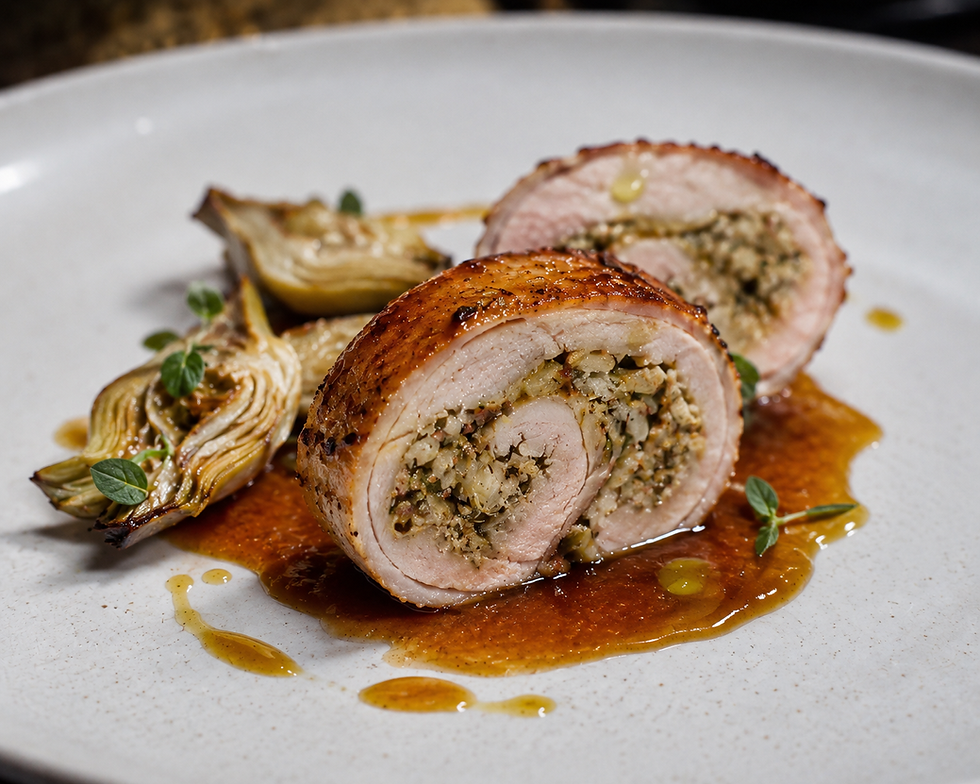
Rabbit has a long and deeply rooted place in Italian regional cooking, especially in central and southern Italy, where the animal was traditionally valued because it could be raised domestically, required relatively little space, and provided lean, flavorful meat. In Sardinia, Sicily, Liguria, Tuscany, Lazio, and several inland areas of Campania and Abruzzo, rabbit appears in braises, roasts, stews, and stuffed preparations.
A stuffed rabbit is particularly interesting because it transforms a rustic ingredient into something refined without losing its regional identity.
This version focuses on three ingredients that work naturally with rabbit: artichokes, aromatic herbs, and aged pecorino. The filling remains savory and structured but not heavy. The meat is rolled tightly, gently roasted, rested carefully, and sliced into thick medallions so the spiral of filling is visible.
The dish is finished with a concentrated rabbit jus and a restrained artichoke garnish.
The concept is elegant, but the flavors remain recognizably Italian.
The Tradition Behind Stuffed Rabbit
Stuffed meat preparations have existed throughout Italy for generations.
The underlying principle was practical: take a relatively lean cut, enrich it with flavorful ingredients, roll it tightly, and cook it slowly enough to keep the meat tender.
Rabbit is particularly suited to this method because its meat contains very little fat.
If cooked carelessly, it becomes dry quickly.
A stuffing containing sautéed artichokes, herbs, olive oil, and cheese adds both moisture and flavor while protecting the interior during cooking.
Historically, fillings might also include breadcrumbs, cured pork, liver, garlic, parsley, wild herbs, or scraps of cheese.
This version keeps the filling cleaner.
Artichokes form the foundation.
Pecorino provides salinity and depth.
Fresh herbs add fragrance.
A small quantity of breadcrumbs absorbs cooking juices and prevents the filling from leaking.
Why Artichokes Work with Rabbit
Rabbit has a delicate but slightly gamey flavor.
Artichokes bring mild bitterness and vegetal sweetness, which complements that flavor instead of masking it.
The relationship is particularly successful when the artichokes are cooked gently rather than aggressively browned.
The filling should taste soft, herbal, and savory.
It should not resemble an artichoke gratin.
The artichokes also help keep the stuffing moist.
Choosing the Rabbit
For this recipe, use a boneless rabbit saddle or a fully deboned rabbit opened into a flat sheet.
If possible, ask a butcher to debone the rabbit while keeping the meat intact.
A whole deboned rabbit gives the most attractive finished roulade because the meat can be distributed more evenly.
If using only saddles, overlap two large pieces slightly before rolling.
The final roulade should be approximately 2½ to 3 inches in diameter.
Yield
Serves 4.
Ingredients
1 deboned whole rabbit, approximately 2½ to 3 lb before deboning
2 tablespoons extra-virgin olive oil
3 medium artichokes
1 small shallot, finely minced
1 garlic clove, finely minced
1/3 cup fresh breadcrumbs
1/3 cup finely grated aged Pecorino Romano or Pecorino Sardo
2 tablespoons flat-leaf parsley, finely chopped
1 tablespoon fresh mint, finely chopped
1 teaspoon fresh thyme leaves
1 teaspoon finely grated lemon zest
1/4 teaspoon freshly ground black pepper
Fine sea salt as needed
2 tablespoons dry white wine
1 tablespoon unsalted butter
For the Rabbit Jus
Reserved rabbit bones, if available
1 tablespoon extra-virgin olive oil
1 small onion, roughly chopped
1 small carrot, roughly chopped
1 celery stalk, roughly chopped
1 garlic clove, crushed
1 tablespoon tomato paste
1/2 cup dry white wine
3 cups chicken stock or light veal stock
1 small rosemary sprig
1 thyme sprig
1 tablespoon cold unsalted butter
For the Artichoke Garnish
1 additional artichoke
1 tablespoon extra-virgin olive oil
1 tablespoon lemon juice
Fine sea salt as needed
Preparing the Artichokes
Fill a bowl with cold water and add the juice of half a lemon.
Remove the tough outer leaves from the artichokes until you reach the pale tender leaves.
Trim approximately one inch from the top.
Peel the outer layer from the stem.
Cut each artichoke in half.
Remove the fuzzy choke using a small spoon.
Place the cleaned artichokes into the lemon water immediately.
This prevents excessive oxidation.
Slice the three artichokes for the filling very thinly.
Cooking the Artichokes
Heat 1 tablespoon of olive oil in a sauté pan over medium-low heat.
Add the shallot.
Cook gently for approximately 2 minutes.
Add the garlic and cook for approximately 20 seconds.
Add the sliced artichokes.
Season lightly with salt.
Cook for approximately 5 minutes, stirring occasionally.
Add the white wine.
Cover and cook for another 4 to 5 minutes.
The artichokes should become tender without developing much color.
Remove the lid.
Allow any remaining liquid to evaporate.
Transfer the mixture to a cutting board.
Chop the cooked artichokes more finely.
Allow them to cool completely.
Preparing the Filling
Transfer the cooled artichokes to a bowl.
Add the breadcrumbs.
Add the pecorino.
Add the parsley.
Add the mint.
Add the thyme.
Add the lemon zest.
Add the black pepper.
Mix gently.
Taste before adding additional salt.
Pecorino can be quite salty.
The filling should hold together loosely when pressed.
If it seems dry, add approximately 1 teaspoon extra-virgin olive oil.
Do not make it wet.
A wet filling can escape during roasting.
Preparing the Rabbit
Place the deboned rabbit on a cutting board, meat side facing upward.
Cover it with plastic wrap.
Using a meat mallet, gently flatten thicker areas.
Do not pound aggressively.
The objective is to create an even thickness, approximately 1/2 inch.
Season the interior lightly with salt and black pepper.
Spread the filling across the rabbit, leaving approximately 3/4 inch around the edges.
Do not overfill.
Rolling the Rabbit
Begin rolling from the longest side.
Roll firmly but not so tightly that the filling is forced outward.
Once rolled, position the seam underneath.
Tie the roulade using butcher’s twine at approximately 1-inch intervals.
Tie one additional lengthwise string if necessary to maintain the cylinder.
The finished roulade should be compact and uniform.
Browning the Rabbit
Heat the oven to 350°F.
Heat 1 tablespoon olive oil in an ovenproof sauté pan over medium-high heat.
Season the exterior of the rabbit lightly with salt.
Place the roulade into the pan.
Brown it on all sides.
Rotate carefully.
The exterior should develop an even golden color.
This stage takes approximately 6 to 8 minutes total.
Add the butter during the final minute.
Baste the rabbit lightly with the foaming butter.
Roasting
Transfer the pan to the oven.
Roast for approximately 22 to 28 minutes.
The exact cooking time depends on the thickness of the roulade.
The internal temperature should reach approximately 150 to 155°F in the center.
Remove from the oven.
Transfer the roulade to a rack or cutting board.
Rest for at least 10 minutes.
The temperature will continue rising slightly during resting.
Do not slice immediately.
Resting is essential because the juices need time to redistribute and the roulade needs to firm enough to cut cleanly.
Making the Rabbit Jus
If you have rabbit bones, roast them first at 425°F for approximately 25 minutes until golden.
Heat olive oil in a saucepan.
Add the onion, carrot, celery, and garlic.
Cook over medium-high heat until lightly caramelized.
Add the tomato paste.
Cook for approximately 1 minute.
Add the roasted rabbit bones.
Pour in the white wine.
Reduce by approximately three-quarters.
Add the stock.
Add the rosemary and thyme.
Simmer gently for approximately 45 minutes.
Strain.
Return the liquid to a clean saucepan.
Reduce until the jus lightly coats the back of a spoon.
Remove from the heat.
Whisk in the cold butter.
Taste and season if necessary.
The final jus should be concentrated but not excessively salty.
If rabbit bones are unavailable, make the same sauce using chicken wings or a high-quality light veal stock as the base.
Preparing the Artichoke Garnish
Clean the remaining artichoke using the same technique.
Slice it very thinly lengthwise.
Heat olive oil in a sauté pan over medium-high heat.
Add the slices in a single layer.
Cook until lightly golden and tender.
Season with salt.
Finish with a few drops of lemon juice.
The artichoke garnish should remain recognizable.
Do not fry it until it becomes brittle.
A refined plate benefits from contrasting textures, but every garnish should still taste like the ingredient it represents.
Slicing the Rabbit
Remove all butcher’s twine.
Using a very sharp slicing knife, trim the uneven ends if necessary.
Cut the roulade into medallions approximately 1¼ inches thick.
For each portion, serve two medallions.
The spiral of rabbit and artichoke filling should be clearly visible.
If the filling collapses while slicing, the roulade was either sliced too hot or stuffed too loosely.
Plating
Place a small spoonful of rabbit jus slightly off-center on a warm plate.
Position two medallions naturally over the sauce.
Do not stack them vertically.
One can lean slightly against the other, but the arrangement should remain low and controlled.
Arrange several sautéed artichoke slices nearby.
Spoon a small amount of additional jus around the rabbit.
Finish with a few tiny drops of extra-virgin olive oil.
If desired, add two or three small mint or parsley leaves.
Do not cover the rabbit with grated cheese or unnecessary garnish.
The filling should remain visible.
The plate should communicate exactly what the dish is: stuffed rabbit with artichokes.
Texture and Balance
A successful roulade has several different textures.
The exterior of the rabbit should be lightly browned.
The meat should remain juicy.
The artichoke filling should be tender but not mushy.
The pecorino should be integrated rather than forming melted pockets.
The jus should be silky and concentrated.
The fresh artichoke garnish adds a slightly firmer vegetal texture.
Each component has a purpose.
Chef Tips
Deboning rabbit is the most difficult part of the recipe. If you are unfamiliar with the technique, ask your butcher to prepare it.
Flatten the rabbit gently. Excessive pounding damages the meat fibers and can cause the roulade to tear.
Cool the filling completely before spreading it over the rabbit.
Never overstuff the roulade.
Tie the rabbit evenly so that each section cooks at approximately the same rate.
Use a thermometer rather than guessing doneness.
Rabbit is extremely lean and can dry out quickly.
Allow the roulade to rest properly before slicing.
Make the jus in advance if possible. Sauces made from roasted bones improve significantly when given enough time to reduce slowly.
Common Mistakes to Avoid
One of the most common mistakes is making the filling too wet.
Artichokes release moisture as they cook.
Any excess liquid should evaporate before they are incorporated into the stuffing.
Another mistake is using too much pecorino.
The cheese should season the filling rather than dominate it.
Overcooking is particularly damaging.
A dry rabbit roulade cannot be rescued by adding more sauce.
Avoid excessive amounts of garlic.
Rabbit is delicate.
Heavy garlic can quickly overpower the meat.
Do not slice the roulade into thin pieces.
Thin slices lose moisture quickly and do not display the filling as attractively.
Wine Pairing
A Vermentino di Gallura works particularly well if you want a white wine pairing.
Its freshness, mineral structure, and herbal notes complement the artichokes and pecorino while remaining delicate enough for rabbit.
For a red wine, choose a lighter Cannonau di Sardegna with restrained oak and moderate alcohol.
A young Chianti Classico can also work well because its acidity refreshes the palate without overwhelming the dish.
Avoid extremely tannic reds.
Artichokes can make heavily tannic wines taste more bitter and metallic.
Why This Dish Works
The strength of this recipe lies in its restraint.
Rabbit, artichoke, pecorino, herbs, and jus are enough.
The dish does not need multiple purees, decorative crisps, or complicated architecture.
The filling brings richness to the lean meat.
The artichokes add freshness and mild bitterness.
The pecorino contributes depth.
The herbs provide aromatic lift.
The jus reconnects everything with the roasted flavor of the rabbit itself.
It is a modern presentation built around an old Italian idea: use a small number of strong ingredients and treat each one carefully.
Chef Gianluca Deiana


Comments