Stuffed Rabbit with Herbs, Artichokes and Pecorino | Coniglio Ripieno alle Erbe, Carciofi e Pecorino
Updated: Oct 24
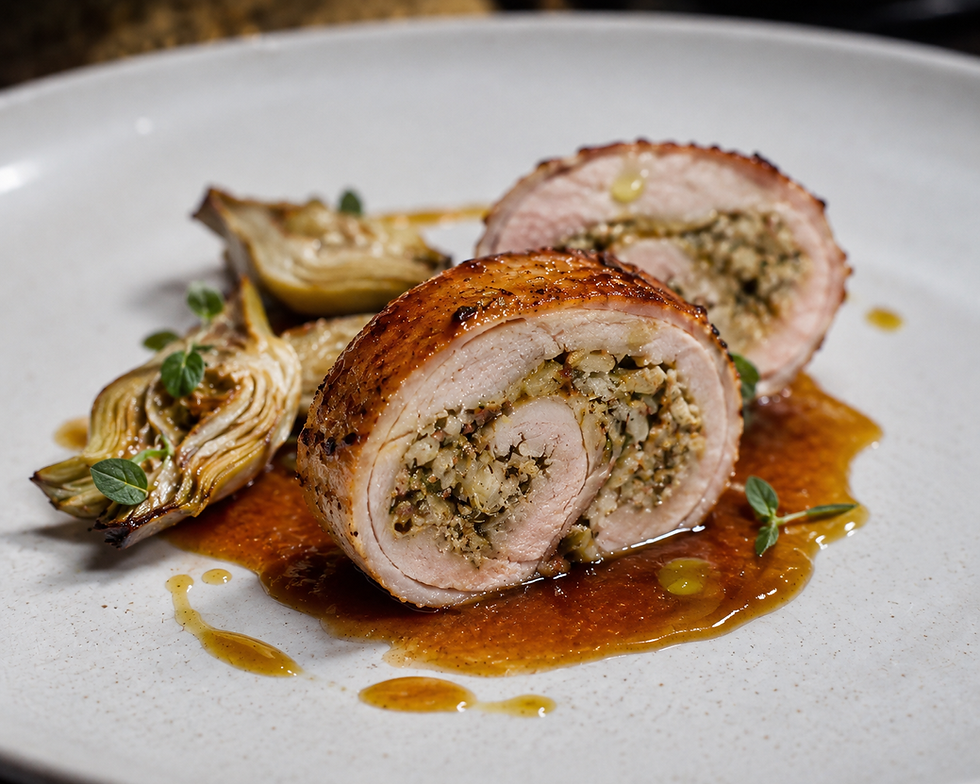
A whole rabbit boned out and rolled around a stuffing is one of the oldest ideas in Italian butchery and one of the least forgiving. The animal gives you a single wide sheet of pale meat that has to become a cylinder cooking evenly, slicing cleanly and staying moist. The stuffing here is spring artichokes stewed in oil, aged pecorino, parsley, mint and thyme bound with a little bread, and the outside of the roll is wrapped in pancetta before it goes into the oven.
That wrapping is the whole technical problem of the dish. Rabbit carries no fat inside the muscle, so every minute in the oven takes moisture out and gives nothing back. All the richness comes from outside: the oil in the filling and the fat rendering down the roll.
What comes out carves into thick medallions with a green and white spiral through the middle, served with the pan juices reduced to a light jus and a few artichoke wedges kept back from the filling. A restaurant plate built from a farmyard animal, a spring vegetable and a hard sheep cheese.
Yield: 4 servings. Prep: 1 hour. Cook: 1 hour. Rest: 20 minutes. Total: about 2 hours 20 minutes. Difficulty: advanced. Course: secondo. Region: central and insular Italy.
The Story
Rabbit sits in Italian cooking where chicken sits almost everywhere else, and every region with a cortile behind the house has a rabbit dish it considers its own. Liguria braises it with Taggiasca olives and pine nuts, the version that travelled with sailors because it kept well. Ischia does coniglio all'ischitana in a terracotta pot with tomato and garlic, eaten at midday with the pasta sauced in the same pot. Sardinia roasts it hard with myrtle branches that perfume the meat while it rests.
The animal climbed a long way to get there. Rabbit was court food in the Renaissance, farmed in walled warrens and served at Ferrara and Mantua when most people ate almost no meat. By the nineteenth century it had moved into the farmyard and stayed, because it needs no pasture, breeds fast and turns kitchen scraps into protein. It became the meat of houses that could not afford veal.
The stuffing belongs to spring, when the artichoke fields of Lazio, Sardinia and Puglia are cutting and the sheep dairies are still turning winter milk into pecorino. Artichoke and pecorino is an old pairing, and it works because the cheese has the salt and the fat to answer the vegetable's bitterness. Put the two inside a rabbit and you have an Italian April on one plate.
Ingredients
For the rabbit
Whole rabbit, 3 lb (1.35 kg), boned into a single sheet, liver and kidneys reserved
Fine sea salt, 1 1/2 tsp (9 g)
Freshly ground black pepper, 1/2 tsp
Thinly sliced pancetta or lardo, 5 oz (140 g)
Extra virgin olive oil, 2 tbsp (30 ml)
For the artichoke and pecorino filling
Globe artichokes, medium, 5
Lemon, 1, halved
Extra virgin olive oil, 4 tbsp (60 ml)
Shallot, finely chopped, 1
Garlic clove, finely chopped, 1
Dry white wine, 1/4 cup (60 ml)
Reserved liver and kidneys, finely chopped
Stale coarse bread, crust removed, 1 1/2 oz (45 g)
Whole milk, 3 tbsp (45 ml)
Aged Pecorino Romano or Sardo, finely grated, 2 1/2 oz (70 g)
Flat leaf parsley, chopped, 3 tbsp
Mint leaves, chopped, 1 tbsp
Thyme leaves, 2 tsp
Lemon zest, finely grated, from 1 lemon
Egg yolk, 1
For the pan juices
Rabbit bones, chopped, from the boning
Shallot, halved, 1
Carrot, roughly chopped, 1 small
Dry white wine, 1/2 cup (120 ml)
Chicken stock, 2 cups (475 ml)
Rosemary sprig, 1
Cold unsalted butter, 1 tbsp (14 g)
For finishing
Artichoke wedges, reserved from the filling, 8
Extra virgin olive oil, a few drops per plate
Flat leaf parsley leaves, small, 12
Flaked sea salt, to taste
Preparation
Step 1
Bone the rabbit from the back. Lay the animal belly down and run a small knife along one side of the spine, staying against the bone and lifting the loin away whole rather than cutting into it. Repeat on the other side, free the rib cage, then work the leg and shoulder bones out from the inside without piercing the skin. You want one continuous sheet with no holes, because every hole is where the filling escapes and the roll collapses. Keep the liver and kidneys, chop the bones for the jus.
Step 2
Even out the thickness. The sheet is thick at the legs and thin at the belly flaps, so rolled as it is the thick end stays raw while the thin end dries. Cover it with plastic and tap the heavy parts with the flat of a mallet until it is roughly even at about half an inch. Tap, do not pound: hard blows tear the fibres and open the holes you just avoided. Season the inner face with two thirds of the salt and all the pepper, then refrigerate on a rack.
Step 3
Trim and stew the artichokes. Squeeze the lemon into a bowl of cold water. Pull the hard outer leaves off each one, cut the top inch away, peel the stem, split them, dig out the choke with a teaspoon and drop the halves into the acidulated water. Cut four into thin wedges, dry them and stew them in 3 tablespoons of the oil with the shallot and garlic over low heat about 15 minutes, until a knife goes through without resistance. Add the wine and cook it away completely. Set eight of the best wedges aside for the plate.
Step 4
Build the filling. Soak the bread in the milk 5 minutes and squeeze it almost dry. Sear the chopped liver and kidneys in the last tablespoon of oil for 1 minute, chop the stewed artichokes coarsely, then combine everything with the bread, pecorino, parsley, mint, thyme, lemon zest and egg yolk. Mix with your hands and taste: it should hold a shape on the spoon and be well seasoned already, since the pecorino brings the salt. If it is wet, dry it in the pan.
Step 5
Fill, roll and tie. Lay the sheet out skin side down and spread the filling evenly, leaving a clear border of about an inch all round. Roll from the long side, tightly, pressing as you go to drive the air out, seam underneath. Lay the pancetta over the whole outside, overlapping slightly, then tie with butcher's twine at regular intervals of about an inch and a half. Even spacing matters more than tight knots: gaps cook faster than sections under the string.
Step 6
Sear and roast. Heat the oven to 325°F (165°C). Warm the 2 tablespoons of oil in a heavy roasting pan and brown the roll on every side, turning it with two spoons rather than a fork, about 8 minutes, until the pancetta has tightened and coloured. Scatter the bones, shallot and carrot around it and roast 45 to 55 minutes, basting with the pan fat every 15 minutes. Take it out at an internal 145°F (63°C) at the thickest point.
Step 7
Rest, finish the jus and slice. Move the roll to a warm plate, cover loosely and leave it 20 minutes. Put the pan back on the heat, pour in the wine and scrape the base clean, add the stock and rosemary and reduce by two thirds until it coats a spoon. Strain, whisk in the cold butter off the heat, keep warm. Cut the twine away and slice into medallions three quarters of an inch thick, one stroke per slice so the spiral stays intact.
Plating
Warm the plates. This is a lean roast eaten in thick slices and a cold plate takes the heat out of it in under a minute. Reheat the reserved artichoke wedges in a spoonful of jus so they arrive hot rather than warm.
Spoon a little jus onto the plate and set two medallions on it, cut face upward and slightly apart, so the spiral reads immediately. Lean two artichoke wedges against the slices, add a few drops of good olive oil, three or four small parsley leaves and a pinch of flaked salt on the meat. Send the rest of the jus to the table separately: poured over the medallions it floods the filling and turns the section grey.
Professional Technique
Everything difficult about this dish comes from one fact: rabbit is the leanest meat sold by a butcher. It has no intramuscular fat at all, no marbling through the loin or the legs, nothing inside the muscle that melts and lubricates the fibres from within. Beef, pork, lamb and even chicken thigh carry internal fat that buys a margin of error. Rabbit carries none, and a long thin roll in the oven for the better part of an hour dries out with complete certainty unless fat is introduced deliberately.
There are two places to put it and this recipe uses both. The first is the filling, carrying four tablespoons of olive oil absorbed by the artichokes plus the fat of the pecorino and the yolk, sitting against the inner surface of the meat throughout and releasing moisture into the sheet from within. The second is the barding, the pancetta laid over the outside, which renders slowly and bastes the meat continuously while standing between the muscle and the dry heat. Take either away and the roast comes out stringy however carefully the temperature is watched.
The boning is the other half of the technique, and it has one rule: the meat must come off the skeleton as a single unbroken sheet. Work from the back, blade flat against the spine and ribs, freeing the leg bones by scraping rather than cutting. A sheet with holes cannot be rolled: the filling finds every gap under pressure and pushes through, the roll loses tension and the slices fall apart. Patience here is the difference between a roast that carves and one that crumbles.
Texture and Moisture Control
The internal temperature is the whole game. Rabbit is properly cooked at 145°F (63°C) and stringy at 160°F (71°C), and the distance between those numbers is perhaps eight minutes in the oven. There is no collagen worth speaking of in the loin to turn into gelatin and rescue an overcooked roll, which is why the low oven and the thermometer are not refinements. Pull it early: carryover takes it another 5°F while it rests.
The filling controls the rest. Artichokes hold a great deal of water and if they go in wet the interior steams instead of setting, the section slumps when cut and liquid runs onto the board. Cook the wine off completely and dry the mixture if it looks loose. The bread and the yolk then bind what moisture is left, holding it inside the spiral through the rest instead of letting it drain. Slicing early undoes all of it at once.
Professional Mise en Place
The boning, the filling and the tying all happen well before service, and a tied roll improves with several hours in the refrigerator because it holds its shape better under the knife. Only the roasting and the jus are last minute.
Equipment and tools
Small boning knife and a long thin slicing knife
Meat mallet and plastic sheeting
Butcher's twine and scissors
Heavy roasting pan for stove and oven
Instant read thermometer, fine mesh strainer
Prepared ahead
Rabbit boned and bones chopped, up to 1 day ahead, kept cold
Artichokes trimmed and stewed, up to 1 day ahead
Filling mixed and fully cooled, up to 1 day ahead
Roll filled, barded and tied, up to 6 hours ahead, on a rack
Service setup
Roll out of the refrigerator 30 minutes before searing
Stock hot, wine measured, rosemary and cold butter within reach
Reserved artichoke wedges ready to warm in a little jus
Plates warm, blade wiped clean between slices
Chef Tips
Ask the butcher to bone the rabbit and keep it in one sheet, in those words. One who takes it apart into loins and legs has given you a different dish. Ask for the bones, liver and kidneys too.
Buy the pancetta sliced thin at the counter, never cubed. It has to cover the roll like a skin, and a thick slice curls away as it renders, leaving bare patches exactly where the fat was supposed to protect the meat.
Chill the tied roll for an hour if you have it. Cold fat holds the cylinder rigid through the searing, the moment most rolls lose their shape, and a firm roll browns evenly instead of flattening on one side.
Use a young pecorino only if you have no aged one, and cut the quantity by a third. A soft sweet pecorino melts into a greasy seam instead of seasoning the artichokes.
Common Mistakes
Skipping the barding. A bare roll in a 325°F (165°C) oven for 50 minutes comes out dry and no jus poured over the slices puts the moisture back. The pancetta is not decoration, it is the only fat between the muscle and the heat.
Boning the rabbit into pieces. Loins and legs handled separately will not roll into a cylinder that holds, and a sheet perforated in three places leaks under pressure. Take the meat off in one piece or ask the butcher to.
Filling the roll too full. An overstuffed roll splits along the seam during the sear and empties into the pan. Leave an inch of clear border on all four sides and accept some filling left over.
Putting a wet filling inside. Artichokes that still hold liquid steam the inside of the roll and the section collapses the moment it is cut. Cook the wine away completely and dry the mixture if it looks loose.
Cooking to a temperature and not a number. Rabbit passes from correct to stringy in a few minutes and looks identical from the outside either way. Take it out at 145°F (63°C), let carryover do the rest, and give it the full twenty minute rest before the knife goes near it.
Wine Pairing
The artichoke makes this an awkward plate for wine. Cynarin, the compound behind its bitterness, temporarily alters how the palate reads sweetness, so a wine tasted alongside artichoke can seem flatter and more metallic than it did alone. The answer is firm acidity, a savoury rather than fruity profile and no residual sugar.
Vermentino di Gallura DOCG: The most reliable white here. Its high acidity and saline granite bite resist the flattening effect of the cynarin better than a softer white would, and the bitter almond finish runs alongside the artichoke instead of arguing with it. Body enough for the pecorino and the pancetta fat.
Fiano di Avellino DOCG: A structured white for more weight on the table. Fiano has real texture and a hazelnut and beeswax depth that meets the aged pecorino directly, while its acidity stays tight enough to cut the rendered pancetta. Serve at 54°F (12°C), not colder, or the aromatics close up.
Cerasuolo d'Abruzzo DOC: The rosato answer, and a good one. Made from Montepulciano bled off early, it has the red fruit and light tannin to follow the roasted surface of the meat and the acidity of a white to handle the artichoke. The easiest bottle here to drink straight through.
Rossese di Dolceacqua DOC: The light red of western Liguria, from the hills that gave us rabbit braised with olives and pine nuts. Pale, low in tannin and scented with wild herbs and rose, it echoes the thyme and mint in the filling rather than covering them. Serve at 57°F (14°C) so the acidity stays lively against the fat.
Etna Rosso DOC: For a red with more nerve. Nerello Mascalese on volcanic ash gives fine grained tannin, high acidity and a smoky mineral savour that reads as salt rather than fruit, which is what the artichoke needs from a red. Structure for the pancetta, lightness enough not to bury a lean white meat.
Storage & Reheating
Keep the roast whole rather than sliced. Wrapped tightly and refrigerated it holds 3 days, and the sealed cylinder loses far less moisture than cut medallions. Store the jus separately for the same 3 days. The roll also freezes well before cooking: bard it, tie it, wrap it twice and freeze up to 1 month, then thaw overnight in the refrigerator and roast as written.
To reheat, slice the cold roll, lay the medallions in a pan with a few spoonfuls of jus, cover and warm over the lowest heat 4 or 5 minutes until just hot. The liquid is what protects them. Reheating dry, in a hot oven or a microwave, drives the last moisture out of a meat that had very little to begin with. A rabbit roll does not improve overnight the way a braise does.
Nutrition
Per serving, based on 4 servings:
Calories: 610 kcal
Total Fat: 36 g
Saturated Fat: 13 g
Trans Fat: 0 g
Unsaturated Fat: 21 g
Cholesterol: 215 mg
Sodium: 980 mg
Total Carbohydrates: 16 g
Fiber: 5 g
Total Sugars: 3 g
Added Sugars: 0 g
Protein: 54 g
Lactose: 0.9 g
Principal micronutrients: vitamin B12, niacin, selenium, phosphorus, potassium, iron, calcium, folate
These figures are estimates. The sodium depends almost entirely on the pancetta and the pecorino, and the fat falls by about a quarter if the barding is removed before serving.


Comments