
Crema al Marsala (Italian Marsala Pastry Cream)
- 5 days ago
- 6 min read
Updated: 23 hours ago
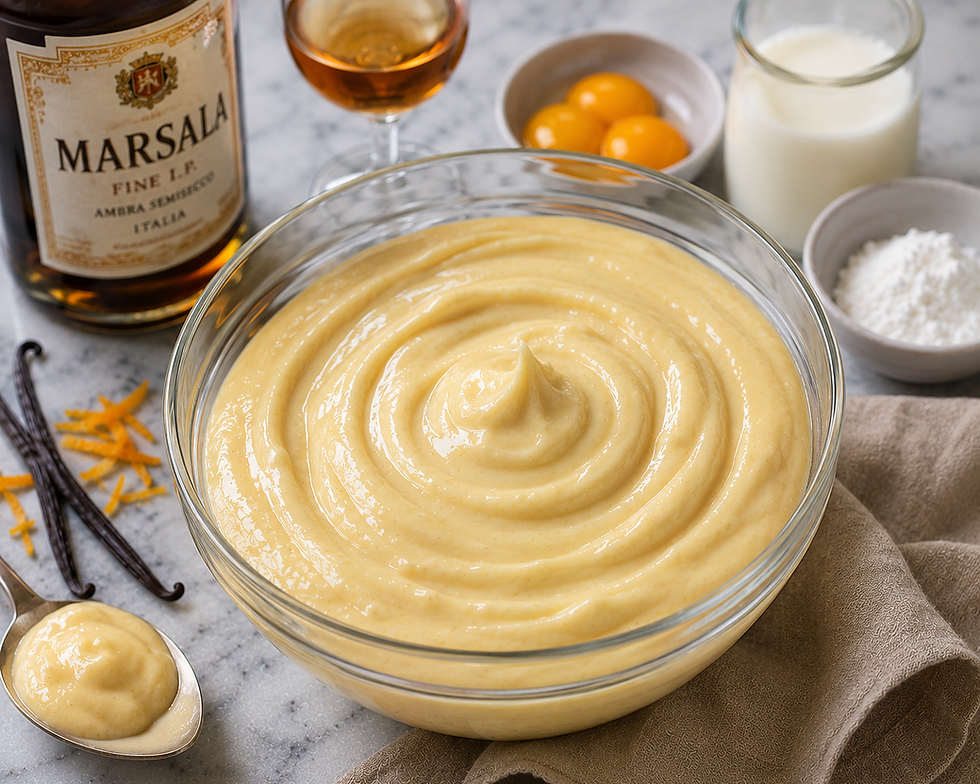
Crema al Marsala | Italian Marsala Pastry Cream
Italian Marsala Pastry Cream
Story of the Dish
Classic Italian Marsala Wine Pastry Cream
Crema al Marsala is a rich and aromatic Italian pastry cream that combines the structure of classic crema pasticcera with the unmistakable character of Marsala wine from Sicily.
Unlike zabaione, which is based primarily on egg yolks, sugar, and wine and is aerated during cooking, Crema al Marsala is a true pastry cream. Milk provides the foundation, egg yolks provide richness, cornstarch creates structure, and Marsala contributes dried fruit, caramel, toasted nut, vanilla, and oxidative wine aromas.
The result should be smooth, glossy, and unmistakably aromatic without tasting harshly alcoholic.
It is particularly suitable for millefoglie, bignè, cannoncini, crostate, cakes, panettone, pandoro, individual desserts, and pastries containing chocolate, coffee, almonds, hazelnuts, or dried fruit.
Yield: About 3 cups
Preparation Time: 15 minutes
Cooking Time: 10 minutes
Cooling Time: About 1 hour
Recipe Information
Yield: About 3 cups
Preparation Time: 15 minutes
Cooking Time: 10 minutes
Ingredients
1 3/4 cups whole milk (14.2 fl oz)
1/4 cup Marsala wine (2.03 fl oz)
5 large egg yolks
1/2 cup granulated sugar (3.53 oz)
1/4 cup cornstarch (1.06 oz)
1 tablespoon unsalted butter (0.49 oz)
1 teaspoon pure vanilla extract, optional
Finely grated zest of 1/2 untreated orange, optional
Pinch of fine sea salt
Choosing the Marsala
The Marsala is the defining ingredient.
Use genuine Sicilian Marsala of good drinking quality.
Do not use inexpensive cooking wine.
A Marsala Superiore works particularly well because its aromas of dried fruit, caramel, toasted nuts, vanilla, and oak integrate beautifully with pastry cream.
The wine should contribute complexity rather than simply alcohol.
Sweet or Dry Marsala
Both can be used, but the sugar must be adjusted accordingly.
A sweeter Marsala produces a softer dessert profile.
A drier Marsala gives the cream greater complexity and allows the pastry chef more precise control over sweetness.
When using a particularly sweet Marsala, reduce the granulated sugar slightly.
Reduce the Marsala
Pour the Marsala into a small saucepan.
Bring it to a gentle simmer.
Reduce for approximately 2 to 3 minutes, until slightly concentrated.
Do not reduce aggressively.
The objective is to soften the raw alcoholic edge while concentrating the wine’s aroma.
Remove from the heat.
Set aside.
Heat the Milk
Pour the whole milk into a heavy bottomed saucepan.
If using orange zest, add several thin strips of peel.
Heat gradually to approximately 180°F to 185°F (180°F to 185°F).
Remove from the heat.
Allow the orange peel to infuse for approximately 5 minutes.
Remove the peel.
Preparation
Prepare the Egg Yolks
Place the egg yolks and sugar in a mixing bowl.
Whisk immediately until smooth and slightly lighter in color.
Add the cornstarch.
Whisk until completely homogeneous and free of lumps.
Temper the Yolks
Slowly pour approximately one third of the hot milk into the egg mixture while whisking continuously.
Gradually incorporate the remaining milk.
Pour everything back into the saucepan.
Cook the Pastry Cream
Place over medium heat.
Whisk continuously, reaching the bottom and corners of the saucepan.
As the mixture approaches 180°F to 185°F (180°F to 185°F), it will thicken rapidly.
Once gentle bubbling begins, continue cooking for approximately 30 to 60 seconds.
Remove immediately from the heat.
Incorporate the Marsala
Allow the pastry cream to rest away from the heat for approximately one minute.
Gradually whisk in the warm reduced Marsala.
Do not pour all the wine into one area of the custard.
Add it slowly while whisking continuously to preserve a smooth texture.
Add the butter and fine sea salt.
Add vanilla if desired.
Whisk until completely emulsified.
Why the Marsala Is Added Near the End
Cooking Marsala aggressively for a long period destroys many of its delicate aromatic compounds.
Adding it toward the end allows enough heat to integrate the wine while preserving more of its character.
The short preliminary reduction removes some harshness and concentrates the wine before it enters the custard.
Professional Emulsion
For an exceptionally smooth result, briefly use an immersion blender.
Keep the blade completely submerged.
Blend until the butter, yolks, dairy, and wine components form a uniform emulsion.
Avoid incorporating air.
Professional Cooling Method
Transfer the hot cream immediately into a clean, shallow container.
Spread into an even layer.
Place plastic wrap directly against the entire surface.
Refrigerate promptly until completely chilled.
Before using, whisk gently until smooth.
Correct Consistency
Crema al Marsala should be:
Silky
Glossy
Smooth
Pipeable
Aromatic
Moderately sweet
Rich without becoming heavy
The Marsala should be clearly recognizable without producing a burning alcoholic sensation.
Marsala and Orange Variation
Add finely grated fresh orange zest after the Marsala has been incorporated.
Orange reinforces the dried fruit and caramel characteristics of the wine.
Use the zest sparingly.
The Marsala must remain the dominant aromatic ingredient.
Marsala and Chocolate Variation
After cooking the pastry cream, add approximately 3 ounces dark chocolate (3 oz).
Whisk until melted.
Then gradually incorporate the reduced Marsala.
Dark chocolate and Marsala create an exceptionally deep flavor suitable for tartlets and plated desserts.
Marsala and Coffee Variation
Replace approximately 1/4 cup of the milk (2.03 fl oz) with concentrated espresso.
Prepare the cream normally.
Incorporate the Marsala near the end.
Coffee and Marsala produce a powerful roasted and caramelized flavor profile.
This variation works beautifully with mascarpone.
Marsala Diplomat Cream
Prepare the Marsala pastry cream and cool completely.
Whip 1 cup heavy whipping cream (8.12 fl oz) to soft peaks.
Whisk the chilled Marsala cream briefly until smooth.
Fold approximately one quarter of the whipped cream into the pastry cream.
Then gently fold in the remaining cream.
This produces a lighter filling for millefoglie, bignè, and cakes.
Marsala and Mascarpone Cream
Combine equal quantities of cold Crema al Marsala and mascarpone.
Work the mascarpone briefly until smooth.
Gradually fold in the pastry cream.
This creates a rich filling particularly suitable for tiramisù inspired desserts and cakes.
Traditional and Modern Uses
Crema al Marsala is excellent for:
Millefoglie
Bignè
Cannoncini
Cornetti
Bomboloni
Crostate
Tartlets
Pan di Spagna
Panettone
Pandoro
Chocolate cakes
Individual pastries
Desserts served in glasses
Best Flavor Pairings
Marsala cream pairs beautifully with:
Dark chocolate
Coffee
Mascarpone
Ricotta
Hazelnuts
Almonds
Pistachios
Amaretti
Orange
Figs
Pears
Chestnuts
Raisins
Vanilla
Marsala and Panettone
Lightly toast slices of panettone until the edges become slightly crisp.
Serve warm with cold or slightly tempered Crema al Marsala.
The dried fruit, citrus peel, butter, and vanilla of panettone naturally complement the aromatic profile of Marsala.
Marsala and Pear
Poach pears gently until tender but still structured.
Allow them to cool.
Serve with chilled Marsala cream and toasted almonds.
Keep the pears only lightly sweetened.
The wine cream should provide the principal sweetness and aromatic complexity.
Mistakes to Avoid
The cream tastes strongly alcoholic: The Marsala was not reduced or was added in excessive quantity.
The Marsala flavor is weak: Poor quality wine or insufficient Marsala was used.
The cream becomes loose: Too much wine was added without adjusting the liquid balance.
The cream is excessively sweet: Sweet Marsala was combined with too much additional sugar.
The cream contains lumps: The custard was overheated or insufficiently whisked.
The cream tastes like starch: The pastry cream was insufficiently cooked.
A skin develops: Plastic wrap was not placed directly against the surface.
Chef Tips
Prepare a thin, crisp almond pasta frolla tart shell.
Brush the interior with a very fine layer of dark chocolate.
Allow the chocolate to set.
Fill with completely chilled Crema al Marsala.
Finish with toasted almonds, a few extremely thin pieces of candied orange peel, and finely grated dark chocolate.
Keep the presentation restrained.
Marsala already provides dried fruit, caramel, toasted nut, vanilla, and wine aromas.
The pastry chef does not need to compete with those flavors.
The goal is to allow the unmistakable character of Sicilian Marsala to remain present from the first aroma to the final spoonful.
Wine Pairing
Choose an Italian wine with enough acidity to refresh the palate and enough body to match the richness of the dish. Delicate recipes generally benefit from lighter, fresher wines, while roasted, braised, aged-cheese, or deeply savory preparations can support more structured selections. Serve the wine at the correct temperature and avoid pairings that overpower the principal ingredient.
Nutrition per Serving
Approximate nutrition per serving: 540 calories, 0.63 oz protein, 2.54 oz carbohydrates, 0.71 oz fat, 0.28 oz saturated fat, 0.14 oz fiber, 0.18 oz sugars, 620 mg sodium, and 55 mg cholesterol. Values vary with the exact ingredients and portion size.
Storage and Reheating
Keep Crema al Marsala refrigerated in a tightly covered container.
For optimal flavor and texture, use within 2 to 3 days.
Cool promptly after preparation.
Freezing is not recommended because the custard can lose its smooth structure after thawing.
Chef’s Technical Note
Wine based pastry creams require balance.
More Marsala does not automatically mean better Marsala flavor.
Excessive wine introduces too much liquid and alcohol, potentially weakening both texture and flavor balance.
Concentrate a moderate quantity instead.
The wine should become part of the cream rather than sitting on top of it aromatically.
Temperature is also important.
Do not boil quality Marsala for an extended period. Many of the aromatic compounds that make the wine interesting are volatile.
Reduce briefly, then incorporate it into the finished hot custard.


Comments