
Revisited Sicilian Stuffed Beef Roll | Falsomagro Siciliano Rivisitato

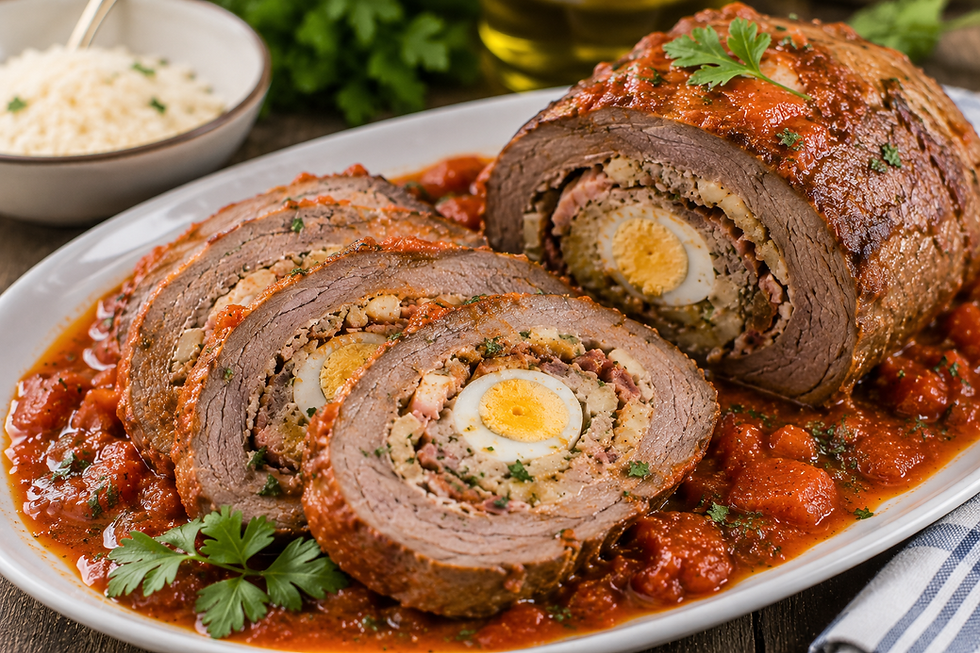
Falsomagro is the theatrical dish of the Sicilian kitchen: a slice of beef that looks like the plainest thing on the table and opens onto sausage, hard boiled egg, cheese and cured pork. This is the revisited version, built as a restaurant plate rather than a family platter. It is not the classic Palermo falsomagro and it is not an involtino. The stuffing is layered so every slice shows the same cross section, the braise is reduced separately into a glossy sauce, and the roll is cooked to a measured core temperature rather than to the clock.
What changes is the engineering. A roll of stuffed beef is a pressure vessel: the filling releases water and steam while the meat contracts around it, and a clean spiral is decided before the pot goes on the heat.
Yield: 6 servings. Prep: 50 minutes. Cook: 1 hour 40 minutes. Rest: 20 minutes. Total: about 2 hours 50 minutes. Difficulty: advanced. Course: secondo piatto. Region: Sicily, Palermo and the western provinces.
The Story
The name explains the dish. In Sicilian it is farsumagru, the false lean, and the joke is structural: from outside the diner sees a modest piece of beef with nothing on it, and inside sits some of the richest food the island cooks. Sausage, pancetta, caciocavallo, hard boiled eggs and pecorino are wrapped in one thin sheet of meat, so the roll reads poor and eats like a feast. Where fasting days were taken seriously and the table was a language of wealth, dressing abundance as austerity was no accident.
Its home is the baronial kitchen of Sicily, the aristocratic houses of Palermo and the great inland estates, where French trained cooks called monzù ran the stoves from the eighteenth century onward. They borrowed the northern habit of stuffing and rolling a cut of meat and filled it with the Sicilian pantry: sausage from the interior, caciocavallo from the Madonie, salt cured pork, parsley, pecorino. It belongs to neither tradition, and it still appears at Easter and at Sunday lunches from Palermo to Caltanissetta, with a different filling in every house.
There is a second reason it survived. One thin slice of beef, pounded wide, feeds six because the beef is a wrapper rather than the substance: an expensive cut stretched with cheap protein, and the table still reads roast. That logic carried the recipe from the baron's dining room into ordinary Sicilian cooking.
Ingredients
For the beef
Beef top round or flank, cut as a single sheet, 2 1/4 lb (1 kg)
Fine sea salt, 1 tsp (6 g)
Freshly ground black pepper, to taste
Butcher twine, about 10 ft (3 m)
For the stuffing
Fresh Sicilian sausage, casing removed, 7 oz (200 g)
Pancetta, thinly sliced, 3 1/2 oz (100 g)
Caciocavallo Ragusano, cut into batons, 4 oz (115 g)
Eggs, hard boiled and peeled, 3
Grated pecorino Siciliano, 1 1/2 oz (40 g)
Fresh breadcrumbs, 1/2 cup (30 g)
Flat leaf parsley, chopped, 3 tbsp (10 g)
Garlic clove, minced, 1
Freshly ground black pepper, to taste
For the braise
Extra virgin olive oil, 3 tbsp (45 ml)
Yellow onion, finely diced, 1 medium
Carrot, finely diced, 1 small
Celery stalk, finely diced, 1
Dry red wine, 1 cup (240 ml)
Tomato passata, 1 1/2 cups (360 ml)
Tomato paste, 1 tbsp (16 g)
Beef stock, 1 1/2 cups (360 ml)
Bay leaves, 2
Fine sea salt, 1/2 tsp (3 g)
For finishing
Cold butter, 1 tbsp (14 g)
Extra virgin olive oil, a few drops per plate
Flat leaf parsley leaves, small, 12
Freshly ground black pepper, to taste
Preparation
Step 1: Butterfly and pound the beef
Have the butcher open the top round into one sheet. Lay it between two pieces of plastic and work it with the flat of a mallet from the centre outward until it measures roughly 12 by 10 in (30 by 25 cm) and is even at about 1/4 in (6 mm). Hold the beef to the light: anywhere you see through is where the roll will split.
Step 2: Build the stuffing mixture
Mix the sausage meat, pecorino, breadcrumbs, parsley, garlic and pepper by hand until uniform but not compacted. The breadcrumbs are not filler: they absorb the fat and water the sausage releases in the braise, which would otherwise pool against the beef. Add no salt, the sausage, pecorino and pancetta carry enough.
Step 3: Layer the filling
Season the inner face lightly. Lay the pancetta over it in a single overlapping layer, leaving a clear border of 1 in (2.5 cm) on all four sides. Spread the sausage mixture over the pancetta in an even sheet, then set the peeled eggs end to end down the centre with the caciocavallo batons alongside. The border is what lets the beef seal onto itself.
Step 4: Roll and tie
Fold the two short sides inward, then roll the beef along its length as tightly as the filling allows and finish seam side down. Tie at intervals of about 1 1/4 in (3 cm), with one long loop down the length to hold the ends. Tie firmly and no tighter: the beef contracts in the pan, and twine that was drum tight going in cuts into the meat and forces filling out of the seam.
Step 5: Sear on every side
Heat the olive oil in a heavy casserole just large enough to hold the roll, over medium high heat. Pat the roll dry and colour it about 3 minutes per face, turning it with two spoons, until every surface including both ends is deeply browned. The sear sets the outer proteins into a continuous skin and is the best insurance against a roll that opens later.
Step 6: Build the braising base
Lift the roll out. Lower the heat, add the onion, carrot and celery to the same fat and cook 8 to 10 minutes until soft and just golden, scraping up the browned residue. Stir in the tomato paste and let it darken a minute, pour in the wine and reduce by half, then add the passata, stock, bay leaves and salt and bring to a bare simmer.
Step 7: Braise gently and probe the centre
Return the roll seam side down so the liquid comes two thirds of the way up it. Cover and hold at the faintest simmer about 1 hour 20 minutes, turning it once halfway and basting the exposed surface. Then push a probe through the beef into the sausage layer: you want 160°F (71°C) at the core, because the sausage goes in raw.
Step 8: Rest the roll, reduce the sauce
Lift the roll onto a board and rest it, loosely covered, a full 20 minutes. Meanwhile remove the bay leaves and reduce the braising liquid until it coats a spoon, then swirl in the cold butter off the heat. Cut the twine only after the rest, then slice about 3/4 in (2 cm) thick with a long thin blade in one drawing movement.
Plating
Plate warm, never hot from the pot. Use wide plates at just above hand temperature: a cold plate chills the sauce into a dull film, a scorching one keeps the cheese in the centre running.
Spoon a pool of reduced sauce slightly off centre and set two slices on it, overlapping, cut faces toward the diner. Never flood them from above: the sauce goes underneath so the layers of beef, pancetta, sausage, egg and cheese stay legible. Finish with a few drops of raw olive oil, two parsley leaves and a turn of pepper. A spoonful of soft potato or plain braised greens is all it needs.
Professional Technique
The technique of this dish is the construction of the roll, and it starts with the pounding. The beef sheet has to be one even thickness across its whole area, because every variation becomes a point where the roll opens in the pot. A thin patch cooks faster, contracts faster and tears; a thick patch stays rigid while everything around it shrinks and forces the seam apart. Work from the centre outward with glancing blows and patch nothing: a hole cannot be repaired, only positioned so it ends up inside the roll.
The second half of the problem is moisture inside the filling. Hard boiled egg and caciocavallo both release water and steam as they heat, and steam sealed inside a roll of meat has nowhere to go except against the seam, where it pushes. That is why the sausage mixture carries breadcrumbs and pecorino to hold that liquid, why the eggs go in whole and dry rather than chopped, and why the filling is spread in a firm even layer. A wet, loose centre is the usual cause of a roll that splits in the first half hour.
The rest follows. Tie at regular intervals of about 1 1/4 in (3 cm) so the pressure is even, and tie firmly rather than tight, because the beef contracts as it cooks and over tensioned twine cuts into the muscle and opens the very seam it was meant to close. Sear every face, ends included, so the outer collagen sets into a continuous skin before any liquid touches it. Braise below a simmer, since a rolling boil agitates the roll and works the seam. Read the core temperature, 160°F (71°C), rather than the clock, because the sausage in the middle heats far more slowly than the beef around it. And rest the roll twenty minutes before cutting: slice it straight from the pot and the cheese is still liquid, the filling is under pressure, and the first cut pushes the centre onto the board.
Texture and Moisture Control
Two textures have to arrive together. The beef wrapper is a lean working muscle full of collagen and needs long gentle moist heat to turn it into gelatin and become sliceable rather than chewy. The filling is fatty and fast and only has to reach a safe core temperature. The braise reconciles them: an hour and twenty minutes just below a simmer is long enough for the collagen and short enough that the sausage does not render into a greasy cavity. At a real boil you get a squeezed dry wrapper around a hollow centre.
The deep sear does flavour work as well as structural work. Maillard browning on every face of the roll, and the same browning left in the pot, carries most of the savoury depth of the sauce, which is why the vegetables go into that unwashed pan. During the rest, juices driven toward the centre redistribute and the cheese sets from liquid to soft, so the slice holds instead of collapsing. The sauce is reduced until it coats a spoon, then emulsified off the heat with cold butter so it stays glossy rather than breaking.
Professional Mise en Place
Almost all of this is done in advance, and nothing is à la minute except the slicing and the plate. Work in two blocks: build and tie, then braise and reduce.
Equipment and tools
Heavy lidded casserole just large enough to hold the roll
Meat mallet and two sheets of heavy plastic
Butcher twine and kitchen shears
Instant read probe thermometer
Long thin slicing knife and a board with a juice channel
Prepared ahead
Eggs hard boiled and peeled, up to 2 days ahead, refrigerated
Sausage mixture combined, up to 1 day ahead, covered and cold
Caciocavallo cut into batons and pancetta sliced, on the day
Roll built and tied, up to 12 hours ahead, then at room temperature 30 minutes
Braising vegetables diced, up to 1 day ahead
Service setup
Roll resting on a board, twine still on, loosely covered
Sauce reduced and held warm, butter not yet added
Plates warm but not hot, slicing knife clean and dry
Probe thermometer within reach for the next roll
Parsley and finishing oil ready in small containers
Chef Tips
Order the beef as one opened sheet and say what it is for. A butcher who knows you are making farsumagru will cut top round or flank along the grain in one piece. Overlapping slices into a sheet never works: the joins open first in the pot.
Boil the eggs a day ahead and keep them whole. Chilled overnight they peel cleanly and hold their shape in the centre, while eggs peeled warm tear and leave gaps in the cross section. Aim for a yolk just set through, about 9 minutes from boiling.
Taste the sauce before you reduce it, not after. Passata, stock, pecorino leaching from the filling and pancetta fat all add salt, and a sauce seasoned at full volume turns aggressive once it has lost a third of its water. Correct at the end.
If caciocavallo is unavailable, use a young provola or a firm scamorza. Avoid mozzarella, which floods the centre with water, and avoid a fully aged cheese, which will not soften into the slice. The cheese has to melt to a soft layer and stay there.
Common Mistakes
Pounding the beef unevenly. Thin patches tear and thick patches refuse to contract with the rest, and both end as a split seam. Work from the centre outward until the sheet is one thickness, and check it against the light before filling.
Tying the roll too tight. The beef shrinks in the pot and over tensioned twine cuts into the muscle, forcing filling out through the seam it was meant to close. Tie firmly at regular intervals and stop there.
Overfilling the centre. A roll stuffed to capacity cannot close on a clear border and leaves no room for the steam the egg and cheese release. Keep the 1 in (2.5 cm) border and accept a slimmer roll.
Cooking to the clock instead of the core. The sausage in the middle goes in raw and heats far more slowly than the beef around it. Probe the centre and read 160°F (71°C) before the roll comes out, whatever the timer says.
Slicing straight out of the pot. The filling is under pressure and the cheese still liquid, so the first cut pushes the centre onto the board. Rest 20 minutes with the twine on, then cut it and slice.
Wine Pairing
Cerasuolo di Vittoria DOCG: The most complete match on the list and a Sicilian one. The Nero d'Avola in the blend brings dark fruit and a tannic frame that cuts the sausage fat and the pancetta, while the Frappato lifts it with red cherry and a floral note that keeps a rich roll from feeling heavy. Its acidity meets the tomato braise on equal terms.
Etna Rosso DOC: The elegant choice, and the one best suited to this revisited version. Nerello Mascalese grown on volcanic ash gives fine grained tannin and a savoury iron and ash note that reads against the seared crust. Serve it at around 61°F (16°C). Its restraint lets the layers of the filling stay distinguishable.
Faro DOC: A rare bottle from the hills above Messina, worth the search. Nerello Mascalese with Nocera and Nerello Cappuccio makes a firmer, more tannic wine than Etna Rosso, with dried herb and pomegranate. That tannin is what the caciocavallo and the pancetta ask for, and its saline finish clears the palate between slices.
Aglianico del Vulture Superiore DOCG: The mainland option when you want more structure. Aglianico carries among the firmest tannins and highest acidity of any southern Italian red, so choose a bottle with some age. The reward is tannin that scours the sausage fat completely and a minerality that echoes the tomato reduction.
Valpolicella Ripasso DOC: A northern alternative that works better than it should. The ripasso method gives dried cherry depth and a little weight without the austerity of Amarone, so it wraps around the richness rather than fighting it. Its bitter almond finish suits the pecorino.
Storage & Reheating
This is one of the dishes that genuinely improves overnight. Cool the roll whole, uncut and with the twine still on, and refrigerate it in an airtight container, sauce stored separately, for up to 3 days. Whole is the key word: a cut roll dries at the exposed faces and loses the set of the filling. A day in the refrigerator firms the cheese and sausage so the slices hold far better.
Reheat the roll whole and gently. Set it in a covered dish with a few spoonfuls of sauce and warm it in a 300°F (150°C) oven for 20 to 25 minutes, until about 140°F (60°C) at the centre, then slice. Never reheat slices in a pan and never use a microwave: both drive water out of the lean wrapper and leave it grey and dry. Warm the sauce separately and, if it has broken, bring it back with cold butter off the heat. Cooked, whole and tightly wrapped, the roll freezes up to 2 months and thaws overnight in the refrigerator. Do not freeze it raw and tied.
Nutrition
Per serving, based on 6 servings:
Calories: 625 kcal
Total Fat: 41 g
Saturated Fat: 15 g
Trans Fat: 0.5 g
Unsaturated Fat: 24 g
Cholesterol: 235 mg
Sodium: 980 mg
Total Carbohydrates: 13 g
Fiber: 2 g
Total Sugars: 6 g
Added Sugars: 0 g
Protein: 48 g
Lactose: 1 g
Principal micronutrients: iron, zinc, selenium, vitamin B12, phosphorus, calcium, niacin
These figures are estimates. Sodium depends heavily on the sausage and pancetta you buy, and much of the braising liquid stays in the pot rather than on the plate.



Comments