
Sicilian Stuffed Beef Roll | Falsomagro alla Siciliana
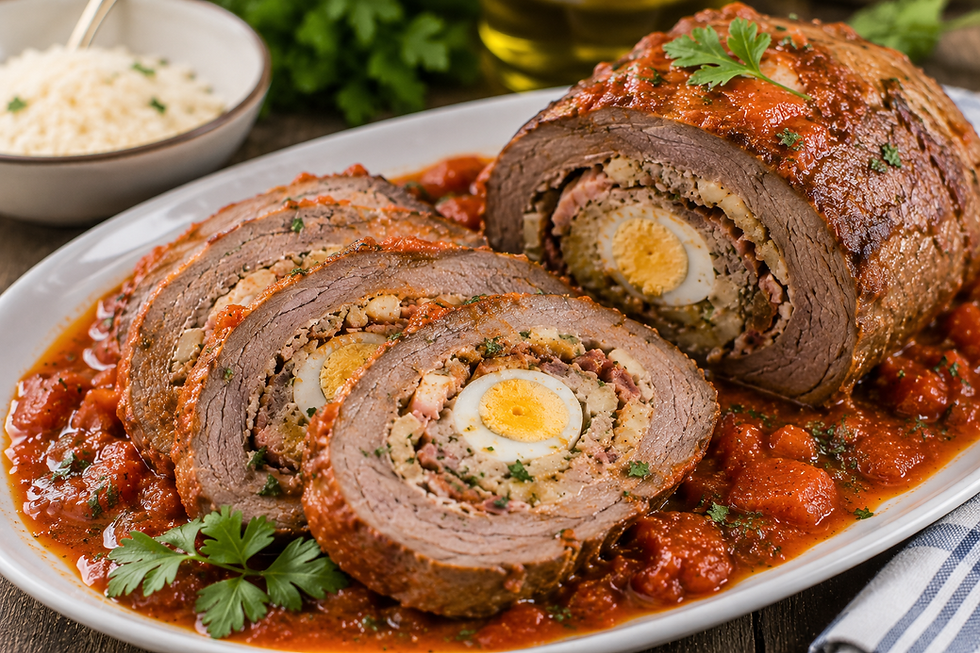
Falsomagro is a lie told with a knife. One wide sheet of beef is spread with ground meat, cheese, salame and whole hard boiled eggs, rolled, tied, browned and braised until the outside is dark and the inside a mosaic. Laid flat on a plate it looks like a thin round of beef with a pale centre. Cut through it and the deception collapses: the beef is only the wrapper.
This version stays with the braised Palermo form, in tomato and red wine rather than roasted dry, and it treats the eggs as the technical problem they actually are. Almost every roll that cracks open in the pot fails for one reason: a column of hard boiled egg down the core of a piece of meat that shrinks around it. This is the second falsomagro on the site and the two are kept deliberately apart: the other post covers building and tying the roll, this one the eggs, the braise and the cut.
Yield: 6 to 8 servings. Prep: 45 minutes. Cook: 2 hours. Rest: 30 minutes minimum. Total: about 3 hours 15 minutes. Difficulty: intermediate to advanced. Course: secondo piatto. Region: Sicily, Palermo and the western provinces.
The Story
The name is the whole joke. Falsomagro, farsumagru in Sicilian, means false lean, and it describes exactly what the dish does to whoever is looking at it. From the outside it reads as a modest slice of beef, the sort of thing a household with little money would serve; inside it is one of the richest things in the Sicilian repertoire. It is named for the disguise, not the food.
Where it came from is still argued. One account puts it in the kitchens of the Sicilian barons, where French trained cooks, the monsu, worked through the eighteenth and nineteenth centuries; those cooks knew farce maigre, a lean forcemeat, and the resemblance of the words is hard to ignore. The other account is the opposite: peasant arithmetic, turning one thin cut of beef into a dish for eight. Both are probably true, since the grand version and the frugal one have coexisted for two centuries.
What is not argued is when it is eaten. Falsomagro is a Sunday and feast day dish, carried to the table whole and carved in front of everyone. The regional forms split on the sauce: Palermo braises it in tomato and red wine, so the sauce is eaten first over pasta and the roll follows, while Catania runs drier, often oven roasted with less tomato, and the slice is firmer. The filling splits too, with sharp elastic caciocavallo ragusano and a visible seam of salame in the west, fresher primosale and sometimes pancetta further east.
Ingredients
For the beef
Beef top round, butterflied into a single sheet, 2 1/2 lb (1.15 kg)
Fine sea salt, 1 tsp (6 g)
Freshly ground black pepper, to taste
Kitchen twine, about 10 ft (3 m)
For the filling
Ground beef, or half beef and half pork, 10 oz (285 g)
Eggs, large, 4, hard boiled and peeled
Egg, large, 1, raw, for binding
Caciocavallo ragusano, or primosale, diced small, 5 oz (140 g)
Salame or mortadella, diced, 3 oz (85 g)
Dry breadcrumbs, 3/4 cup (75 g)
Pecorino Siciliano, grated, 1 1/2 oz (40 g)
Flat leaf parsley, chopped, 1/3 cup (15 g)
Garlic clove, minced, 1
Fine sea salt, 1/2 tsp (3 g)
Freshly ground black pepper, to taste
For the braise
Extra virgin olive oil, 3 tbsp (45 ml)
Yellow onion, finely chopped, 1 medium
Carrot, finely chopped, 1 small
Celery stalk, finely chopped, 1
Dry red wine, 1 cup (240 ml)
Canned peeled tomatoes, hand crushed, 2 cups (480 g)
Tomato paste, 1 tbsp (16 g)
Bay leaves, 2
Beef stock, 1 cup (240 ml), as needed
Fine sea salt and black pepper, to taste
For finishing
Extra virgin olive oil, for the plates
Flat leaf parsley, chopped, 1 tbsp
Pecorino Siciliano, grated, to taste
Preparation
Step 1
Boil and cool the eggs first. Simmer the four eggs for 9 minutes, then move them into iced water until cold through, peel under cold running water and dry. A warm egg sweats inside the roll and a soft centred one breaks when it is tied.
Step 2
Open the beef into one even sheet. Ask for top round butterflied into a single flat piece about 12 by 10 inches (30 by 25 cm), then pound it between two sheets of plastic, from the centre outward, until it is even everywhere at around 1/2 inch (12 mm). Even matters, not thin: a thick middle stays raw while a thin edge tears. Season it.
Step 3
Mix the filling and taste it. Combine the ground meat, breadcrumbs, pecorino, parsley, garlic, the raw egg and seasoning, working it only until homogeneous. Fry a teaspoon and correct the salt now, because nothing can be adjusted once the roll is closed. Fold in the diced caciocavallo and salame last and barely, so they stay visible.
Step 4
Spread the filling and line up the eggs. Press the mixture over the beef about 1/2 inch (12 mm) deep, stopping 1 1/4 inches (3 cm) short of every edge, since that bare border is what seals the roll. Set the four eggs end to end in one straight line parallel to the short edge you will roll from, slightly nearer it than the centre, and press them half in.
Step 5
Roll tightly from the short side. Fold the short edge over the eggs and pull the beef back toward yourself so the first turn is tight and no air is trapped. Keep the tension constant, finish with the seam underneath and tuck the ends in. It should feel dense, with no soft give.
Step 6
Tie at regular intervals, then crosswise. Loop the twine every 1 inch (2.5 cm), snug enough to mark the surface but not cut it, then run two lengths end to end over the tucked ends. Spacing matters more than force: uneven loops let the meat bulge and split.
Step 7
Brown every side. Heat the oil in a heavy casserole just wide enough for the roll and brown it over medium high heat for about 12 minutes, a quarter turn at a time, so every face colours. Move it with tongs, never a fork, since a puncture is a leak. The fond must be deep brown, never black.
Step 8
Build the braise. Soften the onion, carrot and celery in the same pan for 8 to 10 minutes, scraping up the fond. Darken the tomato paste, add the wine and reduce by half, then add the tomatoes, bay leaves and seasoning and bring to a simmer.
Step 9
Braise low and turn gently. Return the roll seam side down and add stock until the liquid reaches two thirds up its sides, no higher. Cover and cook at a bare simmer for about 1 hour 45 minutes, turning every 30 minutes. An internal 160°F (71°C) means done, but soft collagen matters more than the reading.
Step 10
Rest it whole for 30 minutes, then slice thick. Cut hot, the filling has not set and the slice slumps the moment the knife leaves it; an hour is better. Snip each loop and pull it away, reduce the sauce uncovered meanwhile, then slice with the sharpest knife you own into rounds a generous 3/4 inch (2 cm) thick, through the middle of an egg.
Plating
Falsomagro is carved at the table in Sicily and there is no reason to change that. What matters on the plate is thickness: two thick slices per person, laid flat and slightly overlapping so both cut faces show. Spoon the reduced sauce around them and over the near edge only, never across the whole slice, because the mosaic of egg, cheese and salame is the dish.
Use warm plates at around 140°F (60°C) and serve the sauce hot, since cheese on a cold plate turns waxy within a minute. Finish with a few drops of olive oil, chopped parsley and a light grating of pecorino over the sauce rather than the meat. Roast potatoes, sautéed greens or bread are the right companions.
Professional Technique
The roll is built around four whole hard boiled eggs lying end to end in its core, and that is a geometry problem before it is a cooking one. Beef shrinks: over two hours at a simmer the fibres contract and the roll tightens measurably around whatever is inside it. Hard boiled egg does not shrink at all, because the white is already fully coagulated and holds almost no free water to lose. The roll therefore contains a continuous channel that stays exactly the size it began while the meat around it tries to become smaller, and that difference has to go somewhere.
Two things decide whether it is absorbed or whether the beef splits. The first is the tying: loops at regular 1 inch (2.5 cm) intervals hold the contracting beef against the rigid core evenly and spread the shrinkage along the whole length, while loose or widely spaced loops let the meat bulge between them until the wall thins and tears, almost always along the seam. The second is proportion: the eggs must be small relative to the thickness of the sheet and the depth of filling around them. Four large eggs in a sheet pounded evenly to 1/2 inch (12 mm) leave enough meat and compressible mince to absorb the difference. Jumbo eggs, or the same eggs in a thin sheet, press against a wall with nothing left to give, and that roll opens in the pot however carefully it is braised.
The same rigid channel governs the cut. Because the eggs do not deform, each slice is a ring of beef and filling around a hard disc of egg, and its strength depends on where the blade lands. Through the middle of an egg the disc sits centred and evenly gripped, and the slice holds when lifted. Off to one side, or at the junction between two eggs, it gets a half moon jammed against one edge with a void behind it, and the round falls apart on the way to the plate. That is why the eggs are lined up straight and the slices cut thick: structure, not presentation.
Texture and Moisture Control
Three things cook at once inside a falsomagro and they want different treatment. The beef sheet is lean, cut from the round, with connective tissue running through it, and it needs long moist heat below a simmer to turn that collagen into gelatin, which is what makes the slice tender. The ground filling is essentially a sausage and turns dry if overworked or braised hot. The cheese melts early, around 130°F (55°C), which is why the filling still reads as moist after two hours.
Water management runs the other way from most braises. The roll must brown hard and dry at the start, because the Maillard crust is the only deep roasted flavour the dish gets and cannot be built later under liquid. After that the liquid comes no more than two thirds up, so the top steams instead of boiling and the crust is not washed off. A bare simmer also keeps the mince from tightening and squeezing its fat into the sauce, which is what gives a greasy braise and a dry centre at once. The final rest belongs to the same control: it lets the gelatin and melted cheese set enough to bind the filling before the knife goes in.
Professional Mise en Place
Almost all of this is done in advance. Only the final reduction of the sauce and the slicing happen near service.
Equipment and tools
Heavy casserole just wide enough to hold the roll, with a lid
Meat mallet and two sheets of plastic for pounding
Kitchen twine and sharp scissors
Long thin slicing knife and a wide spatula
Tongs and a spatula for turning the roll, never a fork
Prepared ahead
Eggs boiled, cooled and peeled, up to 1 day ahead, kept dry
Beef butterflied and pounded, up to 1 day ahead, covered
Filling mixed and seasoning already tested by frying a spoonful
Soffritto of onion, carrot and celery chopped and ready
The whole roll assembled, tied and refrigerated, up to 12 hours ahead
The entire braise completed a day ahead, which improves it
Service setup
Roll resting whole and untied, 30 minutes minimum
Sauce reducing uncovered while it rests, bay leaves out
Slicing knife sharpened, warm dish ready for the slices
Plates warming at about 140°F (60°C)
Chef Tips
Buy the beef by describing what you are making. Ask for top round butterflied into one flat sheet of about 12 by 10 inches (30 by 25 cm) and the hardest part is done before you get home. A roll built from two overlapping pieces separates at the join.
Use large eggs and not one size up. It sounds trivial and it is the commonest cause of a split roll, because jumbo eggs push the wall of beef outward with nothing left to compress.
Fry a teaspoon of filling and taste it before spreading any. Once the roll is tied the seasoning is fixed, and a bland filling wastes the afternoon. Season slightly harder than feels right, since the beef is salted only on its surfaces.
Make it the day before. Falsomagro is better on day two: the filling has set, the slices hold, the sauce has thickened. Refrigerate it whole in its sauce, then slice it cold and reheat the slices.
Common Mistakes
Tying loosely or at uneven intervals. The main reason a falsomagro splits. The beef contracts around eggs that do not, and only even loops every 1 inch (2.5 cm) spread that tension.
Spreading the filling to the edges. Without a bare border of 1 1/4 inches (3 cm) there is nothing to seal with, and the filling is forced out on the first turn.
Slicing the roll hot. The filling has not set and the juices are mobile, so the slice slumps on the board. Thirty minutes is the minimum and an hour is better.
Cutting thin, or cutting beside an egg. A thin round cannot hold the rigid disc of egg, and a cut between two eggs leaves a void nothing bridges.
Braising at a rolling boil. Hard heat tightens the filling and drives its fat into the sauce, giving a greasy braise and a dry centre at once.
Wine Pairing
Etna Rosso DOC: Nerello Mascalese from the volcanic slopes has fine grained tannin and a savoury iron note rather than heavy fruit, which handles the tomato acidity of the braise without either side sharpening. Its high acidity cuts the fat of the caciocavallo and the ground pork, while the tannin has just enough grip for the browned crust.
Cerasuolo di Vittoria DOCG: The most Sicilian answer here. Nero d'Avola supplies body and dark fruit for the beef, while Frappato brings a lifted red cherry perfume and lower tannin that keeps the pairing from turning heavy over a long Sunday lunch. Moderate structure for a dish that is rich rather than powerful.
Montepulciano d'Abruzzo DOC: Soft round tannin and generous plummy fruit sit comfortably against a tomato and red wine sauce, and the modest acidity that would be a flaw elsewhere is an asset here, since the sauce brings plenty of its own. Weight enough for the salame without tasting sweet beside it.
Barbera d'Asti DOCG: Choose this when the sauce has come out rich and the filling heavy on cheese. Barbera is built on acidity with very little tannin, and that cutting quality scrubs the palate between mouthfuls in a way the softer southern reds cannot, making the grated pecorino taste bright rather than salty.
Salice Salentino DOC: Negroamaro from Puglia, warm with a faintly bitter finish. That bitter edge is the point: it answers sharp aged caciocavallo directly instead of smoothing it over, while the ripe dark fruit behind it absorbs the sweetness long cooked tomato develops.
Storage & Reheating
This dish genuinely improves overnight, so cook it a day ahead when you can. Cool the roll whole in its sauce and refrigerate it whole, submerged, for up to 3 days. Storing it whole keeps the cut faces from drying and lets the filling set, which is why day two slices cut so much more cleanly. It freezes in sauce and in slices for up to 2 months.
Reheat slices rather than the whole roll. Slice it cold, lay the rounds flat in a wide pan with sauce halfway up them, cover, and warm over low heat for 10 to 12 minutes, turning once. The sauce protects the lean beef, so never reheat it dry or uncovered, and never microwave at full power, which squeezes water out of the egg white. Leftover sauce keeps 5 days and belongs on short pasta.
Nutrition
Per serving, based on 8 servings, roll and sauce together:
Calories: 520 kcal
Total Fat: 31 g
Saturated Fat: 12 g
Trans Fat: 0.5 g
Unsaturated Fat: 17 g
Cholesterol: 215 mg
Sodium: 780 mg
Total Carbohydrates: 14 g
Fiber: 2 g
Total Sugars: 5 g
Added Sugars: 0 g
Protein: 45 g
Lactose: 0.8 g
Principal micronutrients: iron, zinc, vitamin B12, selenium, calcium, phosphorus
These figures are estimates. The largest variables are the fat content of the ground meat, how much sauce goes onto each portion, and the salt in the salame and caciocavallo.


Comments