
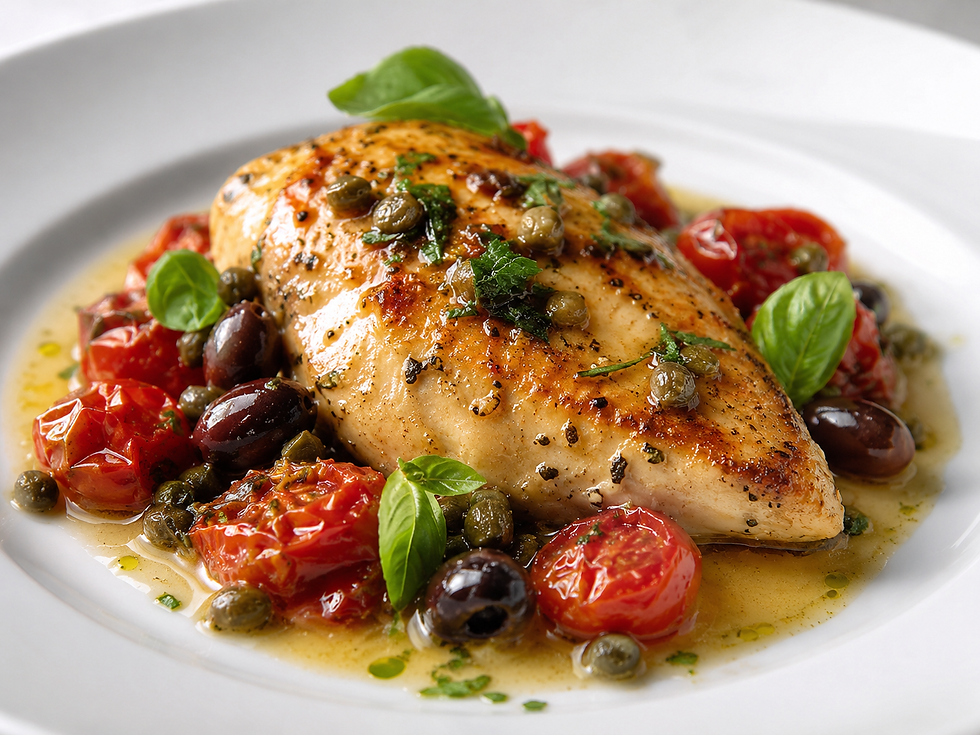
Italian Sicilian Chicken Breast | Petto di Pollo con Peperoni alla Siciliana

This is a plate of Sicilian peppers that happens to carry a chicken breast, and the order matters. Long sweet peppers from the island, cooked slowly in olive oil with onion and finished with wine vinegar and sugar, turn into peperonata: glossy, sharp and dense enough to hold its shape on a spoon. The chicken is the quiet partner that gives it somewhere to sit.
What separates the Sicilian version from every other pepper stew in Italy is the agrodolce finish. Vinegar and sugar go in at the end, and they are not a seasoning adjustment but the structural idea of the dish. Sicily learned that balance from centuries of Arab kitchens, and it repeats from caponata to sarde a beccafico to the sweet and sour rabbit of the interior.
The chicken is cooked as plainly as possible so it does not compete: dry brined, seared hard, brought to temperature and rested. A spoonful of capuliato, the Sicilian paste of minced sun dried tomatoes, goes in at the very end as a savoury accent rather than a base, and almonds and mint close it.
Yield: 4 servings. Prep: 30 minutes. Cook: 45 minutes. Rest: 10 minutes. Total: about 1 hour 25 minutes. Difficulty: intermediate. Course: secondo. Region: Sicily.
The Story
Peperonata is the summer work of Sicilian home kitchens, made in quantity when the peppers come in and eaten for a week afterwards. The peppers are not the squat bell peppers of northern markets but the long tapered corno di bue type, thin walled and intensely sweet, grown across the plains of Catania, the Nebrodi foothills and the market gardens around Palermo. They cook down faster, they carry more sugar, and their skins are fine enough that peeling is optional.
The sweet and sour treatment came with the Arab rule of the ninth to eleventh centuries, which brought sugar cane, citrus, almonds and a taste for setting sweetness against acidity in savoury food. Vinegar had a practical role too: an agrodolce vegetable holds for days in a warm climate without refrigeration, which is why peperonata was made in large pots and is still reckoned better on the second day.
Chicken arrived at this pairing late. Peperonata was a contorno and an antipasto long before anyone set poultry on it, and in Sicilian family cooking it accompanied whatever the butcher had. A single breast over a bed of peppers is a modern arrangement of a very old preparation, and the honest thing to say is that the peppers are the tradition.
Ingredients
For the chicken
Boneless skin on chicken breasts, 4, about 7 oz (200 g) each
Fine sea salt, 1 1/4 tsp (7 g), for the dry brine
Extra virgin olive oil, 2 tbsp (30 ml)
Garlic clove, smashed, 1
Fresh oregano sprigs, 2, or dried Sicilian oregano, 1/2 tsp (0.5 g)
Freshly ground black pepper, to taste
For the Sicilian peperonata
Long sweet red and yellow peppers, corno di bue type, 2 lb (900 g)
Yellow onion, sliced thin, 1 large, 7 oz (200 g)
Extra virgin olive oil, 1/4 cup (60 ml)
Garlic cloves, sliced, 2
Bay leaf, 1
Fine sea salt, 1 tsp (6 g)
White wine vinegar, 3 tbsp (45 ml)
Granulated sugar, 2 tsp (8 g)
Capuliato, minced sun dried tomato paste, 2 tsp (12 g)
Salted capers, rinsed, 1 tbsp (10 g)
Green olives, pitted and torn, 1/4 cup (40 g)
For finishing
Blanched almonds, toasted and roughly chopped, 2 tbsp (18 g)
Fresh mint leaves, torn, 8 to 10
Extra virgin olive oil, for the plates
Flaked sea salt, a small pinch per plate
Preparation
Step 1. Dry brine the chicken
Pat the breasts dry, season them all over with the fine sea salt and set them uncovered on a rack in the refrigerator for 1 to 8 hours. That is the whole of the base technique for any chicken breast: salt drawn into the flesh holds moisture, and an uncovered rest dries the skin so it will crisp. Bring them to room temperature for 20 minutes before cooking.
Step 2. Cut and salt the peppers
Wipe the peppers rather than washing them, since water in the folds will steam them later. Strip out ribs and seeds and cut the flesh into wide strips about 3/4 inch (2 cm) across, following the natural lobes. Cut too small they dissolve, cut too large they never soften through. Toss with half the salt and leave them in a colander.
Step 3. Sweat the onion
Warm the olive oil in a wide heavy sauté pan over medium low heat, add the onion, garlic, bay leaf and remaining salt, and cook 10 to 12 minutes until the onion is translucent with no colour at all. This is a gentle sweat, not a fry. Browning here puts a roasted note in the pan that fights the vinegar later.
Step 4. Cook the peppers down
Add the drained strips, raise the heat to medium and stir to coat them in oil. Cook uncovered 25 to 30 minutes, stirring often, until they collapse to half their volume and a slick of orange oil separates at the sides of the pan. Uncovered matters: a lid traps the water they release and boils them into a pale mush.
Step 5. Add the agrodolce
Stir the sugar through and let it dissolve for 30 seconds, then pour in the vinegar all at once and turn the heat to high. Let it bubble hard 60 to 90 seconds, scraping the base, until the sharp smell softens and the liquid has almost gone. Add the capuliato, capers and torn olives, stir once and take the pan off the heat.
Step 6. Sear the chicken
Set a heavy stainless steel or cast iron pan over medium high heat with the olive oil and lay the breasts skin side down. Press each flat for 20 seconds so the skin makes full contact, then leave them 6 to 7 minutes untouched, until the skin is deep gold and releases on its own. Turn them, add the garlic and oregano, and lower the heat.
Step 7. Cook to temperature and rest
Continue 5 to 7 minutes, basting with the scented oil, until a probe in the thickest part reads 160°F (71°C). Move the breasts to a warm plate, skin side up, and rest 8 to 10 minutes: carryover takes them to 165°F (74°C) and the juices settle back through the meat.
Step 8. Taste the peperonata last
While the chicken rests, warm the peppers through over low heat for 2 minutes and taste them now rather than earlier. Agrodolce settles as it cools, and what tasted sharp in the pan often reads flat ten minutes later. Correct with a few drops of vinegar or a pinch of sugar, never both at once.
Plating
Warm the plates, which matters here because the peperonata carries a lot of olive oil and oil on a cold plate turns dull within a minute. Spoon a generous bed of peppers slightly off centre, loosely piled rather than flattened, so the plate keeps height and the colours stay separate.
Carve each breast across the grain into four or five thick slices on a slight angle, and lay them overlapping against the peppers so both the crisp skin and the cut face show. Never spoon peppers over the skin: the only reason to cook it that carefully is to let the diner see and hear it.
Finish with the almonds scattered around rather than on the meat, a few torn mint leaves, a thread of raw olive oil over the peppers and flaked salt on the slices. Spoon the resting juices over the chicken and serve at once, with bread and nothing else.
Professional Technique
The technique that defines this plate is the management of the agrodolce, and it comes down to when the vinegar goes in and how long it stays over heat. Add it early, with the peppers still firm, and the acid sets the pectin in the cell walls: the strips stop softening and stay stubbornly crunchy however long you cook them. Add it and pull the pan straight off the heat instead, and the volatile acetic fraction never leaves, so the dish reaches the table smelling raw and sour rather than sweet and sharp.
The 60 to 90 seconds of hard boiling after the vinegar goes in is the entire window. In that time the harsh aromatics leave as steam, the sugar and remaining acid bind with the pepper juices into a syrupy glaze, and the liquid reduces enough to coat the strips instead of pooling under them. You can hear it: the pan moves from a watery bubble to a tighter, fatter sizzle as the water goes and the oil takes over.
The ratio is the second point. Three tablespoons of vinegar against two teaspoons of sugar across 2 lb (900 g) of peppers leaves acidity clearly in front, which is correct, because the peppers give up a great deal of sweetness as they reduce. Judge that balance at the end and after the pan has stood a few minutes, since sweetness reads stronger at serving temperature than at boiling point.
Texture and Moisture Control
Peppers are close to ninety percent water, and the cooking is an exercise in removing most of it without reducing the flesh to pulp. Salting the strips pulls the first fraction out before they see the pan, and cooking uncovered takes the rest away as steam. The visible signal is the oil separating: while free water remains the oil stays emulsified through the mass, and when it slicks out at the edge of the pan the peppers are concentrated enough to hold a spoon shape. They should finish silky but still recognisable as strips.
On the chicken side the variables are the skin and the interior. Skin only crisps once its own moisture has gone, so it needs a dry surface, unbroken contact with the pan and six full minutes undisturbed. The interior needs the probe: 160°F (71°C) off the heat, carrying to 165°F (74°C) through the rest, gives firm juicy meat, while anything past 170°F (77°C) squeezes the fibres and no peperonata puts that moisture back.
Professional Mise en Place
The peperonata is a make ahead preparation and the chicken is entirely à la minute, so the two halves of this dish live on opposite sides of the service.
Equipment and tools
Wide heavy sauté pan for the peppers, 12 inch (30 cm) or larger
Heavy stainless steel or cast iron pan for the chicken
Instant read probe thermometer
Colander for the pepper strips and a rack for the dry brine
Sharp carving knife and a warm resting plate
Prepared ahead
Peperonata complete through the agrodolce, up to 3 days ahead
Chicken dry brined uncovered on a rack, 1 to 8 hours ahead
Almonds toasted and chopped, stored airtight
Capers rinsed and olives torn, held in one small bowl
Service setup
Peperonata warm over the lowest heat, tasted and corrected
Chicken at room temperature, surface dry, salt already on it
Probe, tongs and basting spoon beside the searing pan
Plates warmed, mint torn at the last moment
Chef Tips
Buy the right peppers or change the dish. Long tapered sweet peppers have thin walls, high sugar and less water than bell peppers, which is what lets a peperonata concentrate in half an hour. Bell peppers need nearer 45 minutes and a heavier hand with the salt, and stay a little watery.
Make the peperonata the day before. It is the single change that improves the plate most and it costs nothing: overnight the vinegar and sugar finish penetrating the flesh, the capers and olives spread their salt, and the whole tastes rounder and less like separate ingredients.
Use proper Sicilian dried oregano, the kind sold on the stem in bunches. Its oil content is far higher than the powdered sort, and a pinch crushed between the palms into the chicken pan at the turn perfumes the basting oil in a way fresh oregano does not.
If you cannot find capuliato, do not reach for tomato paste or passata, which turn the peppers into a sauce. Mince two sun dried tomato halves very finely with salt and a few drops of oil instead. The quantity stays small: a savoury shadow behind the peppers, not a tomato element.
Common Mistakes
Adding the vinegar too early. Acid firms the pectin in pepper cell walls and stops them softening, so strips that meet vinegar while still firm stay crunchy through any further cooking. Collapse them fully first, then acidify.
Cooking the peppers with a lid on. The lid traps every drop the peppers release and turns concentration into stewing. The strips go pale, the flavour thins and the oil never separates. Leave the pan uncovered for the full half hour.
Browning the onion at the start. A caramelized base puts a dark roasted note under the dish that collides with the vinegar and makes the agrodolce taste muddled. Sweat it until translucent and stop before any colour appears.
Reducing the vinegar to nothing. Past 90 seconds at high heat the glaze turns tacky and tastes of burnt sugar rather than sweet and sour peppers. Stop while a film of syrup still moves in the pan.
Cooking the chicken to 175°F (79°C). Breast is safe and far juicier pulled at 160°F (71°C) and rested to 165°F (74°C). Every degree beyond contracts the muscle fibres and squeezes out water you cannot recover.
Moving the breast while the skin is setting. Lifting it to check or turning it early breaks the contact the skin needs and leaves it patchy. It releases from the pan by itself when it is properly crisp.
Treating this as a tomato dish. Passata or a heavy hand of paste turns Sicilian peperonata into an ordinary pepper and tomato stew and erases the agrodolce. The dish is built on peppers, vinegar and sugar.
Wine Pairing
Etna Bianco DOC: Carricante grown on volcanic soil above Catania, and the most precise match here. Its high fixed acidity meets the vinegar of the agrodolce on equal terms instead of being flattened by it, and the saline mineral finish picks up the capers and green olives directly. A good bottle has enough weight to carry the olive oil in the peppers without thinning out.
Grillo Sicilia DOC: The western Sicilian white, from the plains around Marsala and Trapani. It brings ripe yellow fruit and a herbal edge that runs parallel to the oregano on the chicken, with acidity firm enough for the sweet and sour finish. Its broader body handles the crisp skin better than a purely mineral white would.
Cerasuolo di Vittoria DOCG: The only DOCG red of Sicily, Nero d Avola with Frappato from the south east, and best served at 58°F (14°C). The Frappato gives bright cherry fruit and soft low tannin that will not clash with vinegar the way a tannic red does, while the Nero d Avola supplies just enough structure for seared poultry skin.
Etna Rosso DOC: Nerello Mascalese from the volcano, pale and firm with fine grained tannin and a smoky mineral spine. Its acidity is unusually high for a red, which is why it survives the agrodolce where a soft warm red tastes flabby. The savoury dried herb character sits easily with the capers, the olives and the sun dried tomato.
Faro DOC: A rare bottling from the hills above Messina, built on the same Nerello grapes but rounder and more perfumed. Its moderate tannin and bright acidity handle both the sweetness of the reduced peppers and the salt of the olives, and the faint bitter orange note it often shows belongs naturally with these flavours.
Storage & Reheating
The peperonata is the part worth keeping. Cooled completely and sealed under a film of olive oil, it holds in the refrigerator for 5 days and improves for the first two. It freezes for up to 3 months in a flat sealed bag, though the strips soften on thawing and are then better folded through pasta than plated under chicken. Thaw overnight and reheat in a pan, never in a microwave, which drives off what is left of the vinegar.
Cooked chicken breast does not improve. Keep the pieces whole rather than sliced, covered and refrigerated for up to 3 days, since a carved breast loses moisture from every cut surface. Reheat from room temperature in a covered pan over low heat with a tablespoon of water, 4 to 5 minutes, only until the centre reaches 140°F (60°C).
Do not try to recover the skin. Once refrigerated it never returns to the texture it had off the pan, and a hot grill only dries the meat underneath. Take it off instead and eat the sliced meat at room temperature over a fresh spoonful of peperonata, which is how Sicilian kitchens have always dealt with what is left.
Nutrition
Per serving, based on 4 servings:
Calories: 520 kcal
Total Fat: 31 g
Saturated Fat: 6 g
Trans Fat: 0 g
Unsaturated Fat: 24 g
Cholesterol: 120 mg
Sodium: 760 mg
Total Carbohydrates: 18 g
Fiber: 5 g
Total Sugars: 11 g
Added Sugars: 2 g
Protein: 44 g
Lactose: 0 g
Principal micronutrients: vitamin C, vitamin A, vitamin B6, niacin, potassium, selenium, vitamin E
These figures are estimates. Sodium varies most, depending on how thoroughly the capers are rinsed and how salty the olives are.



Comments