
Italian Mediterranean Chicken Breast | Petto di Pollo alla Mediterranea con Olive e Pomodorini
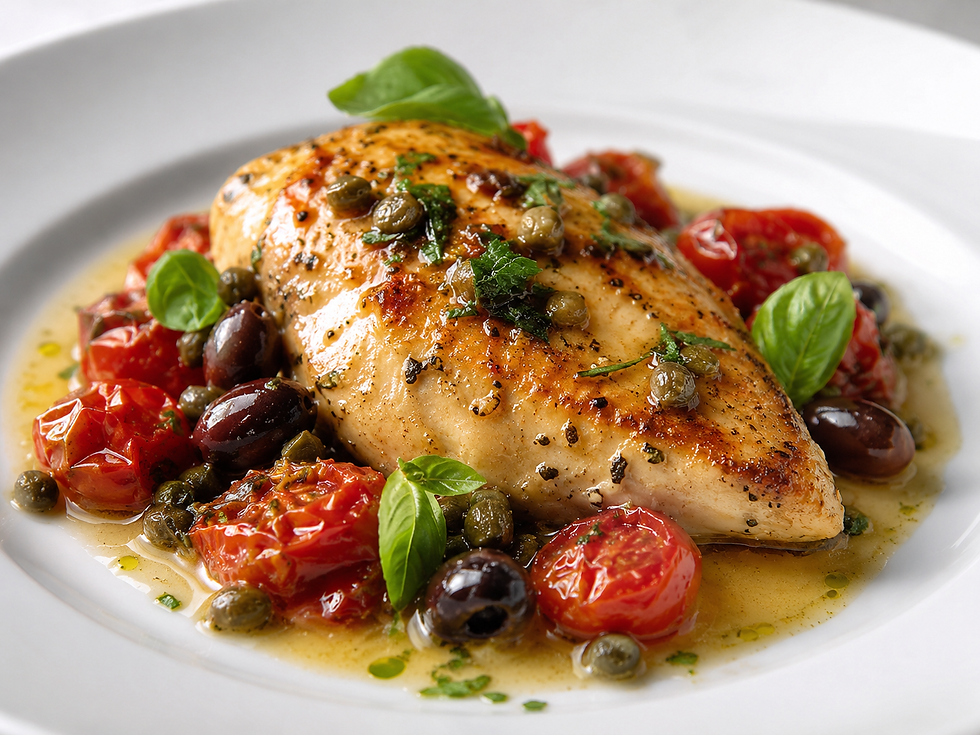
This is an olive dish. The cherry tomatoes give the sauce body and a sweetness to push against, but the flavour that defines the plate comes from a handful of small, dark, oil cured olives and a pinch of dried oregano.
The chicken is cooked the way any good chicken breast is cooked: salted in advance, seared hard for colour, finished gently, pulled at a precise temperature and rested. What is worth learning here is the sauce, which is an exercise in salt management. Olives, capers and their brine can push a pan sauce past the point of no return in under a minute, so almost nothing is seasoned until the very end.
There is no cheese anywhere in it and none should be added. The sauce is bound with a little butter and with the starch free reduction of tomato and wine, and it wants to stay sharp and glossy rather than creamy.
Yield: 4 main course servings. Prep: 20 minutes. Cook: 30 minutes. Dry salting: 4 hours or overnight. Difficulty: easy to intermediate. Course: secondo. Region: southern Italy, with a Ligurian olive borrowed for the purpose.
The Story
The olive is the part of this plate with a real biography. The small, dark, wrinkled ones most cooks reach for are Taggiasca, grown on the terraced slopes of the Ligurian west between Imperia and Ventimiglia, where Benedictine monks are credited with spreading the cultivar from the eleventh century onwards. They are tiny and high in oil, cured slowly in brine and finished in oil, and they taste of almond and dried herbs rather than of salt alone. They are gathered in nets stretched under the trees, because the fruit is too small and soft to strip by hand.
Further south the same job is done by different fruit. Gaeta olives from the Lazio coast are salt cured, softer, purplish and slightly bitter. In Puglia and Calabria the table olives are larger and greener, cracked and cured with fennel or chilli, and in Sicily the Nocellara del Belice is meaty enough to be eaten on its own. Every one of them will work in the pan and every one will move the dish somewhere else, which is why the added salt is decided after tasting and not before.
Oregano is the other fixed point. Italian cooking uses it dried far more often than fresh, which is unusual for a herb, and the reason is chemical: drying concentrates the carvacrol and thymol that give oregano its warm, slightly medicinal edge, while the fresh leaf is milder and grassier. Sicilian oregano sold on the branch, in bunches tied with string, is the standard reference.
Ingredients
For the chicken
Boneless skinless chicken breasts, 4 pieces, 6 oz each (170 g each)
Fine sea salt, 1 1/2 tsp (9 g)
Freshly ground black pepper, to taste
Extra virgin olive oil, 2 tbsp (30 ml)
For the olive and tomato sauce
Taggiasca olives in oil, pitted, 1/2 cup (85 g)
Cherry tomatoes, halved, 10 oz (285 g)
Salted capers, rinsed, 1 1/2 tbsp (15 g)
Garlic cloves, thinly sliced, 3
Dried oregano on the branch, 1 1/2 tsp (2 g)
Crushed red pepper flakes, 1/4 tsp (0.5 g)
Dry white wine, 1/2 cup (120 ml)
Chicken stock, unsalted, 1/2 cup (120 ml)
Extra virgin olive oil, 2 tbsp (30 ml)
Cold unsalted butter, 1 tbsp (14 g)
For finishing
Flat leaf parsley, chopped, 2 tbsp (5 g)
Lemon juice, 2 tsp (10 ml)
Extra virgin olive oil, a few drops per plate
Flaky sea salt, only if the sauce needs it
Preparation
Step 1

Salt the chicken breasts on every surface and set them uncovered on a rack over a tray in the refrigerator for 4 hours, preferably overnight. That is the base chicken method in full: dry salt, sear hard, pull at 160°F (71°C) and rest. Meanwhile pit the olives under the flat of a knife, rinse the capers in two changes of cold water, halve the tomatoes and slice the garlic thinly. Do not season anything else yet.
Step 2

Blot the breasts dry and bring them to room temperature for 30 minutes. Heat a wide heavy skillet over medium high heat with 2 tablespoons of olive oil until it shimmers. Lay the breasts in presentation side down and leave them alone for 4 to 5 minutes, until the crust releases by itself. Turn them and give the second side 3 minutes. They should be deeply coloured and still undercooked in the centre, because the sauce will finish them.
Step 3

Lift the chicken onto a plate and drop the heat to medium. Add the remaining olive oil, then the sliced garlic and the chilli flakes, and stir for about 30 seconds, only until the garlic turns pale gold. Add the halved tomatoes cut side down and leave them without stirring for 2 minutes, so the cut faces blister and their sugars caramelise instead of stewing in the liquid they release.
Step 4

Add the olives and drained capers, then crumble in the oregano, rubbing the branch between your palms over the pan. Pour in the white wine and let it bubble hard for a minute while you scrape the base, then add the stock. Return the chicken along with any juices on the plate, lower to a steady simmer and cover loosely. Cook 6 to 8 minutes, turning the breasts once.
Step 5

Check with an instant read thermometer at the thickest point. Pull the breasts onto a warm plate the moment they read 160°F (71°C), tent them loosely and rest 8 minutes while carryover takes the centre to about 165°F (74°C). Raise the heat and reduce the sauce until it just coats a spoon and the tomatoes have collapsed at the edges but are not a purée, usually 3 to 4 minutes.
Step 6

Take the pan off the heat and, now and only now, taste the sauce. Between the olives, the capers and the salt off the chicken it may already be seasoned, which is why nothing was added earlier. Swirl in the cold butter and the lemon juice for gloss, then stir in the parsley. Add flaky salt only if the tasting says so.
Step 7

Carve each breast across the grain into four or five thick slices on a slight angle, holding them together as you lift them so the meat keeps its heat. Spoon the sauce around and partly over the slices, making sure every portion gets its share of olives, capers and blistered tomato rather than just liquid. Finish with a few drops of raw olive oil.
Plating
Warm the plates and choose shallow bowls or plates with a rim, because this sauce is loose by design and a flat plate lets it run to the edge. White is best: the plate is red, black and green already.
Fan the sliced chicken slightly off centre with the slices touching. Spoon the sauce so that the solids land against the meat and the liquid pools beside it, and count the pieces as you go, three or four olives and a few capers per portion, so nobody is served a plate of tomato and nobody is served a plate of brine. Lay the blistered tomato halves cut side up where they can be seen.
Finish with the parsley already stirred into the sauce rather than scattered raw on top, a few drops of good olive oil and nothing else. No basil leaf, no cheese, no balsamic. Good bread on the side is the only accompaniment the dish wants.
Professional Technique
The technique that matters here is the management of two competing salts and one acid, and it is what separates a good version of this dish from a punishing one.
Olives and capers arrive already seasoned and neither announces how much salt it is carrying. A Taggiasca finished in oil may sit around three per cent sodium by weight, a salt packed Gaeta or a cracked Pugliese olive can be twice that, and capers straight from the jar are saltier than either. Rinsing the capers in two changes of water removes the surface crust without flattening their flavour. Everything else follows from one rule: nothing in the sauce is seasoned until the pan comes off the heat. By then the wine and stock have reduced, the olives have released part of their cure and the chicken has given up some of its own salt, and only then can the total be judged. Salt added at the start of a sauce that reduces by half has doubled in concentration by the time anyone tastes it.
The acidity from the tomatoes runs the other way. Cherry tomatoes dropped straight into liquid stew rather than brown, and stewed tomato is sharp and thin. Laying them cut side down on a hot surface for two undisturbed minutes caramelises the sugars at the cut face, which lowers the perceived acidity and adds a roasted depth no amount of extra cooking time will produce later.
The oregano is added late and dry for the same category of reason. Its aroma sits in volatile phenols that boil away fast, so a herb added at the beginning of a twenty minute reduction is largely gone by service. Crumbling it in just before the wine gives it enough contact with hot fat to bloom and not enough time to evaporate.
Texture and Moisture Control
The chicken is the fragile element. Breast meat is lean, with almost no collagen to turn into gelatin, so nothing compensates once the fibres contract and force water out, which happens fast beyond 160°F (71°C). Searing for colour and then finishing in a covered pan at a gentle simmer keeps the surface far below what a dry pan would impose, so the outside does not overcook while the centre catches up.
The sauce reaches its consistency without any thickener. There is no flour and no starch, so the body comes from reduction, from the pectin in the tomato skins and from the final butter. Reduce until it coats a spoon and no further: past that the tomatoes break down completely and the sauce turns to a dull purée. The butter goes in off the heat, below about 190°F (88°C), where the fat disperses into fine droplets and adds gloss. Added to a boiling pan it splits at once.
Tomato texture is worth protecting. The aim is halves that have collapsed at the edges and kept their shape in the middle, so a fork still meets something. Overcooked, they dissolve and the plate loses its one soft, juicy contrast against the firm chicken and the dense olives.
Professional Mise en Place
The sauce comes together in under ten minutes from the moment the chicken leaves the pan, so nothing can be prepared during service. Everything is cut, rinsed and measured before the skillet is lit.
Equipment and tools
Wide heavy skillet, cast iron or stainless steel, never nonstick
Lid that fits the skillet loosely
Instant read thermometer
Rack and tray for the dry salting, small sieve for the capers
Carving board and a sharp slicing knife
Prepared ahead
Chicken breasts salted uncovered on a rack, 4 hours to overnight
Olives pitted and capers rinsed and drained, several hours ahead
Tomatoes halved and garlic sliced, up to 2 hours ahead, covered
Wine and stock measured, lemon juiced, parsley chopped
Butter cut and kept cold until the last moment
Service setup
Everything for the sauce in small containers beside the stove in order of use
Thermometer within reach, not in a drawer
Plates warming, carving board ready
Salt held back deliberately and tasted for at the end
Oregano branch kept whole and crumbled into the pan at the moment
Chef Tips
Buy olives with the stones still in and pit them yourself under the flat of a knife. Pitted olives sold in brine are softer, waterier and duller, because the machine breaks the flesh and the cure runs straight through it.
Taste one olive and one caper before you start and adjust in your head. If the olives are mild, you will need a pinch of salt at the end; if they are aggressive, you will need lemon juice instead. That single tasting decides how the sauce is finished.
Use tomatoes that are actually sweet. In winter, when cherry tomatoes are pale and acidic, roast them separately at 400°F (200°C) for 15 minutes with a little oil before they go into the pan, which concentrates what sugar they have and rescues an otherwise sour sauce.
Buy oregano on the branch rather than ground. It keeps its aroma for a year in a sealed jar away from light, and rubbing the flower heads between your palms over the pan releases far more than a spoonful of dust.
Common Mistakes
Salting the sauce early. The liquid reduces by roughly half, which doubles the concentration of everything dissolved in it, and the olives and capers keep giving up salt the whole time. Season at the end, off the heat, or not at all.
Cooking the chicken through in the sear. If the breast is finished before the sauce exists, it spends the next ten minutes drying in the pan and the sauce has nothing left to do. Sear for colour only and leave the centre clearly undercooked.
Stirring the tomatoes as soon as they hit the pan. They then stew in their own juice and the sauce stays sharp and thin. Two undisturbed minutes cut side down on a hot surface is what produces the roasted sweetness the dish is built on.
Using pitted olives from brine. They are waterlogged and bland, they break apart in the sauce and they release far more liquid than whole olives do. Pit them yourself, from a jar in oil.
Adding the oregano at the start. Its aroma compounds are volatile and a long reduction drives them off, leaving a vaguely dusty background note. Crumble it in immediately before the wine.
Finishing with cheese or basil. Grated cheese fights the brine and turns the sauce heavy, and basil pushes the plate towards a different, sweeter register. Parsley and oregano are the herbs this dish uses.
Wine Pairing
Grillo Sicilia DOC: The most natural answer, from the same island as the oregano. Grillo has enough weight and a faintly waxy texture to stand up to the olives, with citrus peel and a saline finish that reads as an extension of the brine rather than a contrast to it.
Etna Bianco DOC: Carricante grown on volcanic soil gives a tighter, flintier white with high acidity and a smoky mineral finish. That acidity is the useful part here: it cuts the olive oil in the sauce and stops a salty plate from becoming tiring, while the stony finish sits comfortably next to the capers.
Cirò Bianco DOC: Greco Bianco from the Calabrian coast, dry, lightly bitter on the close and built for exactly this kind of cooking. The gentle bitterness meets the olives on their own terms instead of trying to sweeten them, and there is enough body to carry a buttered pan sauce without the wine disappearing under it.
Locorotondo DOC: A pale, dry, understated Pugliese white from Verdeca and Bianco d'Alessano, low in alcohol and high in refreshment. It brings almost no flavour of its own to argue with the seasoning, and its crisp finish resets the palate between salty mouthfuls.
Cerasuolo di Vittoria DOCG: The red option, and a Sicilian one. The Frappato in the blend gives bright red cherry and a wild herb lift that runs directly into the oregano, while the Nero d'Avola supplies just enough structure for the seared crust. Serve it cool, around 57°F (14°C), and choose an unoaked bottling.
Storage & Reheating
Keep the chicken and the sauce in separate containers. Stored together, the breast sits in a salty acidic liquid overnight and comes out saltier and slightly mealy on the surface. The sauce itself keeps 4 days refrigerated and improves after the first, as the oregano and the olive cure go on infusing into the tomato.
Do not slice the chicken before storing, since a whole breast loses far less moisture than slices do, and it keeps 3 days in an airtight container. To reheat, bring it to room temperature for 20 minutes, then set it in a covered pan with a tablespoon of stock over the lowest heat for 4 to 5 minutes. Warm the sauce separately and combine the two on the plate. A microwave on high will make this cut rubbery in under a minute.
The sauce alone freezes well for up to 2 months and is worth doubling for that reason. Thaw it overnight in the refrigerator and rewarm it gently, whisking in a small piece of cold butter at the end to bring the gloss back. Do not freeze the cooked chicken, which turns stringy. Leftover sauce is excellent tossed through short pasta.
Nutrition
Per serving, based on 4 main course portions:
Calories: 430 kcal
Total Fat: 24 g
Saturated Fat: 5 g
Trans Fat: 0 g
Unsaturated Fat: 18 g
Cholesterol: 115 mg
Sodium: 890 mg
Total Carbohydrates: 8 g
Fiber: 2 g
Total Sugars: 4 g
Added Sugars: 0 g
Protein: 41 g
Lactose: 0.1 g
Principal micronutrients: vitamin C, vitamin K, lycopene, potassium, niacin, vitamin B6, selenium, phosphorus
These figures are estimates, and the sodium in particular swings widely with the cure on the olives and capers.


Comments