
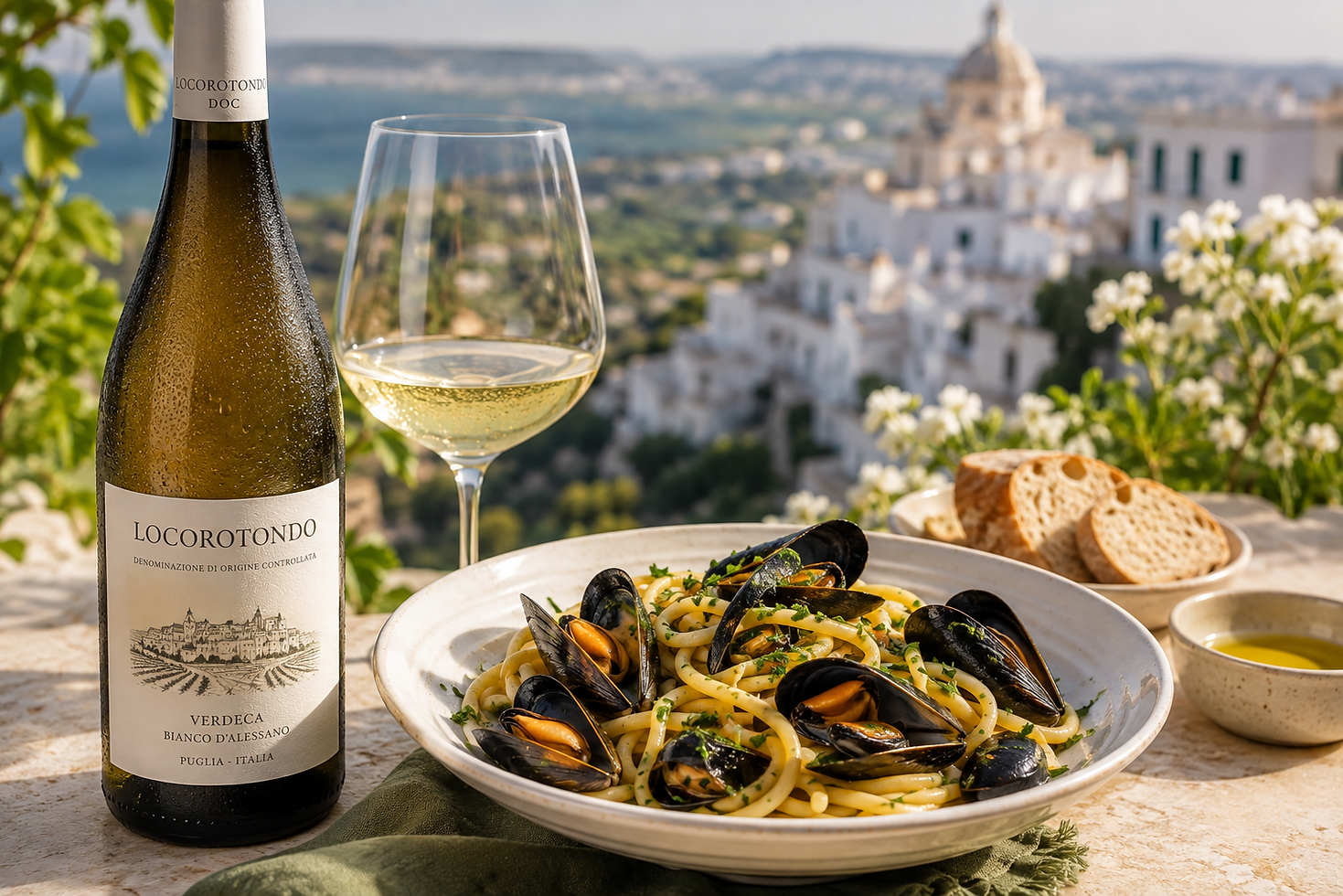
Wine Pairing: Locorotondo DOC
Updated: Aug 31

Locorotondo DOC is a dry white with additional Superiore, Riserva, Spumante and Passito categories in the denomination whose importance comes from regional identity and practical usefulness at the table. From the Valle d’Itria around Locorotondo and Cisternino, it shows how a local grape or historically coherent group of grapes can create a wine that feels specific without depending on excessive ripeness, oak or marketing prestige. In General, the useful question for Locorotondo DOC is how the detail changes bottle choice, serving temperature, food weight or expected development in the cellar.
The tasting register is lemon, green apple, white flowers, fennel, almond and a dry mineral finish. Those notes are useful only when connected to structure: acidity, tannin, sweetness, alcohol and texture decide what belongs on the plate and whether the wine remains refreshing through a full course. For Locorotondo DOC, General becomes clearer when producer style and vintage are compared side by side, because the denomination allows more variation than a single tasting can show.
What Locorotondo DOC Is
Locorotondo DOC is a dry white with additional Superiore, Riserva, Spumante and Passito categories in the denomination from the Valle d’Itria around Locorotondo and Cisternino. The denomination establishes origin and production rules, while estates still make meaningful choices about harvest date, extraction, oxygen, lees, wood and release timing. A restaurant context makes What Locorotondo DOC Is practical for Locorotondo DOC: the wine must remain balanced after several bites, not merely impressive in the first sip before food arrives.
Expect lemon, green apple, white flowers, fennel, almond and a dry mineral finish. The best examples are coherent rather than exaggerated: fruit remains clear, savory detail lengthens the finish, and the wine gains definition as it sits beside food. Collectors should read What Locorotondo DOC Is together with provenance for Locorotondo DOC, since storage, importer selection and release timing can influence the bottle almost as much as regional reputation.
For U. S. buyers this is usually a specialist category. Producer, vintage, importer and storage history are more useful than a generic shelf score, particularly when shipments are small and bottle age varies from market to market. The strongest examples of Locorotondo DOC make What Locorotondo DOC Is recognizable without exaggeration, preserving freshness and proportion while showing enough character to justify the denomination.
The Territory of the Valle d’Itria around Locorotondo and Cisternino
The Valle d’Itria is a limestone-rich inland landscape of Puglia, elevated enough to moderate the region’s heat and exposed to useful air movement between Adriatic and Ionian influences. That setting helps white grapes retain freshness and herbal detail. Comparing vintages of Locorotondo DOC is another test of The Territory of the Valle d’Itria around Locorotondo and Cisternino; recurring traits suggest territorial identity, while dramatic swings often reveal producer choices or unusual seasonal conditions.
Exposure, wind, elevation and soil drainage control how quickly grapes accumulate sugar and how much freshness remains at harvest. Those factors are especially important in Italian regions where summer warmth can otherwise make a wine broad before it becomes fully complex. For pairing, The Territory of the Valle d’Itria around Locorotondo and Cisternino matters because Locorotondo DOC should gain clarity beside food: acidity, tannin, sweetness, mousse or aromatic intensity must remain integrated rather than tiring.
Human choices complete the terroir. Farming, yield, picking date and traditional cellar habits create differences among producers that should be preserved rather than flattened. A strong bottle tastes of place while still being clean, balanced and useful with food. When buying Locorotondo DOC in the United States, The Territory of the Valle d’Itria around Locorotondo and Cisternino can explain price differences because smaller allocations, longer maturation and more selective vineyard work often affect availability as well as cost.
Grapes and Production Rules
The classic Locorotondo blend requires at least 50% Verdeca and at least 35% Bianco d’Alessano, with a limited portion of other permitted white grapes. The DOC also includes additional styles, so the exact label should guide service and pairing. In Grapes and Production Rules, the useful question for Locorotondo DOC is how the detail changes bottle choice, serving temperature, food weight or expected development in the cellar.
Regulations guarantee origin and define boundaries, but compliance is not the same as excellence. Vineyard balance, sorting, fermentation and maturation determine whether the finished wine merely meets the rules or expresses them convincingly. For Locorotondo DOC, Grapes and Production Rules becomes clearer when producer style and vintage are compared side by side, because the denomination allows more variation than a single tasting can show.
When shopping, focus on grape composition, style, vintage and maturation rather than memorizing every technical number. Those are the details that materially change service, aging and food pairing. A restaurant context makes Grapes and Production Rules practical for Locorotondo DOC: the wine must remain balanced after several bites, not merely impressive in the first sip before food arrives.
How Verdeca and Bianco d’Alessano Works
Verdeca at a minimum of 50% and Bianco d’Alessano at a minimum of 35%, with a limited share of other permitted whites. The composition should create a clear relationship between aroma, body and freshness. In varietal wines, the grape must remain recognizable; in blends or multi-style denominations, the label must make the intended expression clear. Collectors should read How Verdeca and Bianco d’Alessano Works together with provenance for Locorotondo DOC, since storage, importer selection and release timing can influence the bottle almost as much as regional reputation.
The strongest versions avoid over-ripeness, excessive oak and unnecessary sweetness unless sweetness is part of the traditional style. Restraint usually makes the wine more articulate at the table because fruit and savory elements become easier to distinguish.
Vintage can change body and acidity substantially. Warmer years often show broader fruit, while cooler or more ventilated seasons emphasize herbs, flowers and structure. Pair the vintage as well as the denomination.
Tasting Profile
A representative glass shows lemon, green apple, white flowers, fennel, almond and a dry mineral finish. The finish is the most useful quality check: it should remain clean and proportionate, with enough freshness, bitterness or tannin to invite another sip.
Texture can range from light and direct to broad and structured depending on style. With food, match weight but preserve contrast; creamy or fatty dishes need a wine that can reset the palate, not one that simply adds more richness.
Bottle age can shift fruit toward dried flowers, herbs, leather, nuts, tea, honey or spice. Mature complexity is valuable only while the wine keeps structural energy.
Serving Temperature, Glassware and Decanting
Serve at about 45–50°F (7–10°C). Use a medium tulip-shaped glass. Fresh whites rarely need decanting; young structured reds can benefit from air; mature or sweet specialty wines should be poured carefully and judged individually.
Start slightly cool and let the wine open naturally.Shop the right glassandshop a decanter.
Spaghetti alle Vongole, Bottarga di Muggine e Limoneworks with Locorotondo DOC because the dish supplies enough salt, fat, starch, sweetness, browned flavor or protein to meet the wine without erasing its regional character. Acidity and savory detail keep the next bite appealing. Choose the dry classic style for seafood; use a richer Superiore or Riserva with risotto and salt cod. A successful bottle should feel more articulate after several bites, not heavier.
Spaghetti alle Vongole, Zafferano e Carciofi Croccantiworks with Locorotondo DOC because the dish supplies enough salt, fat, starch, sweetness, browned flavor or protein to meet the wine without erasing its regional character. Acidity and savory detail keep the next bite appealing. Choose the dry classic style for seafood; use a richer Superiore or Riserva with risotto and salt cod. A successful bottle should feel more articulate after several bites, not heavier.
Baccalà alla Livorneseworks with Locorotondo DOC because the dish supplies enough salt, fat, starch, sweetness, browned flavor or protein to meet the wine without erasing its regional character. Acidity and savory detail keep the next bite appealing. Choose the dry classic style for seafood; use a richer Superiore or Riserva with risotto and salt cod. A successful bottle should feel more articulate after several bites, not heavier.With Baccalà alla Livornese, choose a bottle that emphasizes acidity, mineral or herbal detail and moderate alcohol; excessive oak or overripeness can flatten the contrast that makes the pairing work.
Baccalà Mantecatoworks with Locorotondo DOC because the dish supplies enough salt, fat, starch, sweetness, browned flavor or protein to meet the wine without erasing its regional character. Acidity and savory detail keep the next bite appealing. Choose the dry classic style for seafood; use a richer Superiore or Riserva with risotto and salt cod. A successful bottle should feel more articulate after several bites, not heavier.With Baccalà Mantecato, choose a bottle that emphasizes acidity, mineral or herbal detail and moderate alcohol; excessive oak or overripeness can flatten the contrast that makes the pairing work.
Baccalà alla Triestinaworks with Locorotondo DOC because the dish supplies enough salt, fat, starch, sweetness, browned flavor or protein to meet the wine without erasing its regional character. Acidity and savory detail keep the next bite appealing. Choose the dry classic style for seafood; use a richer Superiore or Riserva with risotto and salt cod. A successful bottle should feel more articulate after several bites, not heavier.With Baccalà alla Triestina, choose a bottle that emphasizes acidity, mineral or herbal detail and moderate alcohol; excessive oak or overripeness can flatten the contrast that makes the pairing work.
Gnocchi di Patate Viola con Capesante Scottate, Bisque di Crostacei e Dragoncelloworks with Locorotondo DOC because the dish supplies enough salt, fat, starch, sweetness, browned flavor or protein to meet the wine without erasing its regional character. Acidity and savory detail keep the next bite appealing. Choose the dry classic style for seafood; use a richer Superiore or Riserva with risotto and salt cod. A successful bottle should feel more articulate after several bites, not heavier.
Risotto alla Milaneseworks with Locorotondo DOC because the dish supplies enough salt, fat, starch, sweetness, browned flavor or protein to meet the wine without erasing its regional character. Acidity and savory detail keep the next bite appealing. Choose the dry classic style for seafood; use a richer Superiore or Riserva with risotto and salt cod. A successful bottle should feel more articulate after several bites, not heavier.With Risotto alla Milanese, choose a bottle that emphasizes acidity, mineral or herbal detail and moderate alcohol; excessive oak or overripeness can flatten the contrast that makes the pairing work.
Pecorino Stagionatoworks with Locorotondo DOC because the dish supplies enough salt, fat, starch, sweetness, browned flavor or protein to meet the wine without erasing its regional character. Acidity and savory detail keep the next bite appealing. Choose the dry classic style for seafood; use a richer Superiore or Riserva with risotto and salt cod. A successful bottle should feel more articulate after several bites, not heavier.With Pecorino Stagionato, choose a bottle that emphasizes acidity, mineral or herbal detail and moderate alcohol; excessive oak or overripeness can flatten the contrast that makes the pairing work.
Pairing Principles
Match structure first: sweetness with sweetness, tannin with protein, acidity with fat and aromatic intensity with aromatic intensity. Regional tradition is useful guidance, but taste mechanics decide whether the pairing succeeds.
Producer style is the second variable. Choose the dry classic style for seafood; use a richer Superiore or Riserva with risotto and salt cod. Re-taste after the food has been on the table; a good match clarifies fruit, herbs and savory detail while keeping the finish energetic.
Five Locorotondo DOC Producers to Know
I Pàstini, Cardone, Calemone, Antica Masseria Jorche, Valle d’Itria cooperative producers are useful names or reference points when exploring this denomination and its immediate production culture. Where an official producer website has not been verified, the name is intentionally left unlinked rather than sending readers to a retailer, importer or unrelated commercial page.
Compare producers by intent. Some emphasize freshness, others maturation, tannin, sweetness or oxidative complexity. The best style is the one that remains transparent and suits the way the bottle will actually be served.
For mature releases, storage history matters. Rare Italian wines can spend years moving through small distribution channels, so provenance may be more important than saving a few dollars.
U. S. availability is uneven and importer-driven. Specialist Italian wine merchants and restaurant-focused retailers are the most realistic sources, and inventory can change from one vintage to the next.
Price and Value
Typical U. S. retail pricing is about $16–$30. Scarcity, vintage and bottle size can move that range significantly, so compare like with like before deciding that a high price represents greater quality.
Value comes from distinctiveness and performance with food. These bottles are strongest when they deliver a clear regional voice at a cost below more famous appellations with similar ambition.
Aging and Storage
Dry classic versions are best within two to four years; Riserva and some structured bottlings can hold longer.
Store bottles in darkness near 55°F (13°C) with stable temperature and little vibration. After opening, reseal and refrigerate; evaluate daily because aromatic wines and tannic reds respond to oxygen differently.
Common Mistakes
Wrong serving temperature and score-driven buying are common errors. Too much cold suppresses aroma; too much warmth magnifies alcohol or sweetness. Prestige does not guarantee pairing accuracy.
Another mistake is treating the denomination as one fixed flavor. Producer, vintage, maturation and exact style matter. Pair the bottle in front of you rather than an abstract regional stereotype.
Wine Spectator and Zafferano & Co. Rating
Wine Spectator reviews individual bottlings and vintages, not Locorotondo DOC as a permanent denomination-wide score. Any Wine Spectator number must remain attached to the exact wine reviewed.
Zafferano & Co. rating for the denomination as a food-pairing category: ★★★★☆. The stars reflect identity, gastronomic usefulness, value and interest, not a claim that every producer performs equally.
Why Locorotondo DOC Matters
Locorotondo matters because it preserves a white-wine identity for inland Puglia based on Verdeca, Bianco d’Alessano and limestone-driven freshness.
For a serious Italian cellar, the wine broadens the map beyond famous names and makes regional diversity useful rather than merely academic. The best bottles combine context, flavor and practical pairing flexibility. Locorotondo matters because it preserves a white-wine identity for inland Puglia based on Verdeca, Bianco d’Alessano and limestone-driven freshness. Comparing several vintages also helps separate enduring territorial character from temporary stylistic fashion.


Comments