
Italian Venetian Creamed Salt Cod | Baccalà Mantecato

Baccalà mantecato is made with stockfish, not with salt cod, and almost every recipe published outside Italy gets this wrong. The fish is stoccafisso, Atlantic cod split and hung on wooden racks in the Arctic wind until it is dry and hard as a board, with no salt on it at any stage. Venice calls it baccalà anyway, for reasons that go back six hundred years, and the name has misled cooks ever since.
The consequence is practical, not academic. Salt cod comes back to life in a day. Stockfish is dehydrated, needs two to three days in changed cold water, and returns to a texture no salted fish can reach: long white fibres that separate cleanly and hold air. That fibre structure is what makes the mantecatura possible, because the cream in this dish is an emulsion of olive oil into fish protein and nothing else. No milk, no potato, no cream, no butter.
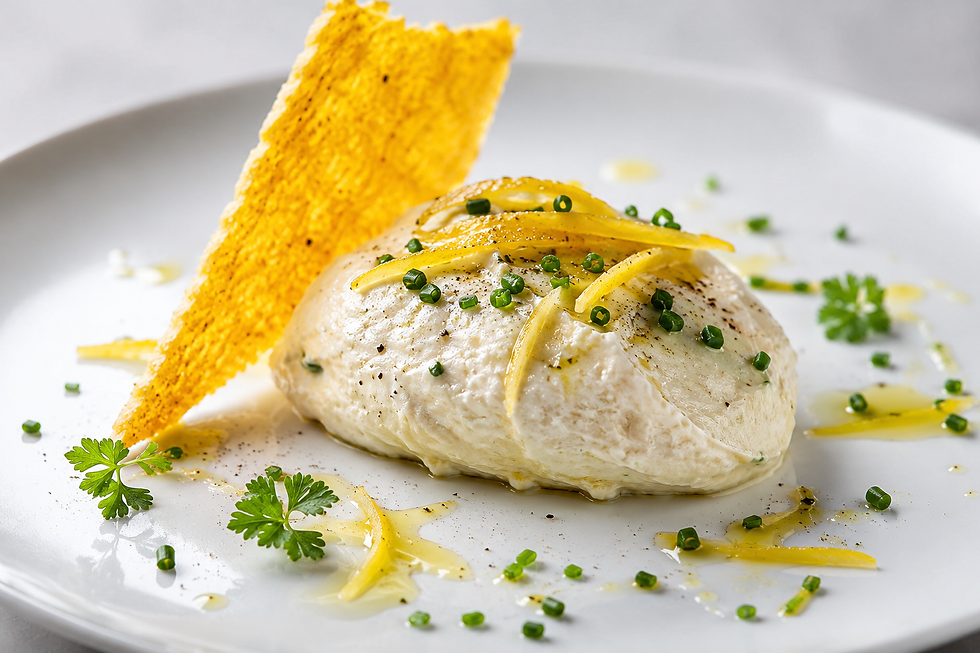
What you should end up with is white, glossy, light enough to hold a soft peak, tasting of fish and good oil in that order. It goes on grilled white polenta and is eaten standing up in a bacaro with a small glass of wine. Below is the classic version as it is made in Venice.
Yield: 6 servings as cicchetti or antipasto. Soaking: 48 to 72 hours. Prep: 40 minutes. Cook: 30 minutes. Rest: 2 hours. Difficulty: intermediate. Course: antipasto or cicchetto. Region: Veneto, Venice and the lagoon.
The Story
The fish reached Venice through a trade route before it reached a Venetian kitchen. When the merchant Pietro Querini was wrecked off Norway in 1432 and wintered on Røst in the Lofoten islands, the account he and two of his officers gave was filed with the Senate, and it is one of the earliest descriptions of Arctic Norway by a southern European. What interested the Republic was not the ethnography but the commodity: a fish that kept for years without salt, at a time when salt was expensive and controlled. Within a few generations stockfish was moving south from Bergen through the Hanseatic network and arriving on the Rialto in quantity.
The name arrived separately from the product, which is the whole source of the confusion. Across the rest of Italy baccalà means cod preserved in salt and stoccafisso means cod dried in air, two different goods at two different prices. Venice and the Veneto call both of them baccalà. The word is foreign, related to the Spanish bacalao and the Portuguese bacalhau and probably reaching the Adriatic through Iberian and Dalmatian traders, and the Veneto attached it to the dried fish it actually bought. So baccalà mantecato is made with stoccafisso, and a cook who buys salt cod for it has already lost the dish.
The preparation belongs to the bacari, the small standing wine bars of the city, where it is served as a cicchetto on a disc of grilled white polenta and eaten in two bites with an ombra of wine. Venetians took it seriously enough to found a Confraternita del Baccalà Mantecato in 2001 to codify what may and may not go into it. The verb mantecare is the one used for finishing a risotto: to work a fat into a protein until the two stop being separate things.
Ingredients
For the stockfish
Dried stockfish, stoccafisso, ragno or Westre Ragno grade, 1 lb (450 g) dry weight
Cold water for soaking, several changes over 2 to 3 days
Water for poaching, 8 cups (1.9 l)
Bay leaf, 1
Black peppercorns, 6
For the mantecatura
Mild extra virgin olive oil, Garda or Ligurian, 1 cup (240 ml)
Fine sea salt, 1 tsp (6 g), adjusted at the end
Freshly ground white pepper, to taste
Garlic clove, whole, 1, optional and removed before serving
For the white polenta crostini
White polenta, bramata bianca, 1 cup (170 g)
Water, 4 cups (950 ml)
Fine sea salt, 1 1/2 tsp (9 g)
Extra virgin olive oil, for the grill, 1 tbsp (15 ml)
For finishing
Flat leaf parsley, very finely chopped, 1 tbsp (3 g), optional
Extra virgin olive oil, a few drops per portion
Freshly ground black pepper, to taste
Preparation
Step 1: Soaking the stockfish
If the stockfish is still board hard, beat it with a rolling pin to break the fibres before it goes into water. Cut it into pieces that fit a large container, cover generously with cold water and refrigerate. Change the water every 8 to 12 hours for 48 to 72 hours, depending on thickness. The fish is ready when it is pliable, swollen to roughly three times its dry weight and pale rather than amber. This step cannot be shortened with warm water, which softens the surface while the core stays hard.
Step 2: Poaching
Drain the fish and put it in a wide pan with the fresh cold water, the bay leaf and the peppercorns. Bring it slowly to about 175°F (80°C), where the surface barely shivers, and hold it 20 to 25 minutes. Never let it boil: a boil hardens the muscle fibres and the mantecatura will never take afterwards. Take the pan off the heat and leave the fish in its water 10 minutes. Lift it out and reserve about 1 cup (240 ml) of the poaching liquid.
Step 3: Cleaning while warm
Clean the fish while it is still hot enough to be uncomfortable, because cooling sets the skin against the flesh and makes the job slower. Peel off the skin, pull out the backbone and run your fingers along every piece to find the fine pin bones, which are numerous in stockfish. Discard the dark line of flesh along the spine. What is left should be clean white flakes: 1 lb (450 g) of dry stockfish gives roughly 1 lb 5 oz (600 g) cleaned.
Step 4: The mantecatura
Put the warm flakes in a stand mixer with the paddle, or in a wide bowl with a sturdy wooden spoon, and work them at low speed until they break into threads. Now add the olive oil in a thin steady stream, exactly as for mayonnaise, never faster than the mixture can absorb. As the emulsion forms the colour lightens from beige to white and the volume increases visibly. If it looks tight or oily, add a spoonful of the warm poaching liquid and keep working.
Step 5: Seasoning and resting
Stop when the mixture holds a soft peak and the surface is glossy rather than wet. Total working time is 12 to 15 minutes by machine and longer by hand. Season with the salt and white pepper, taste and correct. If you used the garlic clove, rub it around the bowl earlier and remove it now. Cover and rest the mantecato at cool room temperature at least 2 hours, which lets the salt distribute and the texture settle. Never serve it straight from the refrigerator.
Step 6: White polenta and crostini
Bring the water to a boil with the salt, rain in the white polenta while whisking, and cook at a bare simmer for 40 minutes, stirring often. White polenta is the Venetian one, milder and finer than the yellow. Pour it about 1/2 inch (1.5 cm) thick onto an oiled tray and let it set completely, at least 2 hours. Cut it into discs, brush lightly with oil and grill on a hot ridged pan until marked and crisp outside while still soft within.
Plating
This is finger food before it is a plated dish, and it looks best when it is not overworked. Grill the polenta at the last moment and let it sit a minute so the surface dries, then spoon or pipe the mantecato on top in a soft quenelle. Do not spread it flat. The point of all that emulsifying was the volume, and pressing it down gives that volume away.
For a plated antipasto, set three crostini on a room temperature plate at different angles, finish each with two drops of good olive oil and a turn of black pepper, and add the parsley only if you want it. Serve the mantecato at cool room temperature, never chilled, because cold flattens both the fish and the oil. Nothing acidic goes on the plate: no lemon wedge, no vinegar, no capers.
Professional Technique
The mantecatura is an emulsion, and knowing which one explains every rule around it. Oil is being dispersed into water held inside the fish, and the emulsifier is the fish protein itself, principally the myofibrillar proteins that the poaching has partly denatured and the beating unwinds into strands. Those strands coat the oil droplets and stop them coalescing. It is the mechanism of mayonnaise, with fish protein doing the work of egg yolk lecithin, and it fails in the same ways: too much oil too fast, or too little water.
Temperature is the second control and it is why the fish is worked warm. Around 120 to 140°F (50 to 60°C) the protein strands are mobile and the oil stays fluid, so the emulsion forms readily. Cold flakes give a dense paste that never lightens, and boiled fish has contracted fibres that will not unwind at all. If the mixture breaks and turns oily it is recoverable: keep beating and add warm poaching liquid a spoonful at a time, as you would rescue a split sauce.
Texture and Moisture Control
The target texture is aerated and spreadable, holding a soft peak without slumping, with the fish still perceptible as fibre rather than reduced to a purée. Two things push it off target. Overworking past the point where the emulsion is complete breaks the fibres into a pasty mass, and it happens quickly once the oil is in, so stop when the peak holds. Underworking leaves flakes swimming in oil that has not been taken up, which looks wet and tastes greasy.
Moisture comes almost entirely from the reserved poaching liquid, and it is the tool for every correction. A mixture that is stiff, dull or oily wants liquid, not more oil. Add it warm, a tablespoon at a time, with the machine running. The mantecato firms as it rests and again in the refrigerator, so leave it slightly softer than you want it on the plate. Olive oil begins to solidify below about 45°F (7°C), which is also why it is served cool rather than cold.
Professional Mise en Place
The long part of this recipe is unattended. Once the soaking schedule is running, the active work is two short sessions.
Equipment and tools
Large non reactive container for soaking, with room for the fish to swell
Stand mixer with paddle, or a wide bowl and a heavy wooden spoon
Wide shallow pan for poaching, plus a thermometer
Tray for setting the polenta and a ridged grill pan
Piping bag with a plain tip if you want a neat quenelle
Prepared ahead
Stockfish soaked 2 to 3 days with the water changed every 8 to 12 hours
Polenta cooked and set on its tray, up to 2 days ahead, refrigerated
Mantecato made 1 day ahead, which improves it, and brought back to room temperature
Poaching liquid reserved and kept, since it is the only correction available
Parsley chopped only at the moment of serving
Service setup
Mantecato out of the refrigerator 1 hour before service, covered
Polenta cut into discs and ready beside the grill pan
Grill pan hot, oiled lightly, crostini grilled to order
Finishing oil and pepper mill within reach
Plates at room temperature, never warmed
Chef Tips
Buy the grade, not just the fish. Stockfish is sorted commercially, and the ragno grades are the thick prime loins that give the long white fibres this dish depends on. Thin low grade fish soaks unevenly, carries more bone and gives a greyer, coarser result no technique can fix.
Use a mild olive oil. A cup of it goes into this and an aggressive peppery Tuscan oil takes over completely, leaving a bitterness that fights the fish. The oils of Lake Garda and the Ligurian coast are the traditional choice for that reason: delicate, slightly sweet and low in polyphenol bite. Keep the assertive oil for the drops on top.
Keep the poaching water. It is the single most useful thing on the bench during the mantecatura, and once it is down the drain there is no substitute for it. Warm it gently before adding, because cold liquid dropped into a warm emulsion can shock it into splitting.
Make it a day ahead. The mantecato is better on the second day, when the salt has distributed evenly and the fish and oil have settled into one flavour rather than two. Take it out of the refrigerator a full hour before serving and beat it briefly by hand to loosen it.
Common Mistakes
Using salt cod instead of stockfish. The commonest error, encouraged by the Venetian name. Salt cod has been cured in brine, has shorter fibres and a different flavour, and it will not whip to the same white volume. Buy stoccafisso, which is dried without salt, and plan the soaking days in advance.
Boiling the fish. A boil contracts and toughens the muscle fibres, and fibres that have contracted will not unwind into the strands the emulsion needs. Hold the poach at about 175°F (80°C) with the surface barely moving, for 20 to 25 minutes and no longer.
Adding the oil too fast. This is a mayonnaise, and pouring the oil in splits it exactly as it would there. A thin steady stream, never faster than the mixture takes it up, and warm poaching liquid whenever it looks tight.
Adding milk, cream, potato or butter. All four appear in versions sold outside Venice and all four are shortcuts around a failed emulsion. They turn a fish preparation into a dairy one and mask precisely the flavour the dish is built on. Fish, oil, salt, pepper, and nothing else.
Working the fish cold. Cold flakes give a dense paste that never lightens, because the protein strands stay rigid and the oil will not disperse. Clean and whip the fish while it is still warm from the poach.
Wine Pairing
Collio Friulano DOC: The north eastern white with the most useful shape for this dish. It has real weight on the palate without oak, so it meets a cup of emulsified olive oil rather than being swallowed by it, and its signature bitter almond finish answers the faint bitterness of good oil directly. Serve it at 50°F (10°C), cool enough to keep the palate moving between bites.
Trento DOC: Mountain metodo classico, and the bubbles are doing mechanical work here: carbon dioxide and high acidity together scrub emulsified fat off the tongue in a way a still wine cannot. The autolytic bread and brioche note from the lees sits naturally beside grilled polenta. Choose a brut rather than an extra dry, since residual sugar is the one thing this plate does not want.
Verdicchio dei Castelli di Jesi Classico Riserva DOCG: The riserva bottlings have the body to stand against a rich spread and a saline, almost briny length that pushes the pairing back towards the sea. Verdicchio also finishes bitter almond, which is why it works with anything built on olive oil, and a few years of bottle age gives it a waxy texture close to that of the mantecato itself.
Erbaluce di Caluso DOCG: The leanest and sharpest choice on the list, from northern Piedmont, and the one to pour if your mantecato has come out particularly rich. Very high acidity, low alcohol, green apple and a stony finish: it does nothing except cut, which is sometimes exactly the job. It also handles the white pepper without amplifying it.
Offida Pecorino DOCG: More aromatic than the others, with anise, white flowers and a herbal edge, and a firm structure that comes from naturally high acidity rather than from oak. That herbal lift is the reason to choose it when you have finished the crostini with parsley, and there is enough body underneath to carry the oil without the wine thinning out.
Storage & Reheating
The mantecato keeps in an airtight container in the refrigerator up to 3 days, with the surface levelled and a thin film of olive oil poured over it to seal out air. It firms considerably when cold, so take it out a full hour before serving and beat it briefly with a spoon, adding a little warm water if it has gone stiff. Never soften it with heat, which splits the emulsion immediately.
Do not freeze it. The emulsion breaks on thawing and cannot be brought back, leaving oily liquid and dry fibres. Soaked but uncooked stockfish freezes well for up to 1 month once drained and patted dry, which keeps the three day soak off the critical path. Set polenta keeps refrigerated 2 days, tightly wrapped, and should be cut and grilled from cold to order rather than held.
Nutrition
Per serving, based on 6 servings with three polenta crostini each:
Calories: 470 kcal
Total Fat: 34 g
Saturated Fat: 5 g
Trans Fat: 0 g
Unsaturated Fat: 28 g
Cholesterol: 55 mg
Sodium: 620 mg
Total Carbohydrates: 21 g
Fiber: 1 g
Total Sugars: 0 g
Added Sugars: 0 g
Protein: 24 g
Lactose: 0 g
Principal micronutrients: iodine, selenium, phosphorus, vitamin B12, vitamin D, vitamin E, niacin
These figures are estimates. Sodium depends on the soaking and on the salt in the polenta, and the fat figure moves with how much oil the emulsion finally takes up.




Comments