
Italian Roasted Pepper Stuffed with Whipped Salt Cod | Peperone Arrosto Ripieno di Baccalà Mantecato

This is a dish with two addresses. The filling belongs to Venice, where salt cod is beaten with olive oil until it becomes a pale spoonable cream. The vessel belongs to the south, where sweet peppers are charred over flame in August and stuffed with whatever the kitchen has. Put one inside the other and neither loses anything: the pepper gives the cream a smoky wall, the cream gives the pepper richness.
Two techniques carry the plate. The first is roasting the pepper and peeling it hot inside a sealed container, so it steams itself and the skin lifts away in sheets. The second is the mantecatura, beating poached salt cod with olive oil added in a thin stream until it emulsifies and turns white. That emulsion is fragile: it breaks if the oil goes in fast and it breaks if the bowl gets too warm.
Everything else is restraint. No cheese, no tomato, no lid of breadcrumbs. A reduction of the roasting juices, a spoon of toasted crumbs, and the pepper warmed only enough to bring the filling back to blood temperature. What reaches the table is soft, smoky, saline and sweet.
Yield: 4 servings, one stuffed pepper each. Soaking: 48 to 72 hours. Prep: 50 minutes. Cook: 45 minutes. Difficulty: advanced. Course: secondo or antipasto. Region: Veneto and the south.
The Story
The pepper came late to Italy and settled in the south. Arriving from the Americas in the sixteenth century, it found in Campania, Basilicata and Calabria the long dry summer and volcanic soil it wanted, and became the vegetable of the August glut. Peppers were roasted on the coals, peeled hot and packed under oil for winter. Stuffing them takes that economy one step further: a peeled roasted pepper is a ready made container.
Baccala mantecato travelled the other way. Salt cod entered the Veneto through the port of Venice and stayed, and the technique is northern in character, a long beating of poached fish with oil closer to whipped butter than to anything southern. The verb mantecare is the one Venetian cooks use for finishing risotto, and it means here what it means there: working fat into something until the texture changes completely.
The two met properly in the last thirty years, when cooks raised in southern families and trained in northern kitchens stopped treating the regions as sealed compartments. It is not fusion, because both halves are Italian and both are made the traditional way. It is a contemporary reading of an old habit: the south has always stuffed the vegetable it had most of, and the Veneto has always had a fish cream in need of something to be served in.
Ingredients
For the peppers
Red bell peppers, large, square shouldered, 4 (about 2 lb, 900 g)
Extra virgin olive oil, 2 tbsp (30 ml)
Fine sea salt, 1/2 tsp (3 g)
For the salt cod
Salt cod fillet, thick centre cut, 1 1/4 lb (570 g) before soaking
Whole milk, 2 cups (480 ml)
Water, 2 cups (480 ml)
Garlic cloves, peeled, 2
Bay leaf, 1
Black peppercorns, 6
For the mantecatura
Extra virgin olive oil, mild and fruity, 1 cup (240 ml)
Garlic clove, very small, 1
Reserved warm poaching milk, 3 to 5 tbsp (45 to 75 ml)
Flat leaf parsley, finely chopped, 1 tbsp (4 g)
Freshly ground white pepper, to taste
Fine sea salt, only if needed
For the pepper reduction
Reserved pepper roasting juices, about 1/3 cup (80 ml)
Aged red wine vinegar, 1 tsp (5 ml)
Extra virgin olive oil, 1 tsp (5 ml)
For finishing
Coarse dry breadcrumbs, 3 tbsp (25 g)
Extra virgin olive oil, for the crumbs, 1 tbsp (15 ml)
Chives, finely sliced, 1 tsp
Finely grated lemon zest, from 1/2 lemon
Freshly ground black pepper, to taste
Preparation
Soaking the salt cod
Rinse the surface salt off under cold water, then submerge the fillet in cold water and refrigerate 48 to 72 hours, changing the water four times a day. A thick centre cut needs the full three days. Judge it by tasting a sliver of the raw flesh: it should be pleasantly seasoned, not salty, and warm water is no shortcut.
Charring the peppers over direct heat
Rub the whole peppers with the olive oil and set them over a high gas flame, under a broiler at its closest setting, or on a grill over live coals. Turn them with tongs every couple of minutes until the skin is blistered and black in large patches on every face, shoulders and base included, which takes 12 to 15 minutes. The skin should be destroyed and the flesh beneath cooked but still holding shape.
Peeling them hot in a closed container
This step decides the dish. The instant the peppers leave the heat, drop them into a bowl, seal it tight with a lid or a plate and leave them 15 minutes, so they steam in their own heat. Peel them while still warm over a second bowl to catch the juice, pulling the skin away with your fingers. Never rinse a roasted pepper under the tap: the water takes the smoke and the sweetness with it.
Opening the peppers into cups
Cut a lid off the stem end of each pepper and reserve it, or split a flat sided pepper lengthwise into one wide boat. Lift out the seed core and brush away stray seeds with a dry pastry brush, not water. Set the peppers cut side down on a rack for 10 minutes so the last interior liquid drains, and add it to the reserved juices. A pepper filled wet will slacken the emulsion on the plate.
Poaching the cod in milk and water
Drain the soaked cod, cut it into pieces of even thickness and put it in a pan with the milk, water, garlic, bay leaf and peppercorns. Bring it very slowly to 175°F (80°C) and hold it there 10 to 12 minutes, until the flesh flakes under light pressure. Never let it boil: boiled salt cod turns stringy and loses the gelatin the emulsion needs. Lift the fish out, pull off skin and bones while hot, and strain the liquid into a small pan to keep warm.
Mantecare the cod with oil in a thin stream
Work while the fish is hot, around 140°F (60°C), because warm protein accepts oil and cold protein refuses it. Put the flakes and the small garlic clove in a sturdy bowl or a stand mixer with the paddle. Break the fish down first with no oil at all, until it is a coarse pale mass. Then start the oil, a few drops at a time and never faster than a thin thread, beating without stopping. The mixture thickens, lightens and at some point turns from grey to white. That change is the emulsion forming.
Holding the emulsion together
Keep the mixture between about 100°F and 115°F (38°C and 46°C): colder and the oil sits in pools, above roughly 120°F (49°C) the emulsion loosens and releases it. If it tightens into a stiff paste, loosen it with a spoon of warm poaching milk, never with more oil. If it breaks, put two spoons of intact emulsion in a clean warm bowl and beat the broken mixture back into it a spoonful at a time. Finish with parsley, white pepper and salt only if tasting asks for it.
Reducing the juices, filling and warming through
Simmer the reserved pepper juices until syrupy and reduced by two thirds, then off the heat stir in the vinegar and the oil. Toast the breadcrumbs in their tablespoon of oil until gold and crisp, and drain them on paper. Fill the peppers generously with the mantecato, spooned or piped, and give them 6 to 8 minutes in a 300°F (150°C) oven, no hotter and no longer. Hot enough to steam the pepper is hot enough to break the cream.
Plating
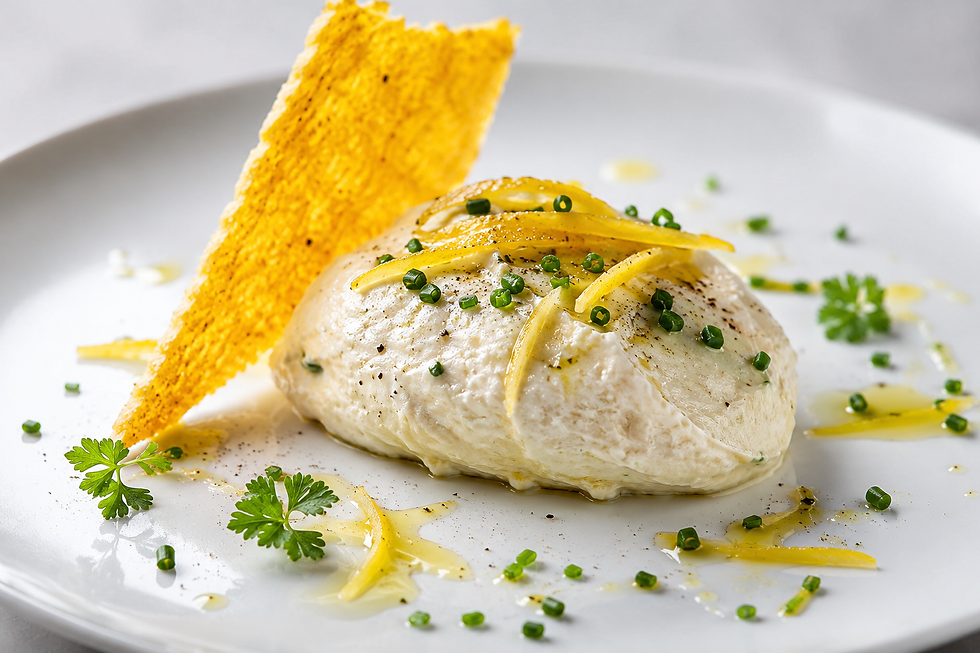
Use a wide plate at room temperature, never a warmed one, since a hot plate goes on cooking the emulsion. Set one filled pepper slightly off centre, upright or lying open, and lean the reserved lid against it at an angle.
Draw the reduction around the pepper as a broken line or three dots, never over the filling, where its acidity would cut across the first mouthful instead of arriving behind it. Scatter the toasted crumbs beside the pepper rather than on top, so they stay dry and audible. Finish with the chives, lemon zest grated directly over the pepper and a turn of black pepper, and serve at once.
Professional Technique
The peeling is a steam technique disguised as a rest. A pepper off live flame holds enough internal heat to make its own steam for several minutes, and in a sealed container that steam is forced back against the skin, collapsing the cells that join cuticle to flesh. The skin then lifts in sheets. Open the bowl early and the steam escapes before it has done the work. The rule is heat in, air out, no water.
The mantecatura is a protein stabilised emulsion, not a mayonnaise. What holds the oil in suspension is the fish itself: muscle protein and the gelatin released during poaching, which is why the poach stays below a simmer and why the dry beating comes before any oil. The limit on how fast oil can go in is how fast that protein can coat new droplets, which is why a thread works and a splash does not.
Temperature is the third mechanism and the least forgiving, because this emulsion is stable only across a narrow band. Above roughly 120°F (49°C) the proteins tighten, release their grip and the mixture breaks in seconds. Every later decision follows: a 300°F (150°C) oven, an eight minute limit, a room temperature plate.
Texture and Moisture Control
Three textures have to arrive intact and each fails in its own way. The pepper must be soft but still structural, so it is fully roasted and then drained, because the flesh holds more water than it seems to. The filling must be smooth and spoonable, set with warm milk rather than extra oil, and the crumbs must be brittle, which is why they touch the plate last.
What ruins an otherwise good plate is free liquid, and it comes from three places: the inside of the pepper, condensation from covering the peppers in the oven, and a reduction stopped too early. So drain the peppers, warm them uncovered, and reduce the juices until they coat a spoon.
Serve warm rather than hot. The right temperature for the filling is close to 100°F (38°C), cooler than most kitchens would send it. There the olive oil smells of fruit rather than of heat, the sweetness of the pepper is readable, and the cream still moves under a spoon.
Professional Mise en Place
The soaking dominates the timeline and the emulsion dominates the service, so plan backwards from both. Only the warming and the plating happen to order.
Equipment and tools
Gas burner, broiler or grill for the peppers, plus long tongs
Bowl with a tight lid, or a lidded container, for steaming the peppers
Stand mixer with paddle, or a sturdy bowl and a wooden spoon
Instant read thermometer, for the poach and for the emulsion
Small saucepan for the reduction and a piping bag with a plain tip
Prepared ahead
Salt cod soaked 48 to 72 hours, drained and kept cold
Peppers roasted, peeled and drained, refrigerated up to 1 day
Pepper juices reduced, up to 2 days at cool room temperature
Breadcrumbs toasted and held in a dry sealed jar, up to 2 days
Poaching liquid strained and reserved for loosening the emulsion
Service setup
Mantecato held at about 100°F (38°C), covered, stirred occasionally
Warm poaching milk within reach for adjusting consistency
Filled peppers on a tray ready for a 300°F (150°C) oven
Reduction, crumbs, chives and lemon lined up at the plating station
Plates at room temperature, never warmed
Chef Tips
Buy the thickest piece of salt cod you can find, from the loin rather than the tail. It soaks evenly, poaches without collapsing and gives flakes with enough gelatin for a stable emulsion. Thin tail pieces desalinate faster but turn to threads in the poach and never quite whiten.
Choose the peppers for shape as much as colour. Big square shouldered fruit with flat sides sit still on a plate and hold a full portion, while long tapering ones are almost impossible to fill evenly. Red only: green peppers are underripe and their grassy bitterness fights the cod.
Use a mild fruity oil for the mantecatura and save the assertive peppery bottle for the finishing drops. A grassy high polyphenol oil beaten in by the cup bullies the fish.
Warm the mixing bowl with hot water and dry it before you start, and the emulsion comes together faster. If the kitchen is cold, set the bowl over a pan of water at 110°F (43°C) while you work, with the thermometer in the fish, not the water.
Common Mistakes
Rinsing the roasted peppers under water. The quickest way to throw away everything the roasting created, since the smoke sits on the surface of the flesh. Peel with dry fingers over a bowl.
Adding the oil too fast. The commonest cause of a broken mantecato. A splash arrives faster than the exposed protein can coat it, so the droplets coalesce and the oil separates. A thin thread, without stopping the beating.
Letting the mixture get hot. Above about 120°F (49°C) the emulsion splits, which is why the filled peppers go into a moderate oven and the plates stay at room temperature.
Boiling the cod instead of poaching it. A rolling boil tightens the fibres into threads and drives off the gelatin the emulsion needs. Hold the liquid at 175°F (80°C) and no higher.
Cutting the soaking short. Two days is not enough for a thick loin. The centre stays salty and no amount of oil or milk dilutes it back. Taste the raw flesh before you commit.
Wine Pairing
Offida Pecorino DOCG: Pecorino from the Marche hills carries unusual weight for a white with this much acidity, and both matter: the acidity cuts a cup of emulsified olive oil, the body stands up to it. Its herbal saline finish picks up the salt still in the cod.
Etna Bianco DOC: Carricante grown on volcanic ash gives a smoky mineral undertow, the one flavour here no other wine mirrors: the char left on the pepper by the flame. Acidity is high and fruit restrained, so it frames the filling, and the bitter finish stops the richness settling.
Ribolla Gialla Collio DOC: A textural pairing rather than a cutting one. Ribolla from the Collio has a phenolic grip and faint tannic edge to push against a fatty fish cream, and its aromatics run to pear skin and white flowers. Pour it around 54°F (12°C), warmer than usual.
Greco di Tufo DOCG: The southern voice, from Irpinia, and the bottle that answers the pepper half of the dish. Greco is broad and slightly waxy with a bitter almond close: that breadth handles the olive oil, and its stone fruit ripeness sits beside a vegetable roasted until it caramelised.
Bianco di Custoza DOC: The Veneto option, deliberately quiet: a light dry blend with soft acidity and gentle white peach and almond aromatics, the sort of wine poured by the glass where salt cod is eaten standing up. It adds no flavour of its own to a plate already doing several things.
Storage & Reheating
Store the parts, never the assembled dish. Roasted peeled peppers keep 3 days refrigerated under a film of olive oil, and freeze flat for 2 months, though they lose structure on thawing. The reduction keeps 1 week in a sealed jar in the refrigerator. The toasted crumbs keep 2 days in a dry jar and must never go near the refrigerator.
The mantecato keeps 2 days refrigerated in an airtight container, surface filmed with oil so it does not dry, and it sets firm when cold. To bring it back, leave it at room temperature for an hour, then beat it in a warm bowl until smooth, adding a spoon of warm milk if stiff. Never use direct heat or a microwave: both split it past recovery. It cannot be frozen.
A filled pepper is best finished at that meal. If you must keep one, refrigerate it covered for 24 hours and bring it back in a 275°F (135°C) oven for about 12 minutes, accepting a looser filling. Warm to order whenever you can, since this is a five minute job once the parts are ready.
Nutrition
Per serving, based on 4 servings:
Calories: 520 kcal
Total Fat: 36 g
Saturated Fat: 6 g
Trans Fat: 0 g
Unsaturated Fat: 29 g
Cholesterol: 70 mg
Sodium: 890 mg
Total Carbohydrates: 16 g
Fiber: 3 g
Total Sugars: 8 g
Added Sugars: 0 g
Protein: 31 g
Lactose: 1.2 g
Principal micronutrients: vitamin C, vitamin A, vitamin B12, selenium, iodine, phosphorus, potassium
These figures are estimates. Sodium moves most and depends on how thoroughly the salt cod was soaked, since most of the poaching liquid is discarded.


Comments