
Italian Roasted Salt Cod with Smoked Potato Purée, Tuscan Kale and Saffron Sauce | Baccalà Arrosto con Purè Affumicato, Cavolo Nero e Salsa allo Zafferano
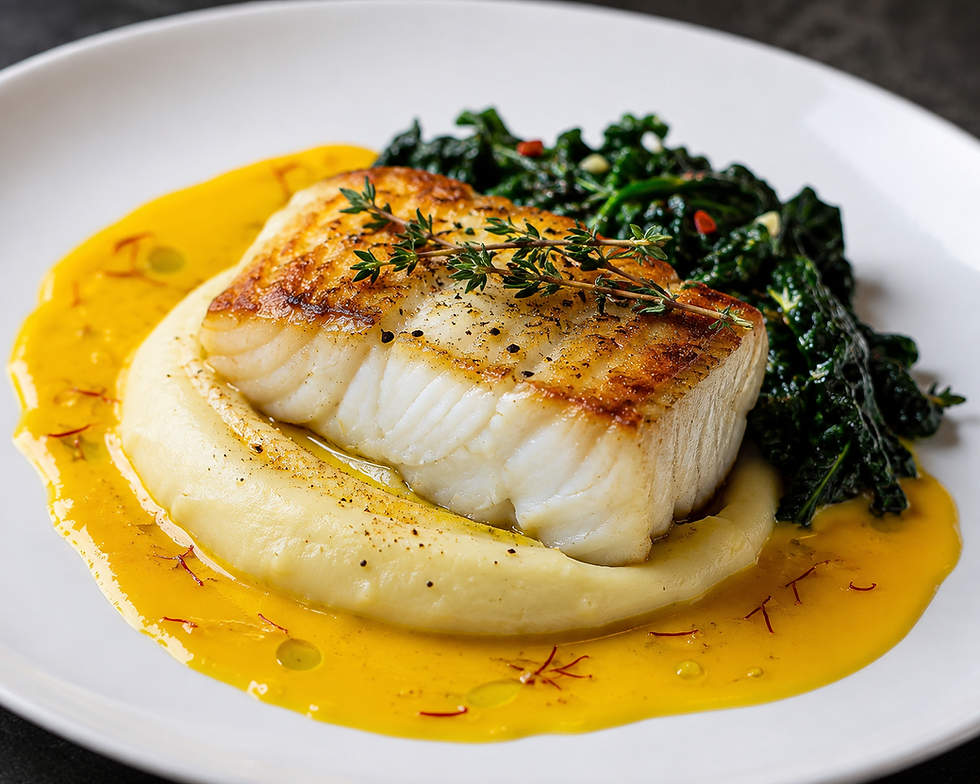
Salt cod is treated here as a prime cut, not as a rustic ingredient boiled soft and buried under tomato. A thick desalted loin roasted slowly in a low oven turns pearly and firm and breaks into wide sheets instead of crumbs. That comes from controlling one number, the temperature at the centre of the fish.
Under the fish sits the part that makes the plate contemporary: a potato purée carrying real smoke. The potatoes are cold smoked raw, so the smoke sits inside the starch rather than on it, and the purée tastes of a wood fire without tasting of ash. Cavolo nero supplies the bitterness that keeps butter and cream from flattening the palate, and a saffron sauce mounted off the heat supplies aroma and colour.
Yield: 4 main course servings. Prep: 45 minutes, plus 24 to 48 hours desalting. Smoking: 30 minutes. Cook: 50 minutes. Difficulty: advanced. Course: secondo di pesce. Region: Tuscany, the inland hills between Florence and San Gimignano.
The Story
Cavolo nero is the plant that anchors this dish to Tuscany. It grows through the cold in the fields of the Chianti and the Mugello, standing in rows like small palms, and frost is not a hazard but the thing that makes it worth eating: cold turns part of its starch to sugar and softens the leaf. Tuscan cooks say the black cabbage is no good before the first frost.
The saffron belongs to the same landscape. San Gimignano has cultivated crocus since the thirteenth century, and for two hundred years saffron was the town's principal export and its working currency: the towers that still rise over the hill were paid for with it. Tuscan saffron has a deeper, more resinous aroma than the Iranian threads that dominate the market. Used properly it is a savoury spice, not a colouring.
What is new here is the treatment rather than the ingredients. Smoking vegetables to give a plate depth without adding meat became standard in Italian restaurant kitchens over the last twenty years, and this purée is a direct product of that shift. So is roasting fish at temperatures that would have seemed absurd to a Tuscan grandmother. The trattoria answer to a salt cod loin was hot fat and a fast crust. The modern answer is slow even heat and a centre that never passes the point where the flakes seize up.
Ingredients
For the salt cod
Thick salt cod loin, centre cut, skin on, 1 3/4 lb (800 g) before desalting
Extra virgin olive oil, 3 tbsp (45 ml)
Garlic clove, lightly crushed, 1
Fresh thyme sprigs, 2
Bay leaf, 1
Freshly ground black pepper, to taste
For the smoked potato purée
Yellow fleshed floury potatoes, 1 1/2 lb (680 g)
Untreated wood chips, apple or beech, 1 cup (60 g)
Whole milk, 3/4 cup (180 ml)
Heavy cream, 1/4 cup (60 ml)
Unsalted butter, cold and cubed, 4 oz (115 g)
Fine sea salt, 1 tsp (6 g)
Freshly grated nutmeg, 1 small pinch
For the cavolo nero
Cavolo nero, Tuscan kale, 10 oz (285 g) on the stem
Extra virgin olive oil, 2 tbsp (30 ml)
Garlic clove, thinly sliced, 1
Dried chilli, small, 1
Fine sea salt, 1/2 tsp (3 g)
For the saffron sauce
Saffron threads, 1 generous pinch, about 0.15 g
Light fish stock, 1 cup (240 ml)
Dry white wine, 1/4 cup (60 ml)
Shallot, finely minced, 1
Unsalted butter, cold and cubed, 2 1/2 oz (70 g)
White wine vinegar, 1 tsp (5 ml)
Fine sea salt, to taste
For finishing
Extra virgin olive oil, a few drops per plate
Finely grated lemon zest, from 1/2 lemon
Flaked sea salt, a small pinch per portion
Preparation
Desalting the loin
Rinse the surface salt off under cold water, then submerge the loin in cold water, skin side up so the salt falls away from the flesh, and refrigerate. Change the water every 6 to 8 hours for 24 to 48 hours depending on thickness and cure. A loin of 1 1/2 inches (4 cm) usually needs 36 hours. Taste a sliver from the thin end before you stop: it should read seasoned, not salty.
Drying and portioning the fish
Lift the loin out, pat it completely dry and leave it uncovered on a rack in the refrigerator for 2 hours. A wet surface steams, and steamed salt cod skin turns to rubber instead of parchment. Cut the dried loin into four portions, straight down rather than at an angle, so every piece has the same thickness across its width and all four reach temperature together.
Cold smoking the potatoes
Peel the potatoes, cut them into even 1 inch (2.5 cm) chunks and spread them on a perforated tray. Hold them in cold smoke from a smoking gun or a stovetop smoker for 25 to 30 minutes, turning once. They must stay raw and cold throughout: smoke penetrates raw starch slowly and evenly, so the flavour ends up inside the purée rather than on it.
Cooking and passing the purée
Put the smoked potatoes in cold salted water, bring to a bare simmer and cook until a knife slides through without resistance, about 20 minutes. Drain and steam dry in the hot pan. Pass them through a ricer while hot, never a blender. Beat cold butter into the hot potato a few cubes at a time, then let the warmed milk and cream down until the purée falls heavily from a spoon. Season with salt and nutmeg.
Blanching and dressing the cavolo nero
Strip the leaves from the thick central ribs with your hands and discard the ribs, which stay woody however long you cook them. Blanch the leaves in heavily salted boiling water for 2 minutes, then drop them into iced water: this fixes the colour and takes the aggressive edge off the raw leaf while leaving the bitterness. Squeeze dry, chop roughly, then toss for 2 minutes in oil warmed with garlic and chilli.
Infusing the saffron and mounting the sauce
Toast the saffron for 20 seconds in a dry pan, crush the threads between your fingers and steep them in 2 tablespoons of warm stock for 15 minutes. Sweat the shallot in a little butter without colour, add the wine and reduce almost to nothing, then add the remaining stock and the infusion and reduce by half. Take the pan off the heat and whisk in the cold butter a cube at a time. Finish with vinegar and salt.
Roasting the salt cod
Heat the oven to 250°F (120°C). Warm the olive oil in an ovenproof pan with the garlic, thyme and bay leaf, lay the portions in skin side down and give them 90 seconds over medium heat, pressing gently so the skin stays flat. Move the pan to the oven and roast 12 to 16 minutes, basting once, until the centre of the thickest piece reads 122°F (50°C). Rest 3 minutes off the heat, where it climbs another two or three degrees.
Plating
Warm the plates. Everything here is served hot and the purée loses its gloss the moment it meets cold porcelain. Wide shallow bowls beat flat plates, because the saffron sauce is loose and runs to the edge of anything without a rim.
Spoon a mound of smoked purée slightly off centre and pull the back of the spoon through it once to make a shallow bed. Pile the cavolo nero beside the purée rather than under the fish, so its bitterness reads separately and its moisture stays out of the potato. Set one portion of baccalà across the join between the two, skin side up, so the crisp surface stays visible and dry.
Spoon the saffron sauce around the base of the purée and over the cavolo nero, never over the skin. Finish with a few drops of raw olive oil on the sauce, grated lemon zest over the fish and a pinch of flaked salt on the skin. Serve at once and serve nothing alongside: this is a composed secondo and it does not want a side dish competing with it.
Professional Technique
The controlling technique is low temperature roasting driven by internal temperature rather than by the clock. Cod protein contracts and expresses water at around 130°F (54°C), the point at which the flakes tighten, gape apart and dry. Pulling at 122°F (50°C) and letting carryover heat finish keeps the fibres relaxed and the moisture in place. A 250°F (120°C) oven raises the centre slowly enough that a probe is useful; in a hot oven that window is under two minutes.
The second technique is cold smoking raw potato. Smoke compounds travel in the vapour phase and bind readily to starch and fat, so a raw, cold, dry starch takes them up evenly while a cooked one mostly carries them on the outside. Smoking before boiling also lets the water pull out the harshest volatile phenols and leave the rounder ones behind, which is why the purée tastes of wood rather than ash. Thirty minutes is the ceiling.
The third is the butter emulsion. Beurre monté holds because the milk proteins and lecithin in butter keep the fat suspended in a little water. Above roughly 190°F (88°C) that suspension breaks and the sauce turns to oil with grains in it. Working off the heat, adding cold butter in small amounts and never letting the pan simmer again keeps it glossy from the first plate to the fourth.
Texture and Moisture Control
Four textures have to reach the table intact: the fish flaking in wide sheets that separate under light pressure but still hold on the fork, the purée dense and slow off a spoon, the cavolo nero tender with the leaf structure still readable, the skin dry and brittle.
Desalting controls moisture more than anything else. Salt cod reabsorbs water as the salt leaves, and a loin soaked too long goes waterlogged and cooks to mush however carefully it is roasted. Stopping while it still tastes seasoned leaves the flesh firm. The two hour dry in the refrigerator then pulls surface water back out, which lets the skin crisp in 90 seconds and stay crisp through the oven.
On the purée side the risk is the opposite. Starch granules swell and hold water during boiling and release it again if worked hard, so a riced potato beaten with cold butter stays smooth while a blended one weeps and turns elastic. Adding butter before dairy matters too: fat coats the starch first and limits what water is absorbed after.
Professional Mise en Place
The desalting runs across two days, so the work is spread out and only the fish and the assembly are done to order.
Equipment and tools
Instant read probe thermometer, the most important tool in this recipe
Smoking gun or stovetop smoker and a perforated tray
Potato ricer or drum sieve, never a blender
Ovenproof sauté pan wide enough for four portions without crowding
Small heavy saucepan for the sauce and a fine mesh sieve
Prepared ahead
Salt cod desalted, dried on a rack and portioned, up to 1 day ahead
Potatoes smoked and refrigerated raw, up to 1 day ahead
Cavolo nero blanched, squeezed and chopped, up to 1 day ahead
Saffron infusion and reduced stock base, up to 1 day ahead
Plates set aside to warm and the probe checked in iced water
Service setup
Purée warm and covered over a low bain marie
Sauce base warm but off the boil, cold butter cubed and within reach
Cavolo nero pan hot and ready for a 2 minute finish
Oven holding steady at 250°F (120°C) with the roasting pan already warm
Lemon zest grated to order, flaked salt and finishing oil at the pass
Chef Tips
Buy the loin, not the tail. Ask for a centre cut piece at least 1 1/4 inches (3 cm) thick with the skin on. Thin tail pieces desalt faster, and a piece of uneven thickness cannot be cooked to one internal temperature.
Taste the desalting water, not only the fish. Water still strongly salty after six hours means a heavy cure and the full 48 hours. Water that tastes almost neutral after the second change means you are close and should test the flesh at once.
Never boil saffron. Steeping the crushed threads in warm liquid extracts crocin and safranal gently, while boiling drives off the aromatics and leaves colour and a metallic bitterness. Reduce the sauce before the saffron goes in, not after.
With no smoker, use a covered roasting tray: lit wood chips in a foil parcel at one end, raw potato chunks on a rack at the other, sealed with foil and left off the heat for 30 minutes.
Common Mistakes
Over desalting the cod. A loin soaked three days tastes of nothing, absorbs water and falls apart in the pan. Taste at 24 hours and again at 36 and stop while it still reads seasoned.
Roasting in a hot oven. At 400°F (200°C) the outside passes 140°F (60°C) long before the centre arrives, so the flakes gape and the fish dries inward. The low oven exists to close that gap.
Smoking the potatoes after cooking them. Cooked potato takes smoke on the surface only and loses it in minutes. Smoke the raw chunks cold, then boil them.
Blending the potatoes. A blade ruptures the swollen granules and frees starch, and the purée turns elastic and glue like. Use a ricer while the potato is hot.
Boiling the sauce after mounting it. The emulsion breaks above roughly 190°F (88°C) and separates into oil and grains. Mount off the heat and hold it warm, not hot.
Wine Pairing
Vernaccia di San Gimignano DOCG: The most exact match here, from the same hill that grows the saffron. Its structure is firmer than most Italian whites and it finishes on a bitter almond note that runs alongside the cavolo nero instead of fighting it. Acidity enough to cut the butter in both purée and sauce, body enough to sit under a thick roasted loin.
Verdicchio dei Castelli di Jesi Classico Riserva DOCG: A riserva has the weight this plate needs and a saline, faintly waxy texture that suits salt cod better than any aromatic white. High acidity handles the cream and butter, while extended lees contact gives a nutty depth reaching towards the smoke. Serve at 54°F (12°C), warmer than a simple white, so the texture opens.
Etna Bianco DOC: Carricante grown on volcanic soil gives a flinty, almost ashy minerality that meets the smoked purée on its own terms rather than contrasting with it. Its acidity stays high even in warm vintages, keeping the palate clean between forkfuls of a rich plate, and the lemon pith character lifts saffron that can otherwise turn heavy.
Franciacorta DOCG: A brut metodo classico is the choice when the crisp skin is the point. Bubbles and bracing acidity scour the fat from the butter emulsion, and the bread and hazelnut of long lees ageing echo both the smoke and the roasted surface of the fish. Choose a low dosage bottling so nothing sweet lands on a plate already carrying saffron.
Chianti Rufina DOCG: For anyone who wants a red with fish, this is the one that works. Rufina sits higher and cooler than the rest of Chianti, so its Sangiovese keeps bright acidity and fine tannin rather than a southern grip. That acidity meets the saffron and the kale directly and the sour cherry fruit stays light enough not to bury the cod.
Storage & Reheating
Roasted salt cod is a dish to eat the day it is cooked. Held overnight the flakes tighten and the skin turns leathery. Cooked portions keep covered in the refrigerator 2 days and come back best in a 200°F (95°C) oven for 8 to 10 minutes, never a microwave. Desalted raw loin keeps on a rack 2 days and freezes for up to 2 months.
The smoked purée keeps refrigerated in an airtight container 3 days and is the one component that improves overnight, because the smoke distributes further through the starch. Rewarm gently over low heat with a splash of hot milk, stirring, and beat in a cube of cold butter to bring the gloss back. Do not freeze it: the starch retrogrades and turns grainy.
The sauce cannot be stored as a finished emulsion. Keep the reduced stock base with the saffron infusion in a sealed jar for up to 3 days and mount it fresh with cold butter each time. Cooked cavolo nero keeps 3 days and reheats well in a hot pan, so it is worth making extra.
Nutrition
Per serving, based on 4 main course portions:
Calories: 640 kcal
Total Fat: 38 g
Saturated Fat: 21 g
Trans Fat: 1 g
Unsaturated Fat: 15 g
Cholesterol: 160 mg
Sodium: 940 mg, highly dependent on how far the cod was desalted
Total Carbohydrates: 33 g
Fiber: 4 g
Total Sugars: 5 g
Added Sugars: 0 g
Protein: 43 g
Lactose: about 5 g
Principal micronutrients: vitamin K 310 mcg, vitamin A 230 mcg, potassium 1,180 mg, selenium 55 mcg, vitamin B12 3.2 mcg, calcium 180 mg
Allergens: fish, milk and sulphites from the wine. All values are estimates and vary with the salt level of the cured loin and the fat content of the dairy.


Comments