
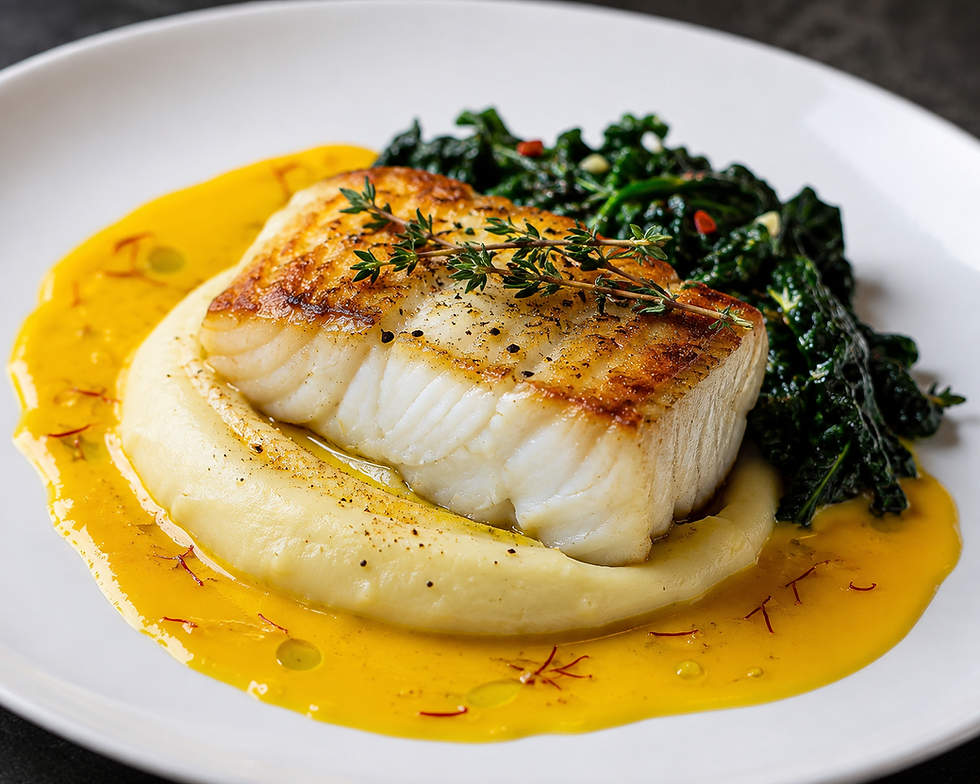
Italian Dentex with Saffron Potato Cream, Artichokes and Vermentino Jus | Dentice con Crema di Patate allo Zafferano e Carciofi

Dentice is the fish the Mediterranean reserves for the table it respects most. It is a solitary predator of rocky ground, lean, firm and pale, and it carries almost no fat to protect it from heat, so every minute it cooks is a minute it can lose. This plate treats it that way: a short sear on the skin, a rest, and a core that never passes 122°F (50°C).
Underneath sits the element that decides whether the dish works, a potato cream coloured and perfumed with saffron. It looks simple and it is the most technical thing on the plate, because potato starch is unforgiving and the wrong tool turns silk into glue in seconds. Around them go artichokes braised until they yield, and a jus of fish bones and dry Vermentino, finished cold so it stays glossy.
Nothing here is decorative. The saffron answers the sweetness of the potato, the artichoke supplies the bitter edge that keeps the cream from cloying, and the jus returns the salinity that such gentle cooking leaves behind.
Yield: 4 main course servings. Prep: 50 minutes. Cook: 45 minutes. Total: about 1 hour 40 minutes. Difficulty: advanced. Course: secondo di pesce. Region: Sardinia and the Mediterranean coast.
The Story
Dentex dentex has been the aristocrat of Mediterranean rock fishing for as long as there are records of it. It grows slowly, hunts alone over reefs and posidonia beds, and has never been farmed at any scale, so a dentice on a fishmonger's slab is almost always a line caught fish from a boat that went out that morning. In Sardinia, Sicily and along the Ligurian coast it fetches close to the price of wild sea bass, and the old rule there is that a fish of this quality is cooked whole, salted, or barely cooked at all.
The saffron is the Sardinian half of the plate. San Gavino Monreale, in the Medio Campidano, has grown Crocus sativus since the Middle Ages, and the harvest is still done the same way: flowers picked before dawn in late October, the three red stigmas pulled from each one by hand the same day, close to two hundred thousand flowers for a kilogram of dried threads. Sardinian cooking uses saffron far more freely than the rest of Italy, in fregola, in malloreddus, in sausage, and it belongs with fish in a way the peninsula has largely forgotten.
The artichoke closes the circle. The spinoso sardo, the thorny violet artichoke of the Sardinian plains, is picked from November through April and is tender enough to eat raw, which is why it survives braising without turning to fibre. The three ingredients together are not a modern invention but a description of what one coastline produces in the same months: the fish at its best in winter, the saffron just dried, the artichokes in the fields.
Ingredients
For the dentex
Dentex fillets, skin on, pin bones out, 4 of 6 oz (170 g) each
Fine sea salt, 1 tsp (6 g)
Extra virgin olive oil, 2 tbsp (30 ml)
Unsalted butter, 1 tbsp (14 g)
Thyme sprigs, 2
White pepper, to taste
For the saffron potato cream
Floury potatoes, russet or Bintje, 1 1/4 lb (570 g)
Coarse sea salt for the baking bed, 2 lb (900 g)
Whole milk, 3/4 cup (180 ml)
Heavy cream, 1/4 cup (60 ml)
Unsalted butter, cold and cubed, 3 oz (85 g)
Saffron threads, 1/4 tsp (0.3 g)
Fine sea salt, 3/4 tsp (5 g)
For the artichokes
Small violet artichokes, spinoso sardo if available, 6
Lemon, halved, 1
Extra virgin olive oil, 3 tbsp (45 ml)
Garlic clove, lightly crushed, 1
Dry white wine, 1/4 cup (60 ml)
Water, 1/2 cup (120 ml)
Fine sea salt, 1/2 tsp (3 g)
For the Vermentino jus
Dentex bones and head, rinsed, gills out, 1 lb (450 g)
Dry Vermentino, 1 1/2 cups (360 ml)
Shallot, thinly sliced, 1
Fennel fronds, 1 small handful
White peppercorns, 6
Unsalted butter, cold and cubed, 1 oz (28 g)
For finishing
Extra virgin olive oil, 2 tsp (10 ml)
Saffron threads, 8, two per plate
Finely grated lemon zest, from 1/2 lemon
Flaky sea salt, 1 pinch per plate
Preparation
Bloom the saffron and bake the potatoes
Warm the milk to about 140°F (60°C), add the saffron and leave it to steep, covered, for at least 30 minutes. Heat the oven to 400°F (205°C). Spread the coarse salt in a roasting tray, set the unpeeled potatoes on it and bake 50 to 60 minutes until a skewer meets no resistance. The salt bed draws moisture out through the skin instead of driving water in.
Pass the potatoes while they are hot
Split each potato the moment it leaves the oven, let the steam escape for 20 seconds, then scoop the flesh and push it straight through a ricer or a drum sieve into a warm saucepan. Work fast. A potato that has fallen below about 150°F (65°C) has begun to set its starch, and no beating recovers it.
Mount the saffron potato cream
Set the pan over the lowest possible heat. Add the cold butter a few cubes at a time, folding rather than whipping, then pour in the saffron milk and the cream in a thin steady thread, stopping when the purée falls slowly from the spatula and closes over itself. Season, cover, and hold over a bain marie at around 150°F (65°C).
Turn and braise the artichokes
Snap off the outer leaves, cut away the top third, pare the stem and scoop any choke, dropping each into water acidulated with the lemon. Quarter them. Warm the oil and garlic in a sauté pan, colour the artichokes cut side down, add the wine and let it evaporate, then the water and salt. Cover and braise 12 to 15 minutes until a knife slides through the base.
Build the Vermentino jus
Sweat the shallot in a dry pan, add the bones, peppercorns and fennel fronds, then the Vermentino. Simmer uncovered, never boiling hard, for 20 minutes, skimming. Strain through a fine mesh sieve, pressing nothing, and reduce until about 1/3 cup (80 ml) remains and it coats a spoon.
Salt and dry the dentex
Season the fillets on both sides and leave them skin up on a rack for 20 minutes. The salt draws a film of moisture to the surface, which you then blot away completely with paper. Score the skin twice, very shallowly, so it cannot contract and curl the fillet.
Sear, rest and check the core
Heat the olive oil in a heavy pan until it shimmers. Lay the fillets in skin side down, press each one flat with a spatula for 15 seconds, then cook undisturbed 3 to 4 minutes until the skin is crisp and the flesh has gone opaque two thirds of the way up. Add the butter and thyme, baste 30 seconds, turn the fish for 20 seconds only and lift it out. Rest 3 minutes on a warm plate: the core should read 122°F (50°C). Whisk the cold butter into the warm jus off the heat just before plating.
Plating
Use a wide plate warmed to about 120°F (50°C), no hotter. A cold plate pulls the cream below the temperature at which its starch stays supple, and a very hot one carries the fish past the core you worked to hit.
Spoon three generous tablespoons of saffron cream slightly off centre and spread it with the back of the spoon into a single shallow sweep, not a circle. Set the fillet skin side up, partly over the cream and partly on the plate, so the crisp side never touches anything wet. Arrange three or four artichoke quarters around it, cut faces towards the diner.
Spoon the jus around the fish and over the artichokes, never across the skin. Finish with a few drops of raw olive oil, the lemon zest over the artichokes only, a pinch of flaky salt on the fish, and the saffron threads on the cream. Serve at once.
Professional Technique
The technique that defines this dish is the potato cream, and the first rule is absolute: a potato is never blended. Blades do not divide potato flesh, they burst the cells open. Each intact cell holds a swollen granule of gelatinised starch, and once the wall breaks that starch escapes into the free liquid, hydrates and links into long chains. What you get is not a cream but an elastic glue, and it is irreversible. The only correct tools are a ricer or a drum sieve, which separate the cooked cells and leave the walls intact.
Timing matters as much as the tool. The potato is passed while still hot, because starch is pliable only near its cooking temperature, then mounted by folding in cold fat first and liquid afterwards in a thin stream, so each particle is coated before it meets enough water to turn tacky. Fat before liquid, always.
The choice of potato follows the same logic. A floury variety such as russet or Bintje is high in amylose and low in moisture, and its cells fall apart from one another with almost no working. A waxy yellow fleshed potato is high in amylopectin and holds together, so it must be forced, and forcing releases free starch. Heat must never fall either: as cooked starch cools it retrogrades, the amylose chains realign and expel water, and a cream that was silk at 150°F (65°C) turns rubbery at room temperature. Hence the bain marie, never a flame, which scorches the base and breaks the emulsion.
The fish asks for the opposite kind of attention: almost none. Dentex is a lean rocky coast predator with very little intramuscular fat, so it has no reserve to lose. Cook it briefly, mostly from the skin side, and pull it at 122°F (50°C), where the flesh is set, pearly and still translucent at the centre.
Texture and Moisture Control
The skin is the only crisp thing on the plate and it is won in the first minute. A dry surface, a hot pan and constant contact are all it needs: pressing the fillet flat for 15 seconds keeps the whole skin against the metal while the proteins set, so the Maillard reaction runs across the entire surface rather than in patches. After that the fish is left alone, because every lift to inspect it cools the skin and softens it.
Inside the fillet, carryover does the last few degrees. Pulled at roughly 115°F (46°C) the fish climbs to 122°F (50°C) during a three minute rest, and that rest lets the fibres relax and reabsorb the juice the heat pushed to the centre. Cut it straight from the pan and that juice runs onto the plate.
The artichokes and the jus control the wetness of the plate. Braised under a lid they finish tender but saturated, so lift them out and drain them while their liquid reduces. The jus, thickened only by cold butter whisked in away from the flame, holds its gloss a few minutes and then splits, so it is finished last and poured at once.
Professional Mise en Place
This plate has a window of about four minutes. Everything but the searing and the final butter is done in advance, and the cream has to be nursed through service.
Equipment and tools
Potato ricer or drum sieve, the only acceptable tools for the cream
Roasting tray for the salt bed, heavy steel pan for the fish
Small saucepan with a lid over a bain marie
Fine mesh conical sieve for the jus
Probe thermometer, fish spatula, offset spatula
Prepared ahead
Saffron steeped in warm milk, up to 1 day ahead
Jus reduced and strained, 1 day ahead, butter not yet added
Artichokes turned, braised and drained, on the day
Fillets salted, blotted and scored, 1 hour ahead on a rack
Potatoes baked and the cream mounted within 45 minutes of service
Service setup
Cream over a bain marie at 150°F (65°C), covered, loosened with warm milk
Jus warm in a small pan, cold butter cubes in a bowl beside it
Artichokes warming gently in their reduced liquid
Plates at about 120°F (50°C), never straight from a hot cupboard
Olive oil, lemon zest, flaky salt and saffron threads within reach
Chef Tips
Buy the whole fish, have it filleted in front of you and take the bones home. A 3 lb (1.35 kg) dentex gives four portions and all the frame the jus needs, and that frame is why the plate tastes of this fish and not of fish in general.
Steep the saffron, never sprinkle it. Colour and aroma live in water soluble compounds that need 30 minutes in warm liquid, and threads dropped into a finished cream stay hard and taste of almost nothing.
Keep a jug of warm milk beside the cream through service. The purée tightens as it stands even over a bain marie, and a spoonful folded in brings it back. Cold milk drops the temperature and sets the starch.
If dentex is unavailable, pagro, sea bass or a thick corvina fillet behave the same way at the same core temperature. Do not substitute salmon or any oily fish: the fat shifts the balance and the saffron vanishes under it.
Common Mistakes
Blending the potatoes. One pass with a blender ruptures the cells, frees the starch and gives a stretchy paste that thinning, straining and reblending cannot fix. Ricer or drum sieve only, and only while hot.
Boiling the potatoes instead of baking them on salt. Boiled flesh absorbs water that must then be offset by more fat and more working, and the working releases free starch. Bake them in their skins on coarse salt.
Using a waxy yellow fleshed potato. It holds together, so it must be forced through the sieve, and forcing does the same damage as a blade. A floury variety falls apart on its own.
Holding the cream cold or over direct heat. Below about 130°F (55°C) the starch retrogrades and the cream turns gummy and weeps. Over a flame the base scorches and the emulsion breaks. Only a covered bain marie works.
Cooking the dentex to flaking point. Flakes that separate cleanly mean the fish passed 140°F (60°C) and lost its juice. Pull it at 115°F (46°C) and let the rest carry it to 122°F (50°C).
Wine Pairing
Vermentino di Gallura DOCG: The bottle the jus is built from and the natural first choice. Grown on decomposed granite in northern Sardinia, it has a saline bite and a firm citrus acidity that cuts through the butter in the cream, while its bitter almond finish runs alongside the artichoke rather than arguing with it.
Etna Bianco DOC: Carricante from volcanic soil, and the best answer to the artichoke here. Its very high acidity and stony length override the cynarin that makes most wines taste oddly sweet beside artichokes, and the smoky note it gains with a year in bottle finds the caramelised skin.
Offida Pecorino DOCG: Marche Pecorino combines ripe stone fruit, an aniseed and hay aroma and a firmly bitter close. The bitterness meets the artichoke, the aromatic lift echoes the fennel in the jus, and the broad texture stands up to the cream without the wine going soft.
Verdicchio dei Castelli di Jesi Classico Riserva DOCG: The extra year of ageing gives this the weight the plate can use: a saffron friendly note of dried herb and beeswax, real structure for a white, and the bitter almond signature of the grape on the finish. The most generous of these wines, and still acidic enough to keep the dish light.
Grillo Sicilia DOC: Grillo brings citrus peel, a light tropical ripeness and a savoury saline core, which is what a lean fish cooked without acid needs. Its glycerine handles the butter, and its Mediterranean herb character sits naturally beside saffron, a crop the island grows itself.
Storage & Reheating
Cooked dentex should be eaten the day it is seared. Refrigerate leftovers covered for up to 24 hours and eat them cold, flaked over the artichokes with olive oil and lemon. Reheating a fish cooked to 122°F (50°C) can only take it past that point.
The saffron cream keeps refrigerated in an airtight container for 2 days. It sets firm and gummy when cold, which is normal: rewarm it over a bain marie, never over direct heat, folding in warm milk a spoonful at a time until it flows. Do not freeze it, since potato starch separates on thawing.
The jus keeps 3 days refrigerated before the butter goes in, and freezes for 2 months in that state. Whisk in the cold butter only at the moment of serving. Braised artichokes keep 3 days covered in their liquid and are better the next day.
Nutrition
Per serving, based on 4 main course portions:
Calories: 610 kcal
Total Fat: 34 g
Saturated Fat: 17 g
Trans Fat: 0.7 g
Unsaturated Fat: 15 g
Cholesterol: 135 mg
Sodium: 590 mg
Total Carbohydrates: 33 g
Fiber: 6 g
Total Sugars: 5 g
Added Sugars: 0 g
Protein: 40 g
Lactose: 3.5 g
Principal micronutrients: iodine, selenium, potassium, vitamin B12, folate, phosphorus, magnesium
These figures are estimates. None of the coarse salt from the baking bed reaches the plate, and the sodium depends mostly on how far the jus is reduced.




Comments