
Mediterranean Turbot with Saffron Mussels and Artichokes | Rombo Mediterraneo con Cozze allo Zafferano, Carciofi Croccanti e Finocchietto

Turbot is the fish Italian cooks are most afraid of wasting, and that fear is the right instinct. It gives no second chance: overcook it and the gelatin that makes it extraordinary drains out, leaving a dry plank.
The saffron and mussel velouté does the protecting. Mussels are steamed open on their own, their liquor is filtered twice and reduced with a light fumet, and the saffron goes in as a warm infusion rather than a boiled pinch. The sauce is finished with cold butter, passed through a sieve and held warm. Artichokes are fried separately so they stay brittle, and raw wild fennel goes on at the last second.
This is not a dish from anyone's grandmother. It is cucina di ricerca, four ingredients of the same Italian spring assembled on a technical argument rather than a tradition, and saying so beats inventing a heritage for it.
Yield: 4 servings. Prep: 45 minutes. Cook: 40 minutes. Total: about 1 hour 25 minutes. Difficulty: advanced. Course: secondo. Style: contemporary Italian research cooking.
The Story
Italian has two names where English mostly has one, and the difference matters at the counter. Rombo chiodato is Scophthalmus maximus, the true turbot, scaleless, with hard bony tubercles across the dark side that give it its name, the nailed rombo. Rombo liscio is Scophthalmus rhombus, brill, smoother, thinner and cheaper. Brill is a good fish. Turbot is a better one: thicker flesh, more gelatin, more resistance to heat.
Both live on the sandy bottoms of the Adriatic and the Tyrrhenian, half buried with only their eyes clear of the sediment, which is why they reach the market almost entirely through trawling. The Adriatic is the Italian turbot ground, and Venice, Chioggia and Ancona have sold it for centuries. That origin is also why turbot often arrives bruised: dragged in a net under other fish it marks easily, and a bruised turbot loses the firmness that justifies its price.
On Italian tables turbot has always been a luxury: the fish of Lenten banquets and of the grand hotel dining rooms of the Adriatic riviera. It is rarely cooked at home, and not only for the price, since it is a big flat animal that does not fit a domestic pan. The artichoke comes from the Roman and Sardinian spring, when the mammole and the spinosi arrive, and wild fennel grows free along every track in the macchia. Together they taste convincingly Italian, and the dish is still a modern invention.
Ingredients
For the turbot
Whole turbot, rombo chiodato, 3 1/2 lb (1.6 kg), or 4 fillets of 5 oz (140 g)
Extra virgin olive oil, 2 tbsp (30 ml)
Unsalted butter, 1 tbsp (14 g)
Fine sea salt, 1/2 tsp (3 g)
Freshly ground white pepper, to taste
For the mussels and the saffron velouté
Mussels, cleaned, 2 lb (900 g)
Dry white wine, 1/2 cup (120 ml)
Shallot, finely sliced, 1
Light fish fumet, from the turbot frame, 1 1/2 cups (360 ml)
Saffron threads, 1/4 tsp (0.2 g), about 40 threads
Unsalted butter, cold, cubed, 3 oz (85 g)
All purpose flour, 1 tsp (3 g), optional
Heavy cream, 2 tbsp (30 ml)
Lemon juice, a few drops
For the crispy artichokes
Young artichokes, mammole or spinosi, 4
Lemon, halved, 1
Peanut oil, for frying, 4 cups (950 ml)
Fine sea salt, to taste
For finishing
Wild fennel fronds, finocchietto selvatico, 1/4 cup loosely packed
Extra virgin olive oil, a few drops per plate
Flaked sea salt, a very small amount
Preparation
Step 1
Judge the fish before you buy it. A fresh turbot is rigid and lies flat without sagging when lifted by the middle. The dark side should be glossy with clear mucus, the underside white rather than yellowed, the eyes domed and black, the gills bright red, the smell nothing but clean seawater. Any sour note, softness or bruising and buy brill instead.
Step 2
Take the four fillets, or keep the fish whole. A flat fish yields four fillets, not two: two broad from the dark upper side, two narrower from the white under side. Run a flexible knife down the central line to the bone, then work outward over the ribs, lifting each fillet clear in one piece. Leave the skin on the dark side fillets, it holds them together and crisps well, and trim the white side skin off. Keep the frame, and if your pan takes it cook the fish whole on the bone.
Step 3
Draw a light fumet. Rinse the bones and head to remove all blood, cover barely with cold water, add a slice of shallot and no salt, and hold at a bare simmer 20 minutes only. Skim, never boil, strain through a fine mesh sieve and reduce to about 1 1/2 cups (360 ml). Cooked longer it turns glue like and bitter, and this sauce needs clarity more than power.
Step 4
Open the mussels on their own and filter the liquor twice. Boil the wine with the shallot, add the mussels, cover, cook over high heat 3 to 4 minutes and lift each shell out as it opens; cooked in the sauce they leach their liquid into it and turn rubbery. Keep 16 plump ones in a spoonful of liquor. Let the liquid settle, pour it off the sediment and pass it through a sieve lined with damp muslin, twice, since one grain of sand ruins a smooth sauce.
Step 5
Infuse the saffron warm, never boil it. Warm 1/4 cup (60 ml) of fumet to about 140°F (60°C) and no hotter, crush the threads between your fingers and leave them 20 minutes. Boiled saffron loses its aroma within a minute and leaves only colour, which is why so many saffron sauces look right and smell of nothing.
Step 6
Build the velouté and sieve it. Reduce the filtered mussel liquor with the remaining fumet by half, until it lightly coats a spoon, then add the cream and the saffron infusion with its threads. Off the boil, whisk in the cold butter a few cubes at a time, holding the sauce between 150°F and 160°F (65°C and 71°C) so the emulsion stays together. If it is still thin, whisk in a teaspoon of flour worked into butter and cook it 2 minutes. Pass it through a fine mesh sieve, correct with lemon and hold it warm without boiling again.
Step 7
Trim the artichokes into acidulated water and fry them at two temperatures. Snap off the outer leaves, pare the stalk back to 1 inch (2.5 cm), halve each artichoke, dig out any choke and drop the pieces into water acidulated with half a lemon. Dry them well. Fry at 285°F (140°C) for 5 to 6 minutes to cook them through without colour, rest them, then take the oil to 375°F (190°C) for 1 minute to blister. Drain on a rack, never on paper, and salt at once.
Step 8
Cook the fish to 126°F to 131°F (52°C to 55°C) and no further. In a pan, lay the fillets skin side down in hot oil, press them flat 20 seconds, cook 3 to 4 minutes until the skin releases, add the butter, turn and baste 1 minute. In the oven, 350°F (175°C) for 8 to 10 minutes on the bone. Steamed, 6 to 7 minutes. Probe the thickest part whichever route you take, pull the fish inside that range and rest it 2 minutes, because it keeps climbing off the heat.
Plating
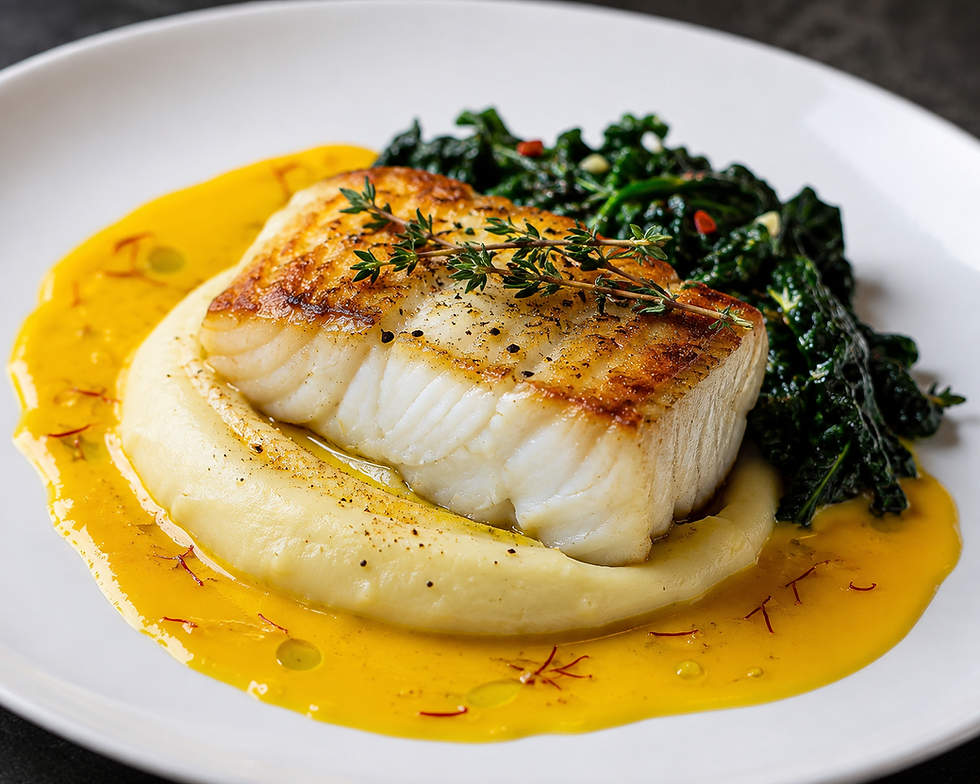
The sauce goes under the fish and never over it. Ladle about 3 tablespoons of warm velouté into the centre of a wide plate and let it settle into a loose pool, then set the turbot on top, skin side up and clear of the sauce: a spoonful poured over the fillet softens the crisp skin within seconds and there is no recovering it.
Arrange four mussels around the fish, resting in the sauce where they belong, and lean two or three artichoke pieces against the fillet, clear of the liquid. Finish with wild fennel fronds over the fish, a few drops of good olive oil on the sauce and a pinch of flaked salt on the artichokes. Serve at once, on plates warm to the palm rather than hot.
Professional Technique
The whole technique of this dish follows from one fact of anatomy: turbot is a flat fish, and a flat fish is built differently from a round one. One eye migrates across the skull in youth, the body falls onto its side and it spends its adult life on the sea floor. That leaves a fish whose musculature runs in four blocks around a central bone rather than two, so a turbot yields four fillets, not two, and those four pieces are not interchangeable.
The flesh itself is the reason turbot commands its price. It is dense and distinctly gelatinous, carrying far more collagen than sea bass or bream, and under heat that collagen converts to gelatin and holds moisture inside the muscle. So turbot takes firmer cooking than a sea bass without breaking up. Where a branzino fillet starts flaking and has to be treated as fragile, a turbot fillet can be pressed flat, given real colour and turned once without falling apart. That tolerance is what lets you crisp the skin properly.
The tolerance is not unlimited, and the third point is the one most cooks miss: the two sides are not the same thickness. The dark upper side carries the thicker, broader fillets, the white under side the thinner ones, and the difference through the middle can be half again as much. Cook them together for the same time and the white side fillets are dry before the dark side ones are done. Portion every fillet to an even thickness and give the thin pieces a shorter turn, or cook the fish whole on the bone, which solves it by itself.
Texture and Moisture Control
Three textures have to reach the table intact and each fails in its own direction. The velouté is a butter emulsion on a reduced mussel and fumet base and it splits once it boils, so it lives between 150°F and 160°F (65°C and 71°C) and nowhere else. Held cooler it sets and dulls; boiled, the butter breaks out and floats.
The saffron behaves like an aromatic rather than a spice, contributing colour and perfume, not body. Crocin, which carries the colour, dissolves readily in warm liquid, while safranal, which carries the smell, is volatile and leaves on the steam. That is the whole case for a warm infusion at about 140°F (60°C) added late: the sauce finishes deep orange and actually smells of saffron.
The mussels and the artichokes are moisture problems. Mussels overcook in seconds, so they are opened separately, pulled the instant the shells part and held in a spoonful of their own liquor rather than in the sauce, which they would thin. The artichokes go the other way: fried twice, gently to cook the flesh through and hot to drive off surface water and blister the leaf edges. Once they touch the velouté they have about a minute, which is why they lean on the fish.
Professional Mise en Place
Everything here is done ahead except the frying and the fish, which are à la minute.
Equipment and tools
Flexible filleting knife, fine mesh conical sieve
Muslin for filtering the mussel liquor
Wide pan for the mussels, deep pan or fryer with a thermometer
Nonstick or well seasoned pan large enough for four fillets
Probe thermometer and a cooling rack
Prepared ahead
Fumet drawn, strained and reduced, up to 1 day ahead
Mussels opened, meat picked, liquor filtered twice, on the day
Saffron infusion made 20 minutes before the sauce
Artichokes trimmed, held in acidulated water, up to 2 hours ahead
Turbot filleted, portioned to even thickness, kept cold on a rack
Service setup
Velouté held between 150°F and 160°F (65°C and 71°C), covered
Frying oil at 285°F (140°C), first fry already done and resting
Mussels warm in their liquor, wild fennel picked
Probe thermometer to hand, plates warm to the palm
Chef Tips
Buy the fish whole and ask for the frame. You need it for the fumet, and ready cut fillets tell you nothing about how fresh the animal was or whether it was really turbot.
If the pan is big enough, cook the turbot on the bone. The bone conducts heat slowly, the collagen around it melts into the flesh and the thickness difference between the two sides stops mattering.
Taste the filtered mussel liquor before you salt anything. It ranges from mildly savoury to genuinely briny depending on where the mussels grew, and you may need no salt at all.
Fry the artichokes while the fish rests. The second fry takes 1 minute, and artichokes that wait five minutes are good but no longer brittle.
Common Mistakes
Cooking turbot to the temperature you would use for salmon. Past about 135°F (57°C) the gelatin that makes this fish worth its price drains out and the flesh goes chalky. Probe the thickest part and pull it at 126°F (52°C).
Cooking the thick and thin fillets together. The dark side fillets are substantially thicker than the white side ones. Give the thin pieces less time, or cook the fish on the bone.
Boiling the saffron. Safranal leaves on the steam within a minute and you are left with orange water. Infuse the threads in fumet at about 140°F (60°C) and add the infusion at the end.
Cooking the mussels in the sauce. They toughen and dump their liquid in, so the sauce thins while the mussels turn to rubber. Steam them open separately, filter the liquor twice and build the sauce on it.
Pouring the velouté over the fish. The skin you worked to crisp goes soft in seconds. Sauce under, fish on top, artichokes clear of the liquid.
Wine Pairing
One warning first. Artichoke contains cynarin, which distorts the palate and leaves many wines tasting flatly sweet or metallic, and it is the hardest element here to pair. The answer is acidity and salinity rather than fruit or oak, so everything below is dry.
Riviera Ligure di Ponente Pigato DOC: The most useful bottle here, precisely because of the artichoke. Pigato from the Ligurian terraces has a firm saline grip and a bitter almond and wild herb finish, and that bitterness meets the cynarin on its own terms instead of collapsing into sweetness. Enough texture for the butter, enough acidity for the fried leaf.
Collio Friulano DOC: The structured alternative from the other end of the country. Friulano off the marly ponca soils is broad and slightly waxy with a pronounced almond close, and that weight carries the gelatinous density of the turbot. Its herbal edge picks up the raw wild fennel.
Verdicchio di Matelica DOC: Grown inland at altitude in the Marche, this is the leaner, more nervous Verdicchio, with sharper acidity and a stony finish rather than coastal waxiness. That tension is what the saffron wants: the sauce is rich and deeply perfumed, and this much cut keeps the palate clean.
Alta Langa DOCG: The metodo classico for the fried element. Always vintage and usually Pinot Nero dominant, it has the weight and bread crust depth for the butter in the velouté, and its fine bubble scrubs frying fat off the palate. Brut or Pas Dosé only.
Oltrepò Pavese Metodo Classico DOCG: The leaner sparkling option, better if the sauce is generous with saffron. Pinot Nero dominant, grown on the Lombard hills, it is drier and more linear than its neighbours, with a chalky close that runs alongside the mussel salinity. Serve it in a white wine glass.
Storage & Reheating
Nothing here improves on standing, so store components and never the assembled plate. The fumet keeps refrigerated 2 days and freezes for a month. The filtered mussel liquor and the picked mussels keep 24 hours only, refrigerated, the mussels covered in a little of their liquor.
The velouté is the fragile part. Refrigerated it holds 2 days, but it sets solid and the emulsion has to be rebuilt: warm the base over the lowest heat or a bain marie, take it off the flame and whisk in a little fresh cold butter. It will not survive a second boil and it cannot be frozen, since butter emulsions separate irreversibly on thawing.
Cooked turbot does not reheat. Eat leftover fillet cold the next day with olive oil and lemon rather than putting it back over heat, where it goes dry in under a minute. Fried artichokes lose their crispness within the hour, so fry only what goes on the plates.
Nutrition
Per serving, based on 4 servings:
Calories: 590 kcal
Total Fat: 38 g
Saturated Fat: 19 g
Trans Fat: 1 g
Unsaturated Fat: 18 g
Cholesterol: 195 mg
Sodium: 980 mg
Total Carbohydrates: 14 g
Fiber: 5 g
Total Sugars: 3 g
Added Sugars: 0 g
Protein: 45 g
Lactose: 0.6 g
Principal micronutrients: iodine, selenium, vitamin B12, iron, phosphorus, potassium, omega 3 fatty acids
These figures are estimates. Fat moves with how much butter reaches the plate, and sodium depends almost entirely on the salinity of the mussel liquor.




Comments