
Roasted John Dory with Cauliflower, Saffron Mussels and Parsley Oil | San Pietro con Cavolfiore, Cozze allo Zafferano e Prezzemolo

The pesce San Pietro is the least forgiving white fish in the Mediterranean. Its fillets are thin, almost fatless and built from unusually wide flakes held together by very little, so thirty seconds too long in the pan and they separate and the juice runs onto the plate.
Everything else here supports a fish that cannot support itself. Cauliflower purée cooked in milk and passed smooth gives the body the fish lacks. The mussels open in their own liquid, and that liquid, filtered and dosed carefully, is the only salt in the dish. The saffron infuses in the mussel liquor rather than in the sauce base, so colour and aroma arrive with the sea. Cold blanched parsley oil supplies the green and the bitterness.
Yield: 4 main course servings. Prep: 50 minutes. Cook: 30 minutes. Rest: 5 minutes. Total: about 1 hour 25 minutes. Difficulty: advanced. Course: secondo di pesce. Region: Adriatic and Tyrrhenian coasts, with Italian saffron.
The Story
The fish carries a saint's name across half of Europe. Pesce San Pietro in Italy, saint pierre in France, and in both cases the name comes from the round dark blotch on each flank, read by tradition as the mark of the apostle's thumb and finger when he took the fish in his hands to find the coin for the temple tax.
It has never been a fish of abundance. Zeus faber lives near the bottom over sand and mud, moves badly and does not shoal. Italian boats bring it in one or two at a time in a mixed trawl or a coastal gillnet, from the northern Adriatic down to Sicily and around Sardinia. In Venice, Livorno and Ancona it is the fish the fishmonger sets aside for the restaurant, and its standing rests on flesh that is firm, sweet, lean and free of small bones.
The other elements belong to central Italian winter cooking. Cauliflower is grown in quantity in the Marche, in Romagna and in Puglia, and along that coast it is served with fish as a matter of course. The mussels are farmed on ropes in the same water, from the Gulf of Trieste down to Cervia, and the saffron is the Italian cultivated kind, from Navelli in Abruzzo or the Sardinian plain around San Gavino Monreale, where it has gone into brodetto for centuries.
Ingredients
For the John Dory
Whole John Dory, pesce San Pietro, 2 fish of about 2 1/4 lb (1 kg), or 4 skin on fillets of 5 oz (140 g)
Extra virgin olive oil, 2 tbsp (30 ml), unsalted butter, 1 tbsp (14 g), 2 thyme sprigs, 1 crushed garlic clove, white pepper
For the mussels
Live mussels, rope grown, 2 1/4 lb (1 kg)
Shallot, thinly sliced, 1 small, extra virgin olive oil, 1 tbsp (15 ml), and 4 parsley stems
For the saffron sauce
Filtered mussel liquor, 3/4 cup (180 ml)
Saffron threads, 1 generous pinch, about 0.2 g
Heavy cream, 1 tbsp (15 ml), and cold unsalted butter, diced, 3 tbsp (42 g)
Water, 2 tbsp (30 ml), only if the liquor needs diluting
For the cauliflower puree
Cauliflower, 1 head of about 1 3/4 lb (800 g)
Whole milk, 1 cup (240 ml), and water, 1/2 cup (120 ml)
Unsalted butter, 2 tbsp (28 g), and fine sea salt, 1/4 tsp (1.5 g)
For the roasted florets
Small cauliflower florets, 12, from the head above
Extra virgin olive oil, 1 tbsp (15 ml), and white pepper
For the parsley oil
Flat leaf parsley leaves only, 2 cups loosely packed (40 g)
Grapeseed or sunflower oil, 1/2 cup (120 ml), and extra virgin olive oil, 2 tbsp (30 ml)
Ice water, for the shock bath
For finishing
Small parsley leaves or fennel fronds, 8 to 12, extra virgin olive oil and white pepper
Preparation
Step 1
Make the parsley oil. Blanch the parsley leaves for 20 seconds, cool them in ice water and squeeze them dry in a cloth. Blend with the grapeseed oil at full speed for 2 minutes, then drip through a cloth lined sieve for 20 minutes without pressing. Whisk in the olive oil.
Step 2
Cook and pass the puree. Set aside the 12 smallest florets and break the rest into even pieces, core included. Simmer them covered with the milk, water, butter and salt for 18 to 22 minutes, until a knife meets no resistance. Drain, keeping the liquid, then blend, adding it back a spoonful at a time until the purée holds a shape, and pass it through a fine mesh sieve.
Step 3
Roast the florets. Heat the oven to 400°F (200°C). Toss the reserved florets with the olive oil and white pepper, lay them cut side down and roast for 12 to 14 minutes, turning once, until the flat faces are browned and the stems still firm. They go in unsalted.
Step 4
Purge and steam the mussels. Soak them in cold water for 20 minutes, scrub them and pull the beards, discarding any that stay open. Sweat the shallot in the olive oil in a wide pan, add the parsley stems and the mussels and cover at once. No wine and no water go in. Lift each mussel out the moment it opens, 2 to 4 minutes in all, and shell most of them.
Step 5
Filter the liquor and infuse the saffron. Let the pan liquid settle for 5 minutes, then pour it through a cloth lined sieve, stopping before the sandy layer reaches the cloth. Warm a third of the 3/4 cup (180 ml) to 140°F (60°C), add the saffron and leave it covered off the heat for 15 minutes. Taste it: if it is fiercely salty, correct with the water.
Step 6
Portion the fish. If it is whole, cut behind the head, run the knife along the spine, lift two fillets from each side and trim the belly edge and tail tip. Leave the skin on, pat the fillets dry, grind white pepper over them and leave them uncovered on a rack in the refrigerator for 20 minutes. Do not salt them.
Step 7
Roast the fish to 118°F (48°C). Heat the oven to 325°F (165°C). Lay the fillets skin side down in the olive oil in an ovenproof pan over medium heat, pressing them flat for 20 seconds so the skin cannot curl. After 2 minutes add the butter, thyme and garlic, spoon the foam over the flesh twice, then give the pan 3 to 4 minutes in the oven. Pull the fish at 118°F (48°C) and rest it 5 minutes.
Step 8
Finish the sauce. While the fish rests, bring the saffron infusion and the rest of the liquor to a bare simmer, add the cream, then whisk in the cold butter off the direct heat until the sauce is glossy. Do not let it boil. Slide the shelled mussels in for 30 seconds, then adjust the sauce only: it is the one element carrying salt.
Plating
Use wide shallow bowls warmed to hand temperature and no hotter. A hot plate goes on cooking a fish this thin.
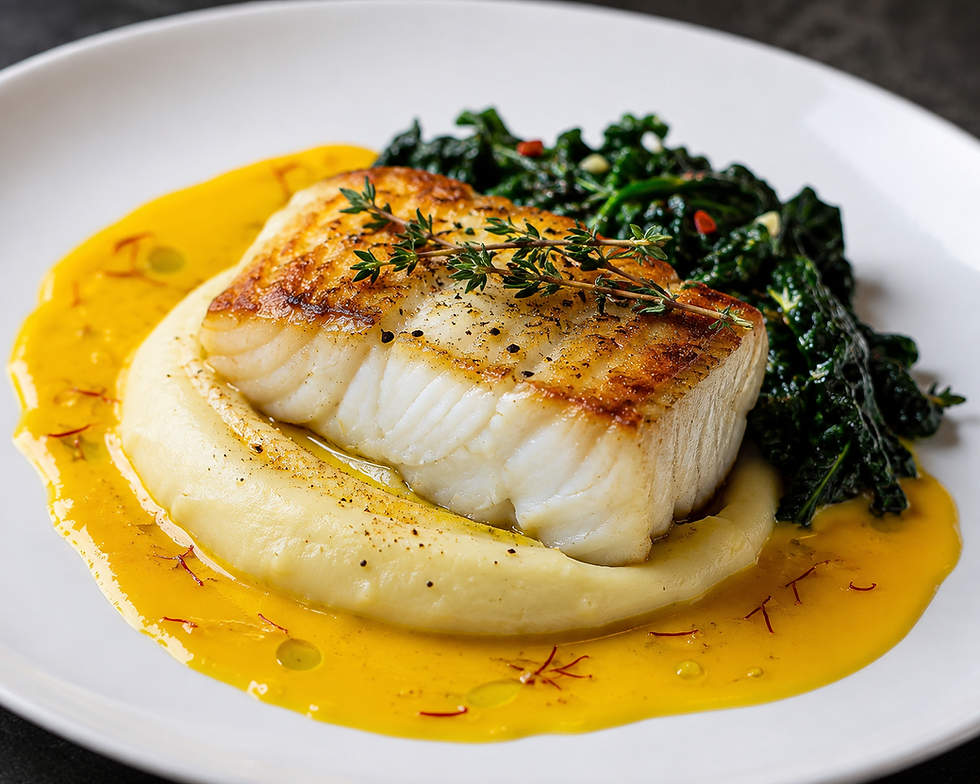
Spread a generous tablespoon of purée slightly off centre with the back of a spoon, in one unbroken movement. Set the fillet on it skin side up, lean three roasted florets against it with the cut faces up, and set two mussels in the half shell beside them with a few shelled ones tucked closer in.
Spoon the saffron sauce around the fish and never over it, letting it pool at the edge of the purée. Add the parsley oil last as six or seven separate drops and do not swirl them: oil and sauce read as two colours only while they stay apart. Finish with the parsley leaves, a few drops of olive oil and a turn of white pepper. No lemon wedge belongs on this plate.
Professional Technique
The technique of this dish is the technique of the fish, and it begins with a number: the John Dory returns barely more than 30 percent of its whole weight as edible fillet. The head is enormous in proportion to the body, the skull and gill plates are heavy, and the frame is deep and flattened side to side, so the useful muscle sits in four thin sheets against a skeleton that weighs more than they do. A fish of 2 1/4 lb (1 kg) gives two portions.
Those fillets dictate the cooking. They are lean almost to the point of having no intramuscular fat, thin through the middle, and made of wide flakes held by very little connective tissue, so nothing buffers the heat and the fish travels from perfectly set to falling apart in seconds. The answer is to keep the skin on, or to cook the fish on the bone when it is large enough, at moderate heat and for very few minutes. The skin does the work the missing fat would do, shielding the muscle and basting it from outside, and the bone does the same from within, which is why a whole roasted San Pietro is more forgiving than a fillet.
Then the number that matters at the stove. Take the fish out at 118°F (48°C) at the thickest point, not the 130°F (54°C) usually quoted for white fish, because a fillet this thin climbs another eight degrees while it rests and reaches the table at about 126°F (52°C), exactly where the wide flakes are opaque, set and still full of juice. Seasoning follows the same discipline: the water the mussels release is intensely saline, concentrated further by the heat, and filtered clean it is the only salt in the dish. Taste it before it goes near the butter, let down a fierce batch with a little water, and never reduce it, since that concentrates the salt in exact proportion to the volume lost.
Texture and Moisture Control
Four textures arrive together and each fails differently. The skin crisps only if the surface is dry, which is what the 20 minutes uncovered on a rack achieves, and pressing the fillet flat for the first seconds keeps the whole surface against the metal instead of letting the centre dome away.
The purée is a question of water. Cauliflower is roughly 92 percent water and releases most of it into the pan, so the milk is there for fat and sweetness rather than volume. Adding the cooking liquid back a spoonful at a time is what lets you stop at the right point: the purée should hold a shape and slide off the spoon slowly. Too loose it runs under the fish, too tight it reads as paste. The sieve removes the stem fibre that no blender breaks down.
The sauce is a butter emulsion on a very small volume of liquid and it lives in a narrow band. Whisk the cold butter in off the direct heat and hold the sauce between 140°F (60°C) and 150°F (65°C): boiled it breaks into a yellow slick over a watery pool, and below about 120°F (49°C) the butter sets and it turns dull. Purée goes onto the plate first, so the liquid the resting fish releases meets it rather than the bare bowl.
Professional Mise en Place
Everything except the fish and the butter emulsion is finished before service. The window at the end is about six minutes long and it contains a fish that cannot be reheated.
Equipment and tools
Instant read probe thermometer, thin tipped
Ovenproof sauté pan wide enough for four fillets without touching
High speed blender and a fine mesh conical sieve
Cloth or coffee filter for the mussel liquor, and a flexible fish spatula
Prepared ahead
Parsley oil, up to 2 days ahead, refrigerated
Cauliflower purée, up to 1 day ahead, rewarmed gently without boiling
Mussels shelled and their liquor filtered, on the day, held cold
Saffron infused in a third of the liquor, 1 hour ahead, covered
Roasted florets, up to 4 hours ahead, at room temperature
Fish portioned, dried and peppered, uncovered on a rack in the refrigerator
Service setup
Purée warm over a low bain marie, with warm milk to loosen it
Liquor and saffron infusion in one small pan, diced cold butter beside it
Bowls warmed to hand temperature, never hot
Probe, spatula and parsley oil within reach
Shelled mussels at room temperature, ready for the sauce
Chef Tips
Buy the fish whole, or watch it being filleted. A John Dory is easy to read while intact: domed clear eye, deep red gills, a rigid body and a dark spot with sharp edges. Once it is two pale fillets on a tray there is nothing left to judge.
Keep the frames and heads. They give the cleanest stock of any Mediterranean white fish, they are more than half of what you paid for, and thirty minutes with celery and a bay leaf makes tomorrow's risotto base.
Taste the mussel liquor before you commit it. Salinity varies enormously with where the mussels grew, and two batches can be the difference between a seasoned sauce and an inedible one.
If pesce San Pietro is unavailable, turbot and brill share the wide flake and the lean flesh and take the same temperatures. Sea bass and sea bream run firmer and slightly fatter and want about 125°F (52°C). Avoid cod and hake, which flake apart under this treatment.
Common Mistakes
Cooking to the usual white fish temperature. Pulled at 130°F (54°C) the fillet finishes near 138°F (59°C) after resting, and the wide flakes separate and give up their juice. Pull at 118°F (48°C) with a probe.
Planning four portions from one fish. The yield is barely over 30 percent, so a 2 1/4 lb (1 kg) fish gives two portions. Buy two fish, or 1 1/4 lb (570 g) of trimmed fillet.
Removing the skin before cooking. It is the only thing shielding a fillet with no fat from the pan. Skinned, the outside overcooks before the centre sets and the fillet tears when moved.
Salting the fish and the florets. The filtered mussel liquor already carries all the salt the plate needs. Season the sauce only and let it season everything else.
Reducing the mussel liquor. Every drop driven off concentrates the salt in proportion, so a liquor reduced by half is twice as salty. Thicken the sauce with cold butter instead.
Boiling the butter sauce. The emulsion breaks above roughly 160°F (71°C) with no way back. Whisk the butter in off the heat and hold the sauce between 140°F (60°C) and 150°F (65°C).
Wine Pairing
Fiano di Avellino DOCG: The most complete match here. Fiano carries more weight and texture in the mouth than most Italian whites without giving up acidity, which is what a butter emulsion and a milk based purée ask for, and its hazelnut and pear character sits alongside the sweetness of the cauliflower instead of cutting across it.
Etna Bianco DOC: Carricante on volcanic soil gives a hard mineral spine and a saline finish, and that salinity is why it works with the mussel liquor: where a softer white tastes flat beside a briny sauce, this one answers in the same register.
Vermentino di Gallura DOCG: The Sardinian white for the Sardinian saffron. Grown on decomposed granite, it has firm citrus acidity and a sea like bite that runs parallel to the mussels, with a bitter almond finish that stops the purée seeming too sweet. Serve it cool rather than cold, around 50°F (10°C).
Verdicchio di Matelica DOC: The inland Verdicchio, tighter and more structured than its coastal cousin, and that structure lets it sit under the fish without being pushed aside by the sauce. High acidity and almond bitterness on the finish cut the butter.
Franciacorta DOCG: A metodo classico brut, and technically the sharpest answer to the emulsion: the mousse and the acidity scour butter off the palate between mouthfuls, while the bread and pastry notes from the lees sit comfortably with the saffron and the mussels. Choose a non vintage brut rather than a long aged riserva.
Storage & Reheating
The components keep and the assembled plate does not, so never build this dish ahead. Cooked John Dory should be eaten within minutes of leaving the pan, since a fillet that has been held or reheated loses the one quality that justifies its price.
The purée keeps refrigerated in an airtight container for 3 days and freezes for a month, needing a blitz with warm milk after thawing. Rewarm it over low heat and stop as soon as it is hot. The parsley oil keeps 2 days refrigerated and loses colour after that. The roasted florets keep a day at room temperature but must never be refrigerated.
Shelled mussels keep 24 hours covered in a little of their filtered liquor and must be reheated in the sauce, for 30 seconds at most. The liquor itself keeps 2 days refrigerated and freezes very well. The butter sauce cannot be stored: it is built in the last two minutes of service, so make only what you will pour.
Nutrition
Per serving, based on 4 main course portions:
Calories: 520 kcal
Total Fat: 34 g
Saturated Fat: 14 g
Trans Fat: 0.5 g
Unsaturated Fat: 19 g
Cholesterol: 135 mg
Sodium: 780 mg
Total Carbohydrates: 16 g
Fiber: 4 g
Total Sugars: 9 g
Added Sugars: 0 g
Protein: 36 g
Lactose: 3 g
Principal micronutrients: selenium, iodine, vitamin B12, iron, phosphorus, potassium, vitamin K
These figures are estimates. Sodium is the least predictable line, since it depends on how salty the mussel liquor turns out and how much of it reaches the plate.




Comments