
Italian Whipped Salt Cod with Crispy Polenta and Candied Lemon | Baccalà Mantecato con Cialda di Polenta Croccante e Limone Candito
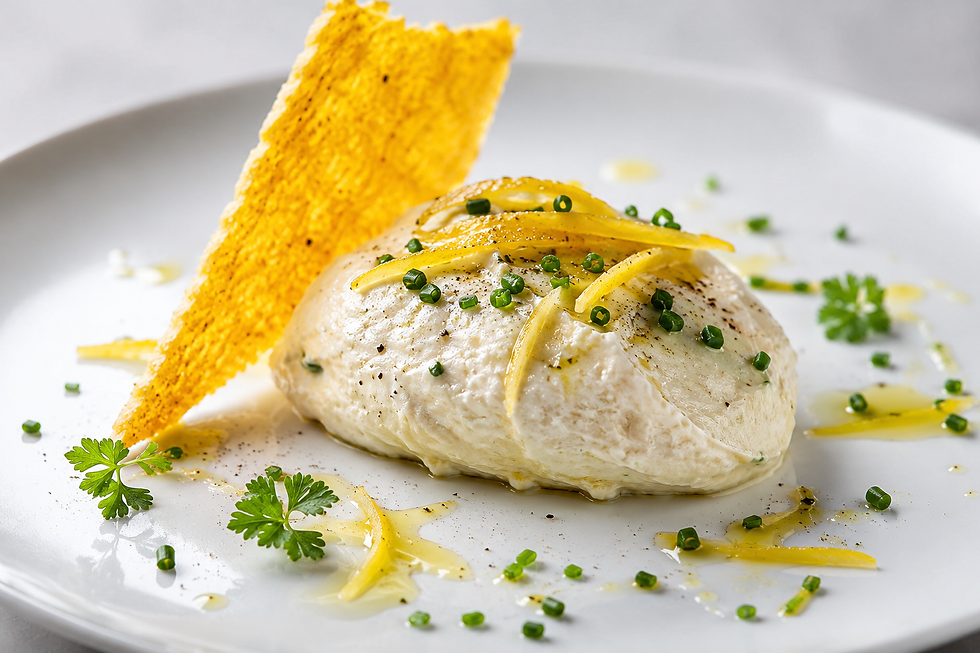
Baccalà mantecato is the most Venetian thing in the Venetian repertoire and the one most often got wrong outside the lagoon. It is not a mousse, not a pâté, and it contains no butter, no cream and no potato. It is cod and olive oil beaten together until the gelatin in the fish takes the oil into suspension and the whole thing turns white, light and almost aerated. Everything else is seasoning.
This version keeps that emulsion exactly as the bacari make it and changes only what surrounds it. The grilled polenta of the cicchetto counter becomes a thin brittle wafer, dried and then crisped, so it snaps instead of yielding. Candied lemon peel is set against the mantecato to cut the oil with something sweet and bitter at once, in place of the squeeze of lemon given at the table.
None of it is difficult, but all of it is timing. The fish needs two days of soaking, the emulsion has to be built while the cod is still warm, and the wafers have to be dried slowly and crisped at the last moment. Read the whole method first, because the order matters more than the technique.
Yield: 4 appetizer servings. Soak: 48 hours. Prep: 45 minutes. Cook: 1 hour 10 minutes. Dry: 2 hours. Total: about 4 hours plus soaking. Difficulty: intermediate. Course: antipasto or light primo. Region: Veneto, Venice.
The Story
The dish exists because of a shipwreck. In 1432 the Venetian merchant Pietro Querini went down off the coast of Norway and was washed up on Røst, in the Lofoten islands, where he spent the winter among fishermen who dried their cod on wooden racks in the open air until it was hard as timber. He came home with the fish and a written account of it, and stockfish entered the Venetian larder as something that kept for years and travelled anywhere.
The confusion in the name belongs to Venice alone. Everywhere else in Italy baccalà means cod preserved in salt and stoccafisso means cod dried in air, and the two are different products. In the Veneto both are called baccalà, and the classic mantecato of the city is made with the air dried fish. Salt cod gives an excellent result and is far easier to find, which is what this recipe is written for, but it is worth knowing which tradition you are standing in when you order the dish in a bacaro.
The preparation itself is cicchetto food, the small plates eaten standing at a counter with a glass of wine, spread on grilled white polenta and handed across on a napkin. It was cheap food built on a cheap preserved fish and a great deal of patience, and it survived into the restaurants of the city without changing its method at all.
Ingredients
For the salt cod
Dried salt cod fillet, thick centre cut, 1 lb 2 oz (500 g) before soaking
Cold water for soaking, changed 6 times
Whole milk, 2 cups (480 ml)
Water, 2 cups (480 ml)
Bay leaf, 1
Black peppercorns, 6
Garlic clove, peeled and left whole, 1
For the mantecato
Mild extra virgin olive oil, 3/4 cup (180 ml)
Sunflower oil, 1/4 cup (60 ml)
Reserved poaching liquid, warm, 1/3 cup (80 ml)
Flat leaf parsley, very finely chopped, 1 tbsp
Fine sea salt and freshly ground white pepper, to taste
For the polenta wafers
Water, 3 cups (720 ml)
Fine white polenta, Biancoperla for preference, 3/4 cup (120 g)
Fine sea salt, 1 tsp (6 g)
Extra virgin olive oil, 1 tbsp (15 ml), for brushing
For the candied lemon
Unwaxed lemons, 2
Granulated sugar, 3/4 cup (150 g)
Water, 3/4 cup (180 ml)
Honey, 1 tsp (7 g)
For finishing
Chives, finely sliced, 1 tbsp
Extra virgin olive oil, a few drops per plate
Sea salt flakes and freshly ground black pepper, to taste
Preparation
Step 1
Soak the salt cod and manage the water. Rinse the fillet under cold running water to take off the surface salt, then submerge it in a deep bowl of cold water in the refrigerator for 48 hours. Change the water six times, roughly every 8 hours, and never let the fish sit in water it has already salted. Keep the centre cut whole rather than portioning it, since cut edges leach salt unevenly. Taste a small raw sliver at the end: it should read as seasoned, not salty.
Step 2
Candy the lemon peel first. Remove the peel from both lemons in wide strips, cut away every trace of white pith and slice the strips into fine julienne. Blanch them three times from cold water, draining and refreshing each time, which takes out the bitterness. Bring the sugar, water and honey to a simmer, add the peel and cook at the barest bubble for 35 minutes, until translucent. Cool them in the syrup and drain on a rack.
Step 3
Cook the polenta and spread it thin. Bring the water to a boil with the salt, rain in the white polenta while whisking hard, and cook on low heat for 40 minutes, stirring often. It must be fully cooked and quite loose, since a stiff polenta cracks rather than spreads. Pour it onto a silicone mat and spread it no thicker than a coin with an offset spatula, working fast before it sets.
Step 4
Dry the sheet, then crisp it. Put the tray into the oven at 175°F (80°C) for 2 hours with the door slightly ajar, until the sheet is dry, pale and rigid. Break it into irregular shards, brush them very lightly with oil and give them 4 minutes at 350°F (175°C), watching closely. They should colour barely at the edges and snap cleanly. Cool on a rack and keep somewhere dry.
Step 5
Poach the cod gently. Drain the soaked fish, lay it in a wide pan and cover it with the milk and water, adding the bay leaf, peppercorns and garlic. Bring it to 180°F (82°C) and hold it there 12 to 15 minutes without ever letting it boil, since a boil tightens the flesh and drives out the gelatin the emulsion depends on. Lift the fish out hot and strain the liquid into a small pan to keep warm.
Step 6
Clean the fish and start the mantecatura. Working while the cod is hot, pull off the skin, take out every bone with fingers and tweezers, and flake the flesh into a stand mixer fitted with the paddle. Beat on low speed for 2 minutes to break the fibres down, then start adding the olive oil and sunflower oil in a very thin thread, exactly as you would build a mayonnaise. Never rush the oil here.
Step 7
Finish the emulsion and rest it. Once half the oil is in, alternate the rest with spoonfuls of warm poaching liquid, which keeps the mixture loose and stops it splitting. Stop when the mantecato is white, glossy and holds a soft peak. Fold in the parsley by hand, season with fine salt and white pepper and rest it 30 minutes at cool room temperature, never in the refrigerator, where the oil sets hard.
Plating
Serve this on cool plates, never warmed ones. The mantecato is an oil emulsion held together by fish gelatin, and a hot plate slackens it within a minute, leaving a ring of oil around the edge. Room temperature is the target for the fish itself: straight from the refrigerator it tastes of nothing and turns waxy, so take it out half an hour before service if it has been chilled.
Shape a generous quenelle with two spoons slightly off centre and lean two polenta shards against it at different angles, so they stand clear of the fish rather than lying under it. Scatter six or eight strands of candied lemon across and beside the quenelle, keeping some off the fish so they stay distinct. Finish with chives, a few drops of good olive oil, a grind of pepper and a pinch of salt flakes on the polenta rather than on the cod, which is already seasoned. Send it out at once: the wafers soften from the moment they touch anything moist.
Professional Technique
The mantecatura is a true emulsion and it behaves like one. Cod is unusually rich in collagen, which converts to gelatin during the poach and dissolves into both the fish and the liquid. That gelatin is the emulsifier: it coats the oil droplets and holds them suspended in the water phase, as egg yolk lecithin does in a mayonnaise. This is why the fish must be beaten hot, why the poaching liquid is kept, and why nothing else is needed to bind it.
Temperature is the variable that decides success. Below about 95°F (35°C) the gelatin begins to set and the mixture turns pasty and refuses more oil; above a simmer during the poach the muscle fibres contract and squeeze out the same gelatin into the pan, leaving dry flesh that will never whip. Holding the poach at 180°F (82°C) and working fast once the fish comes out keeps you inside the window where the emulsion forms easily.
Texture and Moisture Control
Two textures carry this plate and they are opposites: an emulsion that must stay soft and a wafer that must stay brittle. The mantecato is controlled by the ratio of warm poaching liquid to oil. Too little and it tightens into a paste as it rests, too much and it slumps and cannot hold a quenelle. Add the liquid gradually and judge by feel rather than measurement, since how much a fillet gives up depends on how thoroughly it was dried and salted.
The polenta is a matter of removing water in two stages. The long dry at 175°F (80°C) drives moisture out of the sheet without colouring it, and the short blast at 350°F (175°C) puffs and sets what is left. Skip the slow dry and the shard stays leathery in the middle however long you bake it. Store the finished wafers in a sealed tin with a small sachet of silica or a piece of dry bread, since they pull humidity out of the air within an hour on a damp day.
Professional Mise en Place
The soaking dictates everything, so count back two days from service. Polenta and candied lemon are both stable and can be done well ahead, while the mantecato wants to be made on the day.
Equipment and tools
Stand mixer with the paddle, or a sturdy wooden spoon and patience
Wide shallow pan for poaching and a probe thermometer
Silicone mat, offset spatula and a flat tray for the polenta sheet
Fine mesh sieve for straining the poaching liquid
Fish tweezers, two dessert spoons for the quenelles
Prepared ahead
Cod soaked 48 hours with six changes of water
Candied lemon peel, up to 2 weeks ahead, kept in its syrup
Polenta sheet cooked, spread and dried, up to 3 days ahead
Wafers broken and crisped on the day, held in a sealed tin
Poaching aromatics measured, milk portioned
Service setup
Mantecato at cool room temperature, covered, never chilled before service
A little warm poaching liquid held back to loosen it if it tightens
Candied lemon drained on a rack, chives cut at the last minute
Wafers kept away from any steam or open water
Plates cool, oil bottle and pepper mill at the pass
Chef Tips
Buy a thick piece from the centre of the fillet and avoid the thin tail. Tail desalts faster than shoulder, so a whole side soaked together finishes uneven, and the thin end overcooks while the thick end is still raw. A square block of even thickness is worth paying more for.
If the emulsion splits, it is almost always because the fish cooled. Warm a tablespoon of poaching liquid in a clean bowl and beat the split mixture into it a spoonful at a time, the same rescue you would use on a broken mayonnaise. It comes back every time, provided you work warm.
Use a mild olive oil rather than a peppery one, and cut it with sunflower oil as this recipe does. A strong Tuscan oil beaten into this quantity of fish turns bitter and takes over completely, and the bitterness sharpens further as the mantecato rests. Save the good oil for the few drops on the plate, where it belongs.
White polenta is not a stylistic choice here, it is the Venetian one. Biancoperla from the Veneto plain is finer and more delicate than yellow, and makes a paler wafer that does not compete with the cod. Yellow polenta works but gives a coarser shard with a corn flavour strong enough to push the fish into the background.
Common Mistakes
Cutting the soaking short. Under soaked cod is aggressively salty and no amount of oil hides it. Give it the full 48 hours with six changes of water, and taste a raw sliver before poaching.
Boiling the fish. A boil contracts the fibres and pushes the gelatin out into the pan, leaving flesh that stays stringy and refuses to take oil. Hold the poach at 180°F (82°C) and use a thermometer.
Whipping cold cod. Below about 95°F (35°C) the gelatin sets and the emulsion will not form, whatever speed you use. Clean and flake the fish while it is hot, even if that means working with a cloth in your hand.
Adding the oil too fast. Poured in rather than threaded, the oil breaks the emulsion in seconds. Go slowly for the first half, then alternate with warm poaching liquid.
Refrigerating the finished mantecato before service. Cold sets the oil and the texture goes waxy. Keep it at cool room temperature, and if it has been chilled, bring it back with a little warm liquid and a beat.
Wine Pairing
Soave Superiore DOCG: The Veneto white that belongs beside this dish and the safest bottle on the list. Garganega from the volcanic soils around Soave gives white peach and a bitter almond finish, and that bitterness runs alongside the candied lemon rather than fighting it. A Superiore has the body to stand up to an emulsion this rich and the acidity to reset the palate between mouthfuls of oil.
Conegliano Valdobbiadene Prosecco Superiore DOCG: What is actually poured with this in the bacari of Venice, and for good reason. The mousse scrubs oil off the palate in a way no still wine manages, and the pear and white flower fruit sits easily with the mild cod. Ask for the brut rather than the extra dry, since residual sugar adds to the candied lemon instead of balancing it.
Lugana DOC: From the southern shore of Lake Garda, and the choice when you want more weight than Soave without losing freshness. Turbiana gives a broader, faintly saline white with citrus peel and a mineral finish, and that salinity meets the residual salt in the cod on its own terms. Its almost waxy texture mirrors the mantecato rather than contrasting with it.
Ribolla Gialla Collio DOC: The most interesting pairing here. Ribolla is high in acid, low in aromatic noise and finishes with a grip almost tannic for a white, which cuts an oil emulsion cleanly. Its green apple and lemon pith character picks up the candied peel exactly, and a skin contact version handles the crisp polenta better than any conventional white.
Franciacorta DOCG: The bottle for a plated version served as a first course rather than a cicchetto. Bottle fermented and aged on lees, it brings a fine persistent bead and a bready note that flatters both the cod and the toasted polenta. Its acidity is firmer than Prosecco and it carries the dish without any sweetness. Choose a non vintage brut and pour it cold.
Storage & Reheating
The mantecato keeps 3 days in an airtight container in the refrigerator, with a film of olive oil over the surface to keep air off it. It sets solid when cold, which is normal. To bring it back, leave it at room temperature for 45 minutes and beat it briefly with a tablespoon of warm water or milk until it loosens and regains its gloss. Never warm it in a pan or a microwave, which splits the emulsion for good.
The polenta wafers keep 5 days in a sealed tin at room temperature, provided nothing damp goes in with them. If they lose their snap, give them 3 minutes at 300°F (150°C) and cool them completely before serving, since they crisp as they cool rather than in the oven. The candied lemon keeps 2 weeks refrigerated in its syrup and improves over the first few days.
Do not freeze the mantecato: the emulsion separates on thawing and there is no way back. You can freeze the poached cod flesh before whipping it, for up to 1 month, but warm it through gently in a little milk before beating, and expect a result noticeably less light than one made from fish that never saw a freezer.
Nutrition
Per serving, based on 4 appetizer portions:
Calories: 520 kcal
Total Fat: 38 g
Saturated Fat: 6 g
Trans Fat: 0 g
Unsaturated Fat: 31 g
Cholesterol: 68 mg
Sodium: 890 mg
Total Carbohydrates: 24 g
Fiber: 1 g
Total Sugars: 9 g
Added Sugars: 8 g
Protein: 28 g
Lactose: 0.8 g
Principal micronutrients: iodine, selenium, vitamin B12, vitamin D, phosphorus, potassium
These figures are estimates. Sodium in particular varies with how thoroughly the cod was desalted, and the sugar depends on how much candied peel reaches the plate.


Comments