

Italian Burrata Hors d'Oeuvre | Crema di Burrata con Acciughe del Cantabrico, Limone Candito e Bottarga

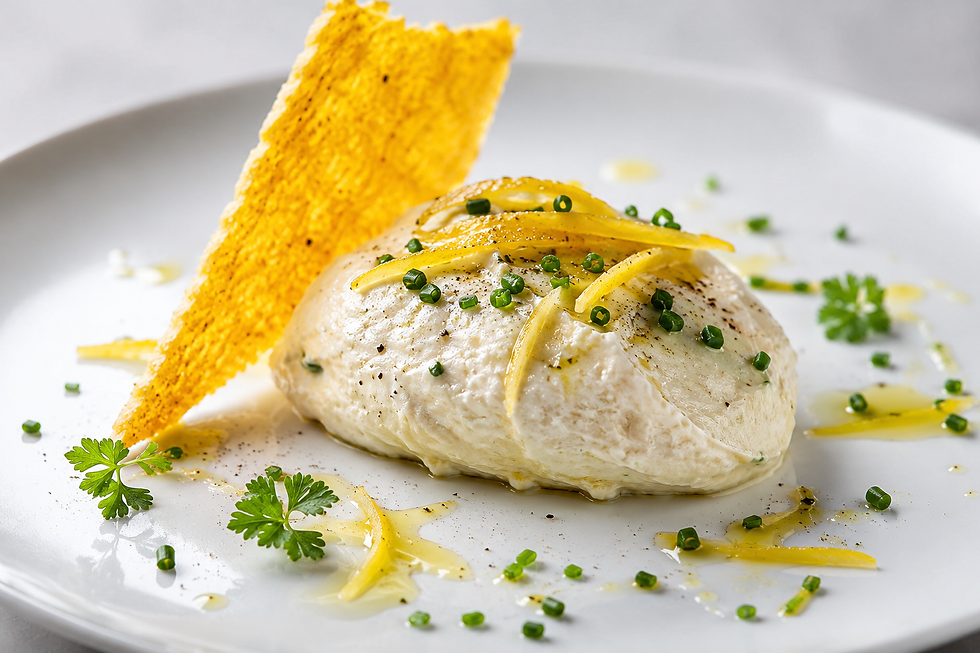
A burrata hors d'oeuvre lives on one ingredient and on the restraint of everything beside it. The stracciatella inside the burrata becomes a cold, glossy cream, and three accents sit on top: a Cantabrian anchovy fillet, a few cubes of lemon peel candied at home, and a veil of bottarga grated at the last second.
Nothing here is cooked except the lemon, and nothing is hidden. The whole dish is a lesson in keeping milk, salt and citrus in balance.
Yield: 4 appetizer servings. Prep: 30 minutes. Cook: 25 minutes. Chill: 30 minutes. Total: about 1 hour 25 minutes. Difficulty: intermediate. Course: antipasto.
The Story
Burrata was born in Andria, in the Murgia plateau of Puglia, in the 1920s. The most repeated account credits Lorenzo Bianchino of Masseria Piano Padula, who could not carry his milk to market during a heavy winter and used the cream he could not sell to fill pouches of stretched mozzarella curd. Inside went stracciatella, the shreds of curd left over from pulling mozzarella, bound with fresh cream. It was a frugal dish born of waste, and it was meant to be eaten within a day.
That short life is why burrata was traditionally tied with a green stalk of asphodel, whose leaves wilted as the cheese aged and told the buyer at a glance how fresh it was. Today the cheese from Andria carries a protected geographical indication, and the point of the protection is the same: a burrata is only worth serving on the day it was made, and it should be milky, sweet and slightly tremulous when the shell is cut.
The dish on this page is a modern composition rather than a traditional one, and it borrows from three coasts. Bottarga is the salted, pressed and air dried roe sac of grey mullet, made for centuries around the lagoons of Cabras in western Sardinia and prized as a cured seasoning that keeps for months. Anchovies from the Cantabrian Sea, on the northern coast of Spain, are caught in spring, salted and matured for many months before being hand filleted and packed in olive oil. Candied lemon peel comes from the confectionery tradition of Sorrento and the Amalfi coast, where the thick skinned lemons are as valued for the peel as for the juice.
What links them is salt and acidity set against fat. Southern Italian cooks have always known that fresh milky cheese needs a sharp, savory companion, whether that is a salted sardine, a lemon or a spoon of good olive oil. Here the three are put on the same plate with a precision that a trattoria would never bother with, and the result reads as Italian even though one ingredient crosses the sea.
There is also a practical reason the pairing works so well at the table. Burrata is sweet and almost bland on its own, which makes it a perfect blank canvas, and a cook who respects it lets the salt come from the sea instead of the salt cellar. Serve it cool, never cold from the refrigerator, and it becomes the most generous first course of an early autumn meal.
Ingredients
For the burrata cream
Fresh burrata, 2 balls, 8 oz (225 g) each, made the same day
Cold heavy cream, 2 tbsp (30 ml), only if needed
Lemon juice, 1 tsp (5 ml)
Fine sea salt, a small pinch, added at the end
White pepper, freshly ground, 1 pinch
For the candied lemon
Unwaxed lemons, 2 large
Granulated sugar, 1 cup (200 g)
Water, 1 cup (240 ml), plus more for blanching
For the plate
Cantabrian anchovy fillets in olive oil, 8 (about 2 oz, 55 g)
Sardinian grey mullet bottarga, 1 oz (30 g), for grating
Extra virgin olive oil, 2 tbsp (30 ml), plus a little for the bread
Thin slices of country bread, 8, about 1/4 inch (6 mm) thick
Fresh chives, snipped, 1 tbsp
Flaky sea salt, to finish, very little
For finishing
Finely grated lemon zest, from 1/2 lemon, taken from a fresh lemon and not the candied ones
Freshly cracked black pepper, 1 small pinch
Reserved candying syrup, 1 tsp (5 ml), for a few drops on each plate
Preparation
Step 1
Chill everything that will touch the cheese. Put the blender jar, the mixing bowl and a fine mesh sieve in the freezer for 20 minutes, and keep the burrata in the refrigerator until the moment you cut it. Also chill two small plates for testing. Warm equipment is the quickest way to spoil this dish, so do not skip the wait, and do not cut corners by rinsing the jar with cold water, which leaves it barely cool.
Step 2
Candy the lemon peel. Peel the lemons in wide strips with a vegetable peeler, taking as little white pith as you can, and trim off any that clings. Cover the strips with cold water, bring to a boil, drain and repeat twice more to lose the bitterness. Dissolve the sugar in 1 cup (240 ml) of water over medium heat until clear, add the blanched strips and cook at a bare simmer for 20 to 25 minutes, until they look translucent and glassy. Cool them in the syrup, drain, then dice into cubes no bigger than 1/8 inch (3 mm).
Step 3
Open the burrata over a sieve. Set the burrata in a colander for a few minutes so the loose whey can drain, then cut each ball in half over the sieve. Scoop the stracciatella and the shell together into the frozen jar, reserving a teaspoon of the whey. Add the lemon juice. Add cream only if the cheese looks stiff, since the cheese carries plenty of its own.
Step 4
Pulse the cream. Give the blender 4 or 5 pulses of about one second each, scraping the sides down with a spatula between them. Stop the instant the cream turns glossy and pourable, even if a few small flecks of shell are still visible. Do not run the motor continuously for any reason. If the mass looks stiff after two pulses, add a teaspoon of the reserved whey and pulse once more.
Step 5
Strain the cream. Press the cream through the chilled sieve into the chilled bowl with a flexible spatula, working from the center outward and scraping the underside of the mesh. Fold in the white pepper, taste, and only now add the smallest pinch of salt. Cover the bowl with plastic touching the surface and refrigerate for at least 30 minutes, so the cream firms to a spreadable, velvety consistency.
Step 6
Toast the bread. Heat the oven to 400°F (200°C). Brush the slices very lightly with olive oil and bake on a tray for 6 to 8 minutes, turning once, until pale gold and crisp all through. Let them cool on a rack so they lose their steam, then keep them in a dry place until service.
Step 7
Prepare the toppings. Drain the anchovies on paper towels, pat them dry, and halve each fillet lengthwise so that every plate gets four thin strips. Snip the chives with sharp scissors and grate the lemon zest. Leave the bottarga wrapped and cold, and grate it only at the very last second, on a fine rasp, so that it falls in a thin, fragrant dust.
Step 8
Taste and adjust. Spoon a little cream onto a chilled plate with a strip of anchovy and a cube of lemon, and taste them together. The cream should be milky and sweet, the anchovy salty and savory, and the lemon a bright, chewy contrast. If the cream tastes flat, add three or four drops of lemon juice and a crack of pepper. Salt is almost never needed.
Plating
Use small chilled plates or shallow bowls kept in the refrigerator until service. Spoon about 3 tablespoons of cream into the center and spread it once with the back of a spoon into a soft, low oval.
The cream should be cool and the crostini warm from the oven, so time the bread to come out just before the plates go up. Choose a plate with a wide rim to give the composition space, because the dish depends on empty white porcelain as much as on what sits on it.
Lay four anchovy halves across the cream in a loose line, scatter a teaspoon of candied lemon cubes beside them, and grate bottarga over the whole plate. Finish with a thread of olive oil, chives and two flakes of salt. Serve the crostini on the side so they stay crisp.
Professional Technique
Blending burrata warms it and breaks it. The blades transfer heat and friction to a fat rich emulsion of curd and cream, and the butterfat of the stracciatella separates within seconds. Because of that, the cheese goes into the blender freezing cold, in a chilled jar, and the motor runs in short pulses only.
The stopping point is visual. Watch for the moment the cream turns glossy and flows in a thick ribbon, then stop. A few more seconds and it will look dull, grainy and slick with oil. Once the fat has separated, more blending cannot bring it back: it only heats the mass further and makes the split worse. A broken batch is better used as a spread on toast than served as the cream.
Working this way also protects the flavour. Overheated stracciatella turns sour and flat, and the sweet lactic freshness that makes the dish worth making disappears. Cold pulsing keeps that sweetness intact for the anchovy to lean on.
Salt goes in after the cream is finished, never before. Salt draws water out of the milk proteins and loosens the curd, so a salted burrata pulses to a thinner, wetter and less stable cream, and the seasoning of the anchovy and bottarga has to be judged against a finished base anyway. Both toppings are salty enough that the cream often needs very little.
The cream is then pressed through a sieve instead of being blended longer to make it smooth. Sieving removes the tough strands of the mozzarella shell mechanically, with no heat at all. Extra blending would chase the same smoothness and pay for it with warmth, which is precisely what the pulse method was designed to avoid.
Texture and Moisture Control
Three textures share the plate: a cool cream, a chewy cube of candied peel, and a crisp crostino. Each one dies in a different way. The cream turns runny as it warms, the candied peel hardens if it is dried out, and the bread goes soft the moment it meets moisture.
Drain the burrata well, because the whey that pools around it will thin the cream and make it weep on the plate. Fold rather than whisk when you add the pepper. If the cream is too stiff to spread, loosen it a teaspoon at a time with cold cream, never with water.
Temperature is the other lever. The cream reads as rich and clean at about 50°F (10°C) and as oily above 65°F (18°C). Serve on chilled plates, and rest the bowl on ice while you work through the plating if the kitchen is warm.
Keep the candied lemon in a little of its syrup, and drain it on paper just before plating so that it adds a glint rather than a puddle. Anchovies are patted dry for the same reason, so that their oil does not run into the cream and cloud its clean white surface.
Professional Mise en Place
Equipment and tools
Blender with a jar that fits in the freezer
Fine mesh sieve and a flexible spatula
Vegetable peeler, small saucepan, sharp paring knife
Fine rasp for the bottarga
Paper towels, small offset spatula and a bowl of ice for holding the cream
Prepared ahead
Candied lemon, up to 1 week ahead, stored in its syrup in the refrigerator
Anchovies halved and drained, kept cold
Bread sliced and brushed, ready for the oven
Lemon zest grated and chives snipped, covered with damp paper
Blender jar, bowl and sieve back in the freezer until needed
Service setup
Cream made no more than 2 hours before service, kept covered and cold
Plates chilled, bottarga grated last, crostini toasted à la minute
Cream held on ice, spoon and offset spatula within reach
Anchovies, lemon cubes and chives lined up in small bowls in plating order
Chef Tips
Buy the burrata the day you cook it and ask for the ball that is still tight and weeping a little whey. A cheese three days old will taste sour after pulsing.
Cantabrian anchovies vary in salt, so taste one before deciding how much salt the cream needs. Choose fillets that are pinkish brown and firm, packed in olive oil, not the pale mushy kind sold in cheap tins.
Save the candying syrup. It keeps for weeks in the refrigerator and works wonderfully in a gin cocktail or a glass of sparkling water.
If the kitchen is hot, chill the spoon as well and dip it in cold water between plates so the cream never sticks to it.
Take the plate out of the refrigerator only at the last moment, so the cream is still cold when it reaches the table.
Common Mistakes
Blending too long. Even ten seconds of continuous running heats the cheese and splits the fat, leaving a greasy, gritty cream. Pulse briefly and stop when it shines.
Salting the cream first. It thins the curd and makes the final seasoning impossible to judge against the anchovy and bottarga.
Leaving the pith on the lemon. White pith is bitter, and three blanchings cannot fully remove it. Peel thinly and take only the yellow zest.
Using warm equipment. A jar left at room temperature adds several degrees to the cream in seconds. Freeze it beforehand.
Grating the bottarga early. It dries and darkens, losing its briny sea perfume. Grate at the very last second, over the finished plate.
Serving straight from the refrigerator. Burrata served at fridge temperature tastes of nothing, because the cold suppresses its sweet milky aroma. Let it stand for a few minutes off the ice.
Overloading the plate. More than four anchovy halves or a heavy hand with bottarga buries the delicacy of the cream. The plate should stay mostly white.
Wine Pairing
Vermentino di Gallura DOCG: The Sardinian match for a Sardinian roe. Its saline edge and crisp citrus acidity meet the bottarga on equal terms, while a light bitter almond finish runs alongside the anchovy. A dry wine of moderate body, it cuts through the milk fat without covering the cream.
Franciacorta DOCG: A dry metodo classico with fine bubbles that scrub the palate after each bite of creamy cheese. Its brisk acidity and toasty, yeasty notes echo the toasted bread and stand up to the salt of the anchovy, refreshing rather than heavy.
Etna Bianco DOC: Grown on volcanic soil, this Carricante based white has bright lemony acidity and a mineral, smoky salinity. The acidity mirrors the candied lemon, and the flinty texture supports both the anchovy and the bottarga without hardness.
Trento DOC: An Alpine metodo classico with a lean, chalky acidity and a fine, persistent mousse. Its citrus and green apple notes rhyme with the candied lemon, and the bubbles lift the fat of the burrata off the tongue. It is the elegant choice for an aperitivo where this dish opens the meal.
Verdicchio di Matelica DOC: A dry, high acid white with green almond, herbs and a firm, savory finish. Its structure is enough to carry the richness of burrata, and its bitter almond edge meets the roe of the bottarga in a clean and quiet way.
Storage & Reheating
Serve the cream within 2 hours of making it. Keep it covered in the refrigerator, and if it must wait overnight, use it the next day only as a spread. Never reheat or freeze it, since freezing splits it on thawing.
If you plan a party, make the lemon, toast the bread and halve the anchovies in the morning, and leave only the cream and the grating for the final half hour. The cream is the one element that cannot be prepared far ahead, so build it in small batches of two balls at a time rather than all at once.
The candied lemon keeps for a week in its syrup, refrigerated. Anchovies stay well in their oil in a closed jar for several days. Wrap the bottarga tightly and refrigerate it, where it lasts for months. Toast the bread fresh each time.
Nutrition
Per serving, based on 4 appetizer portions:
Calories: 420 kcal
Total Fat: 27 g
Saturated Fat: 14 g
Trans Fat: 0 g
Unsaturated Fat: 11 g
Cholesterol: 75 mg
Sodium: 780 mg
Total Carbohydrates: 25 g
Fiber: 1 g
Total Sugars: 8 g
Added Sugars: 5 g
Protein: 18 g
Lactose: 1.5 g
Principal micronutrients: calcium, vitamin B12, selenium, phosphorus, omega 3 fatty acids
These figures are estimates. Sodium depends heavily on the saltiness of the anchovies and the bottarga, and on how much flaky salt you add at the end. The sugar figures come mostly from the candied lemon, of which each plate holds only a teaspoon.


Comments