
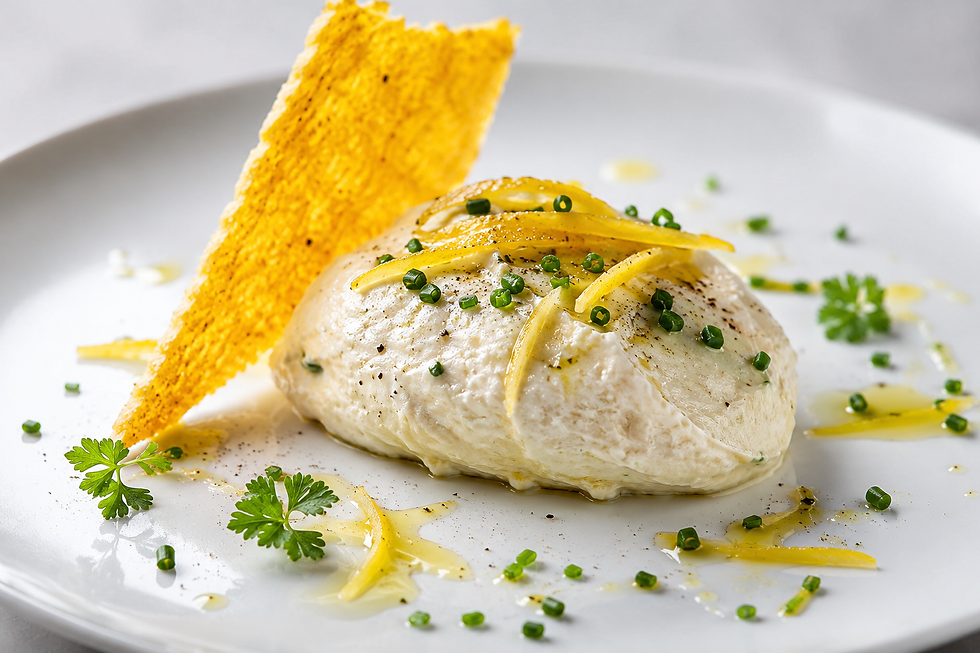
Italian Crispy Polenta Crostino with Whipped Salt Cod and Caviar | Crostino di Polenta Croccante, Baccalà Mantecato e Caviale

Three things happen in one mouthful, and the order matters. The polenta crostino cracks, the baccalà mantecato collapses into cream, and the caviar breaks against the roof of the mouth and releases salt. Take one away and the other two are ordinary. Together they are the most Venetian bite there is, dressed up far enough to leave the bacaro and reach a tasting menu.
Nothing here is difficult, but two things must be exactly right. The polenta has to be set hard overnight and fried at a temperature that crusts it without steaming the inside, so the shell shatters while the centre stays soft. The baccalà has to be whipped until the oil is completely absorbed and the fish reads as cream, and then stopped, because thirty seconds past that point it splits.
Yield: 12 crostini, 4 servings of 3. Soak: 48 to 72 hours. Prep: 45 minutes. Cook: 1 hour. Set: 6 hours or overnight. Difficulty: intermediate. Course: antipasto or cicchetto. Region: Veneto, Venice and the lagoon.
The Story
Venice calls this baccalà, and Venice is wrong on purpose. Everywhere else in Italy baccalà means cod cured in salt, but the Venetian dish is made with stoccafisso, cod dried hard in the wind of the Lofoten islands without a grain of salt on it. The name stuck and nobody in the city intends to correct it. The fish arrived by accident: in 1432 the Venetian merchant Pietro Querini was shipwrecked on Rost, at the far north of Norway, wintered with the islanders and sailed home with stockfish and an account of how it was made. Five centuries later the Lofoten boats still ship their best grade to the Veneto.
Mantecato is a verb before it is a dish. It means working fat into something until the two become one substance, the same word a Venetian cook uses for finishing a risotto, and here it describes beating mild olive oil into poached stockfish until the fibres break down and the mixture turns white. There is no cream in it, no butter, no potato. The creaminess comes from the collagen in the fish and from the emulsion.
The crostino belongs to the bacari, the small standing bars in the alleys off the Rialto where Venetians eat cicchetti with a glass of wine called an ombra. There the mantecato is spooned onto grilled white polenta made from the Biancoperla maize of the Veneto plain, milder and finer than the yellow polenta of Lombardy. Frying it rather than grilling it and crowning it with caviar is the modern restaurant move, and an honest one: the lagoon has sturgeon in its history.
Ingredients
For the white polenta
White polenta, Biancoperla if you can find it, 1 cup (150 g)
Whole milk, 2 cups (480 ml)
Water, 2 cups (480 ml)
Fine sea salt, 1 tsp (6 g)
Unsalted butter, 2 tbsp (28 g)
Bay leaf, 1
For the baccalà mantecato
Dried stockfish, whole, 1 lb (450 g) before soaking
Whole milk, 2 cups (480 ml)
Water, 2 cups (480 ml)
Garlic clove, peeled and left whole, 1
Bay leaf, 1, and black peppercorns, 6
Mild extra virgin olive oil, 3/4 cup (180 ml), at room temperature
Lemon juice, 1 tsp (5 ml)
Fine sea salt and ground white pepper, to taste
For frying the crostini
Neutral oil for frying, 4 cups (950 ml)
Fine semola for dusting, 2 tbsp (20 g)
For finishing
Caviar, oscietra or Italian farmed white sturgeon, 1 oz (30 g)
Chives, very finely sliced, 1 tbsp
Extra virgin olive oil, a few drops per crostino
Flaked sea salt, a small pinch
Preparation
Soak the stockfish
Stockfish is dried to the hardness of a plank and needs 48 to 72 hours in cold water to come back. Ask the fishmonger to cut it into large pieces, put them in a deep container under cold water and refrigerate, changing the water morning and evening. It is ready when the flesh gives under a thumb and has swollen to roughly three times its dry weight.
Poach it in milk and water
Put the drained pieces in a pan with the milk, water, garlic, bay leaf and peppercorns. Bring it to the barest simmer and hold it there for 20 to 25 minutes, never letting it boil. The milk softens the fibres and rounds the saltiness the drying leaves behind. Lift the fish out and keep the poaching liquid, which is what you will use to adjust the cream later.
Pick the fish clean
Let the pieces cool until you can handle them, then take them apart with your fingers while still warm. Every scrap of skin, every bone and the dark line along the spine has to come out, because a single bone in a mantecato is the one thing a guest will remember. Cold stockfish stops separating cleanly.
Mantecare the baccalà
Put the picked fish in a stand mixer with the paddle, or a wide bowl with a wooden spoon, and work it on low speed. Once the fibres break down, add the olive oil in a very thin stream, exactly as you would build a mayonnaise. The mixture goes from shaggy to pale to white and glossy over about 8 minutes, and that change is where you stop.
Season and rest the cream
Add the lemon juice, then correct with salt and white pepper. Stockfish varies a great deal in how salty it finishes, so season only at this stage. Press the mantecato into a container, cover the surface with film and refrigerate at least 2 hours. Bring it back towards room temperature before serving or it will taste flat.
Cook the white polenta
Bring the milk, water, salt and bay leaf to a simmer, then rain in the polenta in a thin stream while whisking hard so no lumps form. Cook on low for 40 to 45 minutes, stirring often and scraping the corners of the pan. It is done when it pulls away from the sides in one mass. Take out the bay leaf and beat in the butter.
Set the slab and cut the crostini
Pour the polenta onto a parchment lined tray and spread it to an even 1/2 inch (1.5 cm). Press a second sheet of parchment onto the surface so no skin forms and refrigerate at least 6 hours or overnight. Turn the cold slab out and cut 12 rectangles of about 2 by 1 1/4 inches (5 by 3 cm) with a thin knife dipped in hot water between cuts, so the edges stay square.
Fry to a crust
Dry the pieces on paper, dust them lightly with semola and knock off the excess. Heat the oil to 350°F (175°C) and fry four at a time for 3 to 4 minutes, turning once, until the outside is pale gold and rigid. Small batches keep the oil temperature up, which is the whole game: below 325°F (165°C) the polenta absorbs oil instead of crusting. Drain on a rack and salt at once.
Plating
This is assembled in the last sixty seconds before it leaves the kitchen. Set the fried crostini on a cool slate or a dark plate, spaced so they do not touch. Three per person, in a line rather than a pile, with the caviar reading as three identical points along it.
Pipe the baccalà mantecato on top, leaving a clear margin of gold polenta visible round the base, because that visible crust is what tells the eye the thing is crisp. A plain round nozzle is neater than a quenelle on a piece this small. Keep the mound low, about 3/4 oz (20 g) per crostino, so the ratio of crust to cream stays honest.
Finish with a small quenelle of caviar set off centre on the cream, lifted with a mother of pearl or plastic spoon, never metal. Add a few drops of olive oil around the base, a scatter of chives and a pinch of flaked salt only if the caviar is mild. Serve at once on cool plates, since warm plates soften the crust from underneath within a minute.
Professional Technique
The mantecatura is the real skill and it is an emulsion, not a mixing. Poached stockfish releases collagen and gelatin that act as the emulsifier, and oil added in a thin stream is dispersed into droplets held in that protein network, which is why the mixture turns white: it scatters light exactly as mayonnaise does. Add the oil too fast and the network cannot capture it. Beat past the finishing point and friction warms the mixture until it splits from the other direction.
The fried polenta is a controlled dehydration. A set slab is a starch gel holding a great deal of water, and at 350°F (175°C) that water flashes to steam at the surface and drives outward, leaving a thin dry shell that crusts while the interior stays soft. Two things break it: oil below 325°F (165°C), which lets the surface absorb fat instead of expelling steam, and wet slab faces, which cool the oil and give a leathery skin. The overnight set firms the gel enough to survive the thermal shock.
The third decision is salt architecture, and on a plate this small it is everything. Four salted elements arrive at once: the fish, the polenta, the fried crust and the caviar. The caviar has to be the loudest and the last, so the mantecato is seasoned deliberately short and the crostino salted lightly. Season each component to taste right alone and the finished bite is inedible.
Texture and Moisture Control
The crostino has a working life of about four minutes once the cream touches it. Moisture moves from the mantecato into the fried shell and softens it from the top down, which is why the crostini are never assembled in advance. If service demands a buffer, fry them, hold them on a rack in a warm dry place and pipe at the pass. Never hold one under a cloche, where its own steam finishes it in two minutes.
The mantecato has one correct consistency: a soft peak on a spoon that still slumps slightly at the edge. Too loose and it runs off and takes the caviar with it, too firm and it reads as paste. Chilling tightens it, so judge at serving temperature, around 60°F (15°C), and loosen it with warm poaching liquid rather than more oil.
Temperature also decides the caviar. Keep the tin on ice and take it out no more than 10 minutes before service. Cold eggs are firm and burst cleanly against the palate, while warmed eggs go slack and the salt reads flat. The polenta should still be warm in the centre, the cream cool, the caviar cold, and that spread of three temperatures in one bite is much of why the dish works.
Professional Mise en Place
Everything except the frying and the assembly is done in advance, and the soaking means the work starts three days out. Plan backwards from service.
Equipment and tools
Deep container for soaking and space in the refrigerator for 3 days
Stand mixer with the paddle, or a wide bowl and a sturdy wooden spoon
Heavy saucepan for the polenta and a flat tray lined with parchment
Deep pan and a probe thermometer for the frying oil, plus a draining rack
Piping bag with a plain round nozzle and a mother of pearl caviar spoon
Prepared ahead
Stockfish soaked 48 to 72 hours, water changed twice a day
Baccalà mantecato made up to 2 days ahead, covered on the surface and refrigerated
Polenta cooked and set in its slab the day before, kept covered
Crostini cut and held on a tray between sheets of parchment
Service setup
Oil at 350°F (175°C) and checked with a probe between batches
Mantecato in a piping bag, brought to about 60°F (15°C) before service
Caviar tin on ice, opened at the last moment, with a nonmetal spoon
Plates cool, chives cut fresh, crostini fried in batches of four
Chef Tips
Buy stockfish rather than salt cod if the dish is going to be Venetian. If only salt cod is available, soak it 24 hours with four changes of water instead of three days and expect a firmer, saltier cream. It is a good dish, but a different one.
Use a mild olive oil at room temperature. A peppery Tuscan oil dominates the fish and its polyphenols make the emulsion feel harsh, while cold oil emulsifies reluctantly. A gentle Garda or Ligurian oil is what a Venetian kitchen reaches for.
Keep the poaching liquid until the plates go out. It is the only correct way to loosen a mantecato that has tightened in the refrigerator, because it adds moisture and flavour without fat. Warm it slightly and fold it in a teaspoon at a time.
Fry a single test piece first. Polenta slabs vary in how much water they hold, and one crostino tells you whether 3 minutes or 4 is right for this batch. Cut it open: the shell should be rigid and the centre soft and steaming.
Common Mistakes
Adding the oil too quickly. The gelatin released by the poached fish can only capture so much oil at a time, and a fast pour leaves the mixture broken with oil at the edges. Add it in a thin steady stream with the mixer on low, and stop the moment the mass turns white and glossy.
Boiling the stockfish. A rolling boil tightens the muscle fibres and drives out the gelatin that makes the emulsion possible, and no beating afterwards recovers it. Hold the liquid at the barest simmer for the full 20 to 25 minutes.
Frying polenta that has not set properly. A warm or shallow slab collapses in the oil, absorbs fat and comes out greasy. Six hours in the refrigerator is a minimum and overnight is better, and the slab must be a full 1/2 inch (1.5 cm) deep.
Assembling the crostini in advance. Moisture from the mantecato passes into the fried shell and the crunch is gone within four minutes, which removes the reason the dish exists. Fry, pipe and crown at the pass.
Using a metal spoon for the caviar. Silver and steel react with the eggs and leave a metallic taste on something you paid a great deal for. Mother of pearl, horn or plain plastic all work, and the tin stays on ice until it is needed.
Wine Pairing
Conegliano Valdobbiadene Prosecco Superiore DOCG: What a bacaro would actually pour with this, and a better match than its reputation suggests. Ask for the Brut rather than the Extra Dry, because residual sugar fights the caviar. The soft bead lifts the oil out of the mantecato, and the green apple and white blossom of Glera never compete with the fish.
Franciacorta DOCG: The bottle for the caviar specifically. Traditional method ageing on the lees gives a fine persistent bead and a toasted bread character that sits under sturgeon roe the way a blini does, while the acidity cuts the fried crust cleanly.
Soave Superiore DOCG: The Veneto still white that belongs on this plate, from the volcanic hills east of Verona. Garganega has a texture that answers the creaminess of the mantecato rather than slicing at it, and its stony saline finish runs alongside the salt of the caviar. The bitter almond note keeps the olive oil from coating the palate.
Ribolla Gialla Collio DOC: From the hills on the Slovenian border and the most interesting choice of the five. High acidity, a faintly tannic grip and citrus peel aromatics give it more structure than most whites of its weight, which is what a fried element needs, and that grip meets the iodine of the caviar.
Bianco di Custoza DOC: The quiet Veneto blend from the moraine hills south of Lake Garda, and the right answer when the crostini open a longer meal. Dry, gently floral and low in alcohol, it refreshes between bites without setting an agenda, and a young bottle at 46°F (8°C) keeps the opening course light.
Storage & Reheating
The baccalà mantecato keeps 3 days in the refrigerator in an airtight container with film pressed onto the surface, and is at its best on day two. It does not freeze: the emulsion breaks on thawing and the fish turns fibrous. Bring it back to about 60°F (15°C) before serving and loosen it with warm poaching liquid rather than fresh oil.
The polenta slab keeps 3 days refrigerated, wrapped in film, and the cut crostini freeze well for up to 1 month on a tray and then in a bag. Fry them from frozen at 340°F (170°C) for 5 to 6 minutes, cooler and longer than fresh ones, so the centre thaws before the shell overcolours. Never thaw them first.
Fried crostini do not keep. A few left over can be brought back once in an oven at 375°F (190°C) for 4 minutes on a rack, which recovers most of the crunch, but a second frying makes them hard. Caviar is opened and finished the same day, and an opened tin stays in the coldest part of the refrigerator with the lid pressed down.
Nutrition
Per serving of 3 crostini, based on 4 servings:
Calories: 480 kcal
Total Fat: 31 g
Saturated Fat: 6 g
Trans Fat: 0 g
Unsaturated Fat: 24 g
Cholesterol: 115 mg
Sodium: 890 mg
Total Carbohydrates: 26 g
Fiber: 1.5 g
Total Sugars: 4 g
Added Sugars: 0 g
Protein: 24 g
Lactose: 3 g
Principal micronutrients: iodine, selenium, phosphorus, vitamin B12, vitamin D, omega 3 fatty acids, calcium
These figures are estimates. Sodium varies widely with the grade of stockfish and the caviar, and most of the frying oil stays in the pan rather than in the crostini.


Comments