

Italian Valdostana Chicken Breast | Petto di Pollo alla Valdostana

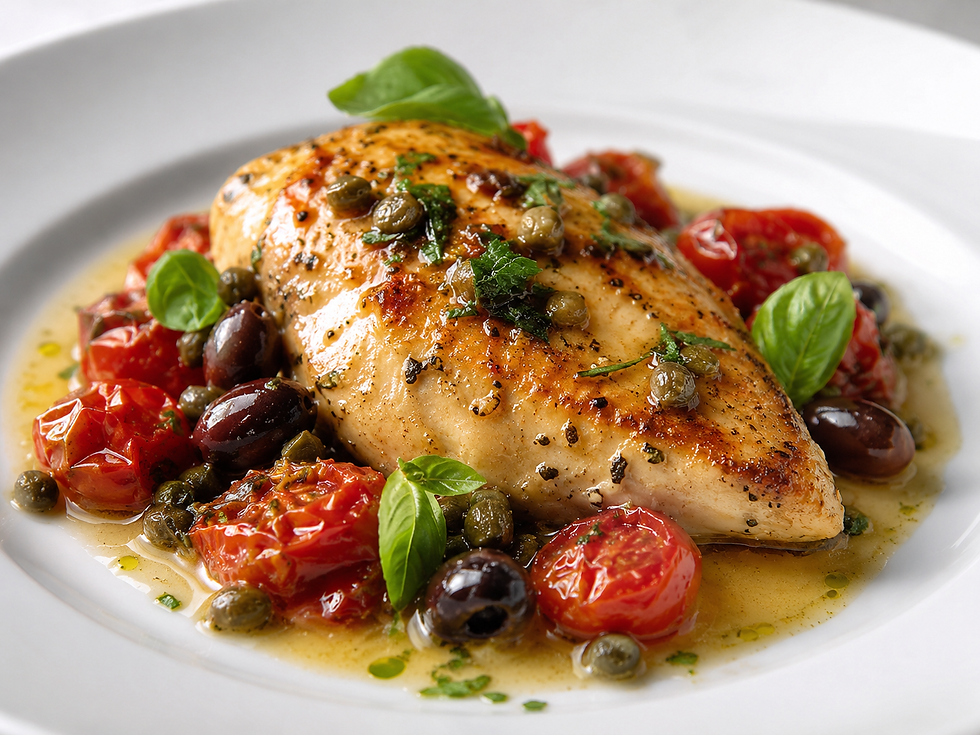
Petto di Pollo alla Valdostana is a chicken breast opened into a pocket, filled with cooked ham and sliced Fontina, sealed, browned in butter, then finished in a moderate oven until the centre is hot and the cheese has softened without escaping. It is a mountain dish in its logic and a technical exercise in its execution, because everything that can go wrong with it goes wrong in the same place: the seam.
The stuffed pocket is not the breaded cotoletta of the Aosta trattorie, where ham and cheese sit on top of a flattened cutlet. Here the filling is inside, protected by meat on both faces, and the breast is sliced at the table so the molten seam shows. That difference changes the entire method of cooking.
Nothing about the shopping list is complicated. What decides the result is how deep the pocket goes, how the Fontina is cut, and whether the breast gets the oven time a stuffed piece of meat genuinely needs.
Yield: 4 servings. Prep: 30 minutes. Chill: 20 minutes. Cook: 25 minutes. Rest: 5 minutes. Total: about 1 hour 20 minutes. Difficulty: intermediate. Course: secondo. Region: Valle d'Aosta.
The Story
Valle d'Aosta is the smallest region in Italy and the highest, a single alpine valley running west from Ivrea to Mont Blanc with side valleys climbing towards Switzerland and Savoy. It is officially bilingual, Italian and French, and for centuries it was a corridor rather than a destination. The cooking that settled there is cooking for cold, made from what survives a winter at altitude: rye bread, cured pork, butter instead of olive oil, and cheese in quantities that would look excessive anywhere south of Turin.
Fontina is the centre of it. It has been made in the valley since at least the thirteenth century, from the raw whole milk of a single herd of Valdostana cows and from one milking, warmed and pressed the same day. The best of it is fontina d'alpeggio, made in summer when the herds are up on the high pastures and matured for three months or more in cool humid cellars, the most famous of them the old military tunnels at Valpelline. The name has been protected since 1957, which matters because the industrial cheese called fontal, sold everywhere and melting quite happily, tastes of almost nothing beside it.
The adjective valdostana on an Italian menu means one thing: ham and Fontina. It was attached first to veal, in the cotoletta alla valdostana that Aosta restaurants have served since the early twentieth century, and it moved to chicken in the 1960s and 1970s when veal grew expensive and chicken breast became the everyday meat of Italian home kitchens. The stuffed pocket belongs to that later domestic history rather than to the old trattoria repertoire, and it is the version most Italian families cook, because a filled breast needs no breadcrumbs and no pan full of frying oil.
Ingredients
For the chicken
Boneless skinless chicken breasts, centre cut and even in thickness, 4 of about 7 oz (200 g) each
Fine sea salt, 1 tsp (6 g)
Freshly ground black pepper, to taste
Freshly grated nutmeg, 1 small pinch
For the filling
Fontina DOP, young, about 4 months, cut into slices 1/8 inch (3 mm) thick, 5 oz (140 g)
Prosciutto cotto, thin slices, 4 slices, about 3 oz (85 g)
Fresh sage leaves, 4
For cooking
All purpose flour, 1/4 cup (30 g), for light dusting
Unsalted butter, 2 tbsp (28 g)
Extra virgin olive oil, 2 tbsp (30 ml)
Dry white wine, 1/2 cup (120 ml)
Chicken stock, low salt, 1/2 cup (120 ml)
For finishing
Cold unsalted butter, cubed, 1 tbsp (14 g)
Flat leaf parsley, chopped, 1 tbsp
Flaky sea salt, to taste
You also need wooden toothpicks or a short length of butcher twine, and an instant read probe thermometer. Oven at 350°F (175°C).
Preparation
Opening the pocket
Lay a breast flat with the thicker side towards your knife hand. Using a thin sharp blade held parallel to the board, cut horizontally into the thick side and work inwards to open a cavity, stopping about 1/2 inch (12 mm) short of the far edge and of both side edges. You are making a pocket with three closed sides, not butterflying the breast. Keep the blade centred so the wall of meat above and below stays equal. Repeat with the other three.
Filling and closing
Season the inside of each pocket with salt, pepper and a trace of nutmeg. Wrap 2 or 3 slices of Fontina inside one slice of prosciutto cotto, slide the parcel in with a sage leaf and push it to the back of the cavity without straining the opening. Close the mouth with two toothpicks set at an angle, or one loop of twine, and season the outside.
Chilling before the pan
Set the stuffed breasts on a rack and refrigerate them uncovered for 20 minutes. Cold firm cheese leaves the pan with the meat still intact, and a dry surface browns far better than a damp one. This rest removes the most common cause of a burst seam.
Flouring
Spread the flour on a plate, turn each breast in it, then pat it hard on both faces so only a fine veil remains. A thick coat goes pasty in the butter and tastes raw. The veil dries the surface and thickens the pan sauce slightly at the end.
Searing for the crust
Heat the oil and butter in a heavy ovenproof pan over medium heat until the butter stops foaming. Lay the breasts in with the smooth closed underside down, never the side holding the toothpicks. Cook 3 to 4 minutes without moving them, until the crust is golden, then turn once and give the second side 3 minutes. Do not press or pierce them.
Finishing in the oven
Transfer the pan to the 350°F (175°C) oven and roast 10 to 14 minutes depending on thickness. Check the temperature in the thickest part of the meat, not in the filling, entering from the side rather than through the seam, and take the pan out at 162°F (72°C), since it climbs to the safe 165°F (74°C) while resting.
Resting and building the sauce
Move the breasts to a warm plate, cover loosely and rest 5 minutes. Put the pan back on medium heat, pour in the wine and scrape up the fond as it reduces by half, about 2 minutes, then add the stock and reduce until the liquid coats a spoon. Off the heat, swirl in the cold butter a cube at a time until the sauce turns glossy. Remove every toothpick before the plate goes out.
Plating
Plates must be hot here, unlike almost every other dish in this repertoire. Fontina sets and goes waxy within a minute on a cool plate, and the point of the preparation is that the filling is still soft when the diner reaches it. Warm four plates in the oven while the meat rests.
Serve each breast whole, or cut it once on the bias and set the two pieces so the cut faces upwards and the seam of ham and cheese is visible. Slice in a single stroke with a sharp knife and do not saw, which drags the filling out. Spoon the sauce around the meat, not over the crust you have just spent seven minutes building.
For the contorno, stay in the valley without repeating the cheese: roasted potatoes with rosemary, savoy cabbage stewed slowly in butter, or braised leeks. A little chopped parsley and a few flakes of salt on the meat, and nothing else on the plate.
Professional Technique
The pocket and its filling are the technique. The horizontal cut has to stop short of the edges, because those three closed sides are the only thing containing the filling once the cheese gives way. Melted Fontina is not a solid that has softened, it is a liquid under pressure inside a cavity that contracts as the muscle fibres tighten, and the pressure looks for the thinnest point, which is decided by the thickness of meat left on each face. Aim for a wall of about 1/2 inch (12 mm) above and below the cavity; a cut that drifts off centre leaves one wall at half that, and the seam opens there.
Placement of the closure matters as much as the cut. Two toothpicks at an angle across the mouth, or one loop of twine, hold the opening while the surface proteins set. What ruins a sound pocket is puncturing the face that goes down first in the pan: it is under real heat and pressure, and any hole there becomes the escape route. Keep the toothpicks on the upper side and the probe out of the seam.
Cut the Fontina into slices, never grated. Grated cheese has enormous surface area and collapses into liquid long before the meat has set, so it runs out while the pocket is still loose. Slices soften only as the breast approaches its final temperature. The prosciutto cotto wrapped around them is the second barrier: it separates the cheese from the wet inner surface of the meat and keeps the filling from sliding as one slippery mass.
The two stage cooking follows from this. The pan gives the crust that only direct contact with hot fat can give, and the moderate oven brings the centre up gently. A stuffed breast reaches temperature much later than bare meat, because the filling enters cold and sits where heat arrives last. In the pan alone, the outside would be dry and dark before the core was safe.
Texture and Moisture Control
Three textures have to arrive together: a crisp golden exterior, chicken that is just cooked and still juicy, and cheese that is molten but not broken. Chicken breast is lean and dries fast above about 170°F (77°C), so pull the pan at 162°F (72°C) and let carryover heat finish the job. Fontina begins to separate into fat and curd above roughly 185°F (85°C), which is the other reason the oven stays moderate: at 425°F (220°C) the filling nearest the wall would break and leak oil while the centre of the meat was still cold.
The rest is not optional. Five minutes lets the fibres relax and reabsorb juice that would otherwise run onto the board, and it lets the filling settle and thicken slightly so it holds together under the knife. Cover loosely, never tightly, or the crust will steam and soften.
Control the sauce the same way. The butter goes in off the heat, one cube at a time, so the fat disperses into the reduced wine and stock instead of splitting; a sauce finished over a flame turns thin and greasy. Reduce far enough that the liquid coats a spoon first, because you cannot reduce it afterwards.
Professional Mise en Place
The stuffing is done well ahead, the cooking is done to order. Once the breasts are filled and chilled, service is a sear, an oven window and a two minute sauce.
Equipment and tools
Thin flexible boning or filleting knife for the pocket
Heavy ovenproof saute pan, wide enough for four breasts without crowding
Instant read probe thermometer
Wooden toothpicks or butcher twine, and a small dish to collect them
Rack and tray for chilling, tongs, small whisk for the sauce
Prepared ahead
Fontina sliced and wrapped in the prosciutto, up to 1 day ahead, refrigerated
Breasts opened, filled, closed and seasoned, up to 8 hours ahead on a rack, uncovered and cold
Flour on a plate, wine and stock measured, butter cubed and kept cold
Contorno cooked and ready to rewarm
Service setup
Oven at 350°F (175°C) and holding, plates warming inside it
Pan hot, butter stopped foaming, breasts out of the refrigerator and dry
Probe within reach, toothpick dish beside the board
Cold butter, parsley and flaky salt lined up for the final minute
Chef Tips
Buy four separate centre cut breasts of similar weight rather than two large ones to split. A breast cut from a very big bird tapers badly, and the thin end is cooked through while the pocket end is still cold.
Use Fontina DOP and check the mark on the rind. Fontal melts easily and behaves well in the pan but brings no flavour at all, and the whole dish rests on the cheese. A young Fontina of about four months is right here; a long matured alpeggio wheel is magnificent alone and too assertive inside chicken.
If a seam opens in the pan anyway, do not fight it. Turn the breast so the opening faces up, move the pan to the oven at once and spoon the escaped cheese back over the meat at the end. The plate is still good.
Count the toothpicks in and count them out. Four breasts, eight toothpicks, eight back in the dish before anything leaves the kitchen.
Common Mistakes
Cutting the pocket too far. A knife that reaches the far edge turns the pocket into an open flap that no toothpick will hold. Stop 1/2 inch (12 mm) short on all three closed sides.
Grating the Fontina. Grated cheese liquefies within a minute and runs out while the meat is still loose. Slice it about 1/8 inch (3 mm) thick.
Putting the toothpicks on the searing side. Every puncture on the face that goes down first becomes a leak under pressure. Keep the closure on the upper side and probe from the flank.
Cooking it entirely in the pan. The filling sits where heat arrives last, so a breast that looks done outside can be well short inside. Sear, then finish at 350°F (175°C) with a probe.
Using prosciutto crudo instead of cotto. Raw cured ham tightens and turns leathery and salty in a closed pocket, and it oversalts the cheese. Cooked ham stays soft and does the barrier job.
Slicing straight away. Cut with no rest and the filling runs onto the plate and the juices onto the board. Five minutes loosely covered fixes both.
Wine Pairing
Valle d'Aosta Petite Arvine: The local white and the most accurate match on the list. Grown on terraces at real altitude, it keeps a tense citrus acidity and a saline finish that cuts through melted Fontina and the butter in the sauce, and its faint grapefruit bitterness answers the salt of the cooked ham. There is enough body to stand up to a whole stuffed breast without any help from oak.
Valle d'Aosta Malvoisie: Pinot Gris under its old Valdostan name, in the dry version. Fuller and rounder than the Petite Arvine, with pear, almond and a note of alpine herbs, it works when the crust is deeply browned and the sauce well reduced. Its texture meets the fat of the cheese on equal terms rather than slicing through it, which makes it the choice for anyone who finds sharp whites austere with butter.
Valle d'Aosta Premetta: A red so pale that it is often taken for a rosato, and almost free of tannin. Serve it at about 55°F (13°C). Red berry fruit and a distinct white pepper edge sit beside the sage and the ham without the tannic grip that would clash with molten cheese, and that low tannin is precisely why a red works with white meat here at all.
Valle d'Aosta Donnas DOC: Nebbiolo grown at the mouth of the valley, lighter and more austere than its Piedmontese relatives, with fine tannin and a mineral, dried rose character. This is the bottle for a portion served with roasted potatoes and plenty of sauce: the tannin has something to hold on to, and the acidity keeps the third mouthful as clean as the first.
Storage & Reheating
Raw stuffed breasts keep better than cooked ones. Filled, closed and left uncovered on a rack, they hold up to 8 hours in the refrigerator and cook straight from cold with 2 extra minutes in the oven. Cooked, they keep 2 days in an airtight container, with the sauce in a separate jar.
Reheat covered in a 300°F (150°C) oven for 12 to 15 minutes with a spoonful of stock in the dish, until the centre reads 140°F (60°C). Never use a microwave: it drives the cheese past the point where it separates and squeezes the breast dry. Rewarm the sauce apart over low heat with a knob of cold butter whisked in.
Uncooked stuffed breasts freeze for up to 1 month, wrapped individually. Thaw overnight in the refrigerator and cook as usual. Do not freeze them once cooked, since the Fontina turns grainy on thawing.
Nutrition
Per serving, based on 4 portions:
Calories: 540 kcal
Total Fat: 31 g
Saturated Fat: 15 g
Trans Fat: 0.5 g
Unsaturated Fat: 15 g
Cholesterol: 185 mg
Sodium: 1080 mg
Total Carbohydrates: 8 g
Fiber: 0 g
Total Sugars: 1 g
Added Sugars: 0 g
Protein: 56 g
Lactose: 0.6 g
Principal micronutrients: calcium, phosphorus, selenium, niacin, vitamin B6, vitamin B12, zinc
These are estimates. Sodium is the figure that moves most, since it depends almost entirely on the ham and on how salty the particular Fontina is.


Comments