
Italian Aosta Valley Fontina Fondue with Poached Egg and Black Truffle | Fonduta Valdostana con Uovo Poché e Tartufo Nero
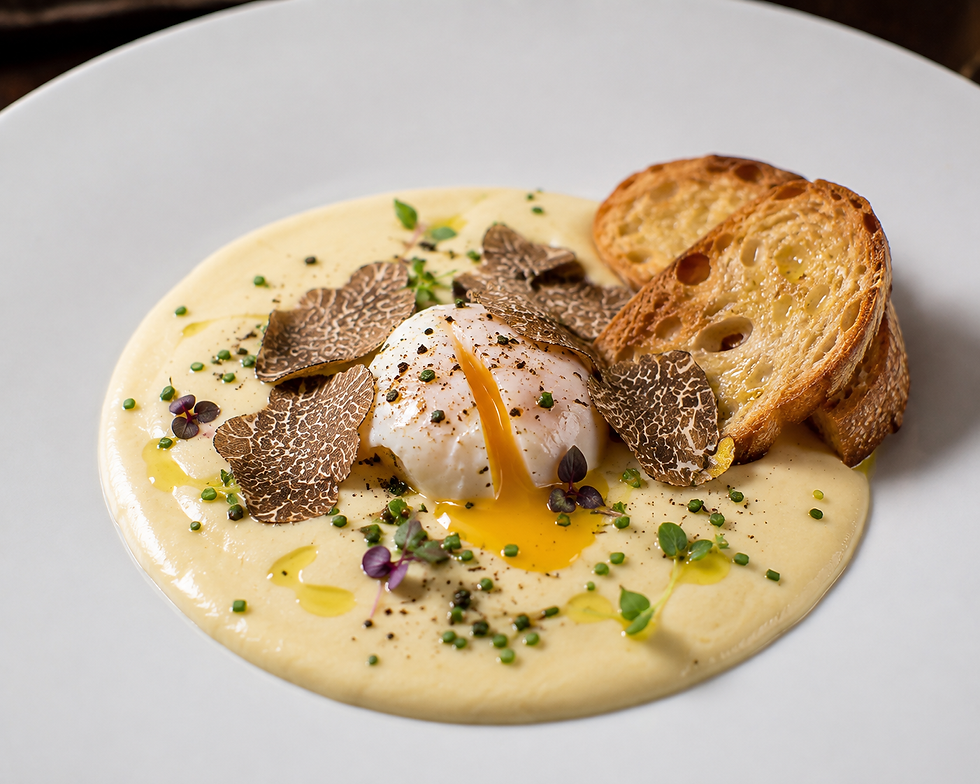
Fonduta valdostana is made of four things and nothing else: Fontina DOP, whole milk, butter and egg yolks. No wine, no kirsch, no starch. What reaches the table is not a sauce thickened with flour but an emulsion held by the cheese's own proteins and the lecithin of the yolks, loose enough to pour and firm enough to hold a poached egg.
That short list is why the dish is difficult. A Swiss fondue carries two insurance policies, the tartaric acid of white wine and a spoonful of cornstarch, and both forgive a pot that gets too hot. The Valdostana version has neither. It relies on soaking the cheese in milk for hours, and on a working temperature so narrow that five degrees the wrong way turn a glossy cream into a stringy mass in a pool of fat.
Add a poached egg and the problem doubles: the white must be set and the yolk liquid while the fonduta below stays under the point at which yolk protein scrambles. Shave black truffle over it and the third variable is aroma, which is volatile and lost to heat.
Yield: 4 servings. Prep: 20 minutes. Soaking: 3 hours minimum, overnight is better. Cook: 25 minutes. Total: about 4 hours including the soak. Difficulty: advanced. Course: antipasto or light main. Region: Valle d'Aosta.
The Story
Fontina is the reason the dish exists, and Fontina is a product of altitude. It is made from raw whole milk of the Valdostana breed, a single milking, worked while still warm from the animal. The curd is heated to around 118°F (48°C), which makes it a semi cooked cheese, then pressed, salted and aged at least three months in cold, very humid cellars. Summer milk comes from cows grazing alpine pasture above 1,700 metres, and that short dense flora gives the wheels their herbal, faintly resinous depth.
Cheese has been made and traded in these valleys for centuries: the frescoes in the courtyard of the Castello di Issogne, painted at the start of the sixteenth century, show a market stall with wheels stacked on it, and eighteenth century documents name Fontina as a product of its own. Fonduta itself is domestic in origin, a way of using broken pieces and the trimmings near the rind, extended with milk because milk was never short.
The truffle is the only element that is not Valdostano. Fonduta with truffle is really a Piedmontese habit, built on the same cheese and finished with white truffle from the Langhe. Black truffle is less pungent, more earthy, survives warm fat better, and holds its own against a cheese as assertive as Fontina. The egg is pure mountain logic: the cheapest way to turn melted cheese into supper.
Ingredients
For the fonduta
Fontina DOP, rind removed, cut into 1/2 inch (1.5 cm) cubes, 1 lb (450 g)
Whole milk, 1 1/4 cups (300 ml)
Unsalted butter, 2 tbsp (28 g)
Egg yolks, large, 4
Fine sea salt, 1 small pinch, only if needed
Freshly ground white pepper, to taste
For the poached eggs
Eggs, as fresh as possible, large, 4
Water, 8 cups (1.9 L)
White wine vinegar, 1 tbsp (15 ml)
Fine sea salt, 1 tsp (6 g)
For the crostini
Valle d'Aosta rye bread or dense sourdough, 4 slices about 1/2 inch (1.5 cm) thick
Unsalted butter, softened, 1 tbsp (14 g)
For finishing
Fresh black truffle, brushed clean, 3/4 oz (20 g)
Extra virgin olive oil, 2 tsp (10 ml)
Freshly ground black pepper, to taste
Preparation
Step 1
Soak the cheese in milk. Trim the rind and any dry edges, then cube the Fontina no larger than 1/2 inch (1.5 cm) so the milk reaches the centre of every piece. Cover with the cold milk and refrigerate at least 3 hours, better overnight. The soak is structural: hydrated casein melts at a lower temperature and holds fat willingly.
Step 2
Set up a proper bain marie. Sit a heavy saucepan or copper bowl inside a wider pan of water, not touching the bottom. Bring the water to a tremble, then drop the heat until the surface is still, between 160°F (71°C) and 175°F (79°C). That holds the upper pan at 140°F (60°C) to 150°F (65°C). Direct heat is not an acceptable substitute at any setting.
Step 3
Melt the Fontina slowly. Soften the butter in the upper pan, then add the cheese with all its soaking milk. Stir constantly with a wooden spoon, scraping the bottom and sides. The cubes lose their edges, the mixture turns grainy, and then between 8 and 12 minutes it pulls together into a glossy pale gold cream. Never let it pass 150°F (65°C).
Step 4
Judge the emulsion before going on. Lift the spoon: the fonduta should coat it evenly and fall in a thick ribbon, about the consistency of warm custard. Threads following the spoon, or fat beading on the surface, mean the pan ran hot and the protein is contracting. Pull it off, add 2 tablespoons of cold milk and beat hard for 30 seconds.
Step 5
Temper and add the yolks off the heat. Take the pan off the water entirely, wait a minute, then whisk two ladles of hot cheese into the yolks one at a time before pouring the mixture back. Give it a minute over the bath, stirring, just enough to thicken without setting.
Step 6
Toast the crostini. Butter the bread lightly on both sides and toast it in a dry pan, or in a 375°F (190°C) oven for about 6 minutes, until crisp outside and still chewy inside. Rye is the Valle d'Aosta answer and its sourness earns its place against the fat.
Step 7
Poach the eggs. Hold the water at 180°F (82°C) with the vinegar and salt, trembling but never bubbling. Crack each egg into a cup, reject any with a loose watery white, and slide it in just above the surface. Poach 3 minutes for a set white and a fluid yolk, then drain on a folded cloth.
Step 8
Hold and serve at once. From here the fonduta lives between 130°F (55°C) and 140°F (60°C). Keep it over the switched off bath, covered, stirred often, loosened with warm milk if it tightens, never with heat. Once the eggs leave the water you have about two minutes, so warm the bowls first.
Plating
Use shallow bowls, warmed to about 120°F (49°C) and no hotter. A cold bowl drops the fonduta out of range within seconds and the surface skins over, while a hot bowl keeps cooking the egg from underneath. Ladle 4 to 5 tablespoons into each and tilt it so the cream settles into an even pool.
Lower the egg into the middle with a slotted spoon, seam side down, so it rests on the surface rather than sinking. Grind black pepper over it and add a few drops of olive oil, which carries the truffle aroma.
Shave the truffle last, at the table, with the slicer set fine and the slices falling on the egg rather than the rim. That is the reason to carry the dish out unfinished: the perfume starts leaving the slices at once, and a bowl shaved in the kitchen arrives with most of it lost. Lean a crostino against the rim and put nothing else in the bowl.
Professional Technique
Fonduta valdostana is a genuine emulsion of casein and milk fat, stabilised by nothing but the cheese, the milk and the yolks. Why no starch goes in explains the method. In a Swiss fondue the wine lowers the pH toward the range where casein disperses most readily, while the cornstarch thickens the water phase and physically stops the fat droplets coalescing: that pot tolerates a boil. The Valdostana recipe refuses both because both flatten the nutty, grassy, faintly bitter character that three months in a cold cellar puts into the cheese.
Hydration replaces them. Fontina is semi cooked, so its moisture is high and its protein network still flexible, and its pH of roughly 5.4 sits close to where casein micelles disperse readily in the presence of calcium. Soaking the cubes in cold milk drives water into that network before any heat arrives, so the melting cheese releases fat into a solution already loose enough to hold it.
Then comes the ceiling. Milk fat is fully liquid by about 95°F (35°C), so fat is never the problem. Casein is. Held between 140°F (60°C) and 150°F (65°C) the protein strands stay extended and keep fat and water suspended between them. Pushed past roughly 160°F (71°C) they contract and knit together, squeezing out everything they held. That is what a broken fonduta is: not curdled in any chemical sense but tightened into a rubbery mass that has let go.
The yolks work on the same margin, which is why they go in off the heat. Yolk lecithin is a powerful emulsifier and gives the fonduta its gloss, but yolk protein thickens at about 150°F (65°C) and sets by 158°F (70°C), the temperature at which the cheese is already at risk, so tempering raises them slowly and their proteins bind water instead of coagulating. The poached egg obeys the same chemistry from the other side: white sets between 145°F (63°C) and 150°F (65°C) while yolk only thickens above 150°F (65°C), and that gap is the entire reason a poached egg works. Water at 180°F (82°C) for 3 minutes sets the white through and leaves the yolk centre below its setting point.
Texture and Moisture Control
Three textures have to coexist: a fonduta that flows but coats, a white that is set and tender, a yolk still liquid, and all three are governed by temperature rather than timing. The fonduta thickens as it cools and tightens as it overheats, and the only safe correction in either direction is milk. A tablespoon of warm milk restores flow without touching the emulsion; heat restores it for thirty seconds and then destroys it.
Moisture control at the plate means draining the egg, which carries a surprising amount of water in the folds of the white and thins the pool into something dull. Five seconds on a folded cloth is enough. The crostini face the opposite risk, so they lean against the rim rather than sit in the cream, and they are toasted to order.
The temperature spread is deliberate: fonduta at 130°F (55°C) to 140°F (60°C), egg straight from the water, truffle at room temperature, bowl barely warm. Too hot and a cheese emulsion tastes of fat alone, its aromatics gone as vapour, and the yolk resting in it sets. Too cold and it turns pasty.
Professional Mise en Place
The dish has a long passive phase and a very short active one, and the last three minutes decide the result.
Equipment and tools
Bain marie: a wide pan of water plus a heavy saucepan or copper bowl inside it
Instant read probe thermometer, the most useful tool in the dish
Wide shallow pan for poaching, slotted spoon, small cups for the eggs
Truffle slicer, soft brush, warmed shallow bowls
Prepared ahead
Fontina cubed and soaking in cold milk, up to 24 hours ahead, refrigerated
Yolks separated and covered, up to 4 hours ahead, at room temperature
Truffle brushed and wrapped in paper in the refrigerator, used the same day
Poaching water measured with the vinegar and salt already in it
Service setup
Fonduta over the switched off bath at 130°F (55°C) to 140°F (60°C), covered, stirred often
Jug of warm milk beside the pan for loosening
Poaching water steady at 180°F (82°C), thermometer in it
Bowls warm to the hand but not hot, crostini toasted last
Truffle, slicer, pepper mill and olive oil on the pass
Chef Tips
Buy Fontina DOP and check the rind for the consortium stamp, a mountain outline over the word Fontina. Fontal, Fontinella and the cheeses sold as fontina style have lower moisture and melt differently, giving a greasy stringy pan however carefully you work.
Use the freshest eggs you can find. A fresh white has a thick inner layer that holds together in water, and that layer thins with age, which is why older eggs spread into rags. Crack each into a cup: if the white runs flat and watery, use that one for the fonduta yolks.
Take the fonduta off the heat slightly looser than you want it. It thickens on standing, again when the yolks go in, and a third time in a warm bowl. The instinct to fix a pan that has gone too thick with heat is what breaks it.
Brushed clean, wrapped loosely in kitchen paper in a closed jar in the refrigerator, a black truffle holds a few days, and the paper wants changing daily. Never store it in rice, which pulls moisture out.
Common Mistakes
Melting the cheese over direct heat. Even on the lowest setting the base of the pan runs well above 160°F (71°C), and the layer touching it tightens and expels fat while the rest is still melting. A bain marie is not a refinement of this recipe, it is the recipe.
Adding starch or flour to be safe. It will stop the fonduta splitting and it will also turn it into a cheese sauce, pasty in texture with the Fontina muffled underneath. If you want that insurance, make a Swiss fondue.
Whisking cold yolks into the hot pan. They reach 158°F (70°C) at the point of contact and set into threads of scrambled egg through the cream. Off the heat, temper them with two ladles of hot cheese first.
Boiling the poaching water. Rolling water tears the white apart and drives heat inward so fast that the yolk firms before the white sets. Hold it at 180°F (82°C), trembling without breaking, for a full 3 minutes.
Shaving the truffle in the kitchen. Its aroma is carried by volatiles that start leaving the slices at once and are largely gone by the time the bowl crosses the room. Carry truffle and slicer to the table instead.
Wine Pairing
Valle d'Aosta Petite Arvine: The regional answer and the best on the list. Grown on terraces along the Dora Baltea, it pairs high natural acidity with a saline, almost mineral finish, and that acidity is what cuts a pool of melted Fontina and four egg yolks. Its grapefruit and white flower register meets the earthiness of the truffle without competing.
Valle d'Aosta Prié Blanc: From ungrafted vines at Morgex and La Salle, among the highest vineyards in Europe, and built almost entirely on acidity: taut, low in alcohol, alpine herb and green apple. The leanness is the point, scrubbing the palate between mouthfuls of a very fat dish where a broader white would add weight to weight.
Alta Langa DOCG: The metodo classico option, and the argument for it is structural: carbon dioxide and a firm dosage lift the cheese off the palate. A bottle with some age brings bready, hazelnut notes from its time on the lees, and those run alongside black truffle remarkably well. Choose brut rather than anything sweeter.
Valle d'Aosta Premetta: For anyone who wants a red with melted cheese, this is the one that works, because it barely behaves like a red: pale in colour, very low in tannin, high in acidity, wild strawberry and white pepper. That matters, since tannin binds to casein and turns the wine metallic. Serve it lightly chilled, around 55°F (13°C).
Storage & Reheating
This is a dish to make and eat, and the poached egg has no storage life at all. Leftover fonduta keeps in an airtight container in the refrigerator for 2 days, setting into a firm block rather like a thick custard. It does not freeze: the emulsion separates on thawing into grainy protein and free fat.
To reheat, put it in a bowl over water held at about 170°F (77°C), add a tablespoon of warm milk for every half cup of cheese and stir patiently. It looks hopeless for two or three minutes and then comes back together. Never use a microwave or direct heat: both create hot spots far above the 160°F (71°C) ceiling.
Poach the eggs fresh, or up to a day ahead held in cold water in the refrigerator, then reheated in water at 140°F (60°C) for 60 seconds and drained. Crostini keep a day in a paper bag and revive in a hot oven for 2 minutes. Use leftover truffle within two days, shaved raw over pasta or eggs.
Nutrition
Per serving, based on 4 servings with one egg each:
Calories: 720 kcal
Total Fat: 54 g
Saturated Fat: 31 g
Trans Fat: 1.5 g
Unsaturated Fat: 19 g
Cholesterol: 430 mg
Sodium: 1,150 mg
Total Carbohydrates: 21 g
Fiber: 2 g
Total Sugars: 5 g
Added Sugars: 0 g
Protein: 36 g
Lactose: 3 g
Principal micronutrients: calcium, phosphorus, vitamin A, vitamin B12, vitamin B2, zinc, selenium
These figures are estimates. Most of the calories come from the cheese, so portion size matters more than any substitution: in smaller bowls as an antipasto the same recipe stretches to six. The sodium depends almost entirely on the Fontina, which is why no salt goes in until it has been tasted.


Comments