
Italian Roasted Mushrooms with Crispy Polenta and Parsley Sauce | Funghi Arrosto con Polenta Croccante e Salsa al Prezzemolo

There are two ways to cook mushrooms and only one leaves the kitchen smelling of the forest. A pan holds perhaps a quarter of what a tray holds, so the mushrooms pile up, the water they shed has nowhere to go, and what should have roasted ends up stewing. The oven gives them room: spread across a hot tray in one layer, with salt held back until the surfaces have coloured, they lose water fast enough to brown instead of grey.
Underneath sits polenta cooked slowly, set overnight, cut into blocks and fried until the outside cracks. That crisp shell over a soft warm middle is the reason the plate works, and it is what Italian mountain kitchens have always done with the polenta nobody finished the day before.
The third element is a raw parsley sauce with capers, lemon and garlic, blended cold so it stays green and aggressive. Roasted mushrooms and fried polenta are both deep and both a little fatty, and without something sharp the plate closes up after four mouthfuls. Nothing here contains dairy or meat, at any stage.
Yield: 4 first course servings. Prep: 30 minutes. Polenta: 45 minutes. Chilling: 4 hours or overnight. Roasting and frying: 45 minutes. Difficulty: intermediate. Course: primo piatto. Region: the Veneto Prealps and the Cansiglio plateau.
The Story
The Cansiglio is a high limestone basin of beech forest above Belluno, shared between the Veneto and Friuli, and for centuries it was the Venetian Republic's timber reserve, guarded because its beeches became the oars and masts of the fleet. Under those beeches lie some of the most productive mushroom grounds in northern Italy, and the villages on its rim, Tambre, Spert, Farra d'Alpago, have collected from it for as long as anyone has written anything down. Autumn there still runs on permits and a daily weight limit.
What those villages ate with the mushrooms was polenta, and polenta twice. The pot was made in the morning, turned out onto a wooden board and cut with a string, and what remained went cold and firm overnight. The next day it was sliced onto the grill plate or into a pan with a little fat, and came back with a crust, which is the better dish. None of this was a refinement: polenta was the flour of poor mountain houses and throwing any away was unthinkable.
The parsley sauce arrives from further west. The Italian green sauce family, bagnet verd in Piedmont and salsa verde across Lombardy and Emilia, was built for boiled meats and depends on parsley, garlic, capers and acidity rather than on cooking. Stripped of the anchovy and egg yolk some versions carry, it belongs to vegetables just as naturally.
Ingredients
For the polenta
Coarse stone ground polenta, 1 1/2 cups (250 g)
Water, 6 cups (1.4 l)
Fine sea salt, 2 tsp (12 g)
Extra virgin olive oil, 2 tbsp (30 ml)
Black pepper, 1/4 tsp (0.5 g)
Olive oil for the tray, 1 tbsp (15 ml)
For the roasted mushrooms
Cremini mushrooms, quartered, 12 oz (340 g)
Oyster mushrooms, torn, 8 oz (225 g)
Shiitake mushrooms, stemmed, 6 oz (170 g)
Extra virgin olive oil, 3 tbsp (45 ml)
Garlic cloves, lightly crushed, 3
Thyme sprigs, 5
Fine sea salt, 1 tsp (6 g)
Black pepper, 1/2 tsp (1 g)
Dry white wine, 1/3 cup (80 ml)
Vegetable stock, 1/2 cup (120 ml)
For the parsley sauce
Flat leaf parsley, packed, 1 cup (30 g)
Extra virgin olive oil, 1/4 cup (60 ml)
Lemon juice, 1 1/2 tbsp (22 ml)
Grated lemon zest, 1 tsp (2 g)
Garlic clove, small, 1
Salted capers, rinsed, 1 tbsp (10 g)
Fine sea salt, 1/4 tsp (1.5 g)
Cold water, 1 to 2 tbsp (15 to 30 ml)
For frying and finishing
Olive oil for shallow frying, 1/3 cup (80 ml)
Walnut halves, 1/3 cup (40 g)
Olive oil for the walnuts, 1 tsp (5 ml)
Flaky sea salt, 1 pinch
Thyme and parsley leaves, a few of each
Preparation
Step 1

Cook the polenta and set it overnight. Bring the water to a boil with the salt already in it, then rain the polenta in through your fingers while whisking hard, so no lump forms. Drop the heat until the surface belches slowly rather than boils and cook 45 minutes, stirring often and scraping the base. It is ready when it pulls cleanly from the side of the pot. Beat in the oil and pepper, spread it 1/2 inch (1.2 cm) thick on an oiled tray and refrigerate uncovered at least 4 hours.
Step 2

Clean and tear the mushrooms for even roasting. Never soak mushrooms. Brush the cremini, wipe the shiitake caps with a barely damp cloth, and pull the oyster clusters apart by hand along their grain. Tear everything to roughly 1 1/2 inches (4 cm), because uneven pieces give scorched edges beside pale wet lumps. Keep the woody stems for stock, and let the cleaned mushrooms sit 20 minutes so surface damp evaporates.
Step 3

Oil, aromatise and spread them in one layer. Heat the oven to 425°F (220°C) with a large heavy roasting tray inside it. Toss the mushrooms with the oil, garlic, thyme and pepper, but keep the salt back. Pull the hot tray out, tip everything onto it and spread the pieces so no two overlap, using a second tray if the first is crowded. They should sizzle loudly on landing. If the tray is silent it was not hot enough.
Step 4
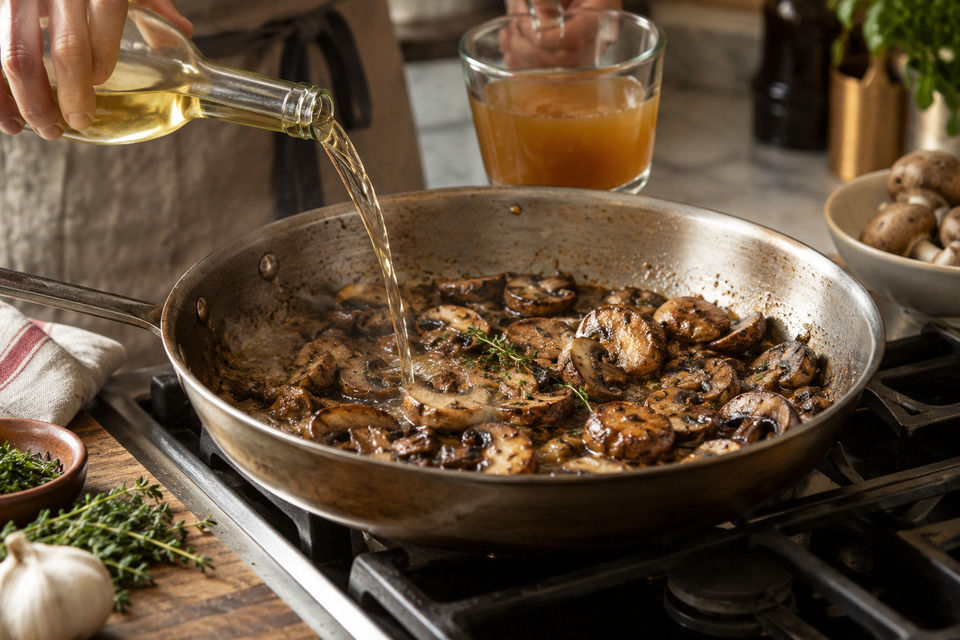
Roast hard, then deglaze and finish. Roast 15 minutes without touching them, turn the pieces with a flat spatula, salt them now that the surfaces have taken colour, and return the tray for 8 minutes. Pour in the wine and stock, scraping the brown film off the base, and roast a final 8 to 10 minutes until the liquid reduces to a few glossy spoonfuls clinging to the mushrooms. Remove the thyme and garlic. They should be deeply browned at the edges and still juicy inside.
Step 5

Blend the parsley sauce cold and keep it cold. Put the parsley, oil, lemon juice, zest, garlic, rinsed capers and salt into a blender and run it in short bursts, scraping down the sides. Heat is the enemy: a blender left running warms the oil and the parsley turns khaki within minutes. Loosen with a tablespoon or two of cold water until the sauce falls from a spoon in a ribbon. It should be sharp enough to make you blink.
Step 6
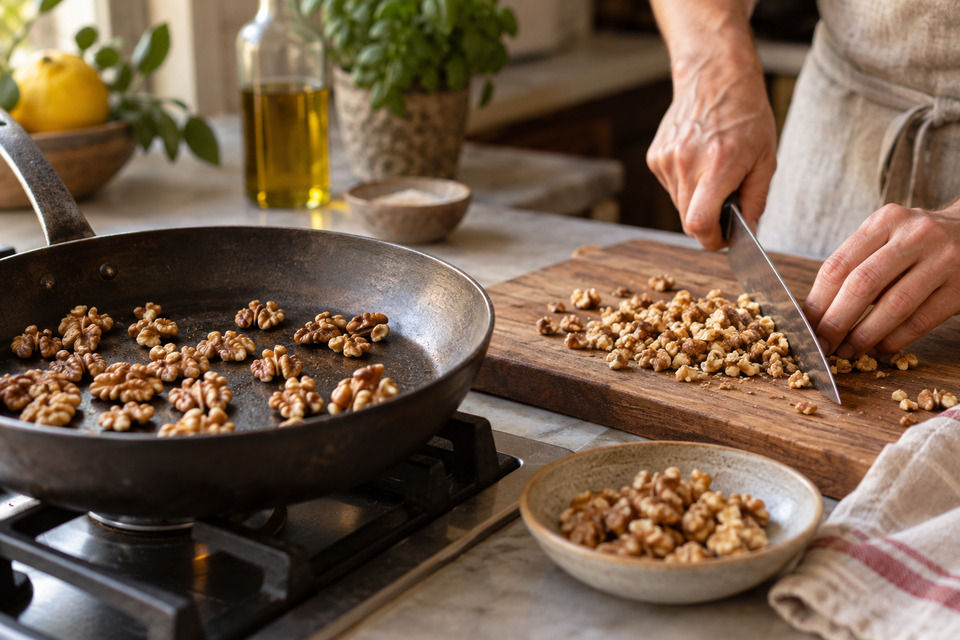
Toast the walnuts and press the polenta dry. Toss the walnuts with the teaspoon of oil and a pinch of flaky salt and give them 7 to 8 minutes in the hot oven, then chop them coarsely. Turn the set polenta out and cut it into 12 rectangles of about 2 by 3 inches (5 by 7 cm). Blot every cut face hard with kitchen paper. A wet surface will not crisp, and this is the step most cooks skip.
Step 7

Fry the polenta and build the plate. Heat the frying oil in a wide heavy pan over medium high heat until a corner of polenta fizzes on contact. Lay the pieces in with space between them and leave them alone for 4 minutes, until a firm golden crust forms and they release by themselves, then turn once and give the second side 3 minutes. Lift onto a rack, never onto paper, and salt at once. Plate immediately: the crust lasts about 5 minutes.
Plating
Use flat plates of about 10 inches (25 cm), warm rather than hot, because a hot plate sweats under fried polenta and costs you the crust. Lay three pieces slightly apart in the middle, never stacked, so air still reaches the fried faces.
Spoon the mushrooms between and partly over the polenta, letting the reduced pan juices fall where they will, and keep at least one fried face of each piece clear of them. Dot the parsley sauce around the mushrooms and in the gaps, not across the top: a green stripe over hot mushrooms dulls within a minute.
Finish with the chopped walnuts, a few thyme and parsley leaves and a grind of black pepper. No extra oil is needed. Carry the plates out at once and tell people to eat the polenta first.
Professional Technique
The central technique is delayed salting on a preheated surface. A mushroom is roughly ninety percent water held in a cell structure that collapses once salt draws on it, which is why salt added at the start guarantees a grey stewed tray whatever the oven temperature. Metal already at 425°F (220°C) flashes off the surface water in the first two minutes, so browning begins before the cells give up their interior moisture, and salting at the halfway turn lets that moisture leave as steam.
The second is the two stage cooking of the polenta, a starch problem rather than a frying one. Long slow cooking fully gelatinises the corn starch and drives off enough water that the mass sets firm when cold; a polenta hurried in twenty minutes stays hydrated and disintegrates in hot oil. Overnight refrigeration then lets that starch retrograde, which is what turns a soft mass into something that holds a cut edge and builds a crust instead of absorbing fat.
The third is the cold blended sauce, which exists to protect chlorophyll. Parsley loses its green to heat and to enzymatic browning, and a blender running for ninety seconds supplies both. Short pulses keep the mixture under about 86°F (30°C), the lemon acid slows the enzyme and the oil limits contact with air. That is why this sauce is built last.
Texture and Moisture Control
Three moisture problems run through this dish at once and they pull in opposite directions. The mushrooms must give up water in the oven but not all of it. The polenta must give up water overnight so that it sets, then keep the rest locked inside while its surface dries in hot oil. The sauce must stay wet and never go near heat.
On the tray the control is surface area and the final deglaze. A crowded tray traps steam and the mushrooms boil; the remedy is a second tray, not a longer roast. The wine and stock at the end are not there to cook anything but to lift the browned film off the metal and carry it back onto the mushrooms as a glaze, which is why they are reduced almost to nothing.
For the polenta, blotting the cut faces and frying genuinely hot separate a crust from a soaked block: oil too cool is absorbed before the surface can set. Fried pieces go onto a rack so steam escapes from below, since on paper they steam themselves soft in two minutes. The plate reads crisp against juicy against sharp for about five minutes, which is why nothing is assembled in advance.
Professional Mise en Place
The polenta puts this dish on a two day timetable, which is an advantage: everything slow happens the day before, and service is one tray and one pan.
Equipment and tools
Heavy pot of 4 quarts (4 l) and a wooden spoon
Rimmed tray for the polenta and a small tray for the walnuts
Two large roasting trays, preheated
Wide frying pan and a rack set over a tray
Blender, flat spatula, bench scraper for clean cuts
Prepared ahead
Polenta cooked, spread and refrigerated, up to 2 days ahead
Mushrooms cleaned and torn, uncovered, up to 4 hours ahead
Walnuts toasted and chopped on the day, kept dry
Capers rinsed, parsley picked, washed and dried
Polenta cut and blotted, up to 1 hour ahead, on a rack
Service setup
Oven and trays at 425°F (220°C) before the mushrooms are tossed
Frying oil heated only in the mushrooms last 10 minutes
Sauce blended at the last moment, left in the jar
Rack ready beside the pan, flaky salt within reach
Plates warm, never hot, garnishes in one small bowl
Chef Tips
Buy coarse stone ground polenta and refuse anything labelled instant. The quick product is precooked and dried, sets into a soft paste rather than a cuttable slab, and will not survive a frying pan. If the only choice is a fine grind, cut the water by a quarter and cook it the full time anyway.
Use three kinds of mushroom rather than one, and treat the tear as part of the recipe. Torn oyster mushrooms give a ragged surface with far more edge than a knife cut face, and those edges are where the colour comes from. If good porcini are in season, replace the shiitake and shorten the first roast by 3 minutes.
Rinse salted capers in several changes of cold water and taste one before it goes into the blender. Capers vary enormously, and the sauce carries only a quarter teaspoon of added salt because the capers do most of that work. Still fiercely salty after rinsing means cut the added salt entirely.
If the polenta refuses to release when you try to turn it, it is not ready. A formed crust lets go by itself, and forcing a spatula under it at three minutes tears the face off. Wait another 30 seconds and try again.
Common Mistakes
Washing the mushrooms under the tap. Mushrooms are absorbent and a rinse adds water the oven must drive off before browning can start, which is why washed mushrooms come out grey. Brush them and wipe them instead.
Salting the mushrooms before they go into the oven. Salt pulls water out of the cells at once, the tray floods and the mushrooms poach in their own juices. Season with oil, pepper and aromatics only, and salt at the halfway turn.
Loading everything onto one tray. Overlapping pieces trap steam and nothing in the middle of the pile will brown. Use two preheated trays and keep a gap between the pieces.
Rushing the polenta. Twenty minutes gives cooked corn flavour but not a set slab, because the starch has not fully gelatinised. Forty five minutes of slow cooking and a night in the refrigerator make it fryable.
Frying polenta with wet faces. Surface moisture turns straight to steam in hot oil, which stops the crust forming and makes the oil spit. Blot every face hard, and blot again if the pieces have been sitting.
Blending the parsley sauce to a smooth purée. A blender left running heats the oil and bruises the leaves, and the green goes army coloured within minutes. Work in short pulses and stop while there is still texture.
Wine Pairing
Ghemme DOCG: Nebbiolo grown on the glacial moraine north of Novara, firmer and more austere than its Langhe cousins, with a distinct iron and dried rose character. That savoury mineral edge extends the roasted mushrooms rather than contrasting with them, and the acidity cuts the oil the polenta has absorbed.
Collio Friulano DOC: The white of the Friulian hills, which finishes on a green almond bitterness most Italian whites lack. That note lines up with the walnuts and the raw garlic instead of arguing with them, and its waxy pear weight has body enough for the polenta.
Etna Rosso DOC: Nerello Mascalese from volcanic sand on the northern slope, pale in the glass but high in acidity, with fine chalky tannin and smoke behind the red fruit. That smoke sits beside the scorched edges of a hard roasted mushroom, and the tannin is light enough not to crush a meatless dish.
Verdicchio di Matelica DOC: The inland Marche Verdicchio, from a cooler valley than the Castelli di Jesi and tighter and more saline for it. Its anise and citrus peel lift finds the lemon and the capers directly, and the acidity resets the palate between mouthfuls of fried polenta.
Dolcetto di Ovada Superiore DOCG: Deep purple, low in acid, moderate in tannin and finishing on the bitter almond note that defines the grape, with a year of ageing ordinary Dolcetto never gets. Its softness suits a plate with no meat and no cheese, and the almond finish answers the walnuts. Serve it at 57°F (14°C).
Storage & Reheating
Store the three components apart, never the assembled plate. Roasted mushrooms keep in an airtight container in the refrigerator for 3 days and are excellent cold on bread. Set polenta keeps on its tray, wrapped, for 2 days; fried polenta does not keep at all. The sauce holds its colour about 6 hours in a sealed jar under a film of oil.
To bring the mushrooms back, spread them on a tray in a 400°F (200°C) oven for 5 to 6 minutes rather than microwaving, which turns them rubbery. A splash of stock restores the gloss. Polenta blocks are recrisped in a hot pan with a teaspoon of oil, about 3 minutes a side, blotted first.
Set polenta freezes well: cut it into portions, freeze them flat and separated, then bag them up to 2 months and fry from frozen over lower heat, about 6 minutes a side. Do not freeze the mushrooms, which collapse on thawing, or the sauce, which separates and browns.
Nutrition
Per serving, based on 4 first course portions:
Calories: 520 kcal
Total Fat: 33 g
Saturated Fat: 4.5 g
Trans Fat: 0 g
Unsaturated Fat: 27 g
Cholesterol: 0 mg
Sodium: 690 mg
Total Carbohydrates: 49 g
Fiber: 6 g
Total Sugars: 5 g
Added Sugars: 0 g
Protein: 11 g
Lactose: 0 g, no dairy in the dish
Principal micronutrients: potassium, copper, selenium, phosphorus, niacin, riboflavin, vitamin K, vitamin D
These figures are estimates. The largest variable is how much frying oil the polenta takes up, which depends on the pan temperature, and the sodium on how well the capers were rinsed.


Comments