

Italian Mezzi Paccheri with Saffron Cream | Mezzi Paccheri alla Crema di Zafferano

Mezzi paccheri are the short version of the wide Neapolitan tube, cut to about half the length of the full pacchero, and they exist for a precise reason: at that size the tube stops collapsing under its own weight and holds sauce inside as well as outside. Every bite delivers twice, once from the abraded exterior and once from the barrel. That makes them the right shape for a sauce that is fluid rather than thick.
The sauce contains no cream. It is built the way a Roman cacio e pepe is built, with grated cheese, starchy pasta water and cold butter whisked into a stable emulsion away from direct heat, then perfumed with saffron that has been steeped rather than scattered. Roasted eggplant folds in for sweetness, torn stracciatella goes on at the last second for cold contrast, and lemon breadcrumbs supply the crunch a soft plate of pasta otherwise lacks. All of it is a matter of timing and temperature rather than difficulty.
Yield: 4 generous first course servings. Prep: 25 minutes. Cook: 40 minutes. Total: about 1 hour 5 minutes. Difficulty: intermediate. Course: primo piatto. Region: Campania and Puglia, with Sardinian saffron.
The Story
Paccheri belong to Naples and to the old Gragnano pasta trade above Castellammare di Stabia, where durum semolina, water from the Monti Lattari and a sea breeze funnelling up the main street dried extruded pasta for centuries. The name comes from the Neapolitan word for a slap, after the noise a wide tube makes landing in a bowl of sauce. The romantic story that the shape was invented to smuggle garlic past northern customs is almost certainly untrue: a large cheap shape simply fed many people from very little flour.
Eggplant arrived in the south through Arab and Sicilian trade and settled into the Mezzogiorno so completely that Campanian and Pugliese cooking are unimaginable without it. Southern cooks historically fried it, because fire was expensive and frying is fast, but dry heat concentrates the sugars in the flesh, so roasted cubes finish sweet and dense rather than saturated with oil.
Stracciatella is the Pugliese half of the plate: the ragged interior of burrata, shreds of pasta filata pulled by hand and loosened with cream, made in the Murgia around Andria since the early twentieth century from mozzarella trimmings. Saffron ties the dish to Sardinia and Abruzzo, the two regions growing Crocus sativus commercially since the Middle Ages, around San Gavino Monreale and on the plain of Navelli.
Ingredients
For the roasted eggplant
Globe eggplant, 2 medium, about 1 3/4 lb (800 g) total
Extra virgin olive oil, 3 tbsp (45 ml)
Fine sea salt, 1 tsp (6 g)
Freshly ground black pepper, to taste
For the saffron cream
Saffron threads, 1 generous pinch, about 0.3 g
Hot water, 1/4 cup (60 ml), at about 150°F (65°C)
Unsalted butter, cold and cubed, 3 tbsp (42 g)
Pecorino Romano DOP, finely grated, 3/4 cup (70 g)
Parmigiano Reggiano, aged 24 months and finely grated, 1/2 cup (45 g)
Reserved pasta cooking water, about 1 1/2 cups (360 ml)
For the lemon breadcrumbs
Fresh breadcrumbs from day old country bread, 1 cup (60 g)
Extra virgin olive oil, 2 tbsp (30 ml)
Grated zest of 1 unwaxed lemon
Fine sea salt, 1 small pinch
Freshly ground black pepper, to taste
For the pasta and finishing
Mezzi paccheri, bronze die and slow dried, 1 lb (450 g)
Coarse sea salt for the pasta water, 2 tbsp (35 g)
Stracciatella di burrata, 10 oz (280 g), at cool room temperature
Extra virgin olive oil for finishing, 2 tbsp (30 ml)
Fresh basil leaves, small, 12 to 16
Preparation
Cutting and Roasting the Eggplant
Heat the oven to 425°F (220°C) with a heavy tray inside it. Cut the eggplants into even cubes of about 3/4 inch (2 cm). Modern globe eggplant is bred low in the bitter compounds that once made salting necessary, so skip it. Toss the cubes with the olive oil, salt and pepper until every face carries a film of oil, then spread them on the hot tray in a single layer with visible gaps between them. Roast 25 to 30 minutes, turning once, until the edges are deep brown and the centres are soft and almost custardy. Set aside at room temperature.
Steeping the Saffron
While the eggplant roasts, put the saffron threads in a small bowl and pour over the hot water, hot to the finger but nowhere near boiling, around 150°F (65°C). Safranal is volatile and degrades in a hot pan, while the colouring compound crocin simply needs time in water. Leave it 20 minutes, until the liquid turns a saturated orange gold that stains a white spoon. Keep the threads in it: they carry aroma the water alone does not.
Toasting the Lemon Breadcrumbs
Pulse the crumb of day old bread to coarse irregular crumbs rather than sand, since uneven crumbs crunch better. Warm the olive oil in a small pan over medium heat, add the crumbs and stir continuously for 4 to 5 minutes. They go from pale to golden very suddenly, so stay with the pan. Pull it off just before they are ready and stir in the lemon zest, salt and pepper with residual warmth only, since zest added earlier turns bitter. Tip onto a cold plate and never cover them.
Salting the Water and Cooking the Mezzi Paccheri
Bring 5 quarts (5 litres) of water to a rolling boil and add the coarse salt once it boils. Taste it: it should be clearly salty, because this water will build the sauce and is the only chance to season the pasta from the inside. Add the mezzi paccheri, stir for 30 seconds so the tubes do not nest, and cook 2 minutes short of the packet time. Ladle out 2 cups (480 ml) of the cloudy water, keep it hot, then drain without rinsing.
Building the Saffron Cream Off the Heat
Use a wide sauté pan, warm but off the flame. Pour in the saffron infusion with its threads and half a ladle of hot pasta water, then whisk in the cold butter one cube at a time until the liquid turns glossy and slightly thickened. Add the grated Pecorino Romano and Parmigiano Reggiano in three or four handfuls, whisking hard between each and loosening with hot pasta water whenever it tightens. Cheese proteins seize and string above roughly 175°F (80°C), which is why this happens away from direct heat. The sauce should pour from the whisk in a ribbon.
Finishing the Pasta in the Pan
Return the pan to low heat, fold in the roasted eggplant, then add the drained pasta and another ladle of hot water. Toss continuously for about 2 minutes, moving the pan rather than stirring, so the starch still leaving the pasta binds with the cheese and butter into a coating that clings. The pasta finishes here, taking on saffron as it goes. If the pan tightens, loosen it; if it looks loose, toss 20 seconds more. Tear the basil in off the heat and taste for salt.
Plating
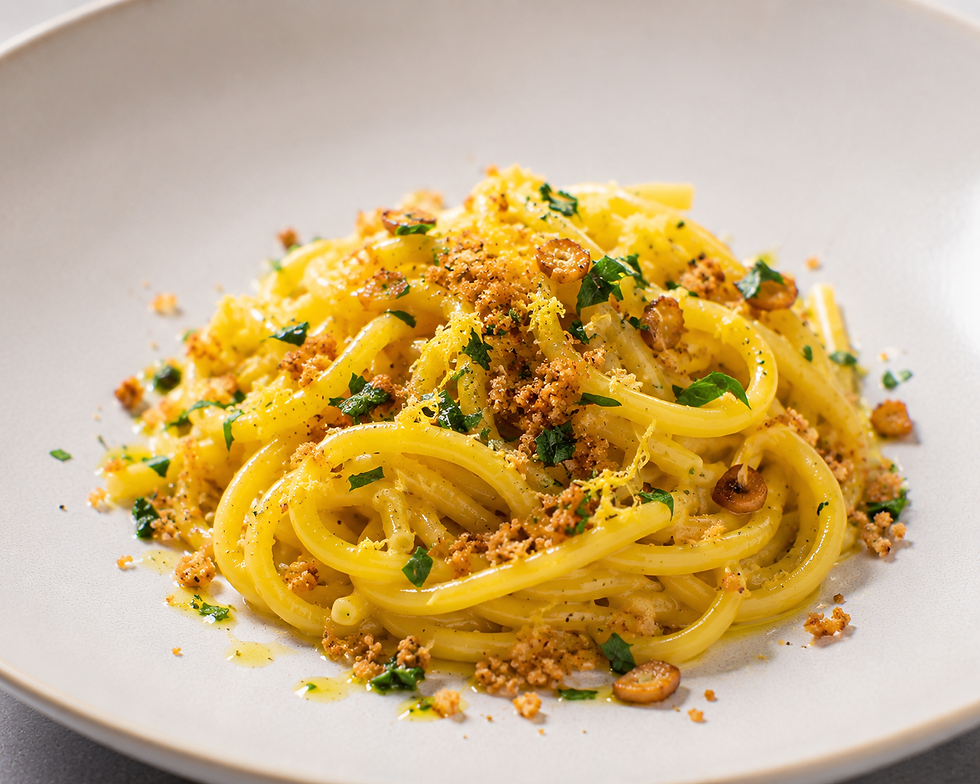
Warm the bowls, but only just. A plate from a hot cupboard melts the stracciatella and wipes out the temperature contrast the dish is built on, while a cold plate sets the sauce into a skin. Hand warm is the target, around 120°F (50°C), in wide shallow bowls with a flat base, so the pasta spreads into a single layer rather than piling up and steaming itself. Spoon it into the centre and let it settle, lifting a few tubes so their open ends face upward. Those visible barrels are the whole argument for the shape. Scrape the pan out over the top.
Tear the stracciatella into loose ragged pieces with your fingers and drop three or four onto each bowl, off centre, never in a neat quenelle. Residual heat softens the outside of each piece while the middle stays cool. Scatter the lemon breadcrumbs over the pasta and around the edge but never directly onto the cheese, where they go soft within a minute. Finish with small basil leaves, a thread of excellent olive oil and a turn of black pepper, and carry the bowls out immediately.
Professional Technique
The technique that defines this dish is the cold butter emulsion, borrowed from a French monté au beurre and applied to a cheese sauce. Butter is roughly 80 percent fat and 16 percent water held together by milk proteins that act as emulsifiers. Whisked in cold, the cubes melt gradually and the fat breaks into droplets small enough to stay suspended. Added melted, or into a boiling pan, the emulsifiers cannot work fast enough and the sauce turns oily. The same logic governs the cheese: both are low moisture, high casein cheeses that disperse smoothly in warm starchy liquid but contract and knit into elastic strings above about 175°F (80°C).
The second technique is treating pasta water as a structural ingredient rather than a thinner. Water that has cooked a pound of bronze die pasta carries a real load of gelatinised amylose and amylopectin, and those long starch molecules coat the fat droplets and prevent them coalescing. That is why the sauce holds with no cream in it, and why the water must be kept hot: cold starchy water in a warm emulsion breaks the structure it is meant to support.
Texture and Moisture Control
Four textures have to arrive together and each fails in its own direction. The pasta must be al dente with a firm pale core, and because it finishes in the sauce it leaves the water two full minutes early. Mezzi paccheri are thick walled and forgiving, but once a tube overcooks the wall softens, the barrel collapses and it can no longer hold sauce. Bite one rather than trusting the packet. The eggplant is the opposite problem: cubes roasted too close together steam in their own vapour, stay pale, and then release that water into the sauce and thin it. The breadcrumbs must stay absolutely dry, uncovered from the pan to the plate, and go on within seconds of service.
The sauce is a moving target because it keeps thickening: starch swells and cheese sets as the temperature falls, so the pan should look slightly too loose when you stop tossing. Draw a spoon across the bottom of the pan and the sauce should close over the line within about two seconds. If it closes instantly it needs another 20 seconds of tossing; if the line holds, add a splash of hot pasta water. Never fix a tight sauce with cold water or more butter, and never fix a thin one by boiling it down, which splits the emulsion.
Professional Mise en Place
The final assembly takes about four minutes and cannot be paused, so everything else is finished and standing before the pasta goes into the water.
Equipment and tools
Wide sauté pan, at least 12 inches (30 cm), deep enough to toss a pound of pasta
Heavy roasting tray, preheated, and a cold plate for the crumbs
Balloon whisk and a fine rasp grater
Stockpot of 5 quart (5 litre) capacity or more, and a ladle
Instant read thermometer for the saffron infusion
Prepared ahead
Eggplant roasted up to 4 hours ahead, left at room temperature, never refrigerated
Breadcrumbs toasted up to 6 hours ahead, kept uncovered in a dry place
Pecorino and Parmigiano grated fine and combined in one bowl
Saffron infusion started 20 minutes before the pasta goes in
Stracciatella out of the refrigerator 20 minutes ahead, cool and not cold
Service setup
Pasta water at a rolling boil and properly salted
Two cups of hot pasta water ladled out beside the sauté pan
Cold cubed butter and grated cheese within reach of the whisking hand
Bowls warmed to hand temperature only, basil torn at the last second
Breadcrumbs and stracciatella at the pass, added after plating
Chef Tips
Buy saffron in threads, never in powder, which is routinely cut with turmeric, safflower or paprika in a fraud that is invisible once it dissolves. Whole threads should be deep red with a paler trumpet at one end. A good pinch is enough for four: doubling it does not double the perfume, it pushes the dish towards medicinal bitterness.
Choose bronze die mezzi paccheri. The rough plate leaves a microscopically abraded surface that both grips sauce and releases far more starch into the water. Teflon die pasta is smooth and glassy and gives up almost nothing, so the sauce will never bind however well you whisk.
Taste the cheese before grating. Pecorino Romano varies enormously in salt between producers, and a salty batch takes the dish past correction once the pasta water goes in. If yours is aggressive, shift the ratio towards the Parmigiano and cut the salt in the pasta water by a third.
If the sauce splits it is recoverable. Take the pan off the heat, add two tablespoons of hot pasta water and whisk hard in one direction only until it comes back together. Adding more cheese makes it worse, and returning the pan to the flame guarantees the loss.
Common Mistakes
Adding the cheese to a pan still on the flame. The commonest failure, and it produces a stringy mass with a slick of oil around it. Grated hard cheese seizes above roughly 175°F (80°C). Build the emulsion off the heat and return the pan to a low flame only once the sauce is smooth.
Crumbling the saffron straight into the sauce. You get the colour and almost none of the aroma, because volatile safranal is driven off by direct heat. Steep the threads 20 minutes at about 150°F (65°C) and pour the liquid in with the threads.
Crowding the eggplant on the tray. Cubes packed edge to edge release water faster than the oven can drive it off, so they steam and turn spongy instead of caramelising. Use two trays, preheat the metal, and leave clear space between the pieces.
Cooking the pasta fully in the water. Tubes that reach al dente in the pot then spend two more minutes in the sauce arrive soft and collapsed. Drain two minutes early and let the sauce finish the job.
Wine Pairing
Fiano di Avellino DOCG: The Campanian white from the same province as the pasta, and the most complete match here. Fiano has real weight and a waxy texture that stands up to a butter and pecorino emulsion instead of vanishing under it, and its hazelnut and smoked note runs alongside the toasted breadcrumbs. A bottle with two or three years on it picks up the honeyed edge of the saffron.
Greco di Tufo DOCG: Sharper and more mineral than Fiano, from sulphur bearing volcanic soils just north of Avellino. Its high acidity and stony bite reset the palate between forkfuls, and the bitter almond finish answers the black pepper and lemon zest. Choose it over the Fiano when your pecorino is salty, because the acid keeps the salt in check.
Locorotondo DOC: The white of the Valle d Itria, from the same corner of Puglia that produces the stracciatella. Verdeca and Bianco d Alessano give a light dry wine with green apple fruit, low alcohol and a clean bitter finish that refreshes rather than competes, which is what you want when the saffron should stay the loudest aroma on the table.
Etna Bianco DOC: Carricante grown at altitude on volcanic ash gives a taut, saline, high acid white with a struck flint character. That salinity lifts the sweetness of the roasted eggplant and stops the stracciatella reading as merely rich. Serve at 50°F (10°C) and give it a few minutes in the glass, because it is closed on opening.
Storage & Reheating
Dressed pasta in a cheese emulsion is a dish to eat immediately. Leftovers keep refrigerated in an airtight box for up to 2 days, but the sauce sets firm and loses its gloss overnight as the starch retrogrades. Reheat in a wide pan over low heat with 2 to 3 tablespoons of water or light stock per portion, tossing gently until it loosens and coats again, and stop the moment it is hot through. A microwave pushes the cheese past the point where it separates. Add stracciatella, breadcrumbs and basil fresh.
The components keep much better separately. Roasted eggplant holds 3 days refrigerated and reheats in a hot oven in 5 minutes, or freezes 2 months. Toasted breadcrumbs keep 5 days in a jar at room temperature and revive in a dry pan. Stracciatella must be used within 2 days of opening and never frozen, since the cream separates and the curd turns rubbery. Do not freeze the finished dish.
Nutrition
Per serving, based on 4 first course portions:
Calories: 820 kcal
Total Fat: 38 g
Saturated Fat: 18 g
Trans Fat: 0.6 g
Unsaturated Fat: 18 g
Cholesterol: 85 mg
Sodium: 1150 mg
Total Carbohydrates: 92 g
Fiber: 8 g
Total Sugars: 9 g
Added Sugars: 0 g
Protein: 31 g
Lactose: about 2 g
Principal micronutrients: calcium 620 mg, phosphorus 520 mg, potassium 700 mg, vitamin A, vitamin B12, manganese
These figures are estimates. Most of the salt in the cooking water is discarded with it, but the pecorino contributes a great deal of sodium and the figure moves with the producer. Served as a smaller primo inside a longer meal, every number drops by roughly a third.




Comments