
Italian Sicilian Spaghetti | Spaghetti alla Norma
Updated: Sep 13

Spaghetti alla Norma takes the essential flavors of the great Catanese classic and applies them specifically to long pasta.
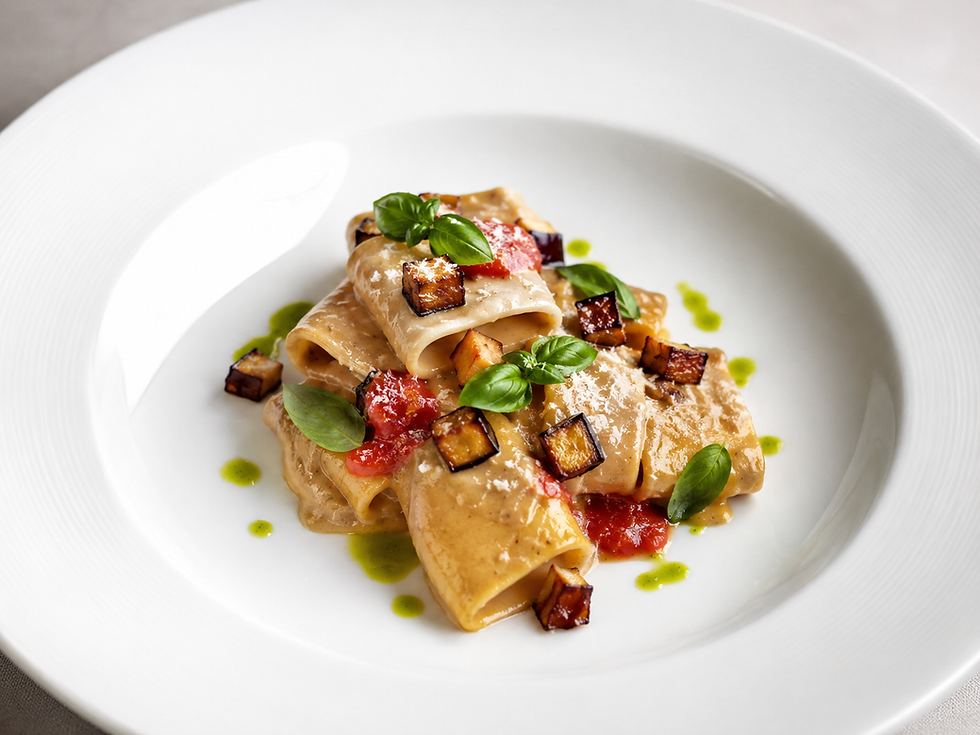
The identity remains unmistakably Sicilian: fried eggplant, ripe tomato, basil, and ricotta salata. What changes is the way the sauce has to be handled.
With rigatoni or maccheroni, pieces of eggplant and tomato can settle naturally inside and around the pasta. With spaghetti, the sauce needs to be smoother and more emulsified so that it clings evenly to every strand.
The eggplant therefore needs two different roles.
Part of it is incorporated into the tomato sauce, helping create body and flavor.
The best fried pieces are reserved for finishing, so the final dish still has the creamy texture and unmistakable character of properly fried eggplant.
The result should be glossy, intensely tomato-scented, aromatic with basil, and finished with enough ricotta salata to provide the salty sheep's-milk character that defines Pasta alla Norma.
The Catanese Origins
Pasta alla Norma belongs to Catania, Sicily.
Its identity is traditionally connected with the celebrated Catanese composer Vincenzo Bellini and his opera Norma.
According to the best-known local tradition, describing something as “una Norma” became a way of saying that it was exceptional, perfect, or worthy of comparison with Bellini's masterpiece.
Whatever the precise path by which the name entered culinary history, the association between Catania, Bellini, and Pasta alla Norma has become inseparable from the dish.
This spaghetti version does not attempt to change those foundations.
It simply treats the traditional ingredients specifically for long pasta.
Servings
4
Prep Time
25 minutes
Eggplant Resting Time
30 minutes
Cook Time
40 minutes
Total Time
Approximately 1 hour 35 minutes
Ingredients
For the Eggplant
2 medium Italian eggplants, approximately 1 1/2 pounds total
1 teaspoon kosher salt
Neutral frying oil, such as sunflower or vegetable oil
For the Tomato Sauce
3 tablespoons extra-virgin olive oil
2 garlic cloves, lightly crushed
28 ounces whole peeled tomatoes
8 fresh basil leaves
1/2 teaspoon kosher salt, plus more as needed
Freshly ground black pepper
For the Pasta
12 ounces spaghetti
Kosher salt for the pasta water
1 cup reserved pasta water
For Finishing
1 cup finely grated ricotta salata
Fresh basil leaves
Extra-virgin olive oil
Freshly ground black pepper
Preparation
1. Prepare the Eggplant
Wash and dry the eggplants.
Trim the ends.
Cut one eggplant into rounds approximately 1/4 inch thick.
Cut the second into medium cubes.
Using two cuts gives the finished dish more texture.
The cubes integrate naturally into the spaghetti.
The rounds can be reserved for a cleaner final presentation.
2. Salt the Eggplant
Place the eggplant in a colander.
Season lightly with kosher salt.
Allow it to stand for approximately 30 minutes.
Modern eggplants are generally less bitter than older varieties, but salting still helps remove surface moisture and improves frying.
3. Dry Completely
Pat every piece thoroughly dry.
This step is essential.
Moisture lowers the temperature of the frying oil and encourages the eggplant to absorb more fat.
Dry eggplant fries faster and develops better color.
Preparing the Tomato Sauce
4. Infuse the Olive Oil
Heat the extra-virgin olive oil in a wide saucepan over medium-low heat.
Add the crushed garlic.
Cook gently for approximately 1 minute.
The garlic should release aroma without turning dark brown.
5. Add the Tomatoes
Crush the peeled tomatoes by hand.
Add them to the pan.
Season lightly with salt and black pepper.
Add several basil leaves.
Bring to a gentle simmer.
6. Cook Until Concentrated
Cook uncovered for approximately 20 to 25 minutes.
The sauce should become concentrated while preserving the fresh character of the tomatoes.
Remove the garlic.
Do not cook the tomato sauce until it becomes dark and excessively sweet.
Norma should remain bright.
Frying the Eggplant
7. Heat the Oil
Heat approximately 1 inch of neutral oil to 350°F.
Maintain the temperature as steadily as possible.
8. Fry in Small Batches
Fry the eggplant without overcrowding the pan.
The cubes will generally require approximately 2 to 3 minutes.
The rounds may take slightly longer.
The exterior should become golden while the center turns creamy.
9. Drain Correctly
Transfer the fried eggplant to a wire rack or absorbent paper.
Season very lightly with salt.
Reserve the best-looking rounds for serving.
Integrating the Eggplant
10. Add Part of the Cubed Eggplant to the Sauce
Place approximately half of the fried eggplant cubes into the tomato sauce.
Using the back of a wooden spoon, crush only some of them.
Do not completely purée them.
This creates a thicker tomato-and-eggplant sauce capable of adhering to spaghetti.
Leave the remaining cubes intact.
Cooking the Spaghetti
11. Boil the Pasta Water
Bring a large pot of water to a rolling boil.
Season generously with kosher salt.
Add the spaghetti.
12. Cook Firmly Al Dente
Cook approximately 2 minutes less than the package instructions.
The spaghetti will finish inside the sauce.
13. Reserve Pasta Water
Before draining, reserve at least 1 cup.
The starch will allow the tomato and eggplant mixture to bind to the spaghetti.
14. Finish the Spaghetti in the Sauce
Transfer the spaghetti directly into the tomato sauce.
Add approximately 1/4 cup pasta water.
Toss vigorously over medium heat.
The sauce should begin clinging evenly to every strand.
15. Add the Remaining Eggplant
Add the remaining fried eggplant cubes.
Toss much more gently now.
You want to maintain visible pieces.
16. Add Ricotta Salata
Reduce the heat to low.
Add approximately one-third of the ricotta salata.
Toss.
Add a little pasta water if needed.
The cheese should season the pasta but not turn it dry.
Why Spaghetti Changes the Technique
Spaghetti does not hold chunky sauce in the same way as rigatoni.
A sauce made entirely from large pieces of eggplant and tomato tends to fall to the bottom of the plate.
By crushing part of the eggplant into the tomato, we create a naturally thicker coating.
The remaining pieces maintain the identity and texture of Norma.
This allows the same traditional ingredients to work properly with long pasta.
Why Ricotta Salata Matters
Ricotta salata is fundamentally different from fresh ricotta.
It is salted, pressed, and aged until firm enough to grate.
Its sheep's-milk flavor gives Pasta alla Norma the salty finishing note that balances both sweet tomato and creamy eggplant.
Parmigiano does not provide the same result.
For this dish, use ricotta salata whenever possible.
Professional Technique
Salt the cooking water correctly, reserve starchy pasta water, and finish the pasta in the sauce whenever the recipe allows. Fresh pasta requires gentler handling and much shorter cooking than dried pasta. The sauce should coat the pasta rather than pool beneath it, and final seasoning should be adjusted only after cheese, cured meat, or other salty components are incorporated.
Chef Tips
Fry the eggplant properly
Do not try to save the dish by frying at low temperature.
Keep some eggplant intact
Texture is part of Norma.
Use a wide pan
Spaghetti needs room for proper tossing.
Finish pasta in the sauce
Never put plain spaghetti on a plate and spoon Norma sauce on top.
Use pasta water carefully
A little starch transforms the sauce.
Add ricotta salata gradually
It is relatively salty.
Mistakes to Avoid
Making the Eggplant Greasy
Usually caused by oil that is too cool.
Using Too Much Tomato Sauce
The eggplant must remain equally important.
Cutting All the Eggplant Too Small
The dish loses texture.
Using Fresh Ricotta
Fresh ricotta creates an entirely different result.
Overcooking the Spaghetti
The pasta still needs time in the sauce.
Adding Too Much Ricotta Salata
The dish becomes dry and salty.
Serving and Presentation
Twist the spaghetti into a low, controlled mound in the center of a warm shallow bowl.
Place several golden eggplant pieces around and over the spaghetti.
Add one or two fried eggplant rounds naturally against the pasta.
Finish with ricotta salata.
Add fresh basil.
Finish with a few drops of excellent extra-virgin olive oil.
Do not construct an artificial tower.
The visual identity should remain obviously Spaghetti alla Norma.
Chef Gianluca’s Recommendation
Spaghetti alla Norma requires slightly more sauce integration than a short-pasta version.
Do not simply change rigatoni to spaghetti and call the recipe finished.
Crush some of the fried eggplant into the tomato.
Keep other pieces whole.
Use enough pasta water to create an emulsion.
Then finish with ricotta salata and basil.
The result should taste completely traditional while behaving properly as a spaghetti dish.
Wine Pairing
Moscato d’Asti DOCG — aromatic sweetness and fresh acidity match the dessert without making the finish heavy.
Vin Santo del Chianti Classico DOC — oxidative complexity and balanced sweetness complement baked, nutty and pastry flavors.
Brachetto d’Acqui DOCG — red-fruit perfume and gentle sparkle refresh the palate between sweet bites.
Nutrition per Serving
Approximate nutrition per serving: 540 calories, 0.63 oz protein, 2.54 oz carbohydrates, 0.71 oz fat, 0.28 oz saturated fat, 0.14 oz fiber, 0.18 oz sugars, 620 mg sodium, and 55 mg cholesterol. Values vary with the exact ingredients and portion size.
Storage and Reheating
Cool leftovers promptly and refrigerate in an airtight container for up to 3 days. Reheat gently with a small amount of stock, water, or sauce as appropriate. Avoid repeated reheating because it damages texture and can dry proteins or overcook starches.




Comments