
Italian Sicilian Baked Paccheri alla Norma | Paccheri alla Norma al Forno
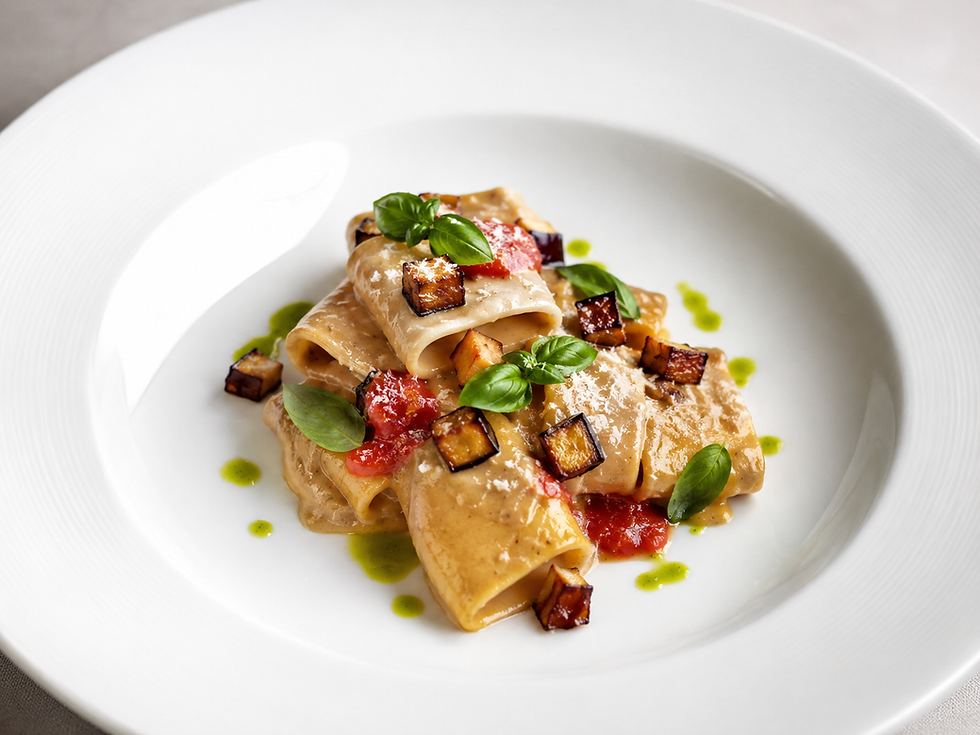
There are two ways to eat Norma in Sicily. One is the weekday plate, tossed in the pan and carried to the table while the eggplant is still slick with oil. The other goes into the oven, and it is the one families make when there are more people than chairs: large paccheri, fried eggplant, a tomato sauce cooked down further than a pan version needs, ricotta salata worked through the whole dish rather than showered on at the end, and thirty minutes of dry heat that turns the rims of the tubes brittle.
This is that second version, and it is not a lighter Norma. Baking changes the dish completely: the sauce tightens and grips, the eggplant loses the last of its sponginess and turns silky, the cheese goes from a fresh salty note to a browned savoury crust. What you lose is the perfume of basil hitting a hot pan. What you gain is depth, structure and a dish that improves while it sits.
Paccheri are the right shape and not a decorative choice. Their walls survive both a boil and a bake, and their open ends trap sauce and eggplant inside the tube, so every piece arrives loaded rather than coated. The method rests on one idea: everything reaches the dish short of done, because the oven finishes it all at once.
Yield: 6 servings. Prep: 45 minutes. Salting the eggplant: 45 minutes. Cook: 1 hour 10 minutes. Rest: 15 minutes. Total: about 2 hours 45 minutes. Difficulty: intermediate. Course: primo. Region: Sicily, Catania and the eastern slopes of Etna.
The Story
Every element of Norma arrived in Sicily from somewhere else and then refused to leave. The eggplant came with Arab agriculture around the ninth century, along with rice, citrus and sugar cane, and for a long time the rest of Europe treated it with suspicion while Sicilian cooks got on with frying it. The tomato arrived far later, from the Spanish colonies, and settled on the volcanic soils of the Etna foothills, where a wide daily temperature swing concentrates sugar and acidity at once. Neither is native. Both are now unthinkable without the island.
The third element is the one people outside Sicily get wrong most often. Ricotta salata is neither ricotta nor parmesan. It is sheep milk ricotta pressed, salted and aged at least three months until firm enough to grate into flakes, dry, milky and sharply saline. In the Iblei hills south of Catania it is still made from flocks grazing on wild thyme and clover, and it is what keeps this dish from tasting like any other tomato pasta.
The baked version belongs to the domestic calendar rather than the restaurant one. In and around Catania a teglia of pasta going into the oven has always meant a Sunday, a feast day or a house full of relatives, because it can be built hours ahead and feeds a crowd from one dish. That practicality shaped the recipe: thicker sauce, shorter boil, cheese folded in rather than sprinkled over. Those are not refinements, they are what the oven demands.
Ingredients
For the eggplant
Globe eggplant, firm and heavy, 2 1/4 lb (1 kg), about 3 medium
Coarse sea salt for purging, 2 tbsp (30 g)
Sunflower or peanut oil for frying, 3 cups (700 ml)
For the tomato sauce
Extra virgin olive oil, 3 tbsp (45 ml)
Garlic cloves, lightly crushed and left whole, 3
Canned San Marzano tomatoes, crushed by hand, 28 oz (800 g)
Tomato passata, 1 cup (240 ml)
Fine sea salt, 1 tsp (6 g)
Granulated sugar, 1/2 tsp (2 g), only if the tomatoes are sharp
Fresh basil, a large sprig plus 12 leaves for layering
For the pasta and the cheese
Dried paccheri, bronze die, 1 lb 2 oz (500 g)
Water for boiling, 6 quarts (5.7 liters)
Coarse sea salt for the water, 2 tbsp (36 g)
Ricotta salata, aged at least 3 months, 7 oz (200 g)
Caciocavallo Ragusano, coarsely grated, 3 oz (85 g)
For finishing
Extra virgin olive oil for the dish and top, 2 tbsp (30 ml)
Ricotta salata, reserved from the 7 oz above, 2 oz (55 g)
Freshly ground black pepper, to taste
Basil leaves, small, 6 to 8
Preparation
Salting and purging the eggplant
Cut the eggplant into cubes of about 3/4 inch (2 cm), skin on. The skin holds each cube together through frying and baking, and without it you end up with pulp. Layer the cubes in a colander with the coarse salt, weight them with a plate and leave them over the sink for 45 minutes. Bitter juice runs out and the cell structure collapses slightly, so the eggplant absorbs far less oil later. Rinse under cold water, then dry the cubes between clean towels: surface water spits in hot oil and steams the eggplant instead of frying it.
Frying the eggplant in batches
Heat the frying oil in a deep pan to 340°F (170°C), checking with a thermometer rather than by eye. Fry in three or four batches, never crowding the pan, 3 to 4 minutes each, until deep gold and soft when pressed. Crowding drops the oil temperature, and eggplant fried in cool oil drinks it. Lift each batch onto a rack over a tray rather than onto paper, so steam escapes underneath. Season very lightly, since the purging salt and the ricotta salata are both still to come.
Building the tomato sauce
Warm the olive oil in a wide saucepan over medium low heat with the crushed garlic, let it turn pale gold without colouring further, around 3 minutes, then lift the garlic out. Add the hand crushed tomatoes, the passata, the salt, the basil sprig and the sugar if the tomatoes need it, and cook uncovered at a lazy simmer for 35 to 40 minutes. Reduce further than you would for a pan tossed Norma, until a spoon dragged across the base leaves a channel that closes slowly. A loose sauce turns a baked pasta into soup.
Grating and splitting the cheese
Grate the ricotta salata on the coarse side of a box grater, not a fine microplane, so it stays in flakes instead of dissolving into the sauce. Divide it: 5 oz (145 g) goes through the pasta, 2 oz (55 g) is held back for the top. Grate the caciocavallo separately. It melts and browns, ricotta salata does not, and the top needs both, one for the crust and one for the salt.
Boiling the paccheri short
Bring the water to a rolling boil and salt it at the rate given above. Slide the paccheri in and stir them apart in the first thirty seconds, when they stick most readily. Cook for exactly two thirds of the package time, around 8 minutes of a 13 minute pasta, so they stay stiff and clearly underdone in the centre. This is the most important timing in the recipe, because the tubes keep absorbing sauce for the whole half hour in the oven. Reserve 1 cup (240 ml) of the water before draining, and never rinse the pasta.
Combining off the heat
Drain the paccheri and return them to the warm pot off the heat. Add three quarters of the tomato sauce and toss gently, loosening with a spoonful of the reserved water if the sauce grips too tightly. Its starch makes the sauce cling to the walls of the tubes rather than run off them. Fold in two thirds of the fried eggplant and the 5 oz (145 g) of ricotta salata, moving the spoon under and over instead of stirring in circles so the cubes stay whole. Taste now: it is the last moment seasoning can be corrected.
Layering the dish
Oil a baking dish of about 9 by 13 inches (23 by 33 cm) and spread two spoonfuls of the remaining sauce across the base. Add half the pasta, scatter over half the reserved eggplant and half the basil leaves, then a little more sauce. Add the rest of the pasta, standing the top tubes with their open ends upward wherever you can, since those exposed rims are what crisp. Finish with the last sauce, the caciocavallo, the reserved ricotta salata, black pepper and a thread of olive oil.
Baking and resting
Bake at 400°F (200°C) for 25 to 30 minutes, uncovered from the start, until the top is blistered and brown in patches and the sauce bubbles at the edges. If the surface colours before the centre is hot, drop the oven to 375°F (190°C) rather than covering it, because foil traps steam and softens the crust. Then leave it alone for 15 minutes: a baked pasta straight from the oven will not hold a cut portion and floods the plate.
Plating
This is served from the dish it was baked in, and trying to make it look like restaurant food does it no favours. Use a large metal spoon rather than a spatula, cut straight down through all the layers and lift a square portion out intact. Take the first portion from a corner, where the crust is best and where the gap makes every later portion easier to release.
Serve on warm plates, not hot ones, crust side up so the browned surface is the first thing anyone sees. Scatter two or three small basil leaves and a little grated ricotta salata, enough to read as fresh salt against the baked cheese underneath. No oil at the table: there is already enough in the eggplant.
Professional Technique
The method turns on one principle: in a baked pasta every component arrives at the dish undercooked, because the oven is not a reheating step but the final third of the cooking. The paccheri come out of the water stiff, the sauce goes in thicker than it should taste, the eggplant is fried to softness but not to collapse. Half an hour at 400°F (200°C) then drives sauce into the pasta walls, drives moisture out of the top and brings all three to the same finished point at once. Cook any of them to completion first and the oven can only ruin it.
The second technique is the deliberate split of the cheese into two roles. Ricotta salata is a pressed, aged, low moisture cheese that carries salt and milky sharpness but will not melt into a sheet, which is why it can be folded through the pasta without disappearing and survives the bake as flakes. Caciocavallo, a stretched curd cheese, melts, pools and browns. Only the first gives a dish with no crust. Only the second tastes of melted cheese instead of Sicily.
Texture and Moisture Control
Moisture is the enemy of every baked pasta, and here there are three sources of it: water inside the boiled paccheri, water in the tomato sauce, and frying oil in the eggplant. The pasta is pulled early and never rinsed, so it takes in sauce rather than water. The sauce is reduced until a dragged spoon leaves a channel, roughly a third tighter than a pan sauce. The eggplant drains on a rack rather than on paper, where trapped steam would soften it back into a sponge.
The reserved cooking water is the one thing that adds moisture on purpose, and it goes in by the spoonful and no more. Its dissolved starch lets the sauce hold the smooth outer wall of a paccheri instead of sliding to the bottom of the dish. The coated pasta should look glossy and slightly wet in the pot, never soupy.
Baking uncovered throughout is what makes the top layer work, since steam under foil softens the rims and turns browned cheese into pale skin. The fifteen minute rest is the same logic in reverse: as the dish cools, the starch that gelatinised in the oven sets and reabsorbs free liquid, which is why a portion cut at five minutes runs and one cut at fifteen holds.
Professional Mise en Place
Almost all of this dish can be built in advance, which is the reason it exists. Only the baking and the rest are last minute, and an assembled dish can wait several hours before it goes in the oven.
Equipment and tools
Deep heavy pan for frying and a probe thermometer
Wire rack set over a tray for draining the eggplant
Wide saucepan for the sauce and a large pot for the pasta
Box grater and a baking dish of 9 by 13 inches (23 by 33 cm)
Prepared ahead
Tomato sauce, up to 3 days ahead, refrigerated and sealed
Eggplant purged, fried and drained, up to 1 day ahead, kept at room temperature
Both cheeses grated and kept separately, covered, on the day
The entire dish assembled and refrigerated up to 6 hours before baking
Service setup
Oven at full temperature and fully preheated, never a rising oven
An assembled dish out of the refrigerator 40 minutes before it bakes
Plates warmed gently, basil and finishing ricotta salata at the pass
A timer set for the rest as well as for the bake
Chef Tips
Buy eggplant that feels heavy for its size, with taut glossy skin and a green calyx at the stem. A light one is dry, with developed seeds, and will be bitter however long you salt it. Press the side gently: the flesh should spring back rather than hold the dent.
Fry the eggplant the day before if the schedule is tight. It holds at room temperature overnight and the flavour deepens. What it will not tolerate is the refrigerator, where cold firms the fat inside the cubes and leaves a waxy texture that never comes back.
If you can only find young ricotta salata, buy it in one piece and leave it uncovered on a plate in the refrigerator for two or three days. It dries and firms, grates into proper flakes instead of shredding, and gains the concentration this dish needs.
Assemble in the morning and bake in the evening whenever you can. The sauce works into the pasta in a way thirty minutes of oven time cannot replicate. Just bring the dish back toward room temperature before it goes in.
Common Mistakes
Boiling the pasta to al dente before baking. Al dente out of the water means overcooked out of the oven, because the tubes absorb sauce for another half hour. Pull them at two thirds of the package time, still visibly stiff in the centre.
Frying the eggplant in oil that is not hot enough. Below about 325°F (160°C) the cubes absorb oil instead of sealing and the dish turns greasy. Use a thermometer, fry in small batches and let the temperature recover between them.
Covering the dish with foil. Foil traps steam, softens the exposed rims and leaves the cheese pale and rubbery. Bake uncovered throughout and lower the temperature if the top colours too fast.
Replacing ricotta salata with pecorino or parmesan. Both bring a nutty sharpness that pushes the dish toward mainland Italy and away from the dry milky salt that defines Norma. If ricotta salata is unavailable, a firm aged feta comes closer than any Italian hard cheese.
Wine Pairing
Etna Rosso DOC: Grown on the same volcanic slopes as the tomatoes, and the most complete answer to this plate. Nerello Mascalese gives high acidity and a fine, almost powdery tannin rather than a grippy one, so it cuts the frying oil without fighting the sweetness of baked tomato. Its red cherry fruit and faint ash note run alongside the browned cheese crust.
Cerasuolo di Vittoria DOCG: Sicily's only DOCG red and the friendliest match here. Nero d'Avola brings body, Frappato brings perfume, and the result has bright sour cherry, light tannin and a floral lift that works against the basil and the ricotta salata. Serve it cool, around 59°F (15°C), and it refreshes rather than adding weight.
Etna Bianco DOC: The white choice, and a serious one. Carricante carries some of the highest natural acidity of any Italian white grape, plus a saline flinty character from the volcanic soil, and that scrubs the palate clean of fried eggplant fat in a way no red can. Its citrus fruit meets the sharp salt of the ricotta salata head on.
Faro DOC: A rare bottle from the hills above Messina, worth hunting down. Built mainly on the Nerelli grapes, it is leaner and more savoury than Etna Rosso, with dried herb and blood orange notes over a firm mineral finish. That austerity is what makes it interesting here, because it refuses to sweeten alongside the tomato.
Storage & Reheating
Baked Norma is one of the rare pasta dishes that genuinely keeps. Covered and refrigerated it holds 3 days, and many Sicilian households consider the second day the better one. Let it cool to room temperature uncovered first, so condensation does not collect on the crust. It freezes for up to 2 months, whole or as portions wrapped separately.
Reheat in the oven and nowhere else. A microwave steams the pasta into a soft uniform mass. Put the portion in a small oven dish, add a tablespoon of water at the side rather than over the top, and heat at 350°F (175°C) for 15 to 20 minutes uncovered, or 25 minutes from frozen with the first 15 covered. Dry heat rebuilds the crust while the water keeps the interior moist.
Nutrition
Per serving, based on 6 portions:
Calories: 690 kcal
Total Fat: 31 g
Saturated Fat: 9 g
Trans Fat: 0 g
Unsaturated Fat: 21 g
Cholesterol: 35 mg
Sodium: 880 mg
Total Carbohydrates: 78 g
Fiber: 8 g
Total Sugars: 12 g
Added Sugars: 0 g
Protein: 22 g
Lactose: 1 g
Principal micronutrients: lycopene, vitamin C, potassium, calcium, phosphorus, vitamin B6, folate
These figures are estimates. The largest variable is how much frying oil the eggplant retains, which depends almost entirely on oil temperature, and most of the salt used to purge the eggplant and boil the pasta is discarded rather than eaten.


Comments