Vegan Italian Puff Pastry with Caramelized Ventagli, Reinterpreted | Pasta Sfoglia Vegana Rivisitata

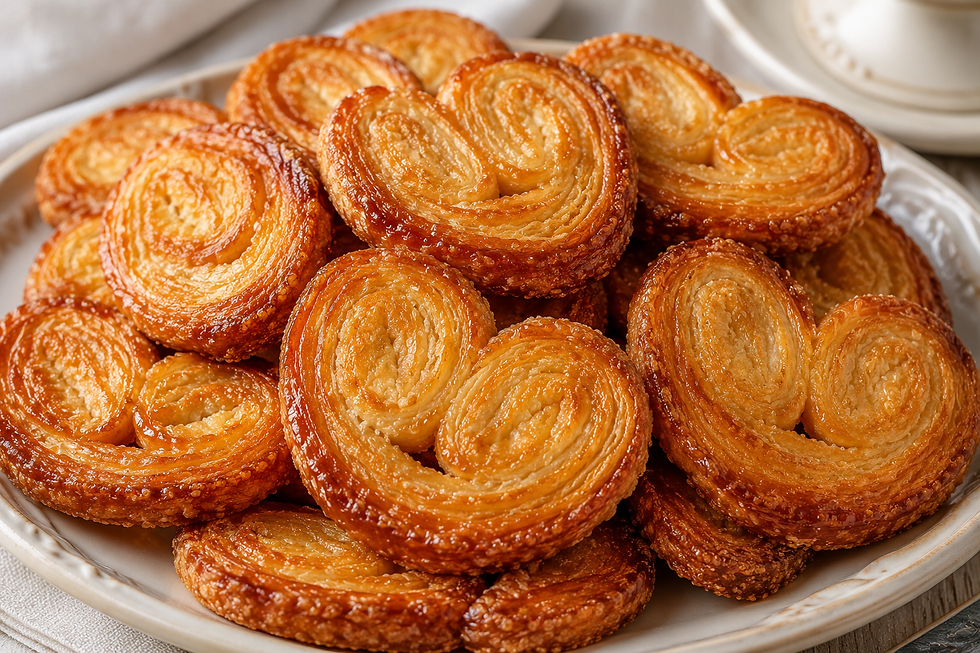
Pasta sfoglia, puff pastry, is the most technical dough of the Italian pastry shop: a simple dough of flour and water wrapped around a block of fat and folded again and again until it holds hundreds of layers that rise in the oven into a light, crisp, golden pastry. Classic pasta sfoglia is made with dairy butter; this vegan version is a reinterpretation, made with a firm plant butter in a block, chosen and handled so that it behaves like the dairy butter of the classic recipe: cold, pliable and never melting into the dough. The method is the classic one, six simple turns with rests in between, and every step is given with its temperature and its reason. To show the pastry at its best, the dough is rolled in sugar and baked into ventagli, the caramelized palmier cookies of Italian pastry shops, crisp and glassy on the outside and flaky inside.
Yield: about 1 lb 5 oz (600 g) of puff pastry, about 30 ventagli (10 servings of 3). Prep: 1 hour of work. Cook: 16 minutes per tray. Rest: about 4 hours between turns, 30 minutes before slicing. Course: dessert, with coffee or with dessert wine. Region: all of Italy.
The Story
The Italian name tells the essence of the dough: sfoglia comes from foglia, leaf, because the baked pastry opens into thin leaves that can be lifted one by one. The origin of puff pastry is disputed. Layered doughs of thin sheets and fat existed around the Mediterranean long before modern pastry, and many stories about a single inventor of puff pastry cannot be documented. What is certain is that the method of enclosing a block of fat in a dough and folding it, as we know it today, was codified in the professional kitchens of Europe and became the shared base of the pastry shops of France, Austria and Italy.
In Italy pasta sfoglia is everywhere. It is the base of the millefoglie, layered with pastry cream, of the cannoncini filled with cream in the shops of Piedmont and of the whole country, of the sfogliatine and of the salatini served with the aperitivo. The ventagli, fans in Italian, are among the simplest and most loved: puff pastry rolled in sugar, folded and sliced, then baked until the sugar turns to caramel. They are sold by weight in pastry shops and appear on breakfast tables and coffee trays from north to south.
Classic puff pastry is not vegan. It is made with a large amount of dairy butter, folded into the dough. This version replaces it with plant butter in a block, with at least 80 percent fat, and adapts the method to its behavior. Plant butters are often softer when cold and melt more abruptly than dairy butter, so the dough is kept colder, the rests are respected and the block is mixed with a little flour to make it more plastic. The détrempe, the base dough, uses a spoonful of melted plant butter and a few drops of lemon juice, as in many professional recipes, to keep it supple.
Puff pastry rewards patience and precision more than strength. Each turn multiplies the layers, each rest relaxes the dough and firms the fat. This recipe follows the classic Italian method of six simple turns and adds the measurements and temperatures that make it work with a plant fat.
Ingredients
The fat is the heart of puff pastry. Buy a plant butter in a block that states at least 80 percent fat on the label, firm at refrigerator temperature and without a strong coconut taste; soft spreads and tub margarines cannot be laminated. For the dough, use Italian type 0 flour or all-purpose flour with about 11 to 12 percent protein: strong enough to stretch thin without tearing, soft enough to stay tender. Use fine granulated sugar for the ventagli, because large crystals do not melt evenly into caramel.
For the détrempe (base dough)
Italian type 0 or all-purpose flour, 2 1/3 cups (300 g)
Fine sea salt, 1 tsp (6 g)
Cold water, 1/2 cup plus 2 tbsp (150 ml)
Plant butter, melted and cooled, 2 tbsp (30 g)
Lemon juice, 1 tsp (5 ml)
For the fat block
Plant butter in a block, at least 80 percent fat, cold, 1 cup (225 g)
Italian type 0 or all-purpose flour, 3 tbsp (25 g)
For the ventagli
Fine granulated sugar, 3/4 cup (150 g)
Fine sea salt, 1 pinch
Ground cinnamon, optional, 1/4 tsp (0.5 g)
Flour, for the work surface, as little as possible
Preparation
Step 1

Make the détrempe. Mix the flour and the salt in a bowl. Add the cold water, the cooled melted plant butter and the lemon juice and mix with a spatula until a shaggy dough forms. Knead it briefly on the counter, for 1 to 2 minutes, only until it comes together and looks fairly smooth. Shape it into a square about 1 inch (2.5 cm) thick, cut a deep cross in the top so it relaxes, wrap it and refrigerate it for 1 hour. The détrempe must not be kneaded like bread: too much gluten makes a puff pastry that resists rolling and shrinks in the oven.
Step 2

Make the fat block. Cut the cold plant butter into pieces, put it in a bowl with the 3 tbsp (25 g) of flour and work it with a spatula for 30 seconds, until smooth and homogeneous. Place it between two sheets of parchment paper and press and roll it into a square of 5 1/2 inches (14 cm) and about 1/2 inch (1.2 cm) thick. Refrigerate it for 30 minutes, until firm but still pliable. The flour absorbs part of the water in the plant butter and makes the block more plastic, so it stretches with the dough instead of breaking or melting.
Step 3

Enclose the fat. Roll the détrempe into a cross shape on a lightly floured surface: the center a square slightly larger than the fat block, the four arms around it thinner, about 1/4 inch (6 mm). Place the fat block in the center and fold the four arms over it, sealing the edges so the fat is completely enclosed. The dough and the fat should have the same consistency, both cool and pliable, around 55°F (13°C). If the fat is harder than the dough it breaks into pieces; if softer, it squeezes out at the sides.
Step 4

Give the first two turns. Roll the package gently into a rectangle about 18 by 7 inches (45 by 18 cm), always rolling in one direction, from the center outward, never pressing hard. Brush off any flour, fold the rectangle in three like a business letter: this is one simple turn. Rotate the dough a quarter turn so the open side faces you, roll it again to the same rectangle and fold it in three again. Press two fingertips into the surface to mark two turns, wrap the dough and refrigerate it for 1 hour.
Step 5

Complete the six turns. Repeat the same rolling and folding twice more, giving two simple turns each time and resting the dough for 1 hour in the refrigerator between the sessions, until you have given six turns in all. Mark the number of turns each time. If at any moment the fat starts to feel soft or the dough springs back, stop and chill it for 20 minutes. Six simple turns create 729 layers of fat, the classic count of Italian pasta sfoglia, and the rests keep them separate.
Step 6

Roll in sugar and shape the ventagli. Mix the sugar with the salt and the cinnamon, if using. Sprinkle a third of the sugar on the counter instead of flour and roll the cold puff pastry on it into a rectangle 12 by 10 inches (30 by 25 cm) and about 1/8 inch (3 mm) thick, sprinkling more sugar on top and turning the dough so both sides are coated. Fold the two long sides toward the center so they meet in the middle, sprinkle with sugar, then fold them again to the center, and finally fold one half over the other. You obtain a long roll of six layers. Wrap it and chill it for 30 minutes.
Step 7

Slice and bake. Set the oven to 400°F (200°C), conventional heat, rack in the center. Cut the chilled roll into slices 3/8 inch (1 cm) thick with a sharp knife, dip both cut faces in the remaining sugar and place them on a tray lined with parchment, spaced 2 inches (5 cm) apart, because they open as they bake. Bake for 10 minutes, until the bottoms are caramelized, then turn each one with a thin spatula and bake for another 5 to 6 minutes, until both sides are amber and glossy. Turning gives an even caramel on both faces.
Step 8

Cool on a rack. Lift the ventagli at once onto a wire rack, before the caramel sets on the parchment. Let them cool completely, about 20 minutes. They are soft when hot and become glassy and crisp as the caramel cools and hardens. Bake the remaining slices on a cool tray: a hot tray melts the sugar before the pastry has time to rise.
Plating
Serve the ventagli at room temperature, three per person, on a flat plate or a small silver tray lined with paper, arranged in a fan so the caramelized spirals face up. Nothing else is needed; a few strips of orange zest on the side of the tray add perfume without touching the sugar.
The ventagli belong to the Italian coffee break and to the end of a meal with a glass of dessert wine. The guest takes them with the fingers: they should shatter with a crisp, glassy crack, then reveal the light, flaky layers of puff pastry inside, with caramel first and a clean, rich finish from the plant fat.
Professional Technique
The key ratio is fat to dough. For a classic puff pastry the fat block weighs about half of the détrempe, here 250 g of block for about 490 g of détrempe, or roughly 75 percent of the flour weight. More fat gives a more fragile, richer pastry that is difficult to handle with a plant fat; less fat gives a pastry that rises poorly and tastes dry.
The hidden variable is temperature. Dough and fat must stay between 50°F and 60°F (10°C and 16°C) during rolling. Below that range the fat breaks into flakes inside the dough and the layers are interrupted; above it, the fat melts into the dough and the layers merge into a single, heavy sheet. A cool kitchen, a cold work surface and strict rests in the refrigerator are more important than speed.
The doneness test is in the cut. Before baking, cut a small slice from the edge of the laminated dough: you should see fine, regular lines of fat and dough with no streaks or blotches. After baking, a broken ventaglio should show distinct, dry layers to the center, separated by small air spaces, with no gummy core.
Lamination Control
Each simple turn multiplies the layers by three. After six turns there are 729 layers of fat, each one extremely thin. In the oven the water in the dough becomes steam, which is trapped by the fat layers and pushes the dough layers apart: that is what makes puff pastry rise without yeast. If the fat layers break or melt, the steam escapes and the pastry stays flat.
Rolling technique protects the layers. Roll with even pressure from the center outward, never back and forth over the same spot, and keep the edges straight and square. Brush off the flour before every fold, because flour trapped between the layers creates dry, white streaks and prevents them from sticking where they should.
The rests are not optional. Each rolling stretches the gluten, which then wants to spring back; the rest in the refrigerator relaxes it and firms the fat again. Skipping a rest gives a dough that fights the rolling pin, layers that tear, and pastry that shrinks and bakes unevenly. Plant butter needs these rests even more than dairy butter, because it softens faster during handling.
Professional Mise en Place
Puff pastry is best made over a day: the détrempe in the morning, three sessions of two turns each with 1 hour rests, then shaping and baking in the evening, or the next day.
Equipment and tools
Digital scale, bowl, spatula, ruler
Long rolling pin without handles, pastry brush for flour
Parchment paper, plastic film, sharp chef's knife
Two baking trays with parchment, thin metal spatula, wire rack, oven thermometer
Prepared ahead
Détrempe mixed and chilled, up to 1 day ahead
Fat block shaped and chilled, up to 1 day ahead
Laminated dough with six turns, up to 3 days in the refrigerator or 2 months in the freezer
Ventagli roll shaped and wrapped, up to 2 days in the refrigerator
Service setup
Ventagli cooled and stored in a tin until service
Flat plates or trays lined with paper
Orange zest strips cut fresh, if using
Coffee or a chilled dessert wine ready
Chef Tips
Keep a ruler by the rolling pin. Measuring the rectangle at every turn keeps the layers even from edge to edge; an irregular rectangle folds into uneven layers and the pastry rises crooked. Square the corners with the side of the rolling pin before each fold.
Freeze the finished dough in portions. Six-turn puff pastry wrapped tightly keeps for 2 months in the freezer. Thaw it overnight in the refrigerator, never at room temperature, so the fat stays firm. A block of homemade sfoglia in the freezer means fresh ventagli, cannoncini or a savory tart in one hour.
Use the same dough for other Italian classics. Rolled to 1/8 inch (3 mm), cut in strips and wrapped around cannoncini molds, then baked at 400°F (200°C) for 18 minutes, it gives the shells of the cannoncini, to fill with a vegan pastry cream. Rolled thin, pricked and baked between two trays, it becomes the crisp sheets of a millefoglie.
For savory salatini, roll the pastry without sugar, brush it with a little plant milk, sprinkle it with sesame, poppy seeds or coarse salt and rosemary, cut it into small squares and bake at 400°F (200°C) for 12 to 14 minutes. They are the classic snack of the Italian aperitivo.
Common Mistakes
Using a soft plant spread. Soft spreads melt into the dough and cannot form layers. Use a plant butter in a block with at least 80 percent fat.
Kneading the détrempe. A strong, elastic base dough fights the rolling pin and shrinks. Mix it only until it comes together.
Fat and dough at different temperatures. Hard fat breaks into pieces, soft fat squeezes out. Bring both to the same cool, pliable state before enclosing.
Skipping the rests. Without rests the gluten tightens and the fat warms, and the layers tear and merge. Rest the dough for 1 hour after every two turns.
Leaving flour between the layers. Trapped flour creates dry streaks and stops the layers from rising evenly. Brush it off before each fold.
Baking the ventagli on a hot tray. The sugar melts before the pastry rises and the ventagli spread flat. Always use a cool tray.
Leaving them on the parchment. The caramel sets and glues them to the paper. Move them to a wire rack as soon as they come out.
Wine Pairing
Moscato d'Asti DOCG: The lightly sparkling sweet white of Piedmont, with aromas of peach, sage and orange blossom and low alcohol. Its fine bubbles cut through the plant fat of the pastry and its fresh sweetness meets the caramel without weight. Serve it at about 43°F (6°C).
Recioto della Valpolicella DOCG: The sweet red of Verona, made from dried Corvina grapes, with notes of cherry, plum and sweet spice. Its dark fruit and soft tannins stand up to the deep caramel of the ventagli and work especially well when they are flavored with cinnamon. Serve it at about 60°F (16°C).
Moscato di Scanzo DOCG: A rare sweet red from the hills near Bergamo in Lombardy, made from dried grapes, with aromas of rose, spice and dried fruit. Its intensity and length make it a refined match for a simple pastry with a strong caramel taste. Serve it at about 59°F (15°C).
Conegliano Valdobbiadene Prosecco Superiore DOCG: The sparkling wine of the Treviso hills in Veneto, best in its Dry or Extra Dry style, with notes of pear, apple and white flowers. Its gentle sweetness and lively bubbles make it a fresh partner for ventagli served at a brunch or a celebration. Serve it at about 45°F (7°C).
Storage & Reheating
Ventagli keep for up to 5 days in an airtight tin at room temperature, away from humidity, which softens the caramel and makes it sticky. Do not refrigerate them. Raw laminated dough keeps for 3 days in the refrigerator and 2 months in the freezer; the shaped, unbaked roll of ventagli also freezes for up to 1 month, and the slices can be cut and baked from frozen, adding 2 minutes to the first side.
If the ventagli lose their crispness, place them on a cool tray lined with parchment and warm them in an oven at 325°F (160°C) for 3 to 4 minutes, then let them cool completely on a wire rack: the caramel hardens again as it cools. Never use the microwave, which melts the sugar and makes the pastry chewy.
Nutrition
Per serving, based on 10 servings of 3 ventagli:
Calories: 330 kcal
Total Fat: 19 g
Saturated Fat: 7 g
Trans Fat: 0 g
Unsaturated Fat: 12 g
Cholesterol: 0 mg
Sodium: 320 mg
Total Carbohydrates: 39 g
Fiber: 1 g
Total Sugars: 14 g
Added Sugars: 14 g
Protein: 4 g
Principal micronutrients: vitamin E, folate, iron, thiamin, selenium
These figures are estimates, calculated on the quantities listed and rounded to the nearest whole number, assuming that about four fifths of the sugar stays on the pastry. They vary with the brand of plant butter, which can contain different amounts of salt and saturated fat.


Comments