
Italian Swordfish alla Ghiotta | Pesce Spada alla Ghiotta
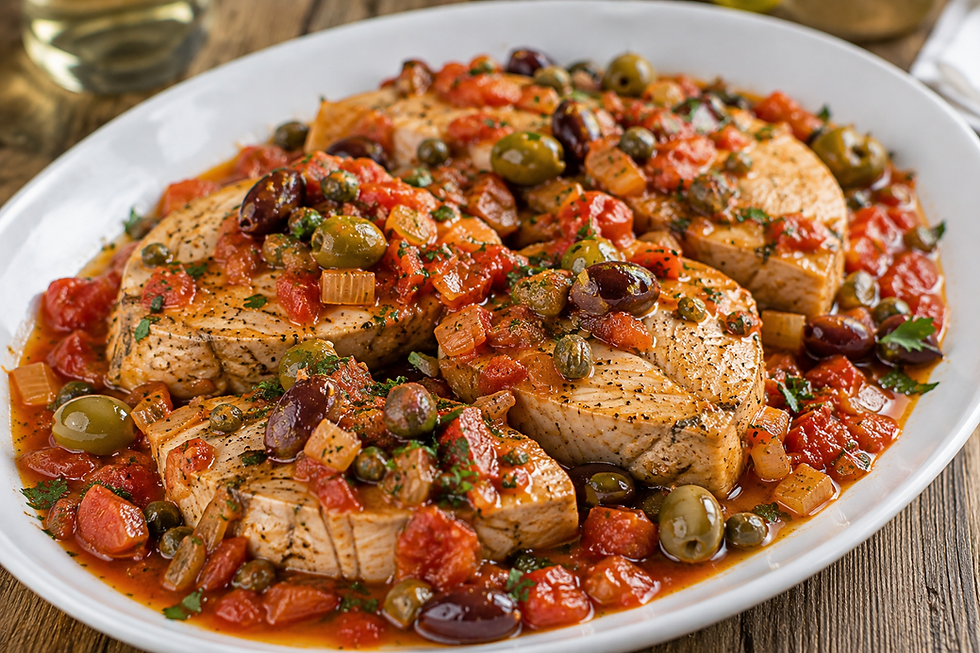
Ghiotta is what Messina does with almost everything that comes out of the strait, and with swordfish it does it best. The word describes a method: onion stewed in olive oil until it turns sweet, then tomato, green olives, salted capers, celery, potatoes, and in the older houses raisins and pine nuts. The sauce is built and reduced on its own, and only at the end does the fish go in. That order is the recipe.
Swordfish is also the least forgiving fish in the Mediterranean. The flesh is dense and muscular, with almost no collagen and little fat between the fibres, so it cannot be braised: twenty minutes in a simmering sauce gives grey, stringy slabs in an excellent sauce, which is how this dish is ruined in home kitchens and tourist restaurants alike.
Here the sauce takes forty minutes and the fish takes six. They meet for the last five and go straight to the table.
Yield: 4 main course servings. Prep: 30 minutes, plus 3 hours to desalt the capers. Cook: 50 minutes. Difficulty: intermediate. Course: secondo di pesce. Region: Sicily, Messina.
The Story
Messina takes swordfish from the strait with a technique unchanged since antiquity. The feluca carries an absurdly tall mast and a bow walkway thirty metres long, a lookout at the top and a harpooner at the far end, and the fish is taken one at a time, by eye and by hand. Strabo described the practice on this water two thousand years ago.
The ghiotta is older than the tomato in it. Its earliest form was a braise of onion, celery, olives, capers and vinegar, the kind of sauce that existed the length of the Mediterranean to make cheap and salted fish worth eating, and it reached stockfish long before swordfish. Messina still cooks stoccafisso alla ghiotta in winter and pesce spada alla ghiotta in summer, from the same pot. Tomato arrived only in the eighteenth century, into a formula already finished.
The raisins and pine nuts are the Arab layer, and they divide families. In the fish restaurants of Ganzirri you find them; inland they are left out on the grounds that the onion already supplies sweetness. Both are correct: Sicily built a cuisine on the tension between sweet and sharp in a savoury dish, from caponata to sarde a beccafico. The potatoes are nobody's refinement. The sauce is too good to waste and something must carry it.
Ingredients
For the swordfish
Swordfish steaks, 1 inch thick, 4 of 6 oz (170 g) each
Fine sea salt, 1/2 tsp (3 g)
Extra virgin olive oil, 2 tbsp (30 ml)
Freshly ground black pepper, to taste
For the ghiotta sauce
Extra virgin olive oil, 1/3 cup (80 ml)
Yellow onions, thinly sliced, 14 oz (400 g)
Celery, inner ribs, sliced, 2 stalks
Garlic cloves, lightly crushed, 2
Peeled plum tomatoes, hand crushed, 1 lb 12 oz (800 g)
Dry white wine, 1/2 cup (120 ml)
Waxy potatoes, peeled, in 3/4 inch cubes, 1 lb (450 g)
Green olives, Nocellara del Belice, pitted, 3/4 cup (120 g)
Capers packed in salt, 3 tbsp (30 g) before desalting
Golden raisins, 1/4 cup (40 g)
Pine nuts, 3 tbsp (25 g)
Fine sea salt, 1 tsp (6 g)
Freshly ground black pepper, to taste
For finishing
Fresh basil leaves, 8 to 10
Extra virgin olive oil, 1 tbsp (15 ml)
Lemon, for zest only, 1/2
Crusty bread, to serve
Preparation
Desalt the capers, soak the raisins, toast the pine nuts
Cover the salted capers with cold water by two inches and leave them three hours, changing the water three or four times. Taste one before use: it should be sharp and floral with the salt behind it. Soak the raisins in warm water for twenty minutes, then drain and squeeze them. Toast the pine nuts in a dry pan for two minutes until pale gold and reserve a third.
Stew the onion, then add the celery and the wine
Warm the 1/3 cup of olive oil in a wide shallow pan over medium low heat, add the onion and crushed garlic with a pinch of salt, and cook eighteen to twenty minutes. This is where the sweetness of the dish comes from and nobody gives it enough time. The onion must not take colour: translucent, collapsing, silky, its sugars released but not caramelized. Add the celery for five minutes, remove the garlic, then pour in the wine and let it bubble two minutes.
Reduce the tomato
Add the tomatoes and the remaining salt, bring to a simmer, then lower the heat so the surface barely moves. Cook uncovered twenty minutes, crushing large pieces against the pan. The sauce must lose about a third of its volume and turn brick coloured, thick enough to hold the mark of a spoon, because a thin ghiotta will not coat the fish.
Cook the potatoes in the sauce, then finish it
Stir in the potato cubes and cook fifteen to eighteen minutes, adding hot water only if the sauce tightens enough to stick. They should be tender through but holding their shape, and tasting of the sauce rather than of boiled potato. Then add the olives, the drained capers, the raisins and the remaining pine nuts and cook five minutes more. Taste it as a finished sauce: sweet from the onion and raisins, sharp from the tomato and capers, salty from the olives. Salt only if it is flat.
Sear the swordfish
Pat the steaks completely dry and salt both sides. Heat the 2 tablespoons of oil in a separate heavy pan over medium high heat until it shimmers, lay in the steaks and leave them two minutes. Turn once and give ninety seconds on the second side. A thin golden crust and nothing more, because the fish finishes in the sauce.
Finish in the ghiotta and rest
Slide the steaks into the simmering sauce, spoon sauce over each one and cover the pan. Cook four to five minutes only, turning each steak once. A thermometer in the thickest steak should read 130°F to 135°F (54°C to 57°C) when you pull the pan, because it climbs as it rests. Tear in the basil off the heat and let it stand three minutes, covered, so the juices redistribute.
Plating
Serve it hot, in generous portions, on warm plates. Heat four wide rimmed bowls in a low oven, because this is an olive oil sauce and it goes dull on cold porcelain. Do not sieve it or reduce it to a glaze: it is a rustic sauce with visible pieces in it.
Spoon a bed of sauce with a good share of the potatoes slightly off centre, then lift a steak on with a fish spatula so it sits partly on the sauce and partly clear of it. Spoon two more tablespoons across the fish, leaving some of the seared surface visible. Scatter the reserved pine nuts, add a few drops of raw olive oil and grate the smallest amount of lemon zest over each steak. No juice: there are already two acids in the sauce, and lemon flattens the tomato and leaves the capers merely sour. Bread goes alongside, not underneath: the scarpetta is not optional here.
Professional Technique
A ghiotta is an agrodolce with no added sugar and no added vinegar, which makes it harder than the sweet and sour preparations that lean on a spoonful of each. The sweet side comes from two places only: the sugars released by onion held for twenty minutes below browning temperature, and the concentrated sugars of the soaked raisins. The sharp side comes from the reduced tomato and from the salted capers, whose flavour is driven by mustard oil compounds and the acids of the salt cure. Because both sides come from ingredients rather than seasonings, your only controls are time and temperature. Rush the onion and there is no sweetness to balance against; brown it and that sweetness becomes caramel, which fights the capers.
The second point decides whether the dish works at all. Swordfish is a warm blooded pelagic fish with dense muscle and a connective tissue content low even by the standards of fish. A braise of beef shin or octopus depends on collagen converting to gelatin over hours, which gives a long forgiving window. Swordfish has almost no collagen to convert, so there is nothing to gain from extended cooking and everything to lose. Its proteins contract and expel water above roughly 140°F (60°C), and that water does not come back. Hence searing it separately and giving it only the last four or five minutes in the sauce, and hence the target of 130°F to 135°F (54°C to 57°C) off the heat rather than the 145°F (63°C) on general safety charts.
The third technique is the capers. Salt packed capers are cured by a process that draws water out of the bud and replaces it with sodium chloride throughout the tissue, not merely on the surface. Removing it is a diffusion problem: the sodium has to migrate back out through the cell walls into a weaker solution, at a rate set by the concentration gradient and by time. So rinsing under a tap achieves nothing, and a single static soak stalls once the surrounding water has turned salty. Three hours in cold water with three or four changes is the answer, each change restoring the gradient.
Texture and Moisture Control
Three textures have to arrive intact: the fish firm and moist, the potatoes tender but whole, the sauce thick enough to cling. The sear is a Maillard operation and needs a dry surface and a hot pan, which is why the steaks are patted dry and salted immediately before cooking rather than half an hour ahead. Salt applied early draws moisture to the surface and you steam the fish instead of browning it. Moisture in the sauce runs the other way: tomatoes are around ninety percent water, so the uncovered simmer turns a pan of juice into a sauce with body, and the potatoes then release starch and thicken it further.
Temperature at the end is where the dish is won. Swordfish at 130°F to 135°F (54°C to 57°C) is faintly rosy at the centre and still holding its juice. At 145°F (63°C) it is opaque and beginning to weep. At 155°F (68°C) it is chalky and there is no way back. The covered rest carries it up three or four degrees, so pull the pan while the thermometer still reads low. Without one, press the top of the steak: it should yield slightly and spring back, never feel rigid.
Professional Mise en Place
Almost all of this can be held, and only the last nine minutes are genuinely à la minute.
Equipment and tools
Wide shallow pan with a lid, four steaks in one layer
Separate heavy skillet or cast iron pan for the sear
Instant read thermometer
Fish spatula, slotted spoon, bowl for the capers
Four wide rimmed bowls, warmed before service
Prepared ahead
Capers desalted up to 1 day ahead, drained and covered
Sauce complete up to 2 days ahead
Potatoes cooked in the sauce as part of it, never separately
Raisins soaked and pine nuts toasted on the day
Swordfish bought the same day, held over ice
Service setup
Sauce at a bare simmer, loosened with hot water if tight
Sear pan preheating separately, oil in but not smoking
Basil torn only once the fish is in the sauce
Reserved pine nuts, lemon and finishing oil to hand
Bowls warm, bread sliced, thermometer beside the stove
Chef Tips
Buy the swordfish as one thick piece and cut it yourself. Fishmongers slice to a weight, not to a thickness, so four steaks of 6 oz can arrive anywhere between half an inch and an inch and a half, which makes one cooking time impossible. Look for pale pink to ivory flesh with a clean line of dark muscle, and refuse anything smelling of ammonia.
Make the sauce the day before if you can. A ghiotta improves overnight, because the oil, the tomato acid and the caper brine keep working on each other. Bring it back with hot water, sear the fish, and the dish finishes in nine minutes.
If you cannot find good salted capers, choose capers in brine over capers in vinegar and taste the sauce twice before adding salt. Vinegar packed capers push the dish towards a sharpness the onion cannot balance, and correcting that with sugar makes a ghiotta taste like a supermarket sauce.
On the raisins and pine nuts, decide rather than compromise. Use both at the quantities given, or leave both out and add a little more onion. Half measures give a solitary raisin every fourth mouthful.
Common Mistakes
Cooking the swordfish in the sauce from the start. This is the mistake that defines the dish and it appears in many published recipes. Swordfish has almost no collagen and nothing to gain from a long braise, so twenty minutes in simmering tomato leaves dry fibrous slabs. Reduce the sauce alone and give the fish the last five minutes.
Rinsing the salted capers instead of soaking them. A rinse removes the crust and nothing else, because the interior of the bud is saturated and needs time to equalize with fresh water. Skipping it leaves a sauce so salty nothing else can be judged.
Browning the onion. The sweetness of a ghiotta comes from onion sugars released slowly below browning temperature. Let it colour and those sugars caramelize into something heavier and faintly bitter that fights the capers.
Not reducing the tomato enough. Tomatoes are mostly water, and a sauce that has not lost a third of its volume will never coat the fish. It runs off the steak and floods the bowl.
Using floury potatoes. High starch varieties break apart in an acidic sauce and turn the ghiotta into a purée with fish in it. Use waxy potatoes and stir gently once they are in the pan.
Wine Pairing
Faro DOC: The exact wine of this dish, grown on the hills above Messina from nerello mascalese with nocera. A pale, sinewy red with high acidity, fine grained tannin and a savoury, almost salty finish, which is what a tomato and caper sauce needs: acid to meet the tomato, and tannin light enough not to clash with fish.
Etna Bianco DOC: Carricante on volcanic soil gives cutting lemon and green apple acidity, a smoky mineral edge and real weight. The acidity handles the reduced tomato and the caper sharpness on equal terms, while the body stands up to a dense steak and a sauce built on a third of a cup of oil.
Grillo Sicilia DOC: Rounder and more aromatic than the Etna whites, with ripe citrus, yellow melon and a herbal note that runs alongside the basil and celery. Its fuller texture makes it the choice when the raisins are in the pan, since it carries enough fruit sweetness of its own to sit beside that sweetness rather than expose it.
Cerasuolo di Vittoria DOCG: Frappato brings red cherry and a floral lift, nero d'Avola just enough structure to keep it from vanishing. Tannin is soft and acidity bright, so it behaves on fish the way a good rosato would, with more aromatic interest. Serve it at 57°F (14°C).
Etna Rosso DOC: The high altitude nerello mascalese, more perfumed than Faro, with dried rose, orange peel and a stony austerity behind the fruit. Choose a younger bottling without heavy oak, since barrel vanilla is the one thing that does not work with capers.
Storage & Reheating
Store the sauce and the fish separately, because they keep on completely different schedules. The ghiotta with its potatoes, olives and capers holds in an airtight container in the refrigerator for 3 days and is better on the second day. It freezes for up to 2 months, although the potatoes soften on thawing, so freeze the sauce without them and add fresh cubes later. Cooked swordfish keeps 1 day only and should never be frozen.
Reheat the sauce covered over low heat with a few tablespoons of water, stirring gently so the potatoes stay whole, and taste again, since refrigeration mutes both salt and acid. Reheating cooked swordfish is a rescue operation rather than a method: warm the sauce first, then return the fish off the heat, cover it and let it come up in the residual warmth for three minutes. Never microwave it. Better still, cut leftover swordfish into chunks, fold it into the reheated sauce with a little more olive oil and serve it over spaghetti, which is what Messina does with the remains of the pan.
Nutrition
Per serving, based on 4 main course portions:
Calories: 640 kcal
Total Fat: 34 g
Saturated Fat: 5 g
Trans Fat: 0 g
Unsaturated Fat: 28 g
Cholesterol: 70 mg
Sodium: 980 mg
Total Carbohydrates: 44 g
Fiber: 6 g
Total Sugars: 16 g
Added Sugars: 0 g
Protein: 40 g
Lactose: 0 g
Micronutrients: omega 3 fatty acids, selenium, vitamin D, vitamin B12, potassium, lycopene
These figures are estimates. Sodium moves most, depending on how thoroughly the capers were desalted and which olives you use, so treat it as an upper guide.


Comments