
Italian Sicilian Swordfish with Tomatoes, Olives, Capers and Pine Nuts | Pesce Spada alla Siciliana

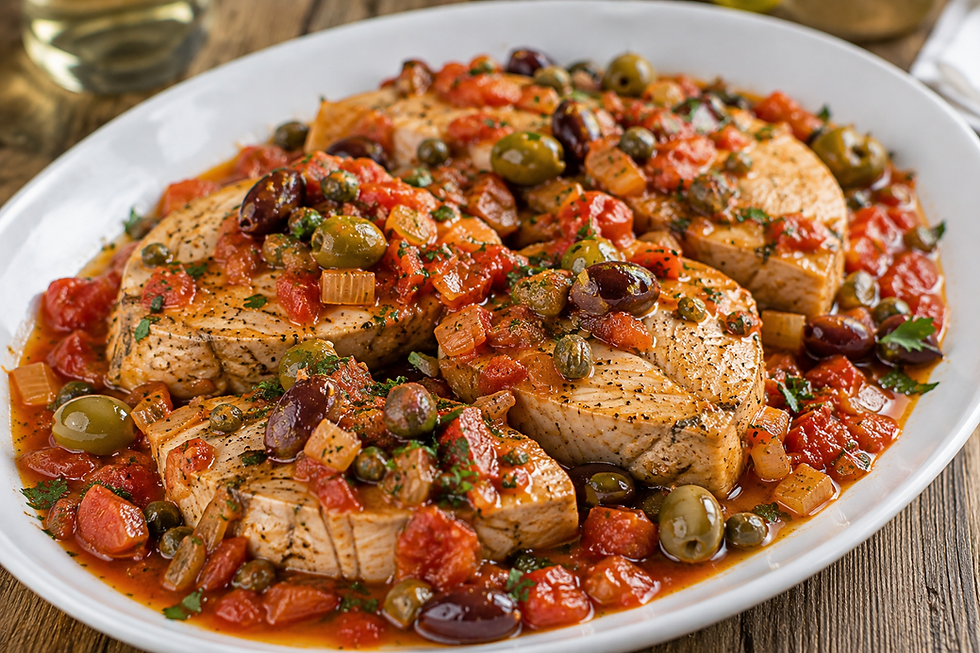
Pesce spada alla Siciliana is the swordfish steak of the Strait of Messina cooked alla ghiotta, which on this coast means a fast tomato sauce loaded with green olives, salted capers and pine nuts. It is a dish of four aggressive ingredients arranged around one delicate one, and the whole difficulty lies there. The sauce is forgiving and almost cooks itself. The fish has a window of about ninety seconds a side.
Swordfish is lean, with firm dense muscle and very little fat inside the flesh, which is why it slices like meat and why it dries out faster than almost anything else that comes off a Sicilian boat. Thickness is the only real insurance: a steak cut at 1 inch (2.5 cm) sears hard and still reaches the plate moist, while a thin one is cooked through before the surface colours.
The other half of the recipe is the agrodolce inheritance. Capers, olives and pine nuts are the savoury side, and a small quantity of raisins with a splash of vinegar turns the same sauce into the sweet and sour version that Messina and Palermo both claim. Both are traditional. Choose one and commit, because a sauce halfway between the two tastes uncertain.
Yield: 4 servings. Prep: 25 minutes. Cook: 20 minutes. Rest: 3 minutes. Total: about 50 minutes. Difficulty: intermediate, with a very short window at the stove. Course: secondo di pesce. Region: Sicily, the Strait of Messina.
The Story
The Strait of Messina is the only place in Italy where hunting swordfish became a craft with its own vocabulary, and most of that vocabulary survives. The boat is the feluca, carrying an iron tower up to 100 feet high and a walkway, the passerello, running some 130 feet out over the water from the bow. The vedetta at the top of the mast spots the fish from above and calls the course down to the helm, and the harpooner walks out along the passerello until he stands almost over the animal before throwing the arpione by hand.
The season runs roughly from May to July, when the fish come through the strait in pairs to spawn, and the old rule of the Messina crews was to strike the female first, because the male circles back to her and can then be taken as well. Men from Scilla on the Calabrian shore and from Ganzirri and Torre Faro on the Sicilian one have worked the same water in the same way for centuries.
Ghiotta is the Messina word for this kind of sauce, applied to stockfish and to fresh tuna as readily as to swordfish: tomato, olives, capers, onion and often potatoes in a shallow pan, with the fish finishing in it. The pine nuts and the raisins are the older layer underneath, left in Sicilian cooking by four centuries of Arab rule along with the sugar and vinegar that produce agrodolce. Swordfish took to all of it because it behaves like meat. It holds a steak shape, it takes a crust, and it stands up to a sauce that would shred a fillet of sea bass. In Sicily it is the fish treated like a cut of beef.
Ingredients
For the swordfish
Swordfish steaks, 1 inch (2.5 cm) thick, 4 pieces of 7 oz (200 g) each
Fine sea salt, 1 tsp (6 g)
Extra virgin olive oil, 2 tbsp (30 ml)
Freshly ground black pepper, to taste
For the ghiotta sauce
Extra virgin olive oil, 3 tbsp (45 ml)
Yellow onion, finely sliced, 1 small
Garlic cloves, thinly sliced, 2
Ripe plum tomatoes, peeled and chopped, 1 lb (450 g), or canned San Marzano, 1 1/2 cups (360 g)
Green olives, Nocellara del Belice, pitted and torn, 1/2 cup (75 g)
Salted capers, rinsed and soaked, 2 tbsp (18 g)
Dry white wine, 1/3 cup (80 ml)
Fine sea salt, 1/2 tsp (3 g)
Crushed red pepper flakes, 1/4 tsp (0.5 g), optional
For the agrodolce, optional
Golden raisins, 2 tbsp (20 g)
White wine vinegar, 1 tbsp (15 ml)
Granulated sugar, 1 tsp (4 g)
For finishing
Pine nuts, 3 tbsp (25 g)
Fresh mint leaves, 8, or basil leaves, 6
Flat leaf parsley, chopped, 1 tbsp (4 g)
Extra virgin olive oil, for the plates
Preparation
Choosing and trimming the steaks
Buy the steaks cut from a whole loin in front of you if you can. The flesh should be pink to pale rose with a clean ivory sheen, never grey and never chalky, and the dark red blood line running through it should look bright rather than brown. It should smell of nothing at all. Ask for 1 inch (2.5 cm) and refuse anything thinner. Trim the blood line away if it is thick, since it carries a strong metallic flavour, and cut off any dried edges.
Salting the fish and drying the surface
Decide about the skin. Left on, the rim holds the steak in shape and can be crisped; taken off, the sauce reaches the flesh from every side. Either is correct, but score the skin in two or three places if you keep it or the steak will buckle in the pan. Salt both faces lightly, wait 10 minutes, then blot the surface completely dry with paper. A wet swordfish steak steams instead of searing and will never take a crust.
Desalting the capers and preparing the olives
Rinse the salted capers under cold running water, soak them in a bowl of cold water for 10 minutes, then taste one. It should be sharp and floral, not aggressively salty, because the sauce reduces and whatever salt the capers carry concentrates in it. Drain them well. Pit the olives by pressing each one under the flat of a knife and tear them into pieces instead of slicing, so the torn edges catch the sauce. Chop neither one fine.
Toasting the pine nuts separately
Toast the pine nuts in a dry pan over low heat, moving them constantly, until pale gold and fragrant, about 3 minutes. Take them out the moment they colour and tip them onto a cold plate, because the residual heat of the pan alone will carry them to bitter. Never toast them in the sauce or alongside the onion: they scorch in oil, and burnt pine nut is the one flavour in this dish that cannot be corrected once it is there.
Building the quick tomato sauce
Warm the olive oil in a wide sauté pan over medium heat, add the onion with a pinch of salt and cook 6 minutes until translucent but not coloured, then add the garlic for 30 seconds only. Pour in the wine and reduce it by half. Add the tomatoes, olives, capers and chilli and simmer briskly for 10 to 12 minutes, until the sauce is glossy and thick enough to hold a line drawn through it with a spoon. For the agrodolce, stir in the raisins, vinegar and sugar now and give it 2 minutes more.
Searing the swordfish
Heat a heavy pan over medium high heat with the 2 tablespoons of olive oil until it shimmers. Lay the steaks in away from you and leave them alone for 90 seconds. Do not move them, do not press them, do not lift a corner to look. Turn them once, and once only, then give the second side 60 seconds. Both faces should be golden brown in patches with the centre still visibly underdone. Grind pepper over them and take the pan off the heat.
Finishing the fish in the sauce and resting it
Slide the seared steaks into the simmering sauce, spoon a little over each one and cook 2 to 3 minutes with the pan barely bubbling, no longer. At 130°F (55°C) in the centre the fish is juicy and faintly translucent; by 140°F (60°C) it is firm and already shedding moisture, and the margin between the two is about a minute. Pull the pan off the heat, scatter the mint and let everything stand 3 minutes before serving.
Plating
Warm the plates, but only just. A hot plate keeps cooking a fish that is already at the edge. Spoon a bed of the ghiotta onto each plate rather than over the steak, set the swordfish on top so the seared face stays visible, then add a spoonful of sauce across one side only, leaving part of the crust exposed and dry.
Scatter the toasted pine nuts last, on top of the sauce where they stay dry and keep their snap, and tear the mint over by hand at the table. A few drops of raw olive oil and the chopped parsley finish it. Serve with nothing more than boiled potatoes, sautéed greens or good bread: this is a sauce people mop up, and something starchy and neutral beside it is doing the right job.
Professional Technique
The technique that defines this dish is the split between a dry high heat sear and a wet gentle finish, and it exists because swordfish survives neither one alone. Seared throughout, the outside is dry before the centre sets. Simmered throughout in the sauce, it never develops the Maillard crust that gives the plate its depth and it leaches moisture into the tomato instead. Ninety seconds of hard contact builds the crust, and two or three minutes in sauce below a simmer then carries the centre to temperature by conduction from every side at once.
The old home version does it in one pass, putting raw steaks straight into the pan with the sauce under a lid, and that is not wrong: it gives a softer, stewed piece of fish with no crust, and on thick steaks it works. What fails is one pass on thin ones. The second point is restraint: the sauce must be reduced before the fish arrives, because reduction that happens with the steaks in the pan happens at their expense.
Texture and Moisture Control
Swordfish muscle is roughly three quarters water held in tightly packed fibres with almost no fat and no connective tissue to turn into gelatin, so nothing compensates for moisture driven out of it. Its proteins contract hard above 140°F (60°C) and squeeze water from the fibres in seconds, which is why a steak that looked perfect in the pan can be dry on the plate. Work to 130°F (55°C) in the centre and accept that the fish looks slightly underdone when you pull it.
The rest is short by design. Three minutes lets the temperature even out and the fibres relax enough to hold their juice when cut, while ten minutes in warm sauce would take the fish well past where you stopped. Thickness is the other control and it is decided at the fish counter. On a 1 inch (2.5 cm) steak the surface reaches searing heat while the centre lags safely behind; on a 1/2 inch one the two arrive together.
Professional Mise en Place
Everything except the fish can stand. With the sauce finished and warm, the garnishes lined up dry and the steaks salted and blotted on a rack, the service is four minutes of pan work and nothing else.
Equipment and tools
Wide sauté pan for the sauce, shallow enough to hold four steaks in one layer
Heavy skillet or cast iron pan for the sear
Small dry pan for the pine nuts and a cold plate beside it
Instant read thermometer, fish spatula, sieve for the capers
Prepared ahead
Ghiotta sauce, up to 3 days ahead, refrigerated and rewarmed gently
Capers rinsed and soaked, olives pitted and torn, on the day
Pine nuts toasted and cooled, held dry and away from steam
Steaks trimmed, salted, blotted and kept cold on a rack, uncovered
Service setup
Sauce at a bare simmer in the wide pan, seasoned and tasted
Sear pan hot and dry beside it, oil measured and ready
Mint, parsley, pine nuts and finishing oil within reach of the plates
Plates barely warm, never hot
Chef Tips
Buy the fish the day you cook it and ask which day the boat landed. Swordfish held two days loses the rose colour first and the smell follows, and by then no sauce hides it. If the counter has only thin steaks, buy one thick piece and cut it yourself.
Taste a caper and an olive before either goes in the pan. The salt in the same weight of capers varies enormously between brands, and the sauce should get no salt of its own until you have accounted for what they bring.
Keep the pine nuts off the sauce until the last second. They go soft within a minute of contact with liquid, and their whole job here is a dry crunch against a soft piece of fish.
If you have overcooked the steaks, do not try to rescue them in the pan. Cut them into large chunks, fold them through the ghiotta off the heat and serve it over pasta or bread, which is what Sicilian kitchens have always done with the ones that went too far.
Common Mistakes
Buying thin steaks. Anything under 3/4 inch (2 cm) cooks through before it browns and no technique corrects it. Ask for 1 inch (2.5 cm) cut from the loin, and if the counter cannot do it, buy a block and cut it at home.
Turning the fish more than once. Every turn interrupts the crust that is forming and cools the surface, so you finish with two grey faces instead of two brown ones. Ninety seconds, one turn, sixty seconds, out of the pan.
Cooking past 140°F (60°C) in the centre. With no fat and no collagen to fall back on, swordfish goes from juicy to cottony in under a minute above that point. Pull it at 130°F (55°C) and let the rest of the sauce finish the job.
Adding the capers without desalting them. The sauce loses a third of its volume and every gram of salt the capers carried concentrates in what remains, which is how a ghiotta ends up inedible. Rinse, soak, then taste one.
Toasting the pine nuts in the sauce pan. Sitting in hot oil beside onion and garlic they pass from raw to bitter without ever going golden. Toast them dry in a separate pan and tip them straight onto a cold plate.
Wine Pairing
Grillo Sicilia DOC: The Sicilian white with enough flesh to stand beside a tomato sauce rather than under it. Grillo carries a clear saline edge and ripe citrus with a herbal note behind it, and that salinity lets it meet the olives and capers head on instead of being flattened. The acidity handles the tomato and there is body enough for the seared crust.
Etna Bianco DOC: Grown on volcanic sand on the slopes above the strait, the closest bottle geographically to the fishing grounds. Carricante gives very high acidity and a stony, smoky finish that cuts through the olive oil in the sauce. Where Grillo meets the capers with weight, this one meets them with tension, and it is the better choice if you have made the agrodolce version.
Cerasuolo d'Abruzzo DOC: A properly dry rosato with real extract, and a useful answer to a plate that is neither fully white nor fully red in character. Sour cherry fruit and a trace of Montepulciano tannin find the browned surface of the fish, with acidity high enough for the tomato. Serve it cold, around 50°F (10°C), so the raisins in the sauce do not read as sweetness in the glass.
Faro DOC: The red of Messina itself, made on the hills directly above the strait from the same Nerello grapes as Etna and almost never seen outside Sicily. It is pale, fragrant and light in tannin, which is what a fish dish can take, and its dried herb and orange peel character sits naturally with the capers. Pour it at 57°F (14°C), cooler than instinct suggests.
Etna Rosso DOC: For the version heavy on tomato, where a red genuinely earns its place. Nerello Mascalese has fine grained tannin and bright acidity rather than power, so it works with the sauce instead of burying the fish, and its ash and sour red fruit echo the olives. Serve a young unoaked bottling cool, and keep sweet wine away from this plate.
Storage & Reheating
Keep the fish and the sauce apart if you can. Cooked swordfish holds refrigerated in a sealed container for 2 days and the ghiotta for 3, and the sauce genuinely improves overnight as the olives and capers settle into the tomato. Stored together, the fish keeps absorbing salt and its texture tightens. Neither part freezes well: the sauce turns watery on thawing and the fish becomes fibrous.
To reheat, warm the sauce in a wide pan until it barely simmers, take it off the heat, slide the cold fish in, cover, and let it come up for 3 to 4 minutes with no flame under it. That is enough for something already cooked and anything more dries it. Never use a microwave on swordfish. Cold, sliced thin over a salad with a spoonful of sauce as dressing, it is arguably better than reheated.
Nutrition
Per serving, based on 4 servings:
Calories: 420 kcal
Total Fat: 24 g
Saturated Fat: 4 g
Trans Fat: 0 g
Unsaturated Fat: 19 g
Cholesterol: 85 mg
Sodium: 780 mg
Total Carbohydrates: 12 g
Fiber: 3 g
Total Sugars: 7 g
Added Sugars: 1 g
Protein: 38 g
Lactose: 0 g
Principal micronutrients: omega 3 fatty acids, selenium, vitamin D, vitamin B12, niacin, potassium, vitamin E
These figures are estimates. Sodium depends almost entirely on how thoroughly the capers and olives are rinsed, and the sugar figure drops to near zero if you make the savoury version without the raisins.




Comments