
Italian Chicken Breast with Castelluccio Lentils | Petto di Pollo con Lenticchie di Castelluccio e Rosmarino
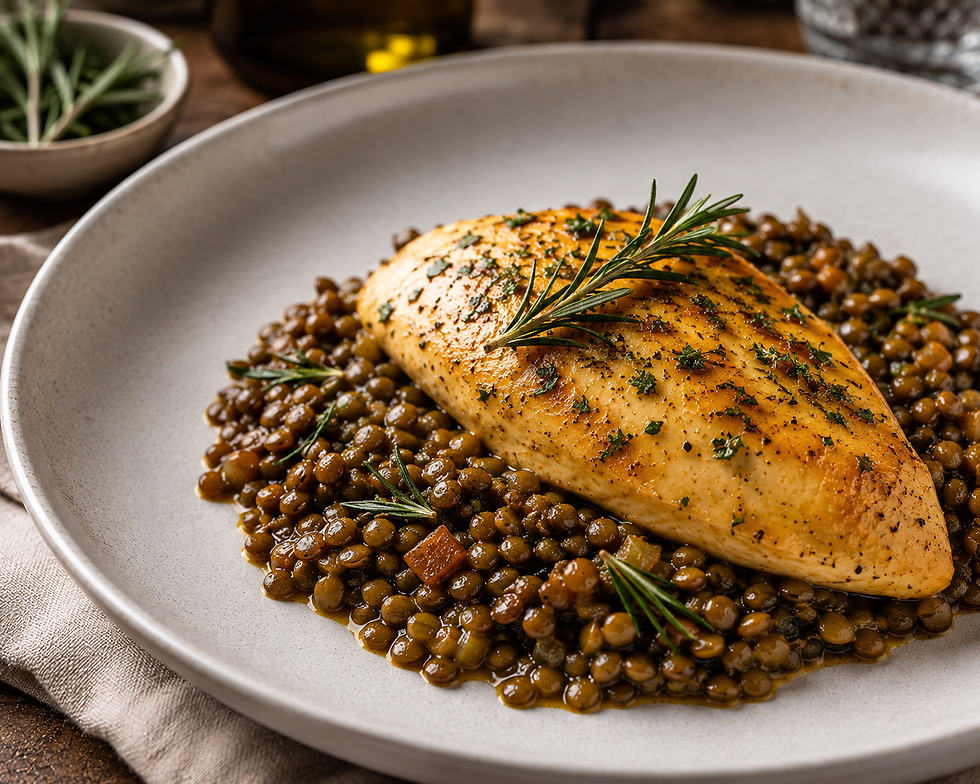
There is a lentil grown on a bare plateau in Umbria that never needs soaking and never breaks. It is smaller than a pencil eraser, mottled brown and green, and its skin is so thin that it cooks in twenty minutes and holds its shape for another ten after that. Everything here is arranged around that one fact: the lentils are braised rather than boiled into soup, dressed with the juices of the chicken, and served as the base of the plate rather than as a side.
The chicken is straightforward: breasts dry brined with rosemary and garlic, seared hard on one side, finished gently, rested and sliced over the lentils. What makes it one dish rather than two things on a plate is the pan. A ladle of the lentil cooking liquid goes back into the fond left by the sear and becomes the sauce, so meat and legume end up tasting of each other. Nothing is thrown away and nothing is bought in.
Yield: 4 servings. Prep: 20 minutes. Dry brine: 1 hour. Cook: 45 minutes. Rest: 6 minutes. Total: about 2 hours 10 minutes. Difficulty: intermediate. Course: secondo piatto.
The Story
Castelluccio di Norcia sits on the edge of the Pian Grande, a flat karst basin in the Monti Sibillini that stretches for about 4 square miles at roughly 4,760 feet (1,450 metres). The altitude is the whole point. Winters are long, the growing season short, and the cold keeps down the insects that plague legumes lower down, which is why these lentils have always been grown without pesticides or fertiliser. Almost nothing else grows well on the plain. Lentils do, and they have been sown there since at least the Middle Ages.
The Lenticchia di Castelluccio di Norcia carries an IGP granted in 1997. It is unusually small, with a mottled green and brown skin thin enough that the lentil needs no soaking at all, and it is famous for holding its shape through cooking instead of collapsing into purée. For two weeks between late June and early July the fields go through the Fiorita, when the lentil flowers open together with poppies, cornflowers and wild mustard and the plain turns red, blue, yellow and white in bands. The harvest itself comes in August.
Then came 24 August and 30 October 2016. The earthquakes that destroyed Amatrice also flattened the village of Castelluccio on its spur above the plain, and the second shock left almost nothing standing. The farmers kept sowing. The plateau itself was undamaged, and within a year the fields were back in production while the growers lived in temporary housing at the bottom of the mountain. Buying these lentils is now a small act of support as well as a matter of taste.
Ingredients
For the chicken
Boneless chicken breasts, skin on, 4 pieces, 7 oz (200 g) each
Fine sea salt, 1 1/4 tsp (7 g), for the dry brine
Fresh rosemary, finely chopped, 1 tbsp
Garlic cloves, finely grated, 2
Freshly ground black pepper, 1/2 tsp
Extra virgin olive oil, 2 tbsp (30 ml)
For the lentils
Lenticchie di Castelluccio di Norcia IGP, 1 1/4 cups (250 g), unsoaked
Extra virgin olive oil, 3 tbsp (45 ml)
Yellow onion, finely diced, 1 small
Carrot, finely diced, 1
Celery stalk, finely diced, 1
Garlic cloves, lightly crushed, 2
Fresh rosemary sprigs, 2
Bay leaf, 1
Canned peeled tomato, crushed by hand, 2 tbsp (30 g)
Light chicken stock or water, 3 1/2 cups (830 ml)
Fine sea salt, to taste
For the pan sauce and finishing
Dry white wine, 1/3 cup (80 ml)
Reserved lentil cooking liquid, 1/2 cup (120 ml)
Cold unsalted butter, cubed, 1 tbsp (14 g)
Red wine vinegar, 1 tsp (5 ml)
Extra virgin olive oil, for finishing
Flat leaf parsley, chopped, 1 tbsp
Preparation
Dry brine the chicken with rosemary and garlic
Pat the breasts completely dry. Mix the salt with the chopped rosemary, the grated garlic and the black pepper and rub it over every surface. Set the breasts on a rack over a tray, uncovered, and refrigerate for 1 hour. The salt seasons the muscle right through while the rosemary oil and garlic sit against the surface long enough to perfume the fat under the skin. Take the meat out 20 minutes before cooking.
Sort the lentils and build the soffritto
Tip the lentils into a bowl and pick through them for small stones, common in an unwashed mountain crop. Rinse once and drain, and do not soak: the skin is thin enough that soaking turns them to mush. Warm the 3 tbsp (45 ml) of olive oil in a heavy saucepan over medium low heat and cook the onion, carrot and celery with a pinch of salt for 10 minutes until soft and sweet without colour. Add the crushed garlic, one rosemary sprig and the bay leaf for 1 minute more.
Braise the lentils
Stir the crushed tomato into the soffritto and cook it out for 2 minutes, then add the drained lentils and turn them through the fat. Pour in the stock, bring to a bare simmer and cook uncovered for 20 to 25 minutes. Do not add salt yet: early salt firms the skins and stops the lentils absorbing liquid evenly, which is why they come out chalky in the middle. Start tasting at 18 minutes. They should be tender with a slight bite and still whole.
Reserve the liquid and hold the lentils
When the lentils are ready, ladle off about 1/2 cup (120 ml) of the cooking liquid into a jug for the sauce, then season the pot with salt. The rest should just cover the lentils and look slightly thickened from the starch they have released. Fish out the bay leaf and rosemary sprig, cover and keep warm off the heat. They go on softening in their own heat, so pull them a minute early.
Sear the chicken breasts
Heat the 2 tbsp (30 ml) of olive oil in a heavy sauté pan over medium high heat until it shimmers. Wipe any loose rosemary off the skin, since it burns, and lay the breasts in skin side down, pressing each flat for 20 seconds. Leave them alone for 6 minutes. When the skin is deep gold and lifts away without sticking, turn them for 3 minutes more and check with a probe. Take them out at about 155°F (68°C).
Deglaze and build the pan sauce
Pour off all but a film of fat, keeping the browned residue, and return the pan to medium heat. Add the white wine and scrape the base hard while it bubbles, reducing by two thirds. Add the reserved lentil liquid and simmer 2 minutes until it has a little body. Off the heat, swirl in the cold cubed butter until glossy and finish with the red wine vinegar, which lifts the whole plate and stops the lentils tasting flat.
Finish the lentils and rest the meat
Return the chicken to the pan for 2 to 3 minutes, spooning sauce over it, until a probe reads 160°F (71°C), then rest it on a board for 6 minutes while carryover takes it to a safe 165°F (74°C). Meanwhile strip the leaves from the second rosemary sprig, chop them very finely and fold them through the warm lentils with a thread of raw olive oil and the parsley. Raw rosemary added now keeps its perfume sharp instead of medicinal.
Plating
Use a shallow bowl rather than a flat plate, warmed but not hot. The lentils carry liquid and a rim keeps everything where you put it.
Spoon a bed of lentils slightly off centre, about six tablespoons per portion, in a loose layer rather than a mound. Slice each breast across the grain into four thick pieces at a slight angle and fan them over the lentils, gold skin up so it stays out of the moisture. Spoon the pan sauce over the meat and let it run down into the lentils.
Finish with a thread of raw olive oil over the lentils, a little parsley and a grind of black pepper. No cheese and no extra rosemary. The only colour this plate needs is the contrast between the dark lentils and the seared skin.
Professional Technique
The technique that matters here is the management of the lentil skin, and it comes down to when salt and acid enter the pan. The seed coat is a pectin and cellulose structure that softens as it hydrates, and both salt and acid interfere: sodium displaces calcium and magnesium in the pectin network unevenly when added early, while acid keeps that pectin rigid. A lentil cooked from the start in salted or tomato heavy liquid ends up firm outside and chalky in the centre. That is why only 2 tbsp (30 g) of tomato goes in, why the salt waits and why the vinegar goes into the sauce rather than the pot.
The second technique is using the lentil cooking liquid as the sauce base instead of stock. That liquid is loaded with the starch and soluble pectin the lentils have shed, so it thickens a pan sauce without flour, cream or long reduction and carries the soffritto straight back onto the meat. Reserve it before you season the pot, or the sauce reduces into something far too salty.
Third is the one sided sear. Chicken breast has a thick end and a thin one, and turning it repeatedly cooks the thin end long before the thick is ready. Six uninterrupted minutes skin side down builds the whole crust in a single stage while the heat travels slowly upward. Everything after that happens at low heat in the sauce.
Texture and Moisture Control
The target is a texture the Umbrians call al dente without irony: tender all the way through but perfectly whole, each lentil separate rather than bound in a purée. Cook them uncovered at a bare simmer, since a rolling boil knocks them against each other and splits the skins, and taste from 18 minutes. Age matters more than the recipe: last season lentils cook in 20 minutes, while ones that have sat two years in a warehouse may take 35 and never soften properly.
Liquid level is the other half. They should finish in just enough liquid to gloss them, not swimming and not dry. If they look soupy at 20 minutes, raise the heat to drive off the excess. If they look dry before they are tender, add hot stock a ladle at a time rather than cold water, which stops the cooking and toughens the skins.
For the chicken, the 1 hour dry brine is what keeps it juicy: salt dissolves some of the myosin and lets the muscle hold water more tightly, so a brined breast loses noticeably less moisture. Pulling the meat at 155°F (68°C) and resting it a full 6 minutes are the other two controls. Slice it early and the juice you worked to keep ends up on the board.
Professional Mise en Place
The lentils are the long job and they hold well, so they go first. The chicken is the last fifteen minutes.
Equipment and tools
Heavy saucepan wide enough that the lentils sit in a shallow layer
Heavy sauté pan, stainless or cast iron, for a good fond
Instant read probe thermometer
Small jug for the reserved cooking liquid, rack and tray for the brine
Prepared ahead
Lentils picked over and rinsed, the day before
Soffritto diced and cooked, up to 2 days ahead, refrigerated
Chicken rubbed and brining on the rack, 1 hour ahead
Lentils braised and cooled, up to 2 days ahead
Service setup
Lentils warm and covered, off the heat, liquid reserved separately
Cold butter cubed, vinegar measured, parsley and rosemary chopped
Bowls warming, probe wiped and within reach
Board and carving knife ready for resting and slicing
Chef Tips
Check the packet for the IGP mark and the harvest year. Genuine Castelluccio lentils are visibly small and mottled and rattle rather than thud. Large uniform brown lentils sold under the name are usually Canadian or Turkish: they need soaking and will not hold their shape here.
Cook the lentils the day before if you can. They improve overnight, absorbing the soffritto properly, and it turns a two hour recipe into a twenty minute one. Reheat them gently with a splash of stock rather than water.
Use rosemary twice and differently. A whole sprig in the braise gives a soft resinous background, while finely chopped raw leaves folded in at the end give the bright pine note. Chopped rosemary added early turns bitter and dominates everything.
A thin slice of pancetta rendered in the soffritto adds depth without turning this into a different recipe, and leaving it out gives a lighter plate. What you should not add is a stock cube: the lentil liquid already carries all the savour the sauce needs.
Common Mistakes
Soaking the lentils. The skin is thin enough to cook straight from dry, and soaking leaves you with split skins and grainy mush. Rinse, pick over for stones and go.
Salting the cooking water at the start. Early salt firms the seed coat unevenly and gives lentils that are tough outside and chalky at the centre. Season only once they are tender, and reserve the cooking liquid before you do.
Adding too much tomato. Acid keeps pectin rigid and stops the lentils softening, so a heavy tomato base leaves them hard after 40 minutes. Two tablespoons is for colour and savour, not for a sauce.
Boiling instead of simmering. A rolling boil knocks the lentils against each other until the skins split and the pot turns to purée. Keep the surface barely moving and leave the pan uncovered.
Chopping rosemary into the braise. Finely chopped rosemary cooked for 25 minutes turns resinous and medicinal and takes over the whole dish. Use a whole sprig in the pot and chop the second one raw at the end.
Discarding the lentil liquid. That starchy liquid is both the thickener and the link between lentils and meat. Replace it with plain stock and the plate never quite comes together.
Wine Pairing
Torgiano Rosso Riserva DOCG: The Umbrian red that belongs on this table, Sangiovese with a little Canaiolo from the hills near Perugia. Its tannin is fine grained rather than gripping, so it meets the earthiness of the lentils without stripping a lean white meat, and the cherry and dried herb fruit runs alongside the rosemary.
Orvieto Classico DOC: The white alternative from the same region, built on Grechetto and Trebbiano grown on volcanic tufo. It has more grip and almond bitterness than its reputation suggests, which is what lets it stand up to legumes, and its brisk acidity cuts the butter mounted sauce cleanly.
Cesanese del Piglio DOCG: A light bodied red from the hills southeast of Rome with soft tannin, sour cherry fruit and a peppery herbal edge that picks up the raw rosemary folded in at the end. The low tannin is the point: nothing here clashes with the drying quality legumes leave on the palate. Serve it at around 60°F (16°C).
Rosso di Montalcino DOC: Younger and brighter than its Brunello sibling and far better suited to chicken. High acidity, moderate tannin and fresh fruit refresh between mouthfuls of a rich braise rather than sitting on top of it, while the leather and tobacco notes echo the seared skin.
Alto Adige DOC Pinot Nero: The most delicate choice here and the one that flatters the chicken most. Mountain grown Pinot Nero keeps fine acidity and a light silky tannin, with red berry fruit and a faint forest floor note that sits naturally against lentils and rosemary.
Storage & Reheating
The lentils are the part that improves. In an airtight container in the refrigerator they hold for 4 days and taste better on the second, once the soffritto has settled into them. Keep the chicken separate, with any remaining sauce spooned over it, for up to 3 days.
Reheat the lentils over low heat with a splash of stock, stirring gently so you do not break them, and correct the seasoning at the end because they absorb salt as they sit. Reheat the chicken separately: slices in a covered pan with a spoonful of sauce over the lowest heat for 5 minutes. A microwave makes the breast rubbery and the lentils burst.
The braised lentils freeze well for up to 3 months in a sealed container, so they are worth making in a double batch. Thaw them overnight in the refrigerator rather than in the pan. Cooked breast does not freeze successfully: cook the meat fresh and use the frozen lentils as the base.
Nutrition
Per serving, based on 4 servings:
Calories: 590 kcal
Total Fat: 24 g
Saturated Fat: 6 g
Trans Fat: 0.2 g
Unsaturated Fat: 17 g
Cholesterol: 135 mg
Sodium: 720 mg
Total Carbohydrates: 42 g
Fiber: 16 g
Total Sugars: 4 g
Added Sugars: 0 g
Protein: 55 g
Lactose: 0.1 g
Principal micronutrients: iron, folate, potassium, magnesium, zinc, niacin, vitamin B6
These figures are estimates. The lentils supply most of the fibre, folate and iron, and skinless breasts lower the fat by about 6 g per serving.


Comments