Apulian Bread and Cheese Fritters | Polpette di Pane Pugliesi
Updated: Oct 24

Polpette di pane are what Puglia does with the bread it refuses to throw away. Stale crumb is soaked, bound with eggs and a generous handful of pecorino, rolled into small balls and fried until the outside shatters and the centre stays soft, savoury and faintly milky.
There is no meat in them at all. They are a cucina povera antipasto that costs almost nothing and vanishes from the platter faster than anything else, especially with warm tomato sauce alongside.
Yield: 24 fritters, 6 appetizer servings. Prep: 25 minutes. Rest: 1 hour. Cook: 30 minutes. Total: about 1 hour 55 minutes. Difficulty: easy. Course: antipasto. Region: Puglia.
The Story
Nowhere in Italy is bread taken more seriously than in Puglia. Around Altamura and across the Murge plateau, families once baked enormous loaves of durum wheat semolina once a week, often in the communal wood oven of the village, and those loaves had to last until the next firing. By the end of the week they were hard as stone, and hard bread was never a problem in that kitchen, only an ingredient waiting for its turn. It went into pancotto, into frisella soaked in seawater, into the bread salads of the Bari coast, and into these fritters.
The second ingredient tells the rest of the story. Puglia is sheep country. For centuries flocks walked the tratturi, the great grass roads that carried shepherds from the mountains of Abruzzo down to the winter pastures of the Tavoliere plain around Foggia, and the cheese made along the way, pecorino and the aged canestrato pugliese, became the protein of the poor. Meat belonged to feast days. On every other day a family had bread, eggs from the yard and the cheese that kept in the cupboard, and polpette di pane are exactly those three things, transformed by a hot pan.
Similar fritters exist across the whole south, in Basilicata, Calabria, Abruzzo and Molise, each with its own cheese and its own herb, and each claimed as local. The Apulian version is defined by restraint: parsley and garlic, plenty of pecorino, no meat and no breadcrumbs inside, since the bread itself is the crumb. Traditionally they are fried in the same olive or seed oil used for the day's other cooking, then eaten hot from the paper at a family table, on a Sunday antipasto platter, or in a pool of simple tomato sauce made from the last of the summer jars.
What keeps the dish alive today is the same thrift that created it. In a region where a good baker still bakes daily and a good cook still hates waste, a tray of polpette di pane is a quiet act of respect toward the loaf. Grandmothers judge the mixture by touch, never by scale, and every household swears its own proportion of cheese to bread is the right one. The recipe below fixes those proportions so that the result is reliable, but the spirit is unchanged: nothing is bought for the purpose, and nothing is wasted.
Ingredients
Choose a sturdy, dense loaf such as Altamura or any rustic semolina bread, two or three days old. Buy the pecorino young, aged about three to six months, and grate it yourself. Every quantity is listed in US measures first, with metric in parentheses.
For the fritters
Stale rustic semolina bread, crust removed, torn, 10 oz (285 g)
Whole milk, warm, 1 cup (240 ml)
Large eggs, 2
Young pecorino, finely grated, 4 oz (115 g)
Flat leaf parsley, finely chopped, 1/4 cup (15 g)
Garlic clove, minced, 1
Fine sea salt, 1/2 tsp (3 g)
Freshly ground black pepper, 1/4 tsp
For the tomato sauce
Extra virgin olive oil, 2 tbsp (30 ml)
Garlic clove, crushed, 1
Canned whole peeled tomatoes, crushed by hand, 14 oz (400 g)
Fresh basil leaves, 4
Fine sea salt, 1/4 tsp (1.5 g)
For frying and rolling
Peanut or sunflower oil, 4 cups (950 ml)
Fine dry breadcrumbs, 1/2 cup (55 g)
For finishing
Pecorino shavings, 1 oz (30 g)
Flaky sea salt, 1 pinch
Flat leaf parsley leaves, a few
Preparation
Soak and squeeze the bread
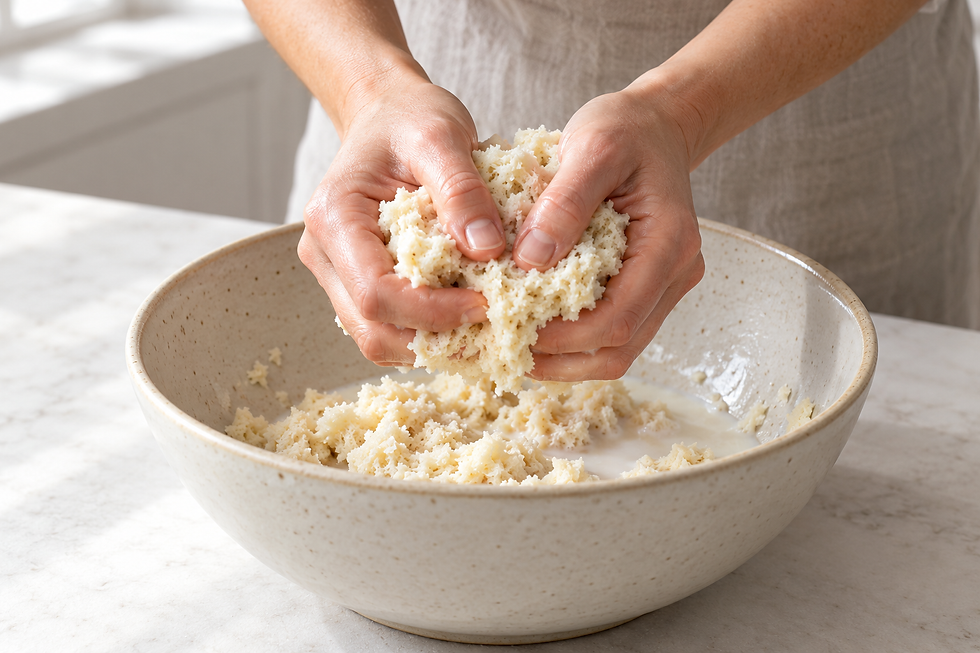
Tear the crustless bread into small pieces and put it in a large bowl. Pour the warm milk over it, press the pieces down with your hands and leave them for 15 minutes, turning once, until no dry core remains. Then squeeze the bread firmly, handful by handful, until it stops dripping. You want a damp, spongy crumb, not a wet one. Discard the excess milk and break the squeezed bread apart with your fingers until no large lumps remain, since lumps become dense spots inside the finished fritter.
Fold in the cheese and eggs

Add the pecorino, parsley, garlic, salt and pepper to the bread. Beat the eggs lightly in a small bowl, pour them over and mix with your hands, squeezing gently, for about 2 minutes. The mixture should look coarse and cohesive, like a very thick porridge that just holds a shape when pressed. If it feels stiff and crumbly, add a spoonful of milk. If it sticks heavily to your palms, add a tablespoon of breadcrumbs.
Rest the mixture cold

Cover the bowl and refrigerate it for at least 1 hour and up to 6 hours. Do not skip this pause. It gives the crumb time to finish absorbing the eggs and the mixture firms visibly, which is what makes shaping easy and frying safe.
Make the tomato sauce

While the mixture rests, warm the olive oil and crushed garlic in a small saucepan over low heat for 1 minute, just until fragrant. Add the crushed tomatoes and salt, and simmer gently for 15 minutes, stirring now and then, until the sauce is thick and no longer tastes raw. Remove the garlic, tear in the basil and keep the sauce warm over the lowest flame. A little sweetness from good canned tomatoes is welcome, and it is what makes the salty cheese taste rounder.
Shape the fritters

Spread the breadcrumbs on a plate. With damp hands, scoop up a heaping tablespoon of the cold mixture, about 1 1/2 oz (40 g), and roll it into a smooth ball about 1 1/2 inches (4 cm) across. Roll it lightly in the breadcrumbs and set it on a tray. You should get 24 balls. Keep your hands wet and the rest of the mixture cold while you work, returning the bowl to the refrigerator between batches of eight. Press each ball gently for a second so the surface closes without any cracks, because a crack is where the oil will find its way in.
Fry in moderate oil

Pour the oil into a heavy pot to a depth of about 2 inches (5 cm) and heat it to 340°F (170°C). Fry 6 to 8 fritters at a time, turning them gently, for 4 to 5 minutes, until deep golden brown all over. Adjust the flame after every batch, because the temperature drops each time cold fritters go in. Do not crowd the pot.
Drain, season and serve

Lift the fritters out with a slotted spoon and drain them on a wire rack set over a tray, not on paper, which traps steam. Scatter a pinch of flaky salt over them while they are still glistening. Serve within a few minutes, with the warm tomato sauce alongside. Taste the first fritter for salt, and adjust the pinch on the rest if needed. Fry the remaining batches the same way, letting the oil return to temperature first.
Plating
Serve the fritters warm, not scalding, on a plain white or terracotta platter, four per person. Spoon a small pool of warm tomato sauce into a shallow bowl in the centre, so guests can dip, and stack the fritters loosely around it rather than piling them in a heap that would steam the bottom layer.
Finish with a few shavings of pecorino, a small pinch of flaky salt and two or three parsley leaves. Add nothing else. A plate of raw bitter greens dressed with lemon, or a bowl of olives from the Salento, is the right companion on the table. Bring the platter to the table straight away, because the crust is at its best for only about ten minutes.
Professional Technique
The cheese is the binder here, not the seasoning. With no meat and only two eggs for 10 oz (285 g) of bread, a polpetta holds together because the pecorino melts in the hot oil and glues the crumb from the inside, while the egg sets around it. That makes the quantity and the type of cheese structural decisions. Below roughly 30 percent of the bread's weight the ball has too little glue and cracks in the pot. Here the ratio is closer to 40 percent.
The type matters as much as the amount. A young or medium pecorino, aged three to six months, melts smoothly and stretches just enough to knit the crumb. A cheese that is too rich in fat, such as a creamy fresh cheese or a very fatty young caciotta, releases oil as it warms, and that oil bleeds out through the crust and opens the ball. A cheese that is too aged, a hard pecorino of a year or more, is dry and crystalline, seasons beautifully but does not melt or pull, and the polpetta crumbles when you bite it.
The rest in the refrigerator serves the same purpose. Cold time lets the crumb take up the egg fully and lets the fat in the cheese firm up, so the mixture holds its shape in your palms. Warm, it slumps and sticks.
Frying in oil that is not too hot completes the logic. At 340°F (170°C) the outside browns slowly enough for the cheese inside to reach melting point before the crust locks it in. In oil at 375°F (190°C) the shell sets in seconds, the centre stays cold, and the steam trapped inside can burst the ball open. In oil below 320°F (160°C) the cheese melts before the egg sets and leaks into the pot.
Texture and Moisture Control
The goal is a thin shattering crust over a centre that is soft and moist, never gummy and never dry. Nearly all of that is decided before the oil is switched on. Squeezing the soaked bread is the first control point: too much retained milk turns the interior pasty and makes the ball steam itself apart, while too little leaves it dense and dry. The mixture should feel like damp sand that just clumps.
The breadcrumb coating is deliberately thin. It adds a fine, sandy crunch and helps the surface brown evenly, but a thick layer would soak up oil and turn heavy. Roll each ball just once, and shake off any excess before it goes into the pot.
After frying, moisture is the enemy of the crust. Fritters stacked on paper or covered with a lid sweat within minutes as their internal steam escapes and softens the shell. A wire rack allows air to circulate underneath and keeps the crust crisp. If you need to hold a batch for service, put the rack in a 200°F (95°C) oven with the door slightly ajar for up to 15 minutes. Serve the sauce on the side and never over the fritters, since even warm sauce dissolves the crunch within a minute.
Professional Mise en Place
This is an easy dish to organise because most of the work happens ahead of time, and only the frying is done at the last moment. Set it up in this order and service is calm.
Equipment and tools
Heavy pot with high sides for frying, and a probe or frying thermometer
Slotted spoon or spider, and a wire rack set over a tray
Small saucepan for the sauce, and a box grater or microplane for the cheese
Small bowl of water for wetting your hands while shaping
Prepared ahead
Bread soaked, squeezed and mixed with the cheese and eggs, chilled up to 6 hours
Fritters shaped, coated and refrigerated on a tray, covered loosely, up to 3 hours
Tomato sauce made and held, up to 2 days in the refrigerator
Service setup
Oil at 340°F (170°C) with the thermometer in place
Rack and tray ready, flaky salt and pecorino shavings within reach
Sauce warm, platter and dipping bowl at room temperature
Chef Tips
Use bread that is genuinely stale, two or three days old, from a dense sturdy loaf. Soft sandwich bread turns to paste when soaked. If your bread is fresh, slice it and dry it in a 250°F (120°C) oven for 20 minutes first.
Grate the pecorino on the fine side of the grater. Coarse shreds do not disperse through the crumb and leave pockets of cheese that leak fat. Finely grated cheese melts evenly and binds better.
Fry a single test fritter before the whole batch. Cook it for 4 minutes, cut it open and taste it. If it falls apart, add a tablespoon of breadcrumbs to the mixture and chill it again. If it is bland, add a pinch more salt and a little pepper.
For a sharper, more Apulian flavour, replace a third of the young pecorino with an aged pecorino, but keep the total weight the same so the melting behaviour stays reliable.
Common Mistakes
Squeezing the bread too little. A soggy mixture cannot hold a shape and the fritters burst in the oil. Squeeze until the crumb stops dripping, and only then add the eggs.
Skipping the chill. A warm mixture is soft and sticky, it is hard to roll and it slumps in the pot. One hour in the refrigerator makes the difference between neat balls and shapeless lumps.
Frying in oil that is too hot. The outside darkens in seconds while the middle stays cold and pasty. Keep the oil at 340°F (170°C) and check the thermometer between batches.
Overcrowding the pot. Too many cold fritters drop the temperature sharply, and they soak up oil instead of crisping. Fry six to eight at a time.
Using the wrong cheese. A very fatty cheese leaks oil and a very hard, aged cheese fails to bind. Choose a young or medium pecorino and grate it finely.
Draining on paper. Paper traps steam against the crust and turns it soft within minutes. Use a wire rack.
Wine Pairing
Locorotondo DOC: The natural Apulian match, made from Verdeca and Bianco d'Alessano grown on the cool hills of the Itria Valley. Its crisp acidity cuts through the fried crust and the richness of the pecorino, while the light citrus and white flower aromas keep the tomato sauce fresh. It is dry, clean and low in alcohol, so it refreshes rather than weighs the palate.
Martina Franca DOC: A neighbour of Locorotondo from the same limestone hills, and slightly more mineral. Its dry, saline finish echoes the salt in the cheese, and the green apple fruit lifts the fat of the frying oil. It is a modest, honest white, and that is exactly what a plate of humble fritters needs.
Trento DOC: A metodo classico sparkling wine is the classic partner for anything fried. The fine bubbles scrub the palate after each bite, and the high acidity slices through the melted cheese and oil. Choose a brut for the driest effect, whose toasty yeast notes also flatter the browned crust.
Salice Salentino DOC: For those who prefer red, this Negroamaro based wine from the Salento is soft in tannin and rich in ripe cherry and dried herb. Serve it lightly chilled. Its warm fruit picks up the sweetness of the tomato sauce, while the low tannin does not clash with the eggs and cheese.
Falanghina del Sannio DOC: A lively Campanian white that sits comfortably beside Apulian cooking. Bright citrus and green apple acidity lift the fried crust, and a faint bitter almond note on the finish runs alongside the parsley and the sheep milk cheese. It has enough body to meet the tomato sauce without tipping into weight.
Storage & Reheating
Fried fritters keep in the refrigerator for up to 3 days in a shallow airtight container, separated by parchment so the crust does not stick. The uncooked mixture keeps for up to 24 hours, covered, and can be shaped the next day. The tomato sauce keeps for 3 days refrigerated.
For the freezer, freeze shaped, uncoated raw balls on a tray, then transfer them to a bag for up to 2 months and fry them straight from frozen at 325°F (165°C) for 6 to 7 minutes. Cooked fritters also freeze for 1 month but lose some crunch.
To reheat, place the fritters on a rack over a tray in a 375°F (190°C) oven for 8 to 10 minutes, turning once, until hot and crisp again. Never microwave them, because the crust turns leathery. Warm the sauce separately in a small pan.
Nutrition
Per serving, based on 6 appetizer portions of 4 fritters with sauce:
Calories: 350 kcal
Total Fat: 16 g
Saturated Fat: 6.5 g
Trans Fat: 0 g
Unsaturated Fat: 9.5 g
Cholesterol: 85 mg
Sodium: 750 mg
Total Carbohydrates: 35 g
Fiber: 3 g
Total Sugars: 5 g
Added Sugars: 0 g
Protein: 14 g
Lactose: 2 g
Principal micronutrients: calcium, phosphorus, vitamin B12, selenium, lycopene
These figures are estimates and vary with the cheese and the oil absorbed.


Comments