
Step by Step Roman Carbonara with Egg Yolk Emulsion | Spaghetti alla Carbonara Passo Passo

This is carbonara taken apart and photographed at every stage, because the dish fails in specific places and those places are easier to recognise than to describe. Seven pictures, seven moments. If your pan and your bowl look like the pictures at each stage, the sauce will work.
The method here is the yolk only version with a Pecorino paste built first, which is how many Roman kitchens run it during service. The cheese is dissolved into a little hot water before the yolks ever appear, so the grains have already melted when the emulsion forms. It produces a sauce that is deeper in colour and noticeably more stable than the whole egg approach, at the cost of being richer.
Nothing is added that Rome would not add: guanciale, Pecorino Romano, egg yolk, black pepper, pasta water. No cream, no butter, no garlic, no onion, no parsley.
Yield: 4 servings. Prep: 15 minutes. Cook: 15 minutes. Total: about 30 minutes. Difficulty: intermediate. Course: primo piatto. Region: Lazio, Rome and the Testaccio quarter.
The Story
Carbonara is a Testaccio dish before it is a Roman one. The quarter grew around the municipal slaughterhouse that opened in 1890, and the osterie that fed the workers built their cooking on what the trade left behind: offal, cheap cuts, cured pork and the hard sheep cheese that came down from the Apennine pastures. That cooking is still called cucina del quinto quarto, the fifth quarter, meaning everything after the four the butcher sold.
Carbonara arrived late into that tradition, in the middle of the twentieth century, but it fitted the pattern exactly. Three cheap and keepable ingredients, one pan, four minutes, and a result rich enough to carry a man through an afternoon of physical work. The osterie of Via Galvani and Via Mastro Giorgio were serving it by the 1960s, and it moved outward from there into the rest of the city rather than the other way around.
Its codification came much later and was largely defensive. As carbonara spread abroad it collected cream, bacon, mushrooms and onions, and by the 1990s Roman cooks were publicly drawing lines around what the dish was. The argument settled on four ingredients plus pepper, guanciale rather than pancetta, and Pecorino Romano rather than Parmigiano. Italy now marks Carbonara Day every April, which tells you how seriously the boundary is taken.
Ingredients
For the pasta
Dried bronze cut spaghetti, 14 oz (400 g)
Water, 4 quarts (3.8 l)
Coarse sea salt, 1 tbsp (18 g)
For the sauce
Guanciale, in one piece, rind removed, 5 1/2 oz (160 g)
Large egg yolks, 6
Pecorino Romano DOP, finely grated, 3 oz (85 g)
Black peppercorns, freshly cracked, 2 tsp (5 g)
Hot pasta water, about 1 1/2 cups (360 ml) reserved
For finishing
Pecorino Romano DOP, finely grated, 2 tbsp (15 g)
Black peppercorns, freshly cracked, to taste
Preparation
Step 1. Cut and render the guanciale
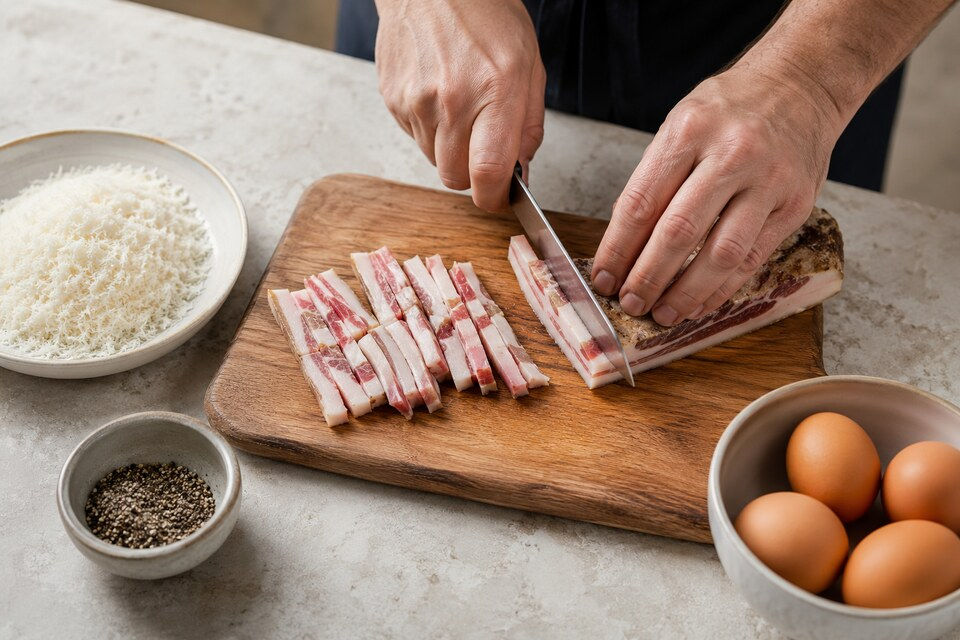
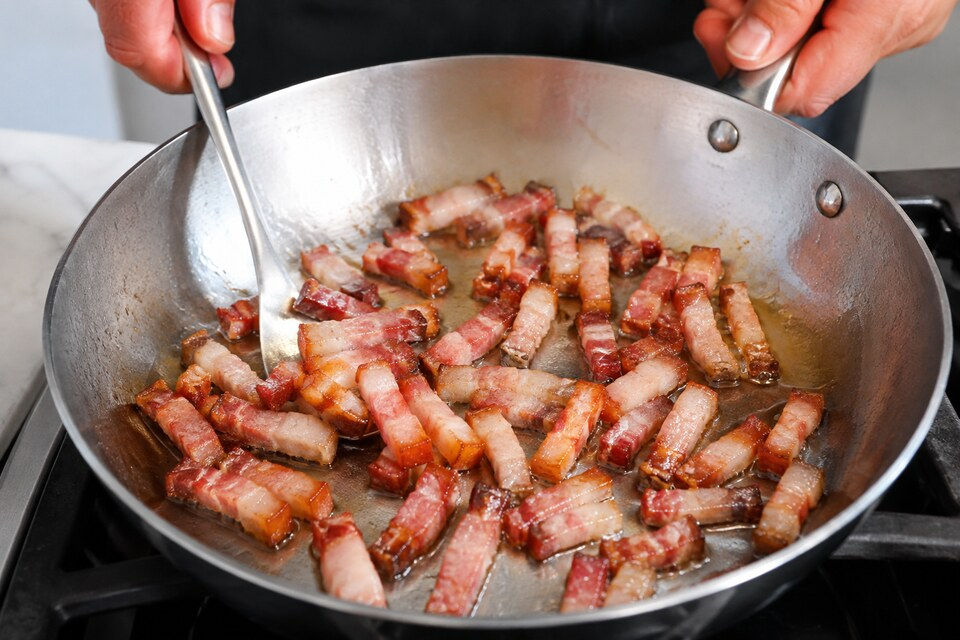
Cut the guanciale into batons about 1/4 inch (6 mm) thick. Put them in a cold dry pan over low heat and leave them for 8 to 10 minutes, turning once. No oil goes in: the piece carries all the fat the dish needs. They are ready when the edges are bronzed and the centres still give slightly. Lift the batons onto a plate and keep every drop of the rendered fat in the pan.
Step 2. Salt the water and start the spaghetti
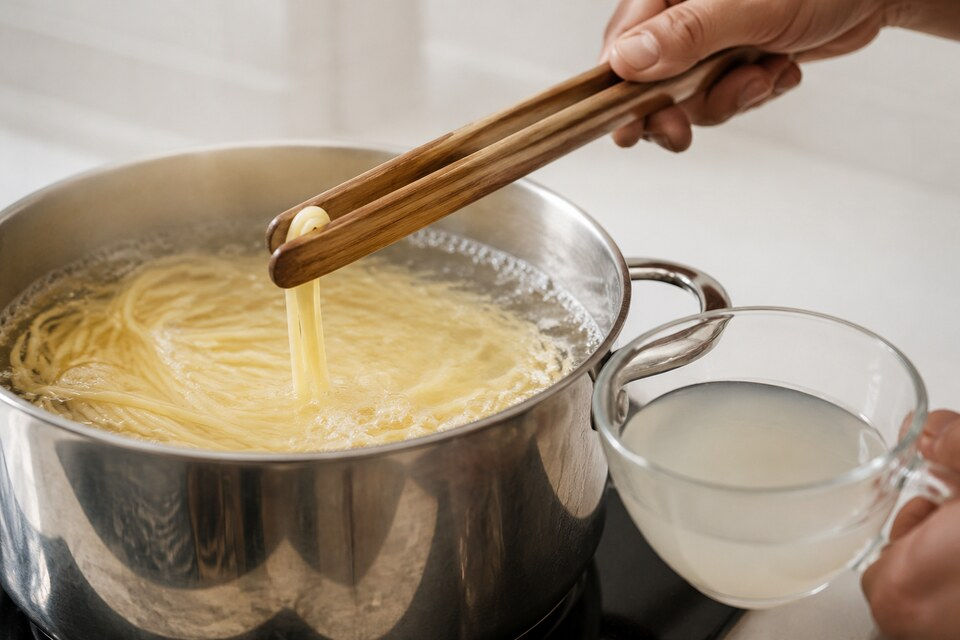
Bring 4 quarts of water to a rolling boil and add just 1 tablespoon of coarse salt. Pecorino Romano and cured pork both arrive salted, so the water is seasoned lighter than usual. Drop the spaghetti, stir for 30 seconds, and set a timer for 1 minute less than the packet says.
Step 3. Crack the pepper and build the Pecorino paste
Crush the peppercorns coarsely under a heavy pan base, then toast them dry in a small pan for 30 seconds until they smell sharp. Tip them into a wide bowl with the grated Pecorino, add 3 tablespoons (45 ml) of the boiling pasta water and stir hard with a fork. The cheese will look lumpy for about twenty seconds and then turn into a smooth grey paste.
Step 4. Whisk in the yolks
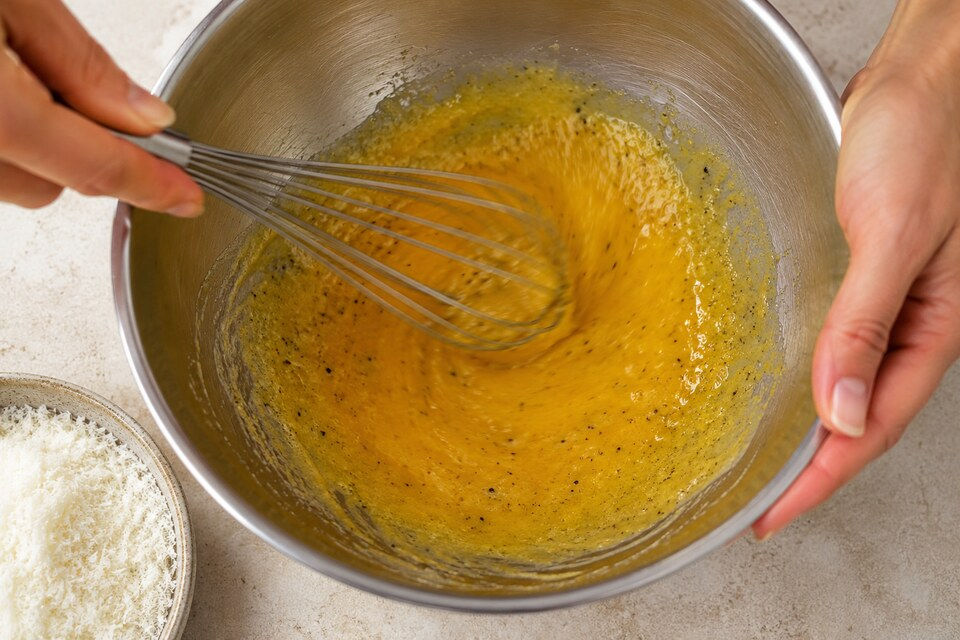
Separate the 6 yolks cleanly, keeping every trace of white out, and add them to the cooled Pecorino paste. Whisk until the mixture is uniform, glossy and the colour of dark honey. It should be thick enough to hold the mark of the whisk for a second. Made in this order the cheese is already dissolved, so the yolks never meet dry grains and the finished sauce cannot turn grainy.
Step 5. Drain at the right moment and keep the water
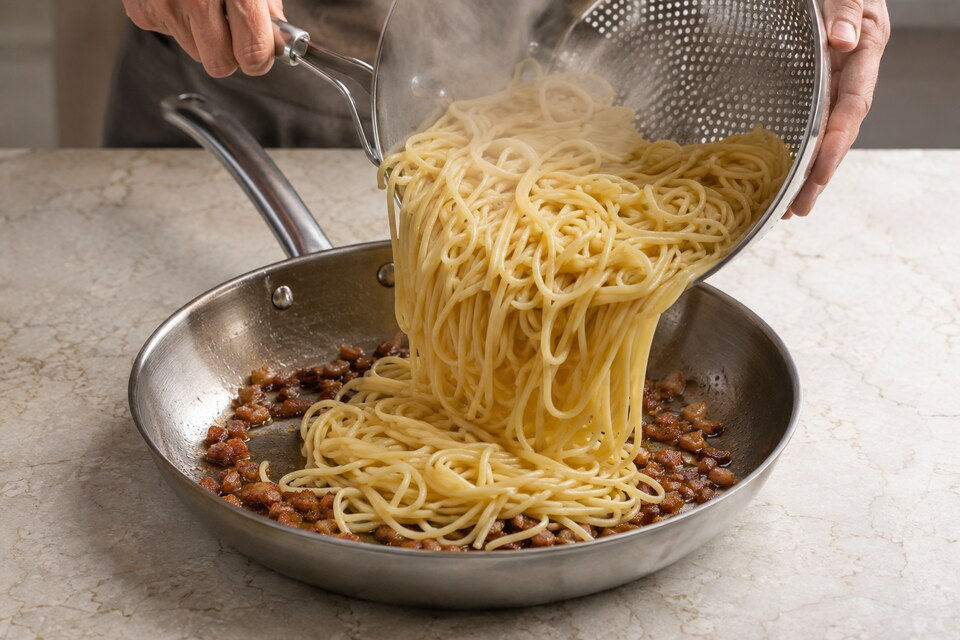
Take out 1 1/2 cups (360 ml) of the cooking water before you touch the colander. Bite a strand: the centre should show a pale line no thicker than a hair. Drain the spaghetti dripping wet, never shaken dry, and do not rinse it. The starch clinging to the surface is what will hold the emulsion together.
Step 6. Combine off the heat
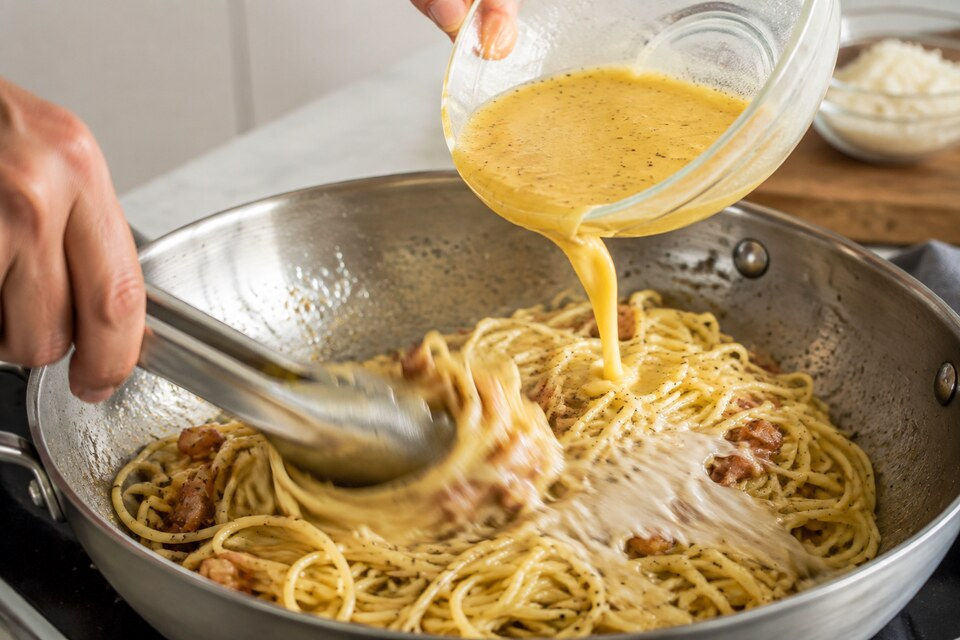
Tip the drained spaghetti into the guanciale pan with the heat off and toss for 20 seconds so each strand takes on the rendered fat. Let the pan stand 30 seconds more, then add the spaghetti to the bowl of yolk mixture rather than pouring the yolks into the pan. The bowl is cooler and wider, and the pasta gives up its heat gradually instead of hitting a hot metal base.
Step 7. Bring the emulsion together and finish
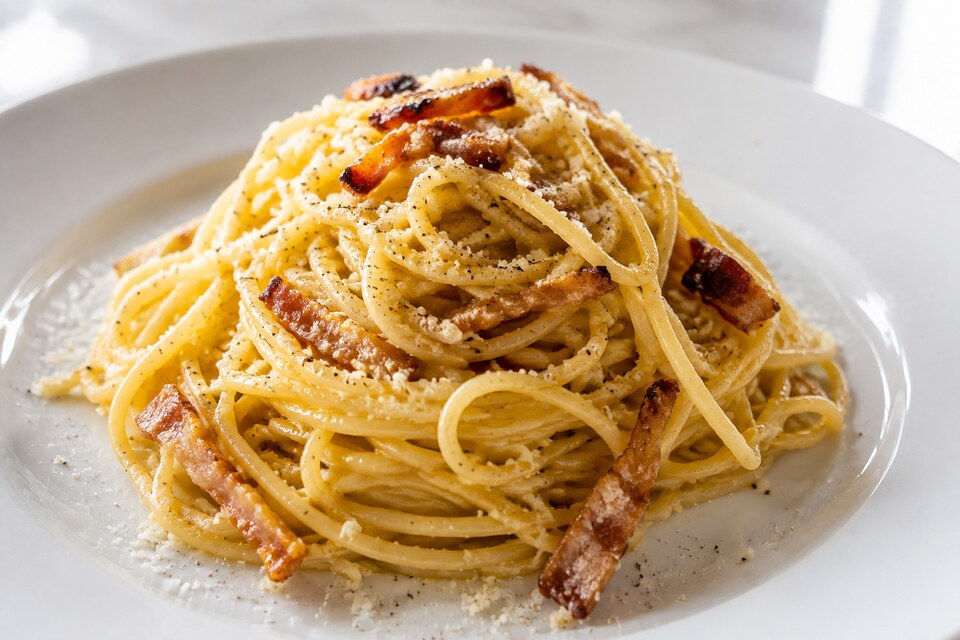
Toss hard and continuously for 40 to 60 seconds, lifting the strands high. Add hot pasta water 2 tablespoons (30 ml) at a time until the sauce turns from a thick paste into a flowing cream that coats each strand. Fold in most of the guanciale, keeping some for the top, grind in more pepper and serve at once.
Plating
Use warmed shallow bowls, never flat plates. A bowl keeps the portion gathered and holds its temperature for the few minutes carbonara has, while a flat plate spreads the pasta thin and it cools before the second forkful. Rinse the bowls in hot water and dry them while the spaghetti cooks.
Twist each portion onto a carving fork and lower it into the bowl so the strands stand in a loose nest. Spoon any sauce left in the mixing bowl over the top, since that is the richest part of it. Crown with the reserved guanciale, the last 2 tablespoons of Pecorino and a final crack of pepper, and carry it to the table immediately.
Plate all four portions together rather than one at a time. The sauce keeps thickening in the mixing bowl while it waits, so a fourth bowl filled ninety seconds after the first will be visibly drier than it. If you are cooking for more than four, cook in two batches with fresh water rather than stretching one bowl across eight servings, and accept that the first table eats before the second.
Professional Technique
The defining move of this version is dissolving the Pecorino before the yolks arrive. Hard sheep cheese is roughly a third protein and a third fat held in a dry matrix, and dropped into egg it hydrates slowly and unevenly, which is the real source of the grainy sauce people blame on heat. Three tablespoons of boiling water and thirty seconds of stirring break that matrix first, so the yolks are folded into something already smooth.
Working yolks only is the second choice, and it changes the physics. Yolk is about half water and a third fat, carrying lecithin and other emulsifiers, and it thickens gradually from around 149°F (65°C). Egg white by contrast sets abruptly near 145°F (63°C) and is the component that produces visible curds. Removing the whites removes the fastest failure and widens the working window, though it also removes water, which is why more pasta water is needed at the end than a whole egg version would take.
Finishing in the bowl rather than the pan is the third. A stainless bowl holding a room temperature mixture is a heat sink; a pan that just rendered pork fat is a heat source that keeps giving for a minute after the flame dies. Moving the pasta to the bowl means the hottest object in the process is the pasta itself, which is exactly enough to thicken yolk and never enough to set it. This is the version to use on an unfamiliar stove.
Texture and Moisture Control
A yolk sauce tightens faster than a whole egg sauce because it holds less water, so it should leave the bowl looser than looks right. Judge it by movement: tilt the bowl and the sauce should slide as a sheet in about two seconds. If it stays put it is already too thick, and another 2 tablespoons of hot water with hard tossing is the fix. Left as it is, it turns pasty in the thirty seconds it takes to reach the table.
Starch does the stabilising. Cooking 14 oz of pasta in 4 quarts rather than a stockpot of water keeps the cooking liquid genuinely cloudy, and those dissolved starch molecules sit between yolk proteins and slow their setting, which is what turns a narrow temperature window into a workable one. Reserve more water than you think you need, keep it hot, and add it in small amounts.
The pasta itself needs to be pulled a full minute early. It keeps cooking in the residual heat while you toss, and it also absorbs the water you add to loosen the sauce, so spaghetti drained at perfect al dente arrives at the table soft. Bronze cut pasta matters here for the same reason: its rough surface sheds more starch into the water and gives the sauce something to grip.
Professional Mise en Place
The last three steps run back to back with no pause, so the bowl, the water and the cheese all have to be ready before the spaghetti is drained.
Equipment and tools
Wide stainless or aluminium pan for the guanciale, never cast iron
Large metal mixing bowl, wide enough to toss a full portion of spaghetti
Microplane or the finest side of a box grater
Heatproof jug for the reserved pasta water and a carving fork for plating
Prepared ahead
Guanciale cut into batons up to 1 day ahead, kept covered and cold
Pecorino grated up to 4 hours ahead and kept covered
Eggs separated and the yolks brought to room temperature 30 minutes before
Peppercorns cracked and toasted immediately before cooking, never earlier
Service setup
Pecorino paste made and cooled, yolks whisked in, bowl standing by the stove
Rendered guanciale on a plate, its fat left in the pan off the heat
1 1/2 cups of pasta water reserved and still hot
Bowls rinsed in hot water, dried and stacked within reach
Chef Tips
Let the Pecorino paste cool for a minute before the yolks go in. It is made with boiling water and will sit near 176°F (80°C) straight after mixing, which is hot enough to cook a yolk on contact. Touch the outside of the bowl first: it should be warm, not uncomfortable.
Save the six egg whites rather than throwing them away. They keep 4 days refrigerated in a sealed jar and freeze for 3 months, and they are exactly what a meringue or an amaretto biscuit needs. A carbonara that costs you half a dozen wasted whites is a badly run kitchen.
If the sauce looks pale when you finish tossing, you have added too much water too fast. Pull back by adding another tablespoon of grated Pecorino and tossing for fifteen seconds; the cheese will absorb the excess and bring the colour and body back together.
Reserve more pasta water than the recipe asks for. It costs nothing, it stays useful for the whole meal, and running out of it halfway through the final toss is the one failure that has no recovery once the pasta is drained and the pot is empty.
Common Mistakes
Adding the yolks to a hot pan. The pan holds enough heat to cook egg for a full minute after the burner goes out. This method exists precisely to avoid that: the pasta goes to the bowl, never the yolks to the pan.
Letting white into the yolks. Egg white sets around 145°F (63°C), well before yolk thickens, and even a small amount is what produces visible white flecks in an otherwise correct sauce. Separate each egg into a small cup first so one broken yolk does not spoil the batch.
Mixing cheese straight into the yolks. Dry grated Pecorino dropped into raw yolk hydrates unevenly and stays gritty no matter how long you whisk. The paste step with hot water is not an extra flourish, it is what makes the sauce smooth.
Using Parmigiano instead of Pecorino Romano. Parmigiano is milder, nuttier and less salty, and it melts differently because it is a cow milk cheese. The sharp sheep tang is a defining flavour of the dish, not a detail.
Draining the pasta bone dry. Shaking the colander hard strips away the surface starch and the clinging water that the emulsion depends on. Lift the spaghetti straight from pot to pan, dripping.
Forgetting to reserve the water. Tipping the pot into the sink is the one error with no recovery, because by then the pasta is drained, the yolks are waiting and there is nothing left to loosen the sauce with. Fill the jug before you move the pot, every single time.
Trimming away the guanciale fat. Cooks used to lean bacon often cut the white off and keep the pink, which leaves nothing to render and no fat to carry the pepper and salt of the cure. The fat is the ingredient here; only the hard peppered rind comes off.
Wine Pairing
Offida Pecorino DOCG: The grape shares a name with the cheese by coincidence and pairs with it by structure. It is one of the few Italian whites with enough body and alcohol to stand against six egg yolks, and its yellow orchard fruit is balanced by a firm acid spine that keeps cutting through the rendered fat. The faint herbal bitterness on the close works well with the toasted pepper.
Greco di Tufo DOCG: Grown on volcanic and clay soils in Irpinia, this is a white of unusual weight and a distinctly smoky sulphur edge. That weight is what a yolk heavy carbonara needs: lighter wines simply vanish under it. The stone fruit and the saline finish keep the plate lively rather than letting it settle into richness.
Trento DOC: Mountain grown Chardonnay and Pinot Nero fermented in bottle, with sharper acidity than most Italian sparkling wine and a long lees driven finish. The bubble physically lifts fat off the tongue between mouthfuls, which is the single most useful thing a wine can do beside this dish. Choose a Brut and serve it properly cold.
Fiano di Avellino DOCG: A white built on texture rather than fruit, with a waxy oily weight in the mouth and notes of hazelnut and honey that run alongside the egg yolk instead of opposing it. The acidity is moderate, so this is the choice when you want the pairing to flow with the richness rather than scrub it away. It improves noticeably with a couple of years in bottle.
Montepulciano d'Abruzzo DOC: The red option, and from the region whose shepherds most likely supplied the original technique. It carries deep plum fruit and soft rounded tannin, low enough in grip that it does not clash with egg yolk the way a tannic Tuscan red would. Serve it at 59°F (15°C) so the fruit stays fresh against the salt of the Pecorino.
Storage & Reheating
A yolk only carbonara stores even worse than the whole egg version, because there is less water in the sauce to begin with and it sets solid in the refrigerator. Cook only what will be eaten. If there are leftovers, cool them quickly, seal them in a shallow container and keep them no longer than 24 hours. Freezing is not an option at all: the emulsion breaks on thawing and cannot be brought back.
To reheat, put the portion in a wide pan with 3 tablespoons (45 ml) of milk or water, cover it and set it over the lowest heat for 3 to 4 minutes, tossing every 30 seconds until the sauce flows again. Milk works slightly better than water here because the extra fat helps the seized yolk loosen. Keep the microwave out of it entirely.
The separate components are far more forgiving. Rendered guanciale keeps 5 days refrigerated in its own fat and reheats in a dry pan in under a minute. Raw yolks keep 2 days under a film of cold water in a sealed container, poured off before use. Grate Pecorino to order, since it dries and clumps within a couple of days of grating.
Nutrition
Per serving, based on 4 servings:
Calories: 825 kcal
Total Fat: 41 g
Saturated Fat: 16 g
Trans Fat: 0 g
Unsaturated Fat: 23 g
Cholesterol: 600 mg
Sodium: 1080 mg
Total Carbohydrates: 76 g
Fiber: 3 g
Total Sugars: 3 g
Added Sugars: 0 g
Protein: 32 g
Lactose: 0.3 g
Principal micronutrients: choline, selenium, calcium, phosphorus, vitamin B12, vitamin A, zinc, folate
These are estimates. Cholesterol is high because the sauce runs on six yolks, and sodium depends on the cure of the guanciale and the age of the Pecorino.


Comments