
Italian Salt Baked Sea Bass with Citrus, Asparagus and Almonds | Spigola al Sale con Agrumi, Asparagi e Mandorle
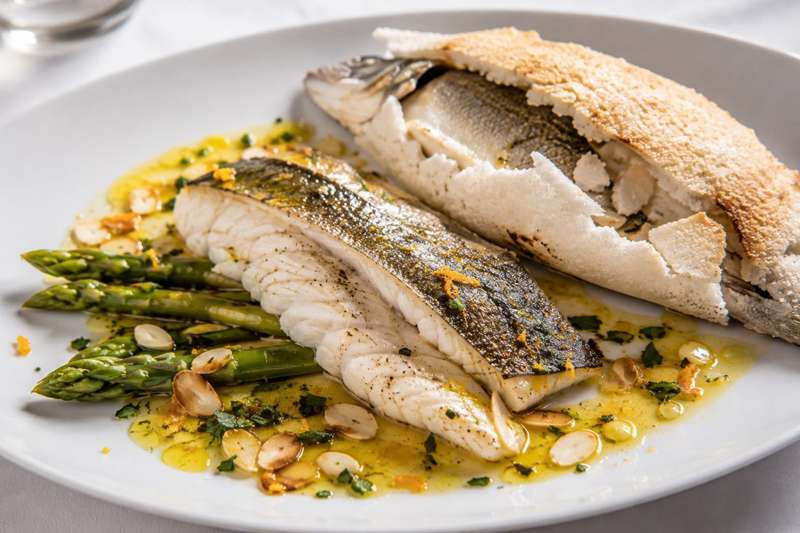
Cooking a whole fish buried in salt is the oldest trick on the Italian coast and nobody has improved on it. A spigola goes into a bed of coarse salt, gets covered with several pounds more, and comes out inside a pale grey shell you crack with the back of a heavy spoon.
This version puts three citrus fruits around it instead of the usual lemon wedge, adds asparagus roasted in the same oven and almonds toasted until they smell of butter. The crust does all the cooking.
The whole dish comes down to three numbers: the weight of salt against the weight of the fish, the internal temperature at the thickest part of the back, and the five minutes of rest before the shell is opened.
Yield: 2 generous servings. Prep: 25 minutes. Cook: 40 minutes. Rest: 5 minutes. Total: about 1 hour 10 minutes. Difficulty: intermediate. Course: secondo di pesce. Region: the Tyrrhenian and Sardinian coasts.
The Story
Salt baking belongs to the places where salt was almost free. The saline of Trapani and Marsala in western Sicily, Cervia on the Adriatic, Margherita di Savoia in Puglia and the Cagliari lagoons produced coarse sea salt in quantities that made it a building material as much as a seasoning. Around those pans a cook could spend two kilos of salt on one fish and throw it away afterwards, which is what the method requires and why it never took hold inland.
Spigola, the fish the north of Italy calls branzino, was the natural candidate. It lives where rivers meet the sea and fattens in the coastal lagoons, the stagni of Sardinia, the lagoon at Orbetello, the Venetian estuaries, so it was caught alive and in good condition rather than landed dead in a net. A fish in that state is worth cooking whole, and cooking it whole and undisturbed is the one thing a salt shell does better than any other method. On feast days it reached the table still sealed, broken open in front of the guests.
The garnish is a spring one and it comes from the same coast. Wild asparagus pushes through the Mediterranean scrub from March, thin and slightly bitter, and cultivated green spears stand in for it the rest of the year. The citrus is the tail end of the winter fruit: blood oranges from around Catania and the bergamot that grows almost nowhere except the Ionian strip of Calabria. The almonds are the Avola and Noto varieties from southeastern Sicily. Together they make a plate that reads as late spring on the Tyrrhenian coast, which is when this dish is most worth cooking.
Ingredients
For the fish
Whole Mediterranean sea bass, spigola, gutted and gilled but NOT scaled, 2 1/4 lb (1 kg)
Lemon, sliced thin, 1/2
Flat leaf parsley, 6 sprigs
Fresh bay leaves, 2
Fennel fronds, 1 small handful
For the salt crust
Coarse sea salt, 4 1/2 lb (2 kg)
Egg whites, large, 3
Cold water, up to 1/4 cup (60 ml), only if needed
For the citrus dressing
Blood orange, 1
Lemon, 1
Bergamot, or Meyer lemon, 1/2
Extra virgin olive oil, 5 tbsp (75 ml)
Fine sea salt, 1/4 tsp (1.5 g)
Freshly ground white pepper, to taste
For the asparagus
Thin green asparagus, 12 oz (340 g)
Extra virgin olive oil, 1 tbsp (15 ml)
Fine sea salt, 1/4 tsp (1.5 g)
For finishing
Blanched almonds, 2 oz (60 g)
Wild fennel or chives, chopped, 1 tbsp
Extra virgin olive oil, a few drops per plate
Flaky sea salt, 1 small pinch per fillet
Preparation
Preparing the fish without seasoning it
Have the fishmonger gut the fish through the belly and pull the gills, and insist the scales stay on. Rinse the cavity, check no blood line is left along the backbone, and dry the outside thoroughly. Slide in the lemon slices, parsley, bay and fennel. Add no salt anywhere, inside or out.
Mixing the salt crust
Tip the coarse salt into a large bowl, add the egg whites and work them together with your hands for a minute. Squeeze a fistful: it should hold its shape like wet sand. If it falls apart, add cold water a spoonful at a time. The ratio is 2 lb of salt for every 1 lb of fish.
Packing the fish in salt
Line a shallow tray with parchment and spread a bed of salt about 1/2 inch (1.5 cm) deep, slightly longer and wider than the fish. Lay the spigola on it and pile the rest over the top, pressing firmly so the salt follows the body from head to tail. Seal the belly opening. No gaps, because steam escapes through gaps.
Baking to temperature, not to the clock
Bake at 400°F (200°C) for 30 to 35 minutes for a 2 1/4 lb (1 kg) fish. You cannot see or touch anything once the shell is sealed, so push a probe thermometer in through the head, entering at the mouth and angling back into the thickest part of the shoulder. Pull the fish at 135°F (57°C).
Resting the fish and cracking the shell
Let the tray stand 5 minutes. The fish keeps cooking in its own heat and the flesh needs the pause to settle before anybody handles it. Then tap the crust firmly with a heavy spoon around the outline of the fish until it fractures, lift it off in large slabs, and brush every loose grain away.
Roasting the asparagus
Snap the woody ends off and peel the lower third of any thick spears. Toss them with the olive oil and fine salt, spread them on a second tray in one layer and give them 10 to 12 minutes in the same oven, until a spear bends but still snaps. Keep them uncovered.
Toasting the almonds
Toast the almonds for 6 to 8 minutes at 325°F (165°C), or in a dry pan over medium heat, shaking often. Stay with them: the window between toasted and bitter is about a minute. Take them out pale gold, cool them, then chop coarsely so both fine pieces and halves remain.
Making the citrus dressing
Cut the peel and pith off the blood orange and cut out the segments. Squeeze 2 tbsp (30 ml) of lemon juice and 1 tbsp (15 ml) of bergamot. Whisk both with the olive oil, salt and white pepper into a loose emulsion, in the last minutes, since citrus juice turns bitter as it sits.
Lifting the fillets off the bone
Peel the skin away in one sheet with the scales attached and discard it. Run a fish spatula along the backbone, lift the upper fillets off, take out the spine with the head and tail, then free the two lower fillets. Check every surface for stray crystals, the belly flap especially.
Plating
Warm the plates to hand warm and no further. The fish leaves the shell at serving temperature and cools fast on cold porcelain, but a plate hot enough to be uncomfortable carries on cooking the underside of the fillet while the guest is still looking at it.
Set one fillet slightly off centre, thicker shoulder end forward, skinned side up. Lay three or four asparagus spears beside it at an angle, never underneath, and tuck two or three blood orange segments between them where the juice cannot run under the fish. Spoon the dressing around the fillet and over the asparagus, not down the middle of the fish.
Scatter the almonds over the asparagus and the edge of the fillet, add the wild fennel and finish with a few drops of your best olive oil and a pinch of flaky salt on the fish. That pinch is the only seasoning the flesh has had, so add it at the pass and serve at once.
Professional Technique
The salt crust is a sealed oven inside the oven, and everything about this dish follows from that. Once the egg white bound salt sets it is a rigid shell with no vents, so all the water the fish releases stays trapped and the relative humidity inside climbs to close to one hundred percent within minutes. The spigola is not roasting, it is steaming in its own juices, and at that humidity no vapour pressure gradient pulls moisture out of the flesh. That is why a fish cooked this way cannot dry out. The dense mineral shell also conducts heat slowly and evenly from every side at once.
The salt does not season the fish, and this is where most cooks go wrong. Sodium cannot travel through intact skin and scales in half an hour, so the salt packed around the spigola never reaches the flesh. Two things follow. Leave the scales on: they are the barrier that makes the method work, and a scaled fish in a salt crust comes out inedibly salty. And never salt the cavity or the skin, because that small amount is the only salt the fish will taste. Season the fillets at the end, on the plate.
Coarse salt on its own does not hold together. It pours off the fish the moment the tray is moved, opens patches where steam escapes, and leaves the oven as loose gravel instead of a shell that lifts away in one piece. Binding it is what makes it set: three egg whites for four and a half pounds of salt, or a quarter cup of cold water, which works less well and gives a more brittle shell. Two pounds of salt per pound of fish is the working ratio.
Because the fish is invisible from the moment it is sealed, a probe thermometer through the head is the only reliable reading available. Enter at the mouth, angle back into the thickest part of the shoulder and pull the tray at 135°F (57°C). Then rest it five minutes: the shell holds enough stored heat to carry the centre a few degrees further, and breaking it open at once means the fish finishes cooking on the plate instead of in the salt.
Texture and Moisture Control
Sea bass protein sets between about 120°F (49°C) and 140°F (60°C), and the flesh turns from translucent to opaque and separating across that narrow band. Pulled at 135°F (57°C) the muscle blocks come apart in clean large flakes that still hold together on a spatula. Ten degrees higher and the same flakes fall into shreds, the connective sheets contract and moisture is squeezed into the tray. There is no way back from that.
The other three elements lose their texture in different directions, and all suffer from being covered. Asparagus roasted correctly gives a tender bend with a snap left in the core, and turns to string within two minutes under foil. Toasted almonds go soft on contact with anything wet, so they reach the plate last and never go into the dressing. The citrus emulsion is a loose oil in juice suspension held by nothing but agitation: whisk it again right before it is spooned out.
Professional Mise en Place
The crust cannot be opened in advance and the fish cannot be held once filleted, so everything is built around one fixed point: the moment the shell is cracked.
Equipment and tools
Instant read probe thermometer, the one tool this dish cannot do without
Shallow baking tray big enough for the whole fish, plus parchment
Large mixing bowl for the salt, and a kitchen scale
Second tray for the asparagus and a small one for the almonds
Heavy spoon for cracking the shell, dry pastry brush, fish spatula, tweezers
Prepared ahead
Almonds toasted and chopped, up to 2 days ahead, kept airtight
Asparagus trimmed and peeled, up to 6 hours ahead, on a damp cloth
Blood orange segmented, lemon and bergamot juiced, up to 2 hours ahead, covered
Salt and egg white mixture packed around the fish, up to 1 hour ahead, refrigerated
Service setup
Oven steady at 400°F (200°C), asparagus tray ready for the last 12 minutes
Thermometer beside the oven, not in a drawer
Plates warming to hand warm, dressing ingredients and whisk to hand
Board, spatula and tweezers laid out, plus a bowl for the crust debris
Chef Tips
Say at the counter that you want the fish gutted and gilled but not scaled. Most fishmongers scale by reflex, and once the scales are gone the fish cannot be cooked in salt at all.
Weigh both the fish and the salt. Two kilos of coarse salt is harder to judge by eye than it sounds, and a crust short by a quarter leaves a bare patch over the back, exactly where the flesh is thickest.
Use coarse sea salt and nothing else. Fine salt packs into a dense mortar that welds itself to the skin and takes flesh with it. The cheapest coarse grey sea salt in the shop is the correct product.
Serve the second fillet on a second round rather than plating all four at once. Fish left waiting on a warm plate for six minutes is far worse than fish eaten straight from the shell. Cooking for four means cooking two fish.
Common Mistakes
Cooking a scaled fish in the crust. The scales and skin keep the salt out of the flesh. Without them the surface is unprotected for half an hour against two kilos of salt, and the fillets come out too salty to eat.
Salting the cavity or the skin. The crust contributes no seasoning, so whatever goes inside is the total. A teaspoon in the belly of a fish this size already reads as well seasoned, and most cooks add three times that.
Leaving the salt loose. Unbound salt slides off as the tray goes into the oven, opens vents that let steam escape, and never sets into a shell you can lift. Three egg whites and two minutes of mixing solves it.
Baking by time alone. Thirty five minutes is an estimate for a 2 1/4 lb (1 kg) fish, and the shell hides every clue. Cook to 135°F (57°C) on a probe pushed in through the head.
Cracking the crust straight out of the oven. The centre of the fish is still climbing when it leaves the oven, and the flesh tears if it has not had time to settle. Five minutes, every time.
Wine Pairing
Vermentino di Gallura DOCG: The reference match, poured with this dish on its home coast. Grown on decomposed granite in northern Sardinia, it has a saline bite that meets the mineral edge of a salt baked fish and a citrus acidity that runs alongside the blood orange and bergamot. Its bitter almond finish picks up the garnish.
Riviera Ligure di Ponente Pigato DOC: Pigato carries more flesh and aromatic weight than most Italian coastal whites, with peach and a resinous herbal top note. That herbal side is the point here: it meets the fennel in the cavity and the green bitterness of the asparagus instead of being flattened by them.
Etna Bianco DOC: Carricante grown on volcanic ash gives searing acidity and a smoky flinty character nothing else in Italy reproduces. The acidity cuts the oil in the dressing while the austerity keeps the wine from overwhelming flesh left almost unseasoned. Same island as the blood oranges.
Verdicchio dei Castelli di Jesi Classico Riserva DOCG: The Riserva bottlings carry more texture and a little age, which suits a whole fish better than a lean young white. Verdicchio finishes on a bitter almond note that lands exactly on the garnish, and it has the breadth to handle asparagus, a vegetable that ruins most whites.
Franciacorta DOCG: For a fish opened at the table, a metodo classico earns its place. The bead scrubs the palate between mouthfuls of oil and almond, the Chardonnay base has body without covering the fish, and the bread and hazelnut notes from the lees sit with the almonds. Brut, never Demi Sec.
Storage & Reheating
Salt baked fish is a dish to eat the day it is cooked. Leftover fillets keep refrigerated in an airtight container for up to 24 hours under a film of olive oil, and they are better cold than reheated: flake them into a salad with the leftover citrus segments.
If you must warm them, use a covered dish at 250°F (120°C) with a spoonful of water for 6 to 8 minutes, and stop before the flakes separate. Never a microwave. Do not freeze cooked fish from a salt crust, since it holds a great deal of water and thawing wrecks the texture.
The crust goes in the bin, not down the sink. Roasted asparagus keeps 2 days refrigerated and is good cold, toasted almonds a week airtight, and the dressing should be made fresh every time.
Nutrition
Per serving, based on 2 generous portions:
Calories: 610 kcal
Total Fat: 40 g
Saturated Fat: 5 g
Trans Fat: 0 g
Unsaturated Fat: 34 g
Cholesterol: 120 mg
Sodium: 520 mg
Total Carbohydrates: 16 g
Fiber: 6 g
Total Sugars: 7 g
Added Sugars: 0 g
Protein: 50 g
Lactose: 0 g
Principal micronutrients: omega 3 fatty acids, vitamin B12, vitamin E, selenium, potassium, folate, magnesium
These figures are estimates. The sodium value assumes the scales and skin were left intact and the crust discarded: a scaled fish cooked the same way would carry several times that amount.


Comments