
Italian Tagliatelle with Porcini Mushrooms | Tagliatelle ai Funghi Porcini
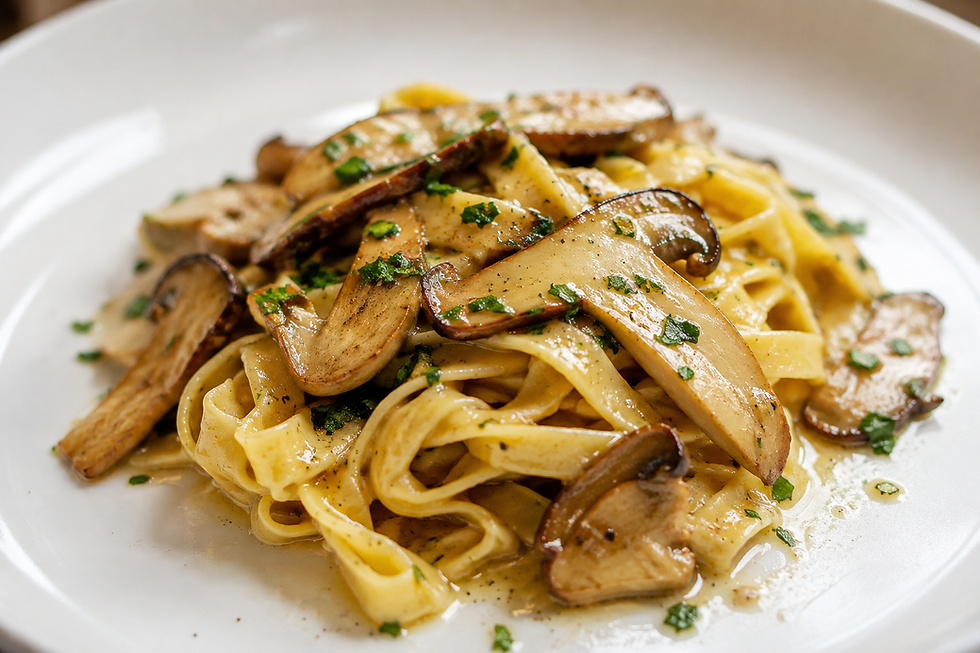
There is no sauce in this dish in the usual sense. No cream, no tomato, no stock reduced for hours. What binds tagliatelle ai funghi porcini is mushroom, butter and the starch that leaves egg pasta as it cooks, and the whole difficulty lies in coaxing enough flavour out of the porcini that those three things are sufficient. Handled badly, porcini release water, stew in it and turn grey. Handled properly they brown, concentrate, and give up an aroma no cultivated mushroom can imitate.
The method here uses fresh and dried porcini together, which is a deliberate decision rather than a compromise. Fresh caps supply the meaty bite and the woodland perfume. Dried ones, and above all their soaking liquid, supply a concentrated savoury depth that drying creates and fresh mushrooms do not have. Together they give a plate that tastes of far more mushroom than it contains.
Yield: 4 servings. Prep: 25 minutes. Cook: 25 minutes. Total: about 50 minutes. Difficulty: intermediate. Course: primo piatto. Season: September to November. Region: the Apennine ridge between Emilia Romagna and Tuscany.
The Story
The porcino, Boletus edulis, grows wild and has never been farmed. Every one that reaches a market was found by somebody walking under chestnut, oak, beech or pine in the days after autumn rain, and that shapes everything about how Italy cooks it. There is no consistent supply, no standard size and no way to order more, so recipes built around porcini stay short and add almost nothing to the mushroom itself.
The Apennine spine between Emilia Romagna and Tuscany is the heart of it. The Fungo di Borgotaro from the upper Taro valley in the Parma province became the first mushroom in Italy to receive IGP protection, in 1996, covering four communes whose chestnut woods produce porcini of a particular density and perfume. Picking is regulated across most of Italy: foragers buy a regional permit, are held to a daily limit of around 3 kilograms, and must carry an open weave basket so spores fall back into the wood.
Tagliatelle arrive from the Emilian plain below those hills, where egg pasta has been the everyday format for centuries. The pairing is a mountain and valley marriage that predates any restaurant menu: the woodsman's find dressed with the housewife's sheet of sfoglia. In Tuscany the same dish is scented with nepitella, the small wild mint growing at the edge of those woods, which Tuscan cooks treat as the mushroom herb the way the rest of Italy treats parsley.
Ingredients
For the pasta
Fresh egg tagliatelle, 14 oz (400 g), or dried egg tagliatelle, 12 oz (340 g)
Water for boiling, 5 quarts (4.7 liters)
Coarse sea salt, 2 tbsp (35 g)
For the porcini
Fresh porcini, firm and dry, 1 lb (450 g)
Dried porcini, 1/2 oz (15 g)
Warm water for soaking, 1 cup (240 ml)
Extra virgin olive oil, 3 tbsp (45 ml)
Unsalted butter, 2 tbsp (28 g)
Garlic cloves, lightly crushed and left whole, 2
Dry white wine, 1/4 cup (60 ml)
Fine sea salt, 3/4 tsp (5 g)
Freshly ground black pepper, to taste
For finishing
Parmigiano Reggiano aged 24 months, finely grated, 1 1/2 oz (42 g)
Unsalted butter, cold and cubed, 1 tbsp (14 g)
Reserved pasta cooking water, about 1 cup (240 ml)
Flat leaf parsley, finely chopped, 2 tbsp, or fresh nepitella, 1 tbsp
Extra virgin olive oil, a thread per plate
Preparation
Soak the dried porcini and keep the liquid
Put the dried porcini in a bowl, pour over the warm water and leave them 20 minutes. Lift them out with your fingers rather than pouring, so the grit stays at the bottom, squeeze them gently over the bowl and chop them coarsely. Strain the soaking liquid through a coffee filter or a doubled square of muslin into a clean cup. That liquid is the most concentrated flavour in the recipe, but it must be filtered, because unfiltered it carries fine sand no amount of cooking removes.
Clean the fresh porcini without water
Never wash porcini under a tap. They are dense and porous and take up water like a sponge, which guarantees they will steam instead of brown. Scrape the earth off the stem with a small knife, wipe the cap with a slightly damp cloth, and trim any part gone soft. Cut the firm caps into slices about 1/4 inch (6 mm) thick and dice the stems smaller, since they are denser and need longer.
Sear the caps in a hot pan
Heat 2 tablespoons of the olive oil in a wide pan over medium high heat until it shimmers, then lay in the sliced caps in a single uncrowded layer. Do not stir for the first 90 seconds. Mushrooms must lose surface moisture before they can brown, and moving them keeps dropping the pan below the temperature where that happens. Once golden on the underside, turn them, give them another minute, and lift them onto a plate. Work in two batches if the pan is not wide enough.
Build the base with stems, garlic and wine
Lower the heat to medium and add the remaining tablespoon of oil with the butter, the crushed garlic and the diced stems. Cook 4 minutes until the stems soften, then add the chopped rehydrated porcini and cook 2 minutes more. Pour in the white wine and let it evaporate almost completely. Add the filtered soaking liquid, leaving the last tablespoon in the cup in case sediment settled, and simmer until reduced by roughly half. Remove the garlic cloves.
Return the caps and season
Slide the seared caps back into the pan with any juice they released on the plate, add the fine salt and a generous grind of black pepper, and cook together for 2 minutes only. The slices should reheat and take on the flavour of the base without going soft, so this is not a further cooking stage. Taste the pan now: it should be intensely savoury and slightly under salted, because the Parmigiano and the pasta water are still to come.
Salt the water and cook the tagliatelle
Bring the 5 quarts of water to a rolling boil and add the coarse salt once it boils, giving about 7 grams per liter. Slide in the tagliatelle, stir once to separate the nests, and cook them 90 seconds short of done, which for fresh egg pasta means barely 90 seconds in total. Lift out a full cup of the cloudy cooking water before you drain, and drain without rinsing. That starch will hold the whole plate together.
Mantecare the pasta with the mushrooms
Transfer the drained tagliatelle directly into the mushroom pan over medium heat with half a cup of the reserved water. Toss continuously with tongs for 60 to 90 seconds, lifting the ribbons so the mushrooms work between the folds instead of collecting at the bottom. Add more water a splash at a time, watching for the moment the liquid stops looking watery and turns glossy, coating the pasta rather than pooling under it.
Finish off the heat with butter, cheese and parsley
Take the pan off the burner entirely and let it stand 20 seconds. Add the cold cubed butter and toss until it vanishes, then add the Parmigiano in two or three additions, tossing hard between each so it melts into the starch rather than the fat. Cheese added over live heat will string and leave an oily surface. Fold in the parsley or nepitella at the very end so it stays green, check the seasoning and serve at once.
Plating
Warm the bowls first, because a sauce bound with cheese and butter tightens on a cold plate within a minute. Use wide shallow bowls rather than deep ones: a pile of pasta in a narrow bowl traps steam underneath and softens the ribbons on the way to the table.
Reserve a few of the best seared cap slices before tossing the pasta and set them on top rather than burying them. Lift each portion into a loose nest, let some ribbons fall open, then arrange the reserved slices so the browned face shows. Spoon over any sauce left in the pan and add a thread of raw olive oil, black pepper and a few parsley leaves. No extra cheese at the table: Parmigiano piled on top buries the mushroom.
Professional Technique
The central technique is managing mushroom water. Fresh porcini are roughly 90 percent water by weight, and that water has to leave the cap before any browning can begin, because the pan surface cannot exceed the boiling point of water while liquid sits on it. A hot wide pan, a single uncrowded layer and 90 seconds of stillness let the moisture escape as steam fast enough for the surface to dry and browning to start. Crowd the pan and the mushrooms boil in their own juice, which is the difference between deep savoury flavour and a grey stewed one.
The second technique is using dried porcini as a flavour concentrate rather than a substitute. Drying converts much of the mushroom's ribonucleotide content into forms the palate reads as intensely savoury, and it drives off water so those compounds sit far more densely in the tissue. Rehydrating in a controlled amount of warm water pulls a good part of that straight into the liquid, which is why the soaking water is treated here as an ingredient and reduced in the pan rather than discarded. Filtering it through paper is not fussiness: dried porcini always carry fine grit, and grit in a sauce cannot be corrected.
Texture and Moisture Control
Three textures have to reach the table intact: the seared cap slices firm with a browned face, the base soft and savoury, the pasta al dente and glossy. Each fails differently. The caps go soft if returned to the pan too early or simmered in the reduced liquid. The base turns thin if the soaking liquid is not reduced by half before the pasta arrives. The pasta goes slack if it is cooked to eating point before its final 90 seconds in the pan.
The binding here is starch and nothing else, which makes the reserved cooking water non negotiable. Amylose and amylopectin released from the egg pasta let butter, oil and mushroom liquid hold together as a single coating instead of splitting into fat and water. Add the water in small splashes and keep tossing, since the emulsion needs agitation as much as starch. Add it all at once and you dilute the flavour you spent twenty minutes concentrating.
Judge the pasta by bite. Fresh egg tagliatelle are cooked when the ribbon resists briefly at the centre and then gives, with no chalky core. Serve immediately after the cheese goes in, since the sauce keeps thickening in the bowl.
Professional Mise en Place
The mushroom base holds well and the searing can be done in advance, so what remains at service is the pasta and the toss.
Equipment and tools
Wide heavy sauté pan, large enough to sear without crowding and to hold the finished pasta
Tall pasta pot and a heatproof cup for the reserved cooking water
Coffee filter or muslin for straining the soaking liquid
Small knife and a soft cloth for cleaning the fresh porcini
Tongs for the mantecatura and a fine rasp grater for the Parmigiano
Prepared ahead
Dried porcini soaked, chopped and the liquid filtered, up to 1 day, kept cold
Fresh porcini cleaned and cut, held on a tray lined with paper, up to 4 hours
Caps seared and the base cooked through the reduction, up to 1 day refrigerated
Parmigiano grated fresh on the day, parsley or nepitella chopped at the last moment
Service setup
Mushroom base warm in the wide pan over low heat, loosened with a spoonful of water if tight
Reserved seared cap slices set aside for the garnish, not in the pan
Pasta water at a rolling boil and already salted
Cup for the cooking water beside the colander, cold butter cubed, cheese within reach
Bowls warmed and waiting
Chef Tips
Choose porcini by weight and smell rather than size. A good one feels heavy and solid, the stem firm under pressure, the underside of the cap pale cream to pale yellow. Once that underside turns olive green and spongy the mushroom is past its best and will collapse in the pan. Check for small holes at the stem base, which mean insects got there first.
If fresh porcini are out of season or beyond the budget, double the dried quantity to 1 oz (30 g) and use 1 lb (450 g) of firm cremini for the body. Say what it is: the dried porcini carry the aroma convincingly, but no other mushroom reproduces the texture of a fresh seared cap.
Never soak dried porcini in water straight from the kettle. Above about 175°F (80°C) the extraction pulls harsh notes along with the good ones and can leave a bitter edge in the liquid. Warm tap water and 20 minutes of patience give a cleaner, sweeter result.
Keep the garlic whole and remove it. Chopped garlic burns in a hot searing pan and turns acrid, and in a dish this restrained a single burnt fragment is obvious. Two crushed cloves perfume the oil and come out before the pasta arrives.
Common Mistakes
Washing fresh porcini under the tap. Their dense flesh absorbs water at once, and a waterlogged mushroom steams instead of browning, arriving grey and slippery. Scrape the stem with a knife and wipe the cap with a barely damp cloth.
Crowding the searing pan. Too many slices at once drop the pan below the temperature at which surface water evaporates, so the mushrooms release liquid and boil in it. Sear in two batches and accept the extra three minutes.
Discarding the soaking liquid. It holds most of the savoury depth the dried porcini were bought for. Filter it and reduce it in the pan rather than pouring away the best part of an ingredient you paid for.
Pouring the soaking liquid straight from the bowl. Dried porcini always shed fine sand which settles at the bottom, and sand in a finished dish cannot be fixed. Strain through a coffee filter and leave the last tablespoon behind.
Adding cream to make it richer. Cream flattens the aroma of porcini rather than carrying it, masking the woodland character the dish exists to show. Pasta water gives all the body needed.
Wine Pairing
Nebbiolo d'Alba DOC: The classic answer, and a sound one. Nebbiolo carries a dried rose, tar and forest floor character that runs alongside the woodland aroma of porcini rather than competing with it. Its firm acidity handles the butter and Parmigiano, while the tannin stays fine enough not to overwhelm egg pasta. Serve at around 61°F (16°C).
Barbaresco DOCG: The same grape given more time and weight, for when the porcini are worth the bottle. Age brings out exactly the dried mushroom and truffle notes that mirror the dish, and the extra structure meets the concentrated soaking liquid without flattening the pasta. Decant a younger bottle for half an hour.
Chianti Rufina DOCG: From the cooler hills northeast of Florence, this is the Tuscan choice and the one to pour if you have scented the dish with nepitella. Sangiovese from Rufina keeps a high, savoury acidity and a note of dried herbs that picks up the mint directly, and its sour cherry fruit cuts the butter cleanly without adding sweetness.
Etna Rosso DOC: Nerello Mascalese grown on volcanic soil gives a pale, light bodied red with aromatic lift and a smoky, ashy edge that meets the seared surface of the caps. Its tannins are soft and its acidity high, which suits a dish with no fat beyond butter and cheese. Serve it cool, around 59°F (15°C).
Verdicchio di Matelica DOC: The white to choose for anyone who would rather not open a red. Grown in a cool inland valley of the Marche, it has more structure and a stonier finish than coastal Verdicchio, and the bitter almond note it ends on sits well against the earthiness of porcini. Enough body for the Parmigiano, enough acidity to stay fresh.
Storage & Reheating
Keep the mushroom base and the pasta separate whenever you can. The base, cooked through the reduction and cooled quickly, holds in an airtight container in the refrigerator for up to 3 days and freezes for up to 2 months in a flat sealed bag. Thaw it overnight and rewarm it gently, loosening with a spoonful of water. Holding no cheese or starch yet, it survives both intact.
Finished pasta keeps no more than 24 hours, refrigerated in a shallow airtight container so it cools fast. To reheat without turning the ribbons to paste, use a wide pan over medium low heat with 2 or 3 tablespoons of water, tossing constantly for about 2 minutes until the sauce coats again. Avoid the microwave, which breaks the cheese emulsion while the centre is still cold.
Never freeze the finished dish, since the starch and butter binding thaws into oily liquid around soft pasta. Raw fresh porcini keep 3 days in the refrigerator in a paper bag, never plastic, which traps moisture and turns them slimy. Dried porcini keep a year in a sealed jar away from light.
Nutrition
Per serving, based on 4 servings:
Calories: 600 kcal
Total Fat: 23 g
Saturated Fat: 8 g
Trans Fat: 0.3 g
Unsaturated Fat: 13 g
Cholesterol: 125 mg
Sodium: 680 mg
Total Carbohydrates: 73 g
Fiber: 6 g
Total Sugars: 4 g
Added Sugars: 0 g
Protein: 24 g
Lactose: 0.6 g
Principal micronutrients: selenium, copper, potassium, phosphorus, niacin, riboflavin, vitamin D
These figures are estimates. Most of the salt in the cooking water is drained away rather than eaten, and the vitamin D in porcini varies enormously with how much sunlight the mushrooms saw before drying.


Comments