
Italian Sicilian Almond Nougat | Torrone Siciliano alle Mandorle
Updated: Sep 14

Sicilian torrone is not the soft white nougat sold in boxes at Christmas. There is no egg white in it and no whipping. Sugar and honey are taken to hard crack, toasted almonds are folded into the boiling mass, and the whole thing is pressed flat, scored while it is still warm and left to set into slabs that snap. It is a confection of two ingredients and a thermometer, and everything difficult about it happens in the four minutes after the pan comes off the flame.
The result should be hard but not glassy, with a caramel that shatters cleanly under the teeth rather than welding them together, and almonds that stay crisp inside it for weeks. The almonds must be genuinely toasted and genuinely hot when they go in. Cold almonds drop the temperature of the sugar on contact, the mass stiffens before it can be spread, and what should have been an even slab becomes a lumpy mound that sets in the pan.
Everything else is timing. Sugar at 300°F (149°C) is dangerous and unforgiving, it keeps darkening off the heat, and it stops being workable roughly 90 seconds after the almonds go in. Read the whole method before lighting the burner and set out every tool within reach.
Yield: about 20 pieces from a 9 inch (23 cm) square. Prep: 20 minutes. Cook: 20 minutes. Set: 2 hours. Difficulty: advanced, hot sugar work. Course: dessert and confectionery. Region: Sicily, from Caltanissetta and the Madonie down to the Val di Noto.
The Story
Sicilian almond torrone belongs to the family of honey and nut confections that the Arabs carried across the Mediterranean, and the island kept the name as well as the method. The Arabic qubbayt gave Sicily cubbaita, the sesame and honey brittle still sold under that name and as giuggiulena, and the almond version is its close relative made with the island's dominant nut instead of sesame. The same root travelled west to Spain and became turron, which is why Sicilian torrone has far more in common with Alicante than with the soft aerated bars of Cremona. In Sicily the confection stayed hard, dark and simple.
It was, and largely remains, festival food rather than everyday food. The torronari set up their stalls at patronal feasts, at the fairs around the feast of the Immacolata in December, and at Christmas markets, working the hot mass on marble slabs in front of the crowd and cutting it to order. Caltanissetta and the towns of the Madonie kept the strongest reputation for it, while the almonds themselves came up from the groves of Avola and Noto in the southeast, where the thin shelled varieties prized for their oil content are grown. The honey is usually orange blossom or wildflower, and in a recipe with three ingredients the choice of honey is the one that decides the flavour.
Ingredients
For the almonds
Whole blanched almonds, 3 cups (425 g)
For the caramel
Granulated sugar, 1 cup (200 g)
Honey, orange blossom or wildflower, 1/2 cup (170 g)
Water, 2 tbsp (30 ml)
For the aromatics
Orange zest, finely grated, from 1 organic orange
Lemon zest, finely grated, from 1/2 organic lemon
Fine sea salt, 1/4 tsp (1.5 g)
Pure vanilla extract, 1/2 tsp (2.5 ml), optional
For finishing
Edible wafer paper, 2 sheets, optional
Neutral oil, for the rolling pin, the knife and the spatula
Preparation
Line the pan and set out the tools
Line a 9 inch (23 cm) square pan with parchment, and if you are using wafer paper cut one sheet now for the base and one for the top. Oil a rolling pin, a large chef knife and a sturdy spatula and lay them beside the pan. Once the almonds meet the sugar you have about 90 seconds of working time, so nothing can be fetched from a drawer later. Keep a bowl of cold water by the stove.
Toast the almonds and keep them hot
Spread the almonds in a single layer and toast at 325°F (165°C) for 12 to 14 minutes, shaking the tray once, until they are clearly golden through and smell strongly of almond. Pale almonds give a flat torrone: almost all of the nut flavour comes from this step. Leave them in the oven with the door shut and the heat turned down to 200°F (95°C) while you cook the sugar. They must go into the caramel hot.
Melt the sugar and honey
Combine the sugar, honey and water in a heavy saucepan at least 3 quart (3 liter) in size, because the mixture triples in volume when it boils. Stir over medium heat only until the sugar has dissolved and the liquid runs clear, then stop stirring. Brush the inside wall of the pan down once with a wet pastry brush to wash back any stray crystals, since a single grain left on the side can seed the whole batch into a grainy mass.
Cook to hard crack
Clip on a candy thermometer with the tip clear of the base and let the syrup boil undisturbed to 300°F (149°C), which usually takes 8 to 12 minutes. The last 20°F pass very quickly, so stay at the pan. Honey darkens faster than sugar and can smell scorched before the thermometer shows it, so watch the colour as well: you want a light amber, the shade of dark tea. Take the pan off the heat the moment the number is reached.
Add the aromatics
Off the heat, stir in the orange zest, the lemon zest, the salt and the vanilla if you are using it. The mixture hisses and foams up, which is water in the zest flashing to steam, so stand back and use a long handled spoon. Work fast: citrus oils are volatile and their perfume burns off within seconds at this temperature, which is why the zest goes in at the end rather than into the syrup.
Fold in the hot almonds
Tip the hot almonds in all at once and stir hard with an oiled spatula until every nut carries a coat of caramel, about 30 seconds. The mass thickens visibly as you work. Do not stir gently or in stages: any almond not coated now will never be coated, and a mixture stirred slowly cools past the point where it can be spread.
Press and level the slab
Scrape everything into the lined pan and press it down at once with the oiled rolling pin, working from the centre outwards to a thickness of 1/2 to 3/4 inch (12 to 18 mm). If you are using wafer paper, lay the top sheet on and roll over that, which gives a clean surface and stops the pin dragging. Push the mixture into the corners with the spatula. Speed matters more than neatness: an uneven slab can be trimmed, but one that sets before it is flat cannot be fixed.
Score, cut and cool
Wait 5 to 10 minutes, until the surface is firm to a fingertip but the slab still gives slightly under pressure, then cut it into bars or diamonds with the oiled chef knife pressed straight down, not dragged. This is the only window. Cut sooner and the caramel smears; cut later, once it is fully cold, and it shatters along its own lines instead of yours. Leave the pieces in the pan for 2 hours at cool room temperature to finish hardening, then lift them apart.
Plating
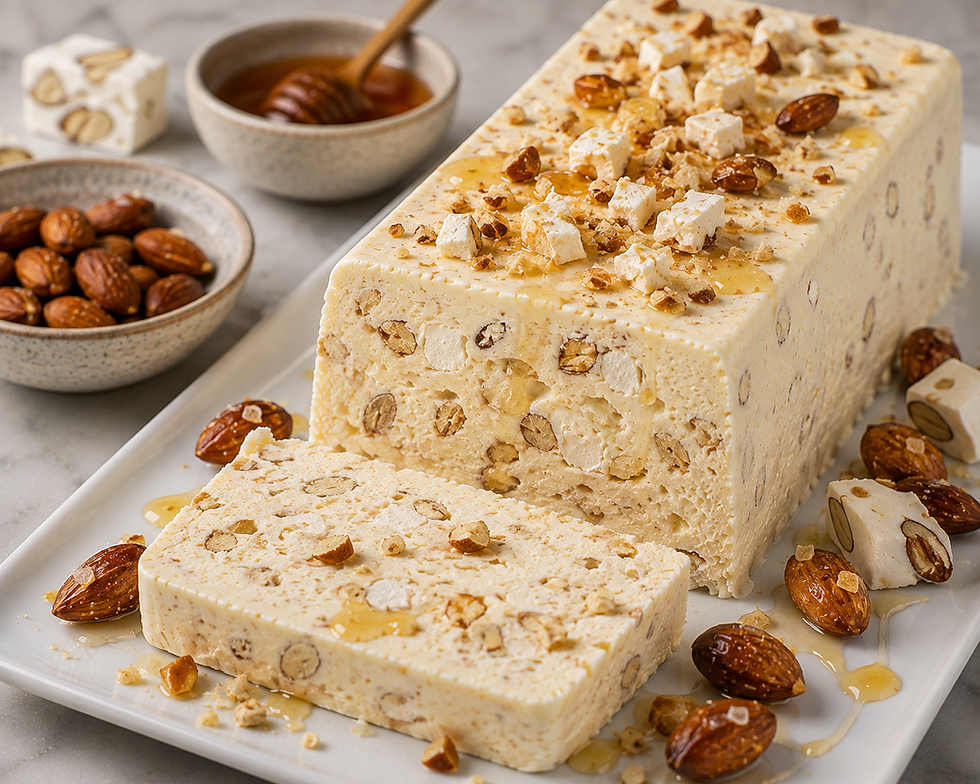
Torrone is served at room temperature, never chilled, and never as a plated dessert with sauces around it. Stack the bars on a wooden board or a flat ceramic dish, arranged so the cut faces show, because that is where the almonds read and a torrone is judged on how densely the nuts are packed. Three or four pieces per person is generous.
Sending it out from a kitchen, cut smaller: diamonds of about 1 inch (2.5 cm) alongside coffee, with candied peel and a couple of other small sweets, is the traditional Sicilian close to a meal and works far better than one large bar on a plate. Keep it away from anything wet, since a slice of orange or a spoonful of cream beside it softens the surface within minutes and costs the confection its snap.
Professional Technique
The controlling technique is sugar cookery at the hard crack stage, and the number is not negotiable. At 300°F (149°C) the syrup has been reduced to roughly 1 percent residual water, which is what allows it to set into a hard glassy solid rather than a chewy one. Stop at 280°F (138°C), the soft crack stage, and the torrone stays tacky and bends instead of snapping. Push past 310°F (154°C) and the sugars turn bitter, especially with honey in the pan, where fructose browns at a lower temperature than sucrose. Calibrate the thermometer before you start: an instrument reading five degrees low will cost you the batch.
The second control is crystallisation, and honey is the reason this recipe tolerates it at all. Honey is mostly invert sugar, glucose and fructose already separated, and those molecules physically obstruct sucrose crystals from linking into a lattice, which keeps the mixture smooth and clear instead of opaque and sandy. The safeguards still matter: dissolve the sugar fully before boiling, wash the pan wall down once, and stop stirring the moment the syrup is clear. A stray crystal can set off a chain reaction that turns the whole pan grainy in seconds, with no recovery from it.
Texture and Moisture Control
Two textures have to hold together: caramel that is hard and brittle, and almonds that are dry and crisp inside it. Both are destroyed by the same enemy, which is water. The caramel is hygroscopic and pulls moisture out of humid air through any exposed surface, going first tacky, then sticky, then soft, and an almond inside softening caramel loses its crunch within a day. This is why Sicilian confectioners refuse to make torrone on a wet day: cook it when the kitchen is dry and cool.
Temperature is the other half. The almonds must be hot when they meet the sugar, ideally above 150°F (65°C), or the mass seizes on contact and cannot be pressed. The slab then needs to cool slowly and evenly at room temperature, not in the refrigerator, where condensation forms on the surface as it warms back up and dissolves the outer layer of caramel into a sticky film. Cut in the narrow warm window, cool in a dry room, and wrap the pieces as soon as they are cold rather than leaving them out on the board overnight.
Professional Mise en Place
This is the recipe where mise en place is not a matter of tidiness but of whether the dish works at all. The entire assembly happens in under two minutes at a temperature that will burn you badly, so set up completely before the pan goes on the heat.
Equipment and tools
Heavy saucepan, at least 3 quart (3 liter), the mixture triples when it boils
Calibrated candy thermometer or a digital probe
Sheet tray for toasting, and a 9 inch (23 cm) square pan lined with parchment
Rolling pin, large chef knife, sturdy spatula, all lightly oiled
Wet pastry brush, long handled spoon, and a bowl of cold water for burns
Prepared ahead
Wafer paper cut to size for the base and the top, before any heat
Zest grated and measured into a small bowl with the salt and the vanilla
Sugar, honey and water weighed into the saucepan
Pan lined, tools oiled and laid out in the order they will be used
Service setup
Almonds holding hot in the oven at 200°F (95°C) with the door closed
Thermometer clipped on with the tip clear of the pan base
Timer set for the 5 minute mark after pressing, for the scoring window
Airtight tins and parchment squares ready for wrapping once cold
Chef Tips
Choose the honey deliberately, because with only three ingredients it is half the flavour. Orange blossom honey is the traditional Sicilian choice and keeps the confection floral and bright. Chestnut or heather honey will dominate and turn the torrone bitter. Whatever you use, it should be liquid and fresh, since crystallised honey needs to be warmed through before it will behave in the pan.
Calibrate the thermometer in boiling water before you start. It should read 212°F (100°C) at sea level, and if it does not, note the difference and correct for it. One reading five degrees high gives a soft torrone that never sets, the commonest equipment failure in sugar work.
If the mass seizes in the pan before you can spread it, return it briefly to low heat and stir. It will loosen enough to press, though the result will be a little darker. This rescue works once. Do it twice and the sugar caramelises past the point of pleasant bitterness.
Oil everything the hot mixture will touch, including the spatula, and reoil the knife between every few cuts. Hot caramel bonds to clean steel instantly, and a knife that sticks tears the slab rather than cutting it.
Common Mistakes
Adding cold almonds. They drop the temperature of the caramel on contact, the mass stiffens before it can be coated or spread, and the result is a lumpy mound rather than a slab. Hold the toasted almonds in a low oven and tip them in hot.
Stopping short of 300°F (149°C). Below hard crack there is too much water left in the syrup and the torrone stays tacky and bends instead of snapping. Use a calibrated thermometer rather than judging colour, because honey darkens before the sugar is ready.
Stirring the syrup while it boils. Agitating a saturated sugar solution encourages crystals to link up, and the clear syrup turns opaque and sandy in seconds with no way back. Stir only until the sugar dissolves, then leave it alone.
Cutting at the wrong moment. Too early and the caramel smears across the blade; fully cold and the slab shatters along its own lines rather than yours. The window is 5 to 10 minutes after pressing, when the surface is firm but the slab still gives.
Cooling it in the refrigerator. Condensation forms on the surface as the slab warms back up and dissolves the outer caramel into a sticky film. Cool at room temperature in a dry room, and never store torrone cold.
Leaving it uncovered. Caramel pulls moisture straight out of humid air, going tacky within hours and soft within a day, and the almonds inside soften with it. Wrap the pieces in parchment and seal them in a tin as soon as they are cold.
Wine Pairing
Vin Santo del Chianti Classico DOC: The classic partner for hard almond confectionery, and it works because both sides are built on oxidation and nut flavour. Years in small barrels give it walnut, dried fig and caramel notes that meet the darkened sugar directly, while its firm acidity cuts the fat of a mouthful of almonds. Serve it at 55°F (13°C).
Ramandolo DOCG: Verduzzo left to dry gives a sweet wine with an unusual tannic grip for a white, and that grip is precisely what a dense brittle needs. The apricot and honeyed apple fruit echoes the honey in the pan, and the slightly astringent finish scrubs the caramel off the palate instead of layering more sugar onto it.
Moscato di Scanzo DOCG: A rare red passito from Bergamo, and the most interesting glass on this list. Dried rose, sage and candied red fruit sit against the toasted almond rather than alongside it, and its light tannin gives the pairing a structure that no white dessert wine can offer. Pour small measures, since it is intense and expensive.
Montefalco Sagrantino Passito DOCG: The heavyweight option, for a torrone made with a dark honey or cut thick. Sagrantino carries more tannin than almost any Italian grape, and dried on the vine it becomes sweet without losing that grip, so it stands up to hard caramel where a delicate Moscato would simply vanish underneath it.
Storage & Reheating
Cool the slab completely, then wrap each piece in parchment or cellophane and pack the pieces in an airtight tin with parchment between the layers. Kept at cool dry room temperature, around 64°F (18°C), it holds its snap and its almond aroma for 3 to 4 weeks, and stays edible longer, though the nuts gradually lose their crispness. Add a small food safe silica sachet if your kitchen is humid.
Never refrigerate it. The cold does not damage the caramel directly, but every time a piece comes back to room temperature condensation forms on the surface and dissolves the outer layer into a tacky film, and after two or three cycles the pieces weld together into a single block. For the same reason, do not freeze it: thawing puts water on the surface faster than anything else.
There is no reheating. A slab gone soft from humidity cannot be revived, though it can be broken up and used as a praline, folded through gelato or crushed over ricotta.
Nutrition
Per piece, based on 20 pieces cut from a 9 inch (23 cm) square:
Calories: 190 kcal
Total Fat: 10 g
Saturated Fat: 0.8 g
Trans Fat: 0 g
Unsaturated Fat: 9 g
Cholesterol: 0 mg
Sodium: 30 mg
Total Carbohydrates: 22 g
Fiber: 2 g
Total Sugars: 19 g
Added Sugars: 18 g
Protein: 4 g
Lactose: 0 g, the recipe contains no dairy
Principal micronutrients: vitamin E, magnesium, manganese, copper, riboflavin, phosphorus
These figures are estimates and depend on how thick the slab was pressed. The recipe contains tree nuts, and no dairy, egg or gluten, though wafer paper is usually potato or wheat starch, so check the packet if gluten matters.



Comments