
Italian Nougat and Almond Semifreddo | Semifreddo al Torrone e Mandorle
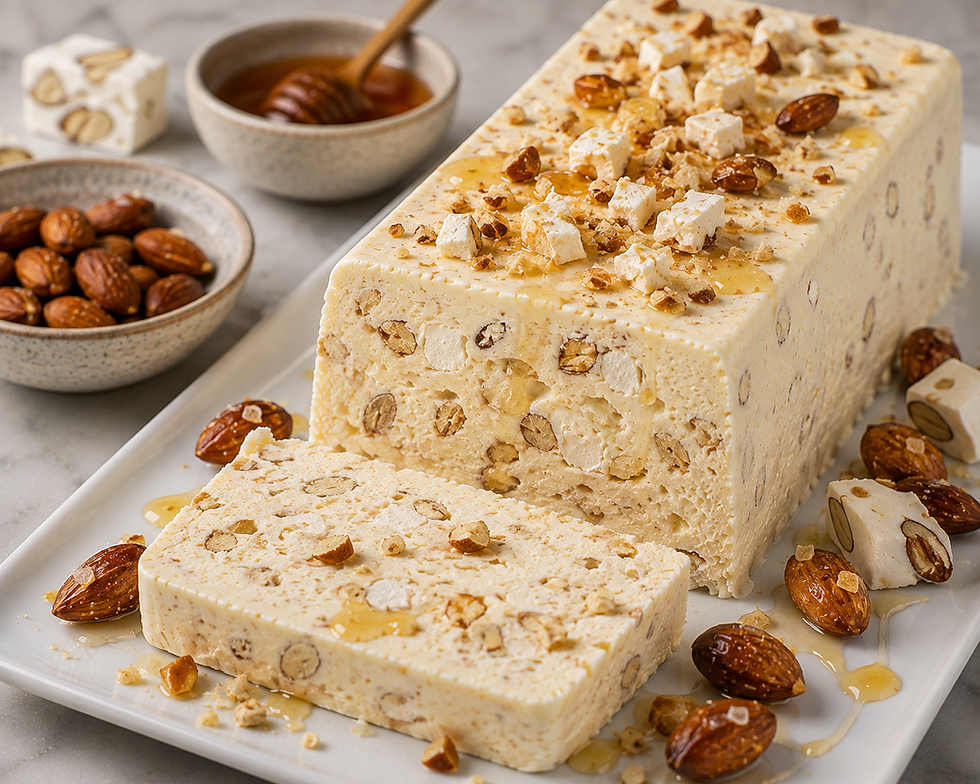
This semifreddo is built on two crisp things that behave in opposite ways. A whole toasted almond stays hard in the freezer for days. A piece of torrone is sugar, and it yields the moment it meets the warmth of the mouth. Putting both into the same frozen dessert means working with two different clocks, and most of the recipe below is really one decision repeated twice: how big to cut each of them.
Yield: 8 servings from a 9 by 5 inch (23 by 12 cm) loaf mould. Prep: 45 minutes. Cook: 15 minutes. Freeze: at least 8 hours. Total: about 9 hours. Difficulty: intermediate. Course: dolce. Region: Sardinia, Lombardy and Campania, wherever torrone is made.
The Story
Torrone has more than one birthplace and all of them are defended loudly. Cremona ties it to the wedding of Bianca Maria Visconti and Francesco Sforza in 1441, at which a sweet of honey, egg white and almonds was supposedly moulded in the shape of the Torrazzo, the bell tower that still stands over the city. Benevento tells a different story and points to the Sannio, where torrone was being made and sold long before any Lombard wedding. Sardinia argues from its own practice: in Tonara and Ozieri, torrone is still cooked in copper over hours, made with honey alone and no added sugar, whipped with egg white and loaded with almonds or hazelnuts, and it comes out chewy and pale rather than brittle.
Behind all three claims sits the almond, and behind the almond sits Sicily. Nut and honey confectionery arrived on the island with the Arabs, and cubbaita, the Sicilian sesame and almond brittle, is a cousin of every torrone on the peninsula. The almonds that matter still come from the same places: the Pizzuta and Fascionello of Avola in the southeast of Sicily, prized for their thin skin and high oil, and the Filippo Cea of Toritto in Puglia, rounder and sweeter. Those two qualities, oil and sweetness, are the reason an almond can be toasted hard and still taste of something once it is frozen.
The semifreddo itself is far younger than the torrone inside it, and its origin is ordinary. Italian houses end every Christmas with torrone left over, hard bars of it in the sideboard, too much to eat and too good to throw away. Pastry kitchens in the north did the practical thing and folded it into a frozen cream, and the dessert stuck because it works: torrone stops being something you have to gnaw at and becomes something that gives way. What began as a way to finish the Christmas sideboard is now on menus in June.
Ingredients
For the almonds
Whole blanched almonds, 4 oz (115 g)
Fine sea salt, 1 pinch
For the torrone
Hard almond torrone, 5 oz (140 g)
For the Italian meringue
Egg whites, at room temperature, 3 oz (85 g), about 3
Granulated sugar, 5 1/2 oz (155 g)
Water, 2 tbsp (30 ml)
Lemon juice, 1/4 tsp (1 ml)
For the sabayon base
Egg yolks, 2 1/2 oz (70 g), about 4
Honey, mild acacia or orange blossom, 2 1/2 tbsp (50 g)
Dry Marsala or dry white wine, 2 tbsp (30 ml)
For the cream
Heavy cream, cold, 36 percent fat or higher, 1 3/4 cups (420 ml)
Vanilla bean, seeds only, 1/2
For finishing
Torrone shards for the top, reserved from the 5 oz above
Toasted almonds, halved, reserved from the 4 oz above
Honey, for a thin drizzle, 1 tbsp (20 g)
Flaky sea salt, a few grains per plate
Preparation
Step 1: Toasting the almonds whole
Heat the oven to 320°F (160°C). Spread the blanched almonds on a tray, add the pinch of salt and toast them for 12 to 14 minutes, shaking the tray once, until the centre of a split almond is the colour of pale straw. Leave them whole at this stage. Cool them completely on the tray. A warm almond going into anything cold is a mistake you cannot undo.
Step 2: Cutting the two inclusions to two different sizes
Halve two thirds of the cooled almonds lengthwise along the natural seam and leave the rest whole. Those go inside the semifreddo. Now take the torrone and break it with a heavy knife into pieces about 1/2 inch (12 mm) across, deliberately larger than any almond on the board, and set them aside separately. Small torrone is wasted torrone. Reserve a handful of the best shards and a dozen almond halves for the top.
Step 3: Cooking the Italian meringue
Put the sugar and water in a small heavy saucepan and bring to a boil without stirring. Start whisking the egg whites with the lemon juice when the syrup is clear and bubbling steadily. Cook the syrup to 244°F (118°C), then pour it down the inside of the bowl in a thin steady stream onto whites that are at soft peak. Whisk on medium until the meringue is thick, glossy and no warmer than the back of your hand, roughly 8 minutes.
Step 4: Whisking the sabayon
Combine the yolks, honey and Marsala in a bowl over barely simmering water and whisk constantly for 5 to 6 minutes, until the mixture triples, holds a ribbon and reaches 165°F (74°C). Keep whisking for 2 minutes off the heat so the residual warmth does not set the yolks against the bowl. Cool it to room temperature, whisking now and then.
Step 5: Whipping the cream
Whip the cold cream with the vanilla seeds to soft peaks only, the stage where the whisk leaves a trail that closes slowly. Stop early. Cream taken to firm peaks eats dense and waxy, and it breaks apart instead of folding, which forces you to work the mixture longer and lose the air you just built.
Step 6: Folding, and putting the almonds in but not the torrone
Fold the cooled sabayon into the meringue in three additions with a large spatula, cutting down the middle and turning the bowl a quarter turn each time. Fold in the cream in two additions. Stop while a few pale streaks remain. Now fold through the halved and whole almonds, and only the almonds. Half the torrone can go in too, folded through with four strokes at the very end and no more.
Step 7: Filling and freezing
Line the loaf mould with cling film, leaving a generous overhang on both long sides. Scrape the mixture in, rap the mould twice on a folded towel to settle it, level the top with an offset spatula and fold the film over. Freeze for at least 8 hours, better overnight, on a flat shelf and not against the freezer wall.
Step 8: Unmoulding, slicing and finishing
Uncover the top, invert onto a chilled board and peel the film away in one movement. Let the loaf stand 5 to 8 minutes. Slice with a long thin blade dipped in hot water and wiped dry between every cut. Scatter the reserved torrone shards and almond halves over the slices at the table, add a thin drizzle of honey and a few grains of flaky salt.
Plating
Use cold plates, straight from the refrigerator rather than the freezer, since a frozen plate pulls the slice back down below the temperature you spent 8 minutes reaching. Lay the slice flat, cut face up, slightly off centre. Do not stand it upright: a semifreddo at serving temperature leans, and it will lean while the guest is watching.
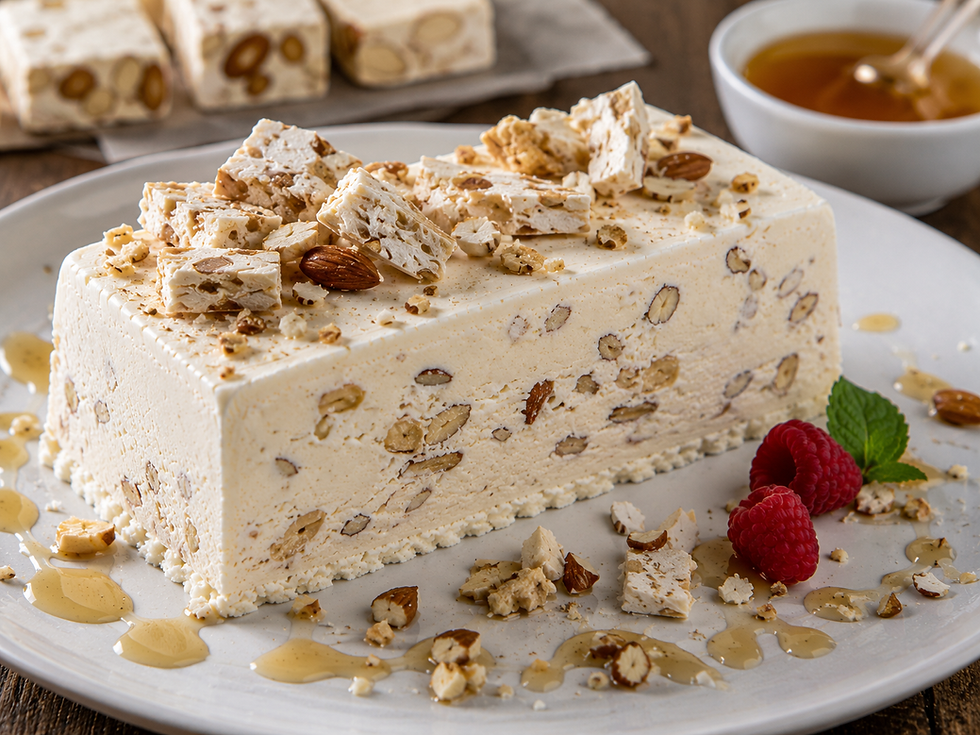
Everything crisp goes on at the last second. Scatter the torrone shards across the slice and just beside it, the almond halves around them, then draw a thin line of honey over the top rather than a pool. Three grains of flaky salt finish it. Nothing sauced, nothing wet, no berry coulis: the moment anything liquid sits under the shards they stop being the reason to eat this dessert.
Professional Technique
The craft of this dessert is in the two crunches, which are not the same kind of crunch at all. A toasted almond is crisp because of what it is made of: a dry cellular structure stiffened by roasting, held together by about half its weight in oil. Fat does not freeze into ice and does not soften at freezer temperature, so an almond that goes into the mould hard comes out hard and stays that way. It snaps under the tooth, and it goes on snapping after the frozen cream around it has already melted.
Torrone is the opposite case. It is a sugar mass, and sugar has no structure to defend once it is warm and wet. Put a piece in the mouth and the edges give almost immediately, the crack turns into a chew and then into nothing. That is not a fault, it is the best thing torrone does, but it is over in two seconds while the almond is still working. Two crunches with two lifespans in the same bite is the effect worth chasing, and you get it by size, not by quantity.
So the sizes are chosen against each other. Almonds go in small, halved or whole, because they only need to be found, and small pieces distribute through every slice. Torrone goes in large, around 1/2 inch (12 mm), because a large piece lasts long enough to be identified as torrone before it gives way, and the coarser the piece the later it arrives in the bite. Chopped fine, torrone reads as grit and is gone before the almond has even been hit. That is also why the best shards are kept out of the mould entirely and scattered at the table: on top they are still fully brittle, and the same dessert then offers three stages, an immediate crack from the surface, a slower chew from inside, and an almond still going at the end.
Texture and Moisture Control
The cream base has to be light enough to eat cold and firm enough to slice, and it gets both from three separately aerated parts. The Italian meringue brings volume and a stable protein network, the sabayon brings yolk fat and richness, the whipped cream brings a soft fat structure that carries flavour on the palate. Each is folded in at the same temperature as the one before it, because a warm addition deflates a cold one on contact.
Serving temperature is where most home semifreddo fails, in both directions. Straight from a domestic freezer at 0°F (minus 18°C) the slice is numb, the honey and the toasted almond read as nothing, and the blade drags. Left out for twenty minutes it slumps and turns into sweetened cream. The window is 5 to 8 minutes at room temperature, and the test is a spoon: it should enter with light resistance and come out clean.
Water on the surface is the other thing to manage. A cold loaf standing in a warm kitchen beads with condensation, and those beads sit exactly where you are about to put the shards. Unmould onto a chilled board, keep the loaf covered until the moment you slice, and put every crisp thing on after the slices are already on the plates.
Professional Mise en Place
Two aerated mixtures and a syrup at temperature all have to arrive at the same moment, so nothing here is improvised. Toast, cut and weigh everything before the first pan goes on the heat.
Equipment and tools
Stand mixer with whisk, plus a hand whisk for the sabayon
Small heavy saucepan and a digital probe thermometer
Loaf mould, 9 by 5 inch (23 by 12 cm), and cling film
Large flexible spatula, offset spatula, long thin slicing knife
Prepared ahead
Almonds toasted and cut, up to 3 days ahead, in a sealed jar at room temperature
Torrone broken and sorted into inclusions and top shards, up to 1 week ahead, sealed and dry
The semifreddo itself, up to 3 weeks ahead, frozen and wrapped
Service setup
Loaf out of the freezer 5 to 8 minutes before the first slice, kept covered
Jug of hot water and a clean cloth beside the board for the blade
Plates cold from the refrigerator, never from the freezer
Shards, almonds, honey and flaky salt in four small bowls within reach
Chef Tips
Buy hard torrone, the brittle kind, not the soft chewy style. Soft torrone is worked with more honey and stays pliable, so it never gives the crack this dessert is built around, and at freezer temperature it turns into a sticky lump instead of a piece that breaks.
Break the torrone with the heel of a heavy knife rather than a food processor. A processor gives you dust and three usable pieces. What you want is irregular chunks of roughly one size, and your hands are better at that than any blade in a bowl.
Take the syrup off the heat 2 degrees early. It carries on climbing in the pan, and meringue made with syrup past 248°F (120°C) sets grainy and refuses to fold cleanly into the sabayon.
If you can find Sardinian honey torrone from Tonara, use it for the shards on top and a commercial hard bar for the inside. It is floral and less cloying, and worth having on the part of the dessert that reaches the palate first.
Common Mistakes
Chopping the torrone as fine as the almonds. This is the central error and it wastes the ingredient. Fine torrone disappears in the first second of the bite and reads as sandiness. Keep the pieces at about 1/2 inch (12 mm) and larger than anything else in the mould.
Whipping the cream to firm peaks. Firm cream will not fold, so you work the mixture harder and lose the air you just built. Stop at the soft trail stage and accept that the base looks slack: it firms in the freezer, not in the bowl.
Serving it straight from the freezer. At freezer temperature the almond, the honey and the toasted notes are all muted and the knife tears the slice. Five to eight minutes on the counter is not optional, it is part of the recipe.
Putting all the torrone inside the mould. Buried shards are softer than shards on top, and a dessert with nothing brittle on the surface loses its first impression. Always keep a handful out and scatter them at the table.
Wine Pairing
Moscato d'Asti DOCG: The easiest match and a genuinely good one. Its low alcohol, gentle fizz and grapey peach aromatics lift a dessert that is mostly fat and sugar, and the bubble scrubs the palate between mouthfuls of frozen cream. Sweetness is moderate enough that it never competes with the torrone, and it is served cold, which suits a cold plate.
Vin Santo del Chianti Classico DOC: The structural choice. Dried Trebbiano and Malvasia give a wine of real extract, and years in small barrels produce dried apricot, orange peel and a marked toasted almond note that meets the almonds in the semifreddo head on. Crucially the acidity stays high, which is what keeps a sweet wine from doubling the weight of a cream dessert. Serve it at around 57°F (14°C).
Malvasia delle Lipari DOC: The most interesting bottle on the list. Malvasia grapes dried on the Aeolian islands give dried fig, candied citrus and a saline volcanic edge that cuts across the honey in the sabayon rather than reinforcing it. That salinity is the reason it works: it behaves on the palate the way the grains of flaky salt behave on the plate, and the wine has enough sweetness to stand beside the torrone.
Recioto di Soave DOCG: For anyone who finds Vin Santo too oxidative. Dried Garganega is delicate and floral, with white peach, acacia honey and a clean bitter almond finish that echoes the toasted almonds directly. The body is lighter than its sweetness suggests, so it slips under the dessert instead of sitting on top of it. Serve it at around 54°F (12°C).
Storage & Reheating
The semifreddo keeps in the freezer for up to 3 weeks, wrapped first in cling film and then in foil or sealed in a rigid container. Freeze it in the mould, and leave it there until you need it: the mould shields it from the temperature swings every time the freezer door opens. Never refreeze a loaf that has been out long enough to soften, since the second freezing gives a coarse icy crumb.
Cut slices do not keep. A sliced face dries and takes on freezer smells within hours, so wrap the remaining loaf tight against the cut and use it within a few days. Nothing here is reheated. The only rewarming is the 5 to 8 minute stand at room temperature before slicing.
Store the reserved torrone shards and toasted almonds at room temperature in a sealed jar, never in the refrigerator or the freezer, and add them only at service.
Nutrition
Per serving, based on 8 servings:
Calories: 465 kcal
Total Fat: 31 g
Saturated Fat: 15 g
Trans Fat: 0 g
Unsaturated Fat: 15 g
Cholesterol: 140 mg
Sodium: 65 mg
Total Carbohydrates: 40 g
Fiber: 2 g
Total Sugars: 37 g
Added Sugars: 33 g
Protein: 7 g
Lactose: 2.5 g
Principal micronutrients: vitamin E, magnesium, calcium, phosphorus, riboflavin, selenium
These figures are estimates and move with the torrone, which varies in sugar and nut content from producer to producer.


Comments