
Italian Nougat Semifreddo | Semifreddo al Torrone
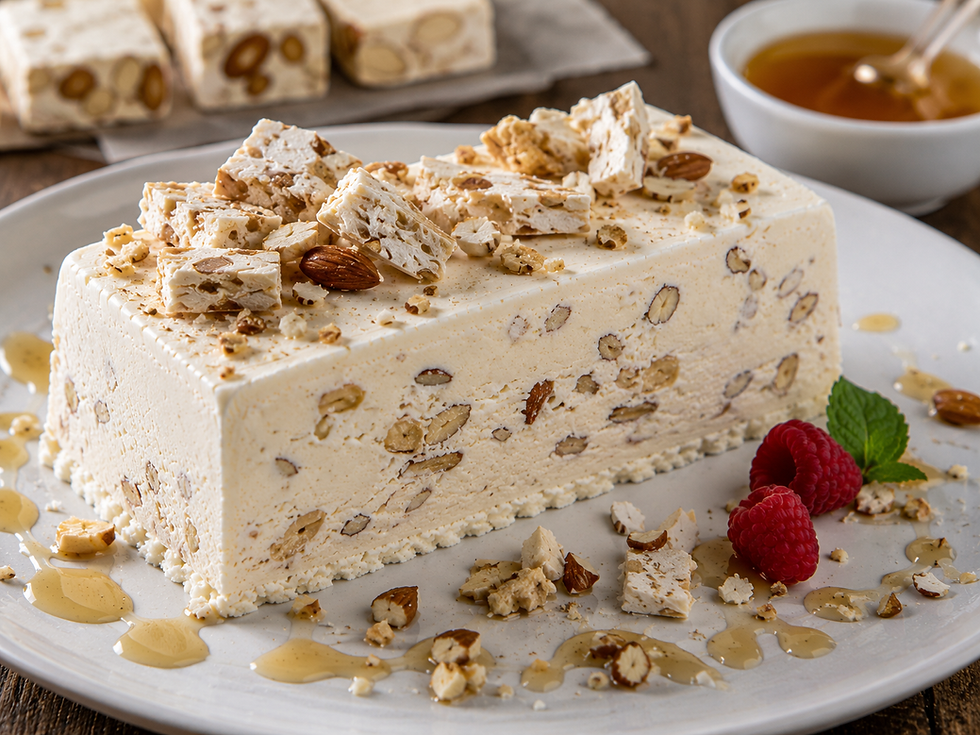
Semifreddo al torrone is what happens when a hard slab of Italian nougat meets a cold cream and slowly gives itself up to it. The result is soft, scoopable and heavily perfumed with honey and toasted almond, and it can be built in two completely different ways depending on whether you want to bite the torrone or only taste it. That decision is made before the first egg is separated, never at the end.
Yield: 8 servings from a 9 by 5 inch loaf mould. Prep: 35 minutes. Freeze: at least 6 hours, overnight is better. Difficulty: intermediate. Course: dolce. Region: Piedmont and Lombardy for the method, Cremona, Benevento or Tonara for the torrone.
The Story
Torrone is centuries older than the cream it ends up in. Cremona claims the first documented one at the wedding banquet of Bianca Maria Visconti and Francesco Sforza in 1441, where the confection was said to be moulded in the shape of the Torrazzo, the enormous bell tower that still dominates the city, and where torrione is supposed to have become torrone. Historians treat that story with reasonable suspicion, since sweets of almond, honey and egg white circulated in Arab Sicily and in the Spanish courts well before any Lombard wedding. What is not in doubt is that torrone was a recorded Cremonese trade by the sixteenth century, and that the city still turns it out by the tonne every November for the Christmas market.
Benevento in Campania built a parallel tradition of its own, softer in the crumb, and gave the world the croccantino, a small torrone jacketed in dark chocolate. Sardinia makes the most austere version of all in Tonara, high in the Barbagia, where the paste is worked for hours over steam with honey and no added sugar at all, then sold from trestle stalls at village fairs and carried down to the coast by anyone who has driven up for it. Each of these behaves differently inside a frozen cream. The Cremonese bar is drier and more almond driven, the Beneventano frankly sweeter, the Sardinian one unmistakably floral, because there the honey is doing all of the work.
The semifreddo itself is much younger and entirely domestic. It belongs to the middle of the twentieth century, to houses and trattorie that wanted a frozen dessert without owning a machine, and it spread through the north on the back of a very practical problem: after Christmas there is always torrone left over. It arrives in slabs, it is attacked enthusiastically for two days, and by the Epiphany what remains is too hard and too sweet for anyone to finish. Breaking it up and burying it in cream was never a pastry chef's invention. It was a way of not wasting an expensive gift, and it produced something better than what it started from.
Ingredients
Weigh everything before the mixer starts, because the base moves quickly once the syrup is on the heat. Buy the best torrone you can find: an industrial bar built on glucose and hardened fat tastes of nothing but sugar once it is buried in cream, while a real almond torrone carries honey, bitter almond and a toasted note in with it.
For the semifreddo base
Large egg yolks, 4, at room temperature
Granulated sugar, 1/3 cup (70 g)
Water, 3 tbsp (45 ml)
Italian acacia or orange blossom honey, 2 tbsp (40 g)
Fine sea salt, 1/8 tsp (0.8 g)
Pure vanilla extract, 1 tsp (5 ml)
For the cream
Heavy cream, very cold, 1 1/2 cups (360 ml), at least 35 percent fat
Mascarpone, cold, 1/3 cup (75 g)
For the torrone
Torrone alle mandorle, 7 oz (200 g), chopped coarse or fine according to the route you have chosen
Torrone duro for the coarse route, torrone morbido for the fine route
For finishing
Sliced almonds, toasted, 1/4 cup (25 g)
Dark chocolate, 70 percent, 1 oz (30 g), shaved
Flaky sea salt, a small pinch per plate
Honey, a few drops per plate, the same honey used in the base
Preparation
Step 1
Line the mould and commit to a route. Line a 9 by 5 inch loaf pan with plastic wrap, leaving a generous overhang on both long sides, and press it flat against the corners so the finished block unmoulds cleanly. Put the pan in the freezer. Now decide which dessert you are making, because it cannot be changed later: coarse torrone folded in at the very end gives you crunch and visible pieces, fine torrone added early gives you a uniform nougat cream with no inclusions at all. Everything after this point follows from that single choice.
Step 2
Chop the torrone and keep it cold. For the coarse route, cut the bar into pieces of roughly 1/4 inch (6 mm) with a heavy knife, working on a cold board, and refuse the temptation to pulse it in a food processor, which shatters the almonds and produces dust that behaves nothing like the pieces. For the fine route, chop it much smaller, close to a coarse sand. Either way, seal it in a bag and put it straight into the freezer until the moment it is needed.
Step 3
Build the bombe base. Whisk the yolks with the honey, salt and vanilla in a stand mixer on medium until pale and slightly thickened, about 3 minutes. Meanwhile bring the sugar and water to 244°F (118°C) in a small heavy saucepan without stirring. With the mixer running, pour the syrup down the inside of the bowl in a thin steady stream, avoiding the whisk. Raise the speed and beat for 6 to 8 minutes, until the mixture has tripled, holds a ribbon and is no warmer than your hand.
Step 4
Whip the cream. In a separate chilled bowl, loosen the mascarpone with a spatula, then add the cold heavy cream and whip to soft peaks only. The whisk should leave a trail that slumps back within a second or two. Stop there. Cream taken to firm peaks at this stage keeps whipping while you fold and will turn grainy and slightly buttery in the freezer, which no amount of careful folding afterwards will repair.
Step 5
Fold, and add the torrone at the right moment. Fold one third of the cream into the bombe base with a large spatula to slacken it, then fold in the rest in two additions, cutting down through the middle and turning the bowl a quarter turn each time. For the fine route, the torrone goes in with that first third, while the mixture is still loose and there is plenty of folding left. For the coarse route, it goes in on the last few strokes and not before, then you stop immediately.
Step 6
Fill the mould and freeze. Scrape the mixture into the frozen pan, rap the pan twice on a folded towel to settle it, and level the top with an offset spatula. Fold the plastic wrap over the surface and press it into contact, which is what keeps ice crystals off the top face. Freeze for at least 6 hours, and overnight if you can. The block is ready when a cake tester meets firm resistance all the way through with no soft channel in the centre.
Plating
Let the loaf stand in the refrigerator for 10 to 15 minutes before it is touched. Lift it out by the plastic overhang onto a chilled board, peel the wrap away and slice with a long thin knife dipped in hot water and wiped dry between every cut. Aim for slices of about 1 inch (2.5 cm). A cold knife drags and tears the surface instead of cutting it.
Serve on chilled plates, never warm ones. Lay the slice slightly off centre, scatter toasted almonds and chocolate shavings along one side rather than over the whole surface, add a few drops of the base honey and finish with the smallest pinch of flaky salt on the plate beside the semifreddo. Nothing else is needed, and a fruit sauce here does the dessert no favours at all.
Professional Technique
The technique that decides this dessert has nothing to do with the cream and everything to do with what torrone does once it is cold and surrounded by moisture. Torrone is essentially sugar and honey with almonds set into it, and sugar and honey are hygroscopic: they pull water towards themselves and hold on to it. Sitting in a moist cream, a piece of torrone is not inert. It draws moisture out of the mixture around it, softens from the outside inwards, and given enough time simply stops existing as a piece, leaving behind sweetness, a faint honey perfume and a few almonds floating where the nougat used to be.
That behaviour is not a fault to be fought. It is a fork in the road, and the professional move is to pick a side. If you want the torrone to be felt, chop it coarse and fold it in on the last strokes, so the pieces spend the minimum possible time in contact with wet cream before the block is frozen solid and the process slows almost to a stop. The pieces survive, and the eater bites through nougat inside a frozen cream.
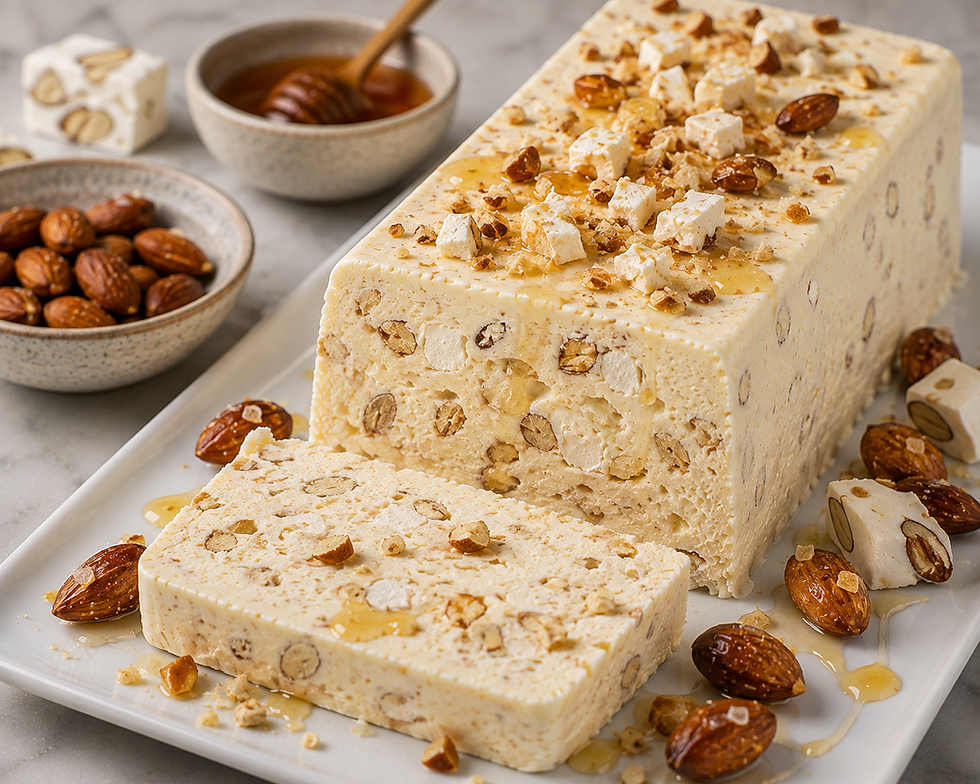
If instead you want torrone as a flavour rather than an object, chop it fine and add it early, then let the folding and the wait before freezing work on it deliberately. It dissolves completely and what you get is a nougat cream: honey and toasted almond in every spoonful, no crunch anywhere, a texture as smooth as a plain semifreddo. These are two different desserts sharing one ingredient list, and the choice has to be made before the torrone is cut, because a coarse chop cannot be rescued into the smooth version and a fine chop can never be given back its crunch.
Texture and Moisture Control
Three things hold this block together at freezer temperature: the air whipped into the bombe base, the fat in the cream and the mascarpone, and the sugars. The honey matters more than its quantity suggests, because it is largely fructose and glucose rather than sucrose and it interferes with ice crystal growth more effectively than table sugar does, which is why two spoonfuls of it keep the semifreddo sliceable at temperatures where a leaner one would set like a brick.
Moisture control is mostly about protecting surfaces. The exposed top face is where crystals form and deposit as a gritty crust, so press the plastic wrap into direct contact with it and leave no air gap.
Serving temperature finishes the job. Straight from a domestic freezer the semifreddo is too hard to read, the honey muted and the almond barely there. Ten to fifteen minutes in the refrigerator brings it to the point where a spoon goes in with slight resistance and the aromatics wake up. Beyond about twenty five minutes it starts to weep, and once it has softened that far it should be eaten rather than returned to the freezer.
Professional Mise en Place
The window between the syrup reaching temperature and the mixture going into the mould is short and continuous, so nothing can be prepared during it. Set the whole station out first.
Equipment and tools
Stand mixer with whisk, plus a second chilled bowl and a hand whisk for the cream
Small heavy saucepan and a reliable digital thermometer
9 by 5 inch loaf pan, plastic wrap, offset spatula, large flexible spatula
Heavy chef knife and a cold cutting board for the torrone
Long thin slicing knife and a jug of hot water for service
Prepared ahead
Mould lined and left in the freezer, at least 30 minutes ahead
Torrone chopped to the chosen size, bagged and frozen
Cream and mascarpone weighed out and left in the refrigerator until whipping
Almonds toasted, chocolate shaved, both up to 2 days ahead
The finished block frozen overnight, which improves both routes
Service setup
Plates chilled, loaf moved to the refrigerator 15 minutes before the first slice
Hot water and a clean towel beside the board for the knife
Garnishes portioned into small bowls within reach
Slices not going out immediately returned to the freezer on a cold tray
Chef Tips
Match the type of torrone to the route. A hard torrone alle mandorle holds its shape far longer in the cold and is the right choice when you want pieces you can bite. A soft torrone gives way quickly, which makes it an excellent choice for the fine route and a poor one for the coarse.
Cut the torrone last, immediately before it goes into the freezer bag. Chopped nougat left sitting on the board starts pulling moisture from the air within minutes and welds itself into one sticky lump that no longer separates in the cream.
Taste the torrone on its own and adjust the sugar in the base accordingly. A very sweet Beneventano bar will push the whole dessert too far, and dropping the granulated sugar by a tablespoon costs the base nothing structurally.
If the bombe base is still warm when the cream is ready, wait. Warm base collapses cold whipped cream on contact, and the volume lost there is the volume that was going to keep the frozen block soft enough to eat.
Common Mistakes
Folding the coarse torrone in too early. Every minute the pieces spend surrounded by unfrozen cream costs them definition, and a mixture that is folded for another two minutes after the torrone goes in comes out of the freezer with soft ghosts where crunch was expected. Add it on the final strokes and stop.
Whipping the cream to firm peaks. It keeps stiffening while you fold, and the fat eventually breaks and turns faintly buttery and grainy in the freezer. Soft peaks that slump back within a second or two are the target, and the folding finishes the job.
Pouring the syrup onto the moving whisk. It flings hot sugar up the side of the bowl where it sets into a hard shell and never rejoins the base, so the yolks are underpasteurised and the volume is short. Pour it in a thin stream down the inside wall instead.
Serving the semifreddo straight from the freezer. At freezer temperature the honey and the almond are effectively switched off and the texture is closer to a brick than a cream. Ten to fifteen minutes in the refrigerator is not optional, it is the last step of the recipe.
Wine Pairing
Moscato d'Asti DOCG: The Piedmontese answer to a Piedmontese dessert and the easiest match here. Its gentle sparkle scrubs the cream fat off the palate between spoonfuls, which no still wine manages, and at around 5 percent alcohol it never competes with a frozen dessert for attention. The sweetness sits just below that of the torrone, so the wine reads as refreshing rather than as more sugar.
Vin Santo del Chianti Classico DOC: The choice when the almond side of the torrone matters more than the honey. Long oxidative ageing in small barrels builds dried apricot, walnut and a bitter nutty finish that lands directly on the toasted almonds, while the acidity underneath is high enough to cut through mascarpone and cream. Serve it cool, around 55°F (13°C), in a small glass.
Malvasia delle Lipari DOC: A honey to honey pairing, and the most aromatic bottle on this list. Dried on the Aeolian islands, it gives candied citrus peel, dried fig and a resinous herbal edge that meets the acacia honey in the base without simply repeating it. There is real acidity behind the sweetness, which is what stops the combination from turning cloying halfway through the slice.
Recioto di Soave DOCG: The least obvious and possibly the best of the four. Dried Garganega gives a sweet wine with a firm mineral spine and a characteristic bitter almond note on the finish, far less perfumed than a moscato, so it frames the dessert instead of decorating it. Its weight matches the density of the frozen cream almost exactly.
Storage & Reheating
The block keeps in the freezer, wrapped tightly in its plastic and sealed inside a rigid container, for up to 1 month. The two routes age differently. The fine version is stable for the full month, since the torrone has already dissolved and nothing is left to change. The coarse version is at its best within the first week, because the pieces keep softening slowly even at freezer temperature and eventually blur into the cream anyway.
There is no reheating step here, only tempering. Move the loaf to the refrigerator for 10 to 15 minutes before slicing, or leave individual slices on chilled plates for about 5 minutes. Never use a microwave, and never refreeze a block that has gone soft: the melted and refrozen mixture loses its air, comes back coarse and icy, and the difference is obvious on the tongue.
Nutrition
Per serving, based on 8 slices from one loaf:
Calories: 385 kcal
Total Fat: 25 g
Saturated Fat: 13 g
Trans Fat: 0 g
Unsaturated Fat: 11 g
Cholesterol: 145 mg
Sodium: 55 mg
Total Carbohydrates: 34 g
Fiber: 1 g
Total Sugars: 31 g
Added Sugars: 28 g
Protein: 6 g
Lactose: 2.2 g
Principal micronutrients: calcium, vitamin A, vitamin E, magnesium, phosphorus, riboflavin
These figures are estimates and move with the torrone, which varies widely in sugar and fat from one producer to another.


Comments