
Italian Ricotta and Lemon Cake | Torta Soffice alla Ricotta e Limone
Updated: Sep 14
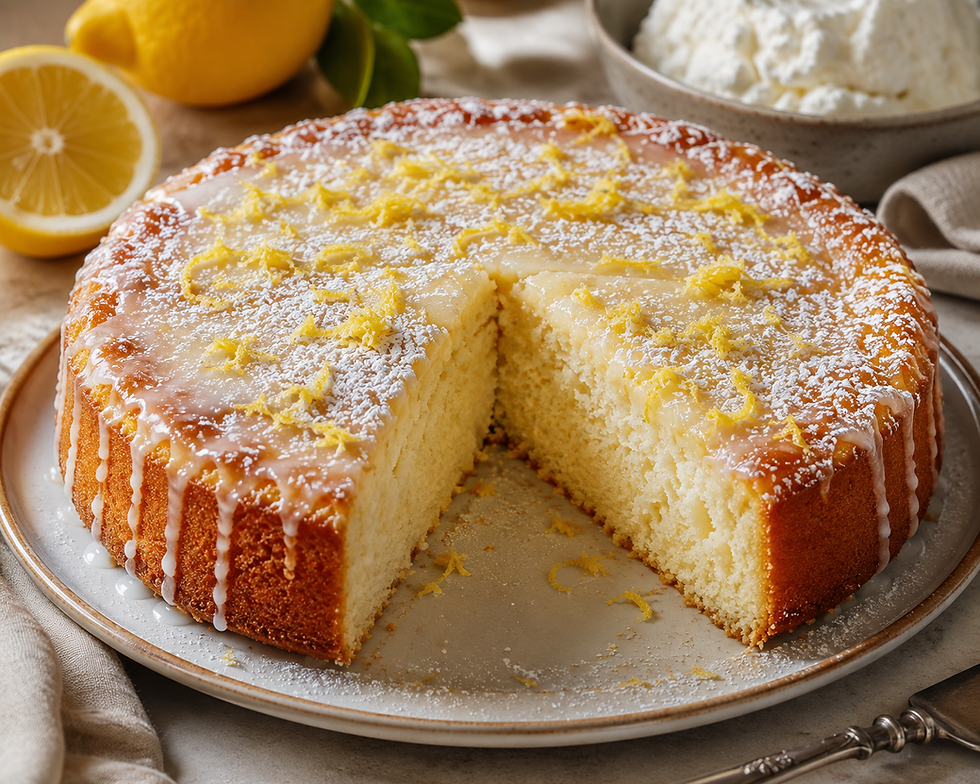
A torta soffice alla ricotta e limone has nowhere to hide. No frosting, no filling, no glaze, only a plain round cake dusted with powdered sugar, so every decision about moisture and mixing is visible in the slice. Done well the crumb is close grained, damp without being wet, and it smells of lemon oil the moment the knife goes in. Done badly it is a gummy band across the base, or a dry cake pretending to be a pound cake.
Ricotta does two jobs butter alone cannot. It carries water into the batter in a form that stays bound rather than draining out, and it brings milk protein that sets soft instead of firm. That is why the cake is still moist on the third day when a butter sponge is stale. The method below is arranged around one variable: how much water the ricotta brings and where it goes.
Yield: one 9 inch (23 cm) cake, 12 slices. Prep: 30 minutes. Drain: 4 hours or overnight. Bake: 45 to 55 minutes. Cool: 2 hours. Difficulty: easy. Course: dolce da credenza. Region: Campania and the lemon coasts.
The Story
Italians have a name for this kind of cake that English does not translate well: dolce da credenza, a cupboard cake. It is not a dessert course. It sits under a glass dome on the sideboard, gets cut at breakfast, again at four with coffee, and again after dinner, and it is expected to be as good on the second day as on the first. The category is built on cakes that keep: crostate, ciambelloni, almond tortas, ricotta cakes like this one. They are plain on purpose, because a cake that must survive three days on a sideboard cannot carry cream.
Ricotta ended up in them for the reason it ends up everywhere in central and southern Italy: it was cheap, made locally, and it went off fast. A household that bought fresh ricotta on market day had two days to use it, and baking was the reliable way. Lemon became the standard partner in Campania because the fruit was there in quantity, above all the sfusato amalfitano and the Sorrento femminello, thick skinned varieties grown on terraces above the sea and prized for the oil in the peel rather than the juice. The zest of two such lemons will scent a whole cake, which is why Italian recipes specify zest and only a spoon or two of juice, never a lemon extract.
Ingredients
Makes one 9 inch (23 cm) cake, 12 slices.
For the cake
All purpose flour, 1 3/4 cups (220 g)
Baking powder, 2 tsp (8 g)
Fine sea salt, 1/4 tsp (1.5 g)
Whole milk ricotta, 1 1/2 cups (370 g) before draining
Granulated sugar, 3/4 cup (150 g)
Unsalted butter, softened, 1/2 cup (113 g)
Eggs, large, at room temperature, 3
Untreated lemons, zest of 2
Fresh lemon juice, 3 tbsp (45 ml)
Pure vanilla extract, 1 tsp (5 ml)
Whole milk, up to 1/4 cup (60 ml), only if the batter is stiff
For the pan
Unsalted butter, softened, 1 tbsp (14 g)
All purpose flour, for dusting, 1 tbsp (8 g)
Parchment round, 9 inch (23 cm), 1
For finishing
Powdered sugar, 2 tbsp (15 g)
Fresh lemon juice, 2 tbsp (30 ml), for the optional brushing syrup
Granulated sugar, 1 tbsp (12 g), for the optional brushing syrup
Candied lemon peel, a few thin strips, optional
Preparation
Drain the ricotta
Spoon the ricotta into a fine mesh sieve lined with a double layer of cheesecloth, set it over a bowl and refrigerate at least 4 hours or overnight. You should collect 2 to 4 tbsp (30 to 60 ml) of whey. Do not press or weight it: pressing compacts the curd and gives a dense crumb rather than a tender one. You want the loose water gone, the structure intact.
Bring everything to room temperature and prepare the pan
Take the butter, eggs and drained ricotta out at least an hour ahead and let them reach around 68°F (20°C). Cold ricotta dropped into creamed butter seizes it into curds no beating recovers. Butter the springform, line the base with parchment, dust the sides with flour and knock out the excess. Set a rack in the lower third and heat the oven to 350°F (175°C) for a full 25 minutes.
Rub the zest into the sugar
Grate the zest of both lemons onto the granulated sugar, taking only the yellow, and rub the two together with your fingertips for a minute until the sugar is damp, pale yellow and strongly perfumed. Bruising the oil cells against the sugar crystals releases far more aroma than stirring zest into flour, and distributes it evenly instead of leaving fragrant streaks.
Cream the butter with the lemon sugar
Beat the softened butter with the lemon sugar on medium speed for 4 to 5 minutes, scraping twice, until visibly paler and grown in volume. You are building the air cells the baking powder will later expand, so this is not a step to shorten. The butter should be pliable and cool, around 65°F (18°C): melted butter holds no air and greasy butter collapses in the oven.
Add the eggs one at a time
Beat in each egg completely before adding the next, scraping between additions so nothing sits unincorporated at the bottom. If the mixture looks split, a tablespoon of the measured flour pulls it back together. Beat in the lemon juice and vanilla last: a little curdling after the acid goes in is normal and disappears once the flour arrives.
Fold in the ricotta briefly
Add the drained ricotta and beat on the lowest speed for no more than 20 seconds, or fold it in by hand. It should look streaky rather than smooth. Working it further breaks the curd open and releases the water you spent the night removing, the quickest way to a wet band across the base.
Fold in the dry ingredients
Whisk the flour, baking powder and salt together and sift once. Fold them in in three additions, cutting down through the centre and turning the bowl a quarter turn between strokes, and stop the moment the last dry streak disappears. The batter should be thick, softly ridged and reluctant to drop from the spatula. If it holds a sharp peak, slacken it with the milk a tablespoon at a time. Gluten developed here shows up later as a chewy crumb.
Bake
Scrape the batter into the pan, level the top and rap the pan once firmly on the counter to release large air pockets. Bake 45 to 55 minutes. It is ready when the top is evenly golden with a fine crack or two across the centre, the edges have begun to pull away, and a skewer inserted halfway between edge and centre comes out with a few moist crumbs rather than clean. The centre should read 200 to 205°F (93 to 96°C). If the top colours early, tent it with foil at 35 minutes, and do not open the oven before then.
Cool, then dust
Leave the cake in the pan on a wire rack 15 minutes, until the sides contract and the crumb firms enough to support itself. Run a thin knife around the edge, release the collar and slide the cake onto the rack, then lift it off the pan base, since cooling on metal traps steam and softens the bottom. Cool at least 2 hours. Dust with powdered sugar through a fine sieve held high, in two light passes, no more than 30 minutes before serving.
Plating
Serve at room temperature, never chilled. Refrigeration firms the butter into something waxy and mutes the lemon oil, and a chilled slice tastes of very little. Cut with a thin bladed knife wiped clean between slices, because a ricotta crumb drags and smears on a warm blade. Twelve wedges from a 9 inch cake is the right portion.
On the plate it wants almost nothing. The powdered sugar, a few strips of candied lemon peel in the centre, and at most a spoonful of barely sweetened whipped cream to one side or a few macerated berries in season. Anything glossy fights the matte, homely surface that is the point of a cupboard cake. Served after a meal, a small glass of sweet wine does more for it than any garnish.
Professional Technique
This is a creamed butter cake carrying a wet, protein rich ingredient, and the method exists to reconcile the two. Creaming drives sugar crystals through solid butter to cut air cells into it, which happens only in a narrow plastic range around 65°F (18°C). Those cells are the scaffolding; the baking powder does not create bubbles so much as inflate the ones creaming already made. Ricotta is an emulsion breaker: roughly three quarters water, and water added to creamed butter wants to collapse that foam. Adding it last, briefly, once the eggs have built a stable emulsion is what keeps the structure standing.
The second point is leavening chemistry, and it explains the 3 tbsp of juice. Most baking powder is double acting: one acid salt reacts on contact with liquid, the second only in the oven. Lemon juice adds free acid that accelerates the first reaction, so a batter left standing loses lift measurably, which is why the flour goes in last and the pan goes into the oven within five minutes. The juice earns its place by lowering the batter pH, keeping the crumb pale and fine rather than the coarse, faintly brown texture an alkaline cake develops.
Texture and Moisture Control
The whole difficulty of this cake is water management. Drained whole milk ricotta sits at roughly 72 to 75 percent moisture and gives a moist, close crumb. Undrained ricotta runs past 80 percent and the centre stays wet and faintly rubbery however long you bake it, because the excess water never leaves, it simply sinks. Compensating with extra flour trades a wet cake for a dry one, so drain rather than adjust. Room temperature eggs matter for the same reason: a properly built emulsion holds that water in suspension instead of letting it pool.
Baking position and the moment you stop are the other controls. The lower third of the oven sets the base before the top over colours, which prevents the sunken wet band people blame on the ricotta. Pull the cake while the centre still shows a faint wobble under a tap, because carryover heat finishes it during the first fifteen minutes of cooling. A perfectly clean skewer means you went five minutes too far. The cake settles slightly in the middle as it cools, and that gentle dip is correct rather than a fault.
Professional Mise en Place
Once the baking powder is wet the batter has to reach the oven within five minutes, so everything is measured and in position before the mixer starts.
Equipment and tools
Springform pan, 9 inch (23 cm), buttered, lined and floured
Stand mixer with paddle, or hand mixer and a wide bowl
Fine mesh sieve and cheesecloth for draining, a second sieve for dusting
Oven thermometer and an instant read probe
Flexible spatula, offset spatula, microplane grater, wire rack
Prepared ahead
Ricotta drained overnight in the refrigerator, whey discarded
Butter, eggs and ricotta out a full hour, at about 68°F (20°C)
Lemons zested and juiced, zest kept covered so its oils do not evaporate
Flour, baking powder and salt whisked together and sifted
Oven preheated a full 25 minutes with a rack in the lower third
Service setup
Wire rack cleared and ready before mixing starts
Foil cut and within reach for tenting at 35 minutes
Milk measured and standing by in case the batter needs slackening
Powdered sugar in a small sieve, used no more than 30 minutes before serving
Thin bladed knife and a damp cloth at the table for clean slices
Chef Tips
Bake this a day ahead. The crumb tightens overnight into exactly the texture the style wants, and the lemon perfume, faint on the first day, comes forward considerably by the second. Very few cakes genuinely improve overnight, and this is one of them.
If sheep milk ricotta is available, use half of it. It is tangier and richer than cow milk ricotta and gives a faintly savoury depth that stops a plain cake becoming monotonous across twelve slices. Do not use the whole quantity in sheep milk, which tips the cake towards cheesecake.
Replace 2 tbsp of the flour with fine semolina for a slightly sandy, traditional bite that reads immediately as southern Italian. It also firms the crumb very slightly, which helps if your ricotta was on the wet side.
For a stronger citrus note, stir 2 tbsp of lemon juice into 1 tbsp of sugar and brush it over the cake while still warm, then let the surface dry completely before dusting. Never dust a warm cake: the sugar dissolves within the hour and leaves damp grey patches.
Common Mistakes
Skipping the drain. The commonest failure and the only one that cannot be corrected later. The loose whey sinks during baking and sets as a wet, faintly rubbery band across the base of every slice.
Beating after the ricotta goes in. More than about 20 seconds breaks the curd, thins the batter and releases the water you spent the night removing. Streaky is correct at that stage; smooth is already too far.
Starting with cold ingredients. Cold ricotta or cold eggs curdle creamed butter beyond recovery, and a broken emulsion bakes into a greasy, heavy crumb. An hour on the counter solves it.
Baking to a clean skewer. That trades the whole point of the cake, its moisture, for five minutes of caution. A few moist crumbs on the skewer and 200 to 205°F (93 to 96°C) in the centre is where to stop.
Grating into the pith. The white layer under the zest is where the bitterness lives, and in a cake this plain there is nothing to mask it. Take only the yellow and turn the fruit as you go.
Using bottled lemon juice. It brings acidity without aroma, since the volatile oils are long gone. The cake will taste sour rather than lemony, and no amount of extra zest fixes the imbalance.
Wine Pairing
Recioto di Soave DOCG: Garganega dried on racks and pressed sweet, with white peach, almond blossom and a dense but never heavy texture. It is one of the few sweet whites gentle enough not to overwhelm a cake this restrained, and its almond edge lands on the ricotta rather than the lemon. Serve it at 50°F (10°C).
Colli Orientali del Friuli Picolit DOCG: A rare and delicate Friulian sweet wine, floral and apricot scented, with markedly less sugar than most passiti. Its lightness is why it works: a bolder bottle would flatten a cake this lightly sweetened, while Picolit meets it at the same level and adds fragrance rather than weight.
Vin Santo del Chianti Classico DOC: Aged for years in small caratelli under the roof, it brings dried fig, walnut and an oxidative note that contrasts the fresh citrus instead of echoing it. There is enough acidity and alcohol behind the sugar to cut the butter in the crumb, which makes it the classic Tuscan partner for a cupboard cake.
Romagna Albana DOCG: In its passito form Albana is honeyed and apricot rich, but it carries an unusual phenolic grip for a white, a faint bitterness from the thick skins. That answers the lemon zest directly and keeps the pairing from turning into sugar on sugar, the usual risk with a sweet wine and a sweet cake.
Storage & Reheating
Keep the cake under a dome or loosely wrapped in foil at cool room temperature, where it holds 3 days and is arguably better on the second. Do not seal it airtight while any warmth remains, or condensation turns the crust tacky. Store it undusted and dust each time you serve.
Refrigeration extends it to 5 days but firms the butter and dulls the citrus, so use it only in a hot kitchen and let chilled slices stand 30 to 45 minutes. It freezes well: wrap the cooled, undusted cake whole or in slices in a double layer of plastic and then foil, up to 2 months. Thaw overnight in the wrapping at room temperature so condensation forms on the plastic rather than the crumb.
Reheating is optional and brief. A slice warmed 8 to 10 minutes at 300°F (150°C), loosely covered, comes back close to freshly baked and the lemon lifts noticeably. Do not use a microwave, which drives moisture to the surface and leaves the slice damp outside and tough within, and never reheat a slice already dusted.
Nutrition
Per serving, based on 12 slices:
Calories: 300 kcal
Total Fat: 15 g
Saturated Fat: 9 g
Trans Fat: 0.4 g
Unsaturated Fat: 5 g
Cholesterol: 85 mg
Sodium: 190 mg
Total Carbohydrates: 32 g
Fiber: 0.6 g
Total Sugars: 18 g
Added Sugars: 16 g
Protein: 8 g
Lactose: 2.5 g
Principal micronutrients: calcium, phosphorus, vitamin A, riboflavin, vitamin B12, folate, selenium
These figures are estimates. Draining concentrates the ricotta solids, so the finished values run slightly richer than the raw ingredient list suggests, and calcium is around 150 mg a slice, unusual for a cake. With sugar held to three quarters of a cup it is far less sweet than an American layer cake of the same size, which is why Italians eat it at breakfast.


Comments