
Italian Hazelnut Affogato | Affogato alla Nocciola
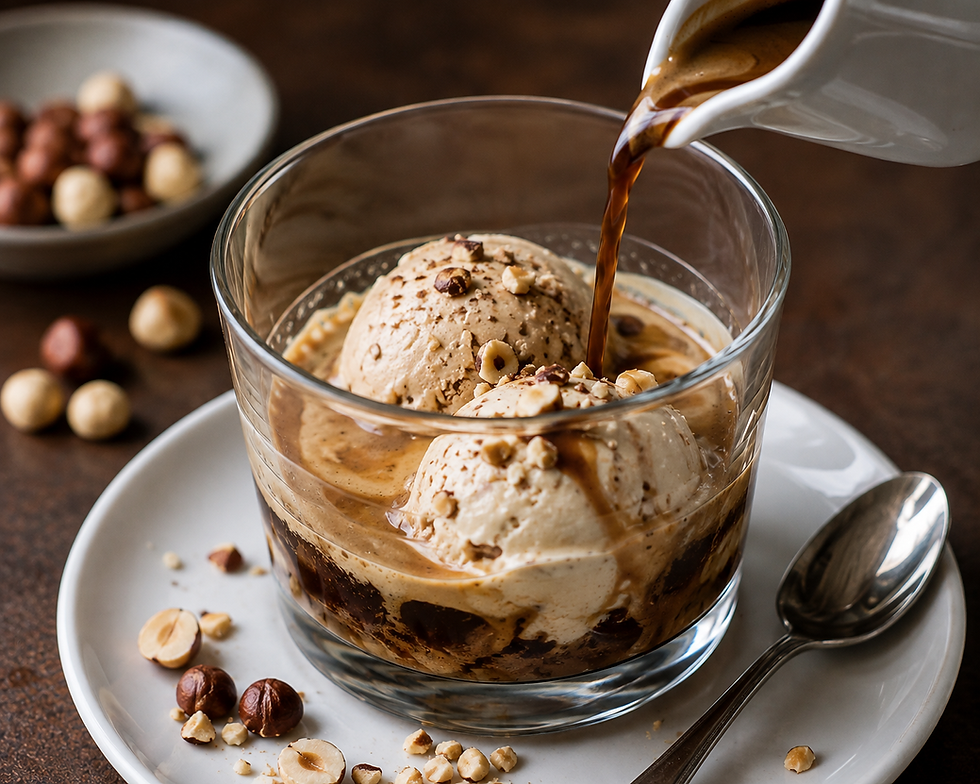
An affogato happens in the last twenty seconds, and everything before them exists to make them hold. This hazelnut version gives the gelato the fat and body to stand up to hot espresso, and treats the glass as part of the recipe rather than as tableware.
One glass carries three temperatures: hot above, frozen below, a band of melted hazelnut cream between them. That band is the dessert, and the work here is keeping it open longer.
Yield: 4 glasses, from about 1 quart (950 ml) of gelato. Prep: 30 minutes. Cook: 15 minutes. Age: 8 hours. Churn and harden: 4 hours. Service: under 1 minute per glass. Difficulty: intermediate. Course: dessert. Region: Piedmont, Turin and the Langhe.
The Story
Affogato was never a pastry dessert. It was built behind a bar by someone with a gelato cabinet on one side, an espresso machine on the other, and no intention of doing more work than that. The name states the entire method: affogato means drowned. A scoop goes into the glass, hot coffee goes over it, and the thing is finished in the time it takes to carry it four steps. In a country where coffee is taken standing and dessert is taken sitting, affogato is the only item that belongs to both, which is why it lives on bar counters from Turin to Palermo and almost never on a restaurant trolley.
Turin is where the vessel became the point. The bicerin, poured in the cafes around Piazza della Consolata since the end of the eighteenth century, is coffee, chocolate and cream layered in a small glass, and the drink took its name from the glass rather than from anything inside it: bicerin is Piedmontese for little glass. Those glasses were squat, heavy and thick, usually held in a metal handle because they were too hot or too cold to grip, and the layers survived the walk to the table because the glass resisted the heat instead of passing it straight through. Nobody in those cafes called it thermodynamics. They kept the glass that worked and stopped buying the ones that did not.
The hazelnut arrived from the same region and the same stubbornness. When the continental blockade of 1806 drove the price of cocoa past what Turin confectioners could pay, they stretched what cocoa they had with hazelnut paste from the Langhe hills, and the result, named gianduia decades later after a carnival mask, turned a shortage into the local signature. Piedmont has grown hazelnuts on those hills ever since, and its gelaterie treat nocciola the way Naples treats lemon: as the flavour you are judged on. Affogato alla nocciola is the two Piedmontese habits landing in the same glass, the hazelnut from the hills and the coffee from the counter, with the glass from the Consolata doing the quiet work in between.
Ingredients
The gelato quantity makes about 1 quart (950 ml), which is more than four glasses need. Smaller batches do not churn properly in a domestic machine, and this gelato keeps, so make the full amount. Buy hazelnut paste that lists hazelnuts and nothing else.
For the hazelnut gelato
Whole milk, 2 1/2 cups (600 ml)
Heavy cream, 3/4 cup (180 ml)
Granulated sugar, 1/2 cup (100 g)
Dextrose, 2 tbsp (25 g)
Skimmed milk powder, 3 tbsp (20 g)
Egg yolks, large, 4
Pure unsweetened hazelnut paste, 5 oz (140 g)
Mild honey, 1 tbsp (20 g)
Fine sea salt, 1/4 tsp (1.5 g)
For the espresso
Medium roast espresso blend, freshly ground, 4 doses of 18 g
Soft filtered water for the machine, about 1 cup (240 ml)
Demerara sugar, 4 tsp (16 g), offered at the table
For finishing
Whole hazelnuts, chopped coarse, 2 tbsp (18 g)
Flaky sea salt, a few grains per glass
Thick walled glasses of 5 oz (150 ml) capacity, 4
Small teaspoons, 4, chilled with the glasses
Preparation
Cook the custard base
Whisk the sugar, dextrose and milk powder together dry, then whisk that mixture into the yolks until pale. Bring the milk and cream to 175F (80C), pour a third of it onto the yolks while whisking, and return everything to the pan. Cook over medium low heat, stirring across the bottom, until the base reaches 183F (84C) and coats the spatula. Take it off the heat at once. Past 185F (85C) the yolk proteins tighten and the gelato carries a faint boiled egg note that hazelnut does nothing to hide.
Dissolve the hazelnut paste off the heat
Add the hazelnut paste, the honey and the salt to the hot base and blend with a stick blender for a full minute, keeping the head submerged so you do not whip air in. The paste is around 60 percent fat and needs mechanical force to disperse; stirred in with a spoon it stays in threads that freeze into greasy streaks. Sieve the base, then cool it fast over an ice bath to below 40F (4C).
Age the base overnight
Cover the cold base and refrigerate it for 8 to 12 hours. Ageing is not resting: the milk proteins hydrate fully, the fat globules crystallise, and the hazelnut fat sets into a network that holds water in place. A base churned immediately gives a looser gelato that melts faster in hot coffee, which matters more here than in any other use of the recipe.
Churn to gelato density
Blend the aged base for thirty seconds and churn it in a machine that has been running cold, stopping at the texture of thick soft serve. Do not push for volume. A low overrun of around 25 percent is what you want, because air is the least stable thing in the glass and a fluffy gelato disappears into the espresso on contact. Scrape it out while it is still glossy.
Harden it flat and covered
Spread the gelato no deeper than 1 1/2 inches (4 cm) in a shallow metal container, press parchment onto the surface, close the lid and freeze at 0F (minus 18C) for at least 4 hours. A shallow depth freezes fast and evenly, so the crystals stay small. The parchment stops the surface drying and picking up freezer smells, which coffee amplifies rather than masks.
Freeze the glasses, never warm them
Put the four thick walled glasses and the teaspoons upright and dry into the freezer at least 2 hours ahead, and leave them there until service. They need to be cold all the way through the wall, not only on the inside surface, and thick glass takes time to get there. Wipe the frost off the outside as each one comes out, so the guest can hold it. Never substitute a warmed ceramic cup, for the reason set out under Professional Technique.
Temper the gelato, then build and pour
Move the gelato to the refrigerator for 10 minutes so it reaches about 8F (minus 13C), where it scoops cleanly without being soft. Set one firm scoop in each frozen glass, add a few chopped hazelnuts and two or three grains of flaky salt, and put the glasses on the tray. Only now pull the espresso, one dose of 18 g to about 1 oz (30 ml) per glass, and pour it over the gelato in front of the guest. Nothing waits in the pass.
Plating
There is no plate here, there is a tray and a sequence. Set each frozen glass on a small saucer or a folded linen so the cold does not mark the table, with the chilled teaspoon beside it rather than in it. Carry the espresso separately, in the cups it was pulled into, and pour at the table.
Pour slowly against the inside wall of the glass, not onto the top of the scoop. Down the wall, the coffee slides underneath and the scoop stays proud above the line with its crown intact; straight down, it bores a hole through the middle and the whole thing sinks. Leave the surface alone after that. No cream, no cocoa, no biscuit on the side. The hazelnuts and the salt went in before the coffee and that is all it needs.
Professional Technique
The glass is the technique. A thin tumbler has almost no mass in its wall, so it can neither absorb nor store anything: the heat of the espresso passes through it in seconds, part of it leaking into the room and the rest working on the gelato from every direction at once. A heavy glass held in the freezer does two things thin glass cannot. It is cold enough to take a share of the coffee's heat into itself, and it has the mass to hold that heat in the wall instead of handing it straight on. That buys roughly a minute, which is the difference between a dessert still hot above and frozen below when the guest is halfway down it, and one that has already become coffee with melted gelato in it.
A preheated ceramic cup is the opposite error, and it is made in good faith. Ceramic is standard in coffee service precisely because it holds heat: a warmed cup keeps espresso at drinking temperature and protects the crema. Bring that logic here and the vessel becomes a second heat source, working on the gelato from the base and the sides while the coffee works from above. The scoop collapses in under thirty seconds. Nothing in this dessert gets warmed: not the glass, not the spoon, not the tray.
The service rule follows from that. An affogato cannot wait anywhere, not in the pass, not on a tray while another table is cleared. Build the glasses when the guests are seated, then pull the coffee as the last action before walking out. If the walk is longer than a few steps, carry the espresso separately and pour on arrival.
Texture and Moisture Control
Three layers have to coexist for the length of the dessert. At the top, coffee near 160F (70C) against gelato at 8F (minus 13C). At the bottom, a core that is still properly frozen. Between them, a thin band where the gelato has melted into the coffee and turned it opaque and thick. That band is what the guest actually tastes, and its width is controlled by the fat and the sugar in the base. Hazelnut paste contributes fat that coats the surface of the scoop and slows the exchange, while the dextrose lowers the freezing point just enough to keep the gelato scoopable without making it slack.
Water is the enemy on both sides of the glass. Coarse crystals on a badly hardened gelato melt first and flood the coffee, so the shallow container and the fast freeze are not housekeeping, they are the reason the scoop holds its shape. On the outside, a frozen glass taken into a warm room sweats at once, and the condensation runs into the saucer and softens anything resting there. Wipe the glass, use a dry saucer, set nothing against it. Overrun matters as much: airy gelato is mostly bubbles with thin walls, and hot coffee destroys them instantly.
Professional Mise en Place
Everything except the coffee is done in advance, and the only live actions are the scoop and the pour. Organise the freezer first: glasses, spoons and gelato all need space in it.
Equipment and tools
Heavy saucepan, digital probe thermometer, fine mesh sieve
Stick blender and a shallow metal container with a lid
Ice cream machine, drum or bowl fully frozen before starting
Four thick walled glasses of 5 oz (150 ml) and four small teaspoons
Espresso machine ground and dialled in, cups already warm for the coffee only
Prepared ahead
Base cooked, blended, sieved and aged, up to 3 days before churning
Gelato churned and hardened flat, ideally the day before service
Hazelnuts chopped coarse and kept in a sealed jar at room temperature
Glasses and spoons in the freezer at least 2 hours ahead
Service setup
Gelato moved to the refrigerator 10 minutes before the first glass
Scoop standing in hot water beside the freezer, wiped dry before each use
Dry saucers, dry linen and a cloth for wiping frost off the glasses
Coffee pulled last, one dose per glass, poured at the table
Chef Tips
Use a medium roast and resist the dark roast instinct. A dark espresso arrives with a scorched edge that sits on the hazelnut and flattens it, while a medium roast keeps the acidity and caramel notes that read as part of the dessert rather than as a separate drink poured over it.
Buy the hazelnut paste rather than making it, unless you own a machine that grinds for fifteen minutes without heating. Domestic processors warm the paste, and once the oils have cooked the flavour goes flat in a way no salt or honey brings back. Read the label: hazelnuts, nothing else.
Keep the scoop in hot water, not warm water, and dry it on a cloth between glasses. A wet scoop leaves a film of water that freezes into a shell, and the shell melts before anything under it does, thinning the coffee in the first seconds.
With no espresso machine a stovetop moka works, brewed short and strong and left thirty seconds to stop boiling. Filter coffee does not work at all: it has neither the concentration nor the temperature to do anything except dilute the gelato into cold sweet milk.
Common Mistakes
Serving in a warmed cup. The commonest failure, and it comes from coffee habit rather than carelessness. A hot vessel works on the gelato from below while the espresso works from above, and the dessert is gone in half a minute.
Letting the glass wait in the pass. An affogato has no holding time. Two minutes between the pour and the table and the guest receives a cold coffee with a skin of melted cream on it. Pull the shot last and walk.
Churning the gelato too airy. High overrun looks generous and behaves badly, because thin walled bubbles collapse on contact with hot liquid. Stop the machine at thick soft serve texture and accept the smaller volume.
Pouring onto the middle of the scoop. A stream aimed at the crown bores through and sinks it. Pour down the inside wall so the coffee arrives underneath and the scoop stays above the line.
Hardening the gelato in a deep tub. A deep container freezes from the outside inward and grows coarse crystals in the centre. Those melt first and water down the coffee. Keep it no deeper than 1 1/2 inches (4 cm).
Wine Pairing
A frozen dessert numbs the palate and hot coffee scours it, so the wine alongside needs concentration, real sweetness and enough alcohol to carry aroma at cellar temperature. Pour small, and pour before the coffee goes in.
Marsala DOC: The Superiore or Vergine styles are the most complete answer here. Long oxidative ageing gives dried fig, toasted nut and a faintly salty finish that sits alongside hazelnut fat instead of arguing with it, and the fortified alcohol keeps the aromas legible against a dessert that is nearly frozen. Serve it around 57F (14C).
Vin Santo del Chianti Classico DOC: Dried Trebbiano and Malvasia give apricot, honey and almond over an acidity that stays high despite the sugar, and that acidity clears the melted cream off the palate between spoonfuls. Its sweetness is generous enough to read as sweet against unsweetened espresso, which is what the dessert needs from a wine.
Recioto della Valpolicella DOCG: Dried Corvina brings sour cherry and plum with a light tannic grip, unusual in a sweet wine and useful because that grip gives the palate structure to hold after the cold. Moderate sweetness and live acidity keep it from feeling heavy beside a dairy dessert, and the red fruit lifts the hazelnut.
Moscato di Scanzo DOCG: A rare Lombardy passito, aromatic and only lightly sweet, built on rose, dried strawberry and a fine dusty tannin. Its perfume survives a frozen dessert better than most, and the low residual weight makes it the choice when the affogato closes a long meal and something richer would stop the table.
Storage & Reheating
An assembled affogato does not store at all: no version of it survives five minutes. What stores is the gelato and the base. The cooked base keeps covered in the refrigerator for up to 3 days before churning, and improves over the first 12 hours. The churned gelato keeps at 0F (minus 18C) for up to 2 weeks in a shallow sealed container with parchment on the surface, after which the hazelnut oils start to taste stale.
Never refreeze gelato that has softened: the water refreezes into large crystals and the texture is coarse for good. If it has gone hard and crumbly, give it 15 minutes in the refrigerator and no heat at all. There is no reheating here. The only hot element is coffee, and coffee is never reheated either. Pull it fresh or do not serve the dessert.
Nutrition
Per serving, based on 4 glasses with one scoop of about 3 oz (85 g) each:
Calories: 340 kcal
Total Fat: 24 g
Saturated Fat: 9 g
Trans Fat: 0 g
Unsaturated Fat: 14 g
Cholesterol: 135 mg
Sodium: 115 mg
Total Carbohydrates: 24 g
Fiber: 1.5 g
Total Sugars: 21 g
Added Sugars: 16 g
Protein: 7 g
Lactose: 5 g
Principal micronutrients: vitamin E, manganese, copper, magnesium, phosphorus, calcium
These figures are estimates and exclude table sugar.


Comments