
Around Italy: Abruzzo, Italy’s Wild Heart
Updated: Aug 30

Abruzzo is the Italy many travelers say they want but rarely take the time to find. Between the highest mountains of the Apennines and the Adriatic Sea, the region compresses national parks, medieval fortresses, shepherding country, vineyards, lively coastal cities and fishing villages into one remarkably varied landscape. In the morning you can cross the high plateau of Campo Imperatore; by evening you can be eating fish beside a trabocco on the coast.
This is not a region that can be understood through one famous town or one signature dish. Abruzzo changes character from province to province, and its cooking changes with it. The mountains of L’Aquila preserve pastoral traditions, saffron and hearty meat dishes. Teramo is known for labor-intensive pasta, soups and timballi. Pescara combines an urban Adriatic identity with nearby hills and vineyards. Chieti reaches from the Maiella to the Costa dei Trabocchi, joining mountain ingredients to one of Italy’s most distinctive stretches of coastline.
Four Provinces, One Powerful Landscape
Abruzzo has four provinces: L’Aquila, Teramo, Pescara and Chieti. The regional capital, L’Aquila, lies inland beneath the Gran Sasso. Teramo occupies the north, between the Monti della Laga and the Adriatic. Pescara is the region’s largest urban and transportation center, while Chieti commands the southern hills above a province that extends to Vasto and the Molise border.
The geography explains the table. Abruzzo contains three national parks—Gran Sasso and Monti della Laga, Majella, and Abruzzo, Lazio and Molise—as well as the Sirente-Velino Regional Park. Sheep and cattle graze in the interior; durum wheat becomes pasta and bread; lentils, chickpeas and beans support soups; saffron grows around the Navelli plateau; and olive trees and vines thrive on the hills descending toward the sea. Along the coast, cooks work with clams, mussels and mixed catches from the Adriatic. Abruzzese cuisine is therefore neither strictly pastoral nor strictly maritime. Its identity comes from the conversation between the two.
For centuries, transhumance moved flocks between seasonal pastures along broad grassy routes called tratturi. That movement shaped villages, work, cheeses, preserved meats and the region’s sense of hospitality. The tradition is not background decoration: it is one of the keys to understanding why bread, sheep’s milk cheese, lamb, mutton and portable foods occupy such an important place at the Abruzzese table.
The Essential Dishes of Abruzzo
Abruzzo’s most recognizable food may be arrosticini, small skewers of mutton traditionally grilled over a long, narrow charcoal brazier called a fornacella. They should arrive hot, simply seasoned and eaten immediately, often with bread dressed with olive oil. Their apparent simplicity leaves nowhere to hide poor meat or careless fire control.
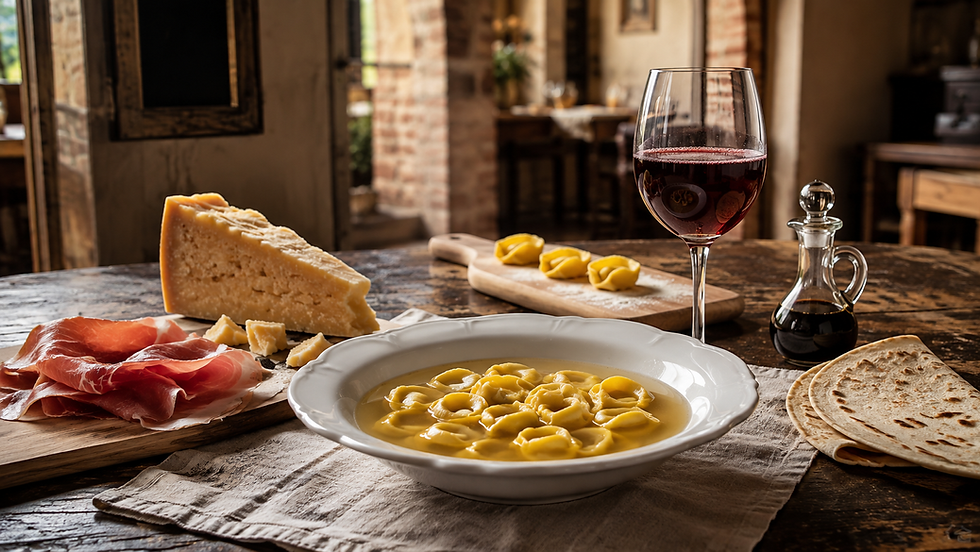
Maccheroni alla chitarra with lamb ragù expresses the region’s relationship with durum wheat. Sheets of pasta are pressed through a wooden frame strung with metal wires, producing long, square-edged strands that hold substantial sauces. In Teramo, scrippelle ’mbusse are thin crepes rolled with cheese and served “soaked” in clear broth, while timballo teramano layers those delicate scrippelle with a rich filling for holidays and family celebrations.
The Teramo calendar also includes virtù teramane, a complex spring soup traditionally associated with the beginning of May. Dried legumes, fresh vegetables, herbs, pasta and preserved meats meet in a dish that marks the transition from winter stores to the new growing season. It is a lesson in household economy transformed into ceremony.
Inland cooks make pallotte cacio e ova, cheese-and-egg balls simmered in tomato sauce, and agnello cacio e ova, lamb finished with a savory emulsion of egg and pecorino. On the southern coast, brodetto alla Vastese uses the catch available that day rather than a rigid list of fashionable fish. Its authenticity depends on freshness, sequence and restraint.
Festive baking is equally important. Pizza di Pasqua Abruzzese is a tall savory cheese bread served around Easter, commonly beside cured meats and eggs. Parrozzo, the domed almond cake covered in dark chocolate, belongs to Pescara’s modern culinary identity. Together, these dishes show why Abruzzo cannot be represented by arrosticini alone.
Products That Define the Region
The region’s pantry is built around precision rather than luxury for its own sake. L’Aquila saffron from the Navelli plateau perfumes risotto, pasta, broths and sweets. Sulmona red garlic is valued for its intense aroma. Lentils from Santo Stefano di Sessanio, mortadella di Campotosto, Ventricina del Vastese, pecorino cheeses, mountain honeys and extra-virgin olive oils from the hills near Loreto Aprutino and Chieti all express specific landscapes.
Along the coast, fresh fish matters more than prestige species. The traditional brodetti of Pescara, Giulianova and Vasto are related but not identical; each reflects local boats, catches and methods. On a trabocco, the setting may be unforgettable, but the real test remains the same as anywhere else: careful cooking and seafood that tastes of the Adriatic rather than heavy sauce.
The Wines of Abruzzo
Abruzzo’s best-known red is Montepulciano d’Abruzzo DOC. It ranges from generous, fruit-driven everyday bottles to structured, age-worthy wines. With arrosticini, lamb ragù or aged pecorino, look for enough freshness to balance fat and enough tannin to support roasted flavors.
Cerasuolo d’Abruzzo DOC is not a pale imitation of another region’s rosé. Made principally from Montepulciano, it is typically deeper in color and more substantial at the table. It can move from salumi and pizza di Pasqua to tomato-based pasta, brodetto and grilled fish.
Trebbiano d’Abruzzo DOC can be light and direct, but serious examples develop texture, savory depth and longevity. Pecorino Abruzzo DOC generally offers bright acidity and aromatic intensity, making it useful with seafood, fresh cheese and vegetable dishes. Cococciola Abruzzo DOC is valued for freshness and a citrus-herbal profile that suits shellfish and lighter Adriatic preparations.
Travelers should also look for Montepulciano d’Abruzzo Colline Teramane DOCG, a more geographically focused expression from the hills of Teramo, and Villamagna DOC, a small red-wine denomination in the province of Chieti. The useful question is not simply “red or white?” but whether the bottle comes from mountain foothills, inland valleys or vineyards influenced by the Adriatic.
Fifteen Places That Explain Abruzzo
1. L’Aquila — Begin in the regional capital with the Basilica of Santa Maria di Collemaggio, the Fountain of the 99 Spouts and a historic center whose continuing restoration is part of the city’s contemporary story.
2. Campo Imperatore and Gran Sasso — The vast high plateau beneath Corno Grande is one of central Italy’s defining mountain landscapes. Come for hiking and cycling in the warmer months and snow sports in winter, always checking mountain conditions before departure.
3. Rocca Calascio — Perched at roughly 1,500 meters, this white-stone fortress delivers one of the great panoramas of the Apennines. The exposed setting is part of its beauty, so wind, heat and winter weather must be taken seriously.
4. Santo Stefano di Sessanio — This fortified stone village inside the Gran Sasso and Monti della Laga National Park rewards a slow walk through lanes, arches and houses tied to the region’s pastoral history.
5. Sulmona — Ovid’s birthplace is known for confetti, red garlic, elegant squares and the medieval aqueduct crossing Piazza Garibaldi. It is also an excellent base between the Maiella and the Abruzzo National Park.
6. Scanno and Lake Scanno — The mountain town has a powerful photographic tradition, while the lake and Sagittario Valley add walking routes and dramatic scenery. Visit the historic center as well as the famous viewpoint.
7. Abruzzo, Lazio and Molise National Park — Base yourself in Pescasseroli or the Upper Sangro Valley for forests, wildlife centers and marked trails around Opi, Civitella Alfedena, Villetta Barrea and Barrea. Wildlife sightings are never guaranteed; responsible visitors keep their distance and follow park rules.
8. Majella National Park — The “mother mountain” combines deep valleys, beech forest, high limestone terrain and hermitages set into rock. Caramanico Terme and the Orfento Valley make practical introductions; longer routes require proper preparation.
9. Pescocostanzo and Pacentro — These mountain towns preserve stone architecture, craft traditions and access to the southern highlands. Pescocostanzo also works as a refined base for winter travel around Roccaraso and Rivisondoli.
10. Pescara — Abruzzo’s largest city provides beaches, nightlife, transport connections and the birthplace of Gabriele d’Annunzio. Its urban energy offers a useful contrast to the region’s villages and parks.
11. The Costa dei Trabocchi — South of Pescara, the Chieti coast is defined by wooden fishing structures extending above the Adriatic. The Via Verde makes it possible to experience much of the coastline by bicycle or on foot, with stops around Ortona, San Vito Chietino, Fossacesia and Rocca San Giovanni.
12. Vasto — The old town stands above the southern Adriatic, with broad sea views, beaches and access to the Punta Aderci nature reserve. This is the natural place to understand brodetto alla Vastese.
13. Chieti — One of Italy’s ancient hill cities, Chieti is essential for the National Archaeological Museum and the Warrior of Capestrano. Its position also makes it a bridge between the Maiella, vineyards and coast.
14. Teramo and Civitella del Tronto — Teramo introduces the cuisine and history of the northern province. Farther inland, the great fortress of Civitella del Tronto overlooks the border country that once separated kingdoms.
15. Atri and the Calanchi — Atri combines a handsome historic center and cathedral with the eroded clay formations of the nearby nature reserve, one of Abruzzo’s most unusual landscapes.
Five Restaurants Worth Planning Around
Abruzzo now supports destination dining at very different levels, from radical contemporary cooking to polished interpretations of regional tradition. Reservations and opening periods should always be checked directly, especially when a restaurant requires a long mountain or coastal drive.
Reale, Castel di Sangro — Niko Romito’s restaurant at Casadonna is the region’s international culinary landmark. The cooking is minimalist in appearance but built on concentrated flavor and rigorous research.
D.one Ristorante Diffuso, Montepagano — Set within the hill village above Roseto degli Abruzzi, D.one uses a contemporary language while remaining connected to the territory.
Al Metrò, San Salvo Marina — A strong choice for modern Adriatic cooking in southern Abruzzo, especially for travelers exploring Vasto and the coast toward Molise.
Villa Maiella, Guardiagrele — The Tinari family connects refined dining to Abruzzese products, its own agricultural work and the landscape at the foot of the Maiella.
La Bandiera, Civitella Casanova — A destination in the Pescara hills for cuisine rooted in family tradition and interpreted with fine-dining discipline.
Zunica 1880 at Villa Corallo in Sant’Omero is another important northern option and makes a useful alternative for a journey through the Teramo countryside.
Five Hotels for Different Abruzzo Journeys
Sextantio Albergo Diffuso, Santo Stefano di Sessanio — Rooms distributed through restored village buildings create the strongest sense of living inside the medieval settlement rather than merely visiting it.
Casadonna, Castel di Sangro — Ten design-conscious rooms share the mountain estate with Reale, making this the region’s clearest choice for a complete gastronomic stay.
Castello di Semivicoli, Casacanditella — A historic Masciarelli wine estate between the Maiella and the Adriatic, well suited to travelers interested in vineyards, tastings and quiet countryside.
Villa Maiella, Guardiagrele — A practical combination of family hospitality, mountain access and destination dining near the Majella National Park.
Relais Ducale Spa & Pool, Pescocostanzo — A five-star mountain base with a spa, useful for exploring Pescocostanzo, Roccaraso, Rivisondoli and the southern plateau.
These properties serve different itineraries; no single hotel is convenient for the whole region. Abruzzo rewards changing base at least once rather than attempting every destination as a day trip.
When to Go and How to Travel
Spring is ideal for green landscapes, villages and the seasonal table, although high mountain routes may still hold snow. Summer brings the fullest access to hiking areas and the Adriatic coast, together with heat and heavier demand in beach towns. Autumn is excellent for vineyards, saffron, forests and food travel. Winter belongs to skiing, mountain villages and hearty cooking, but weather can alter road access quickly.
Pescara is the most useful regional gateway by air and rail, while travelers coming from Rome often enter through L’Aquila or the western mountain routes. Trains serve the Adriatic corridor well, but a car is the most effective way to connect inland villages, parks, restaurants and wine estates. Distances that look short on a map can involve winding mountain roads, so plan fewer stops and leave daylight for unfamiliar routes.
A balanced first journey needs at least several days and two bases: one inland, such as Santo Stefano di Sessanio, Sulmona or Pescocostanzo, and one near the coast, such as Pescara, Ortona or Vasto. That structure allows travelers to experience the central truth of Abruzzo: mountain and sea are not competing identities. Together they form the region.
Territory Before Tourism
Abruzzo should be read first through geography: high Apennine massifs, national parks, hill towns, pastoral plateaus and the Adriatic coast. This physical structure explains far more than scenery. It shaped transport, agriculture, defensive settlement, market towns, cooking and even the pace of social life. A traveler who understands the territory can read a menu, a village street or a vineyard with much greater accuracy. The purpose of an Around Italy guide is to make those connections visible instead of presenting isolated attractions. When moving through Abruzzo, pay attention to how quickly ingredients, architecture and local habits change as altitude, coastline or agricultural land changes. Those differences are the substance of regional Italy.
Food as Regional Evidence
The core food vocabulary includes arrosticini, maccheroni alla chitarra, lamb, saffron, legumes, cheeses and seafood. These foods are valuable not because they are famous, but because they reveal what local people historically had available and how they learned to preserve, transform and serve it. A serious food itinerary should include a market, bakery or producer in addition to restaurants. Observe how bread is used, which fats dominate, whether sauces are based on meat, vegetables or fish, and how seasonality changes the menu. When a preparation appears repeatedly across villages, that repetition is evidence of a regional system rather than coincidence.
Wine and the Table
Wine should be approached with the same regional logic. Important references here include Montepulciano d’Abruzzo, Trebbiano d’Abruzzo and Cerasuolo. The best pairings are usually local because the food and wine evolved within the same agricultural environment. Rather than chasing the most expensive bottle, compare a regional wine with the dishes it traditionally accompanies. Acidity, tannin, salinity, bitterness and richness make more sense at the table than in an isolated tasting. A winery visit is especially useful when it includes discussion of soil, altitude, exposure and local grape varieties.
What to See and Why
A useful route includes L’Aquila, a mountain park, Sulmona or another inland town, a trabocco coast stop and a winery. These stops should not be treated as equal boxes to check. Choose one or two anchors each day and allow the movement between them to reveal the landscape. A small road through olive groves, a market town at midday or a hill village near sunset can be as important as a major monument. If a place is famous, arrive early or stay late enough to experience it outside peak visitor hours. The strongest regional itineraries create contrast between city and countryside, coast and interior, archaeology and everyday life.
How to Move
The practical transport strategy is a car for mountains and villages, with rail useful along parts of the coast. Italy can look compact on a map while still requiring significant travel time, particularly in mountainous or rural areas. Avoid planning days that depend on perfect traffic, parking or ferry connections. If driving, group destinations geographically and leave time for unplanned stops. If using rail, build the itinerary around stations rather than forcing rail travel onto places it does not serve well. The goal is not maximum distance. The goal is enough time in each place to understand it.
Season and Rhythm
The strongest general period is late spring, summer for mountains and early autumn, but season should be chosen according to the purpose of the trip. Harvests, food festivals, beach weather, snow, hiking conditions and religious celebrations all occur at different times. Seasonal travel also changes what appears on restaurant menus and market stalls. Morning is often best for markets and historic centers, midday for a long meal, and late afternoon for landscapes and smaller towns. This rhythm may look less efficient on paper, but it produces a much better experience on the ground.
What to Buy
Useful regional purchases include saffron, confetti, cheese, cured meats, pasta and regional wine. Buy fewer products with better provenance. Ask where something was made, which grape or milk was used, and whether the product is actually typical of the area. Specialist food stores, farm shops, enoteche and bakeries are usually more useful than generic souvenir stores. The purchase should help preserve a memory of territory, not simply carry an Italian flag on the packaging.
A Better Three-Day Structure
Day one should establish the main city or town and its food culture. Walk the historic core, visit one major cultural site, observe a market or commercial street and eat traditionally. Day two should move outward into the agricultural or natural landscape connected to the destination. Day three should introduce contrast: a smaller community, archaeological area, coast, mountain route, vineyard or craft tradition. This center–territory–contrast model is more useful than a list of attractions because it gives the traveler a working understanding of how the region functions.
Common Mistakes
The biggest mistake is trying to see too much. The second is eating without regional context. The third is assuming that the most photographed place is automatically the most representative. Leave room for ordinary life. Do not judge every town by nightlife or every restaurant by international service expectations. Local opening hours, meal times and traditions are part of the destination. Regional travel becomes richer when the visitor adapts to the place rather than demanding that every place behave the same way.
Why This Story Matters
Abruzzo matters in Around Italy because it shows the country as a collection of territories rather than a single lifestyle brand. The food, architecture, agriculture and habits described here are specific responses to history and geography. That specificity is what makes Italian regional culture so durable. A complete guide should leave the reader able to explain not only what to visit, but why the place developed the way it did.


Comments