
Around Italy: Emilia-Romagna, Art and Appetite
Updated: Aug 30
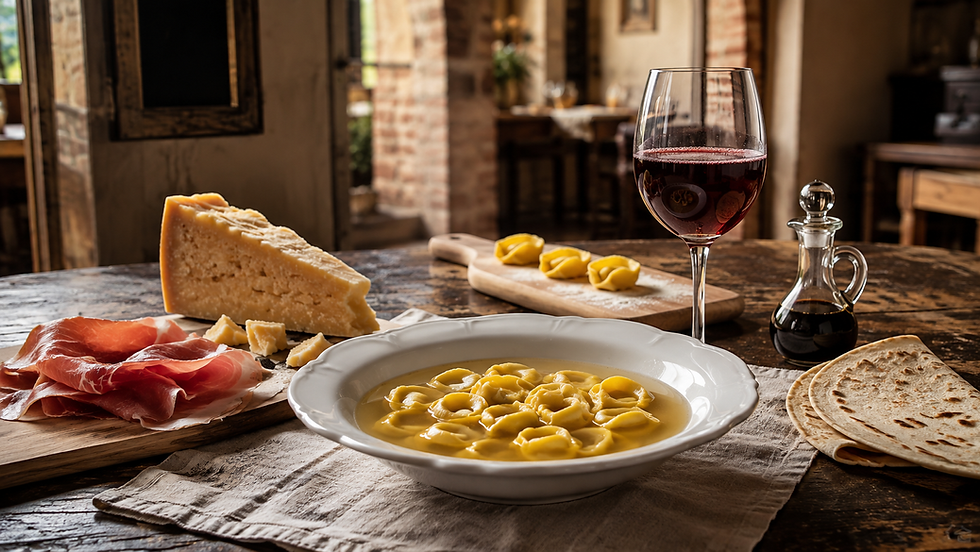
Emilia-Romagna is often presented as Italy’s great Food Valley, but that description is only the beginning. The region stretches from the Po River and the western plains around Piacenza to the Adriatic coast of Rimini, with the Apennines forming its southern backbone. Between them run Roman roads, medieval communes, Renaissance courts, agricultural estates, fishing ports, university cities, spa towns, ceramic workshops, automobile factories, vineyards, dairies, and some of Europe’s most productive farmland.
Its name joins two historical territories with related but distinct identities. Emilia follows the Via Emilia through Piacenza, Parma, Reggio Emilia, Modena, Bologna, and part of Ferrara. Romagna turns toward Ravenna, Forlì-Cesena, Rimini, and the Adriatic, while Bologna and the Imola area form an important hinge between the two. The differences are audible in dialects, visible in architecture, and unmistakable at the table. Stuffed pasta, cured pork, aged cheese, fresh egg dough, broth, flatbread, eels, seafood, balsamic vinegar, sparkling red wine, and structured hill wines all belong to the region, but never in exactly the same place.
The abundance can be deceptive. Emilia-Romagna’s cooking is not rich because cooks simply add more butter, cheese, or meat. It is rich because generations learned how to transform wheat, milk, pork, grapes, fruit, vegetables, and leftovers through exact technique. A tortellino depends on the thinness of the dough, the balance of the filling, and the broth. Parmigiano Reggiano depends on milk, time, temperature, and maturation. Traditional balsamic vinegar requires cooked grape must, a sequence of barrels, and years of patient concentration. Even piadina, the humblest-looking bread of Romagna, changes in thickness, fat, and texture as the traveler moves along the coast.
Nine Provinces, Nine Ways to Understand the Region
Bologna is the regional capital and the principal transport, university, cultural, and commercial center. Its porticoes, brick palaces, towers, markets, theaters, and arcaded streets create one of Italy’s most recognizable urban landscapes. The metropolitan territory extends far beyond the city into plains, vineyards, the Imola area, and the Apennines. Tortellini, tagliatelle with ragù, green lasagne, mortadella, cotoletta alla bolognese, friggione, certosino, and torta di riso belong to this food culture, but each has a specific setting and occasion. Bologna’s reputation as “la grassa” should never obscure its intellectual, musical, political, and artisanal history.
Ferrara is a Renaissance city surrounded by walls and closely connected to water. The Este court shaped its architecture and ceremonial cuisine, while the Po Delta, wetlands, reclaimed land, and Adriatic influence created another set of ingredients and techniques. Cappellacci di zucca, salama da sugo, coppia ferrarese, pasticcio di maccheroni, eels, rice, pumpkin, and torta tenerina express a province where aristocratic cooking, agricultural labor, and lagoon traditions meet. The flat landscape is best explored slowly, often by bicycle.
Forlì-Cesena reaches from the Via Emilia to the Tuscan-Romagnol Apennines and the Adriatic. Forlì carries rationalist architecture, medieval history, and the memory of powerful local families; Cesena is associated with the Malatestiana Library, the Malatesta legacy, fruit cultivation, and a lively market culture. Cesenatico adds a working canal port and seafood identity, while Longiano, Bertinoro, Bagno di Romagna, Predappio, and the valleys inland reveal vineyards, thermal water, forests, stone towns, and farms. Piadina, cappelletti, passatelli, squacquerone, Sangiovese, grilled meats, and Adriatic fish all change character between coast and hills.
Modena combines Roman foundations, Romanesque architecture, agricultural wealth, mechanical engineering, opera, and a global automobile culture. The cathedral, Ghirlandina tower, and Piazza Grande form its monumental center, while the surrounding province contains Maranello, Castelvetro, Vignola, Carpi, Sassuolo, and the Apennines. Traditional Balsamic Vinegar of Modena, Parmigiano Reggiano, Lambrusco, zampone, cotechino, gnocco fritto, crescentine, tortellini, cherries, and cured pork place Modena at the center of the regional table. Ferrari and Maserati add another form of craftsmanship based on precision, materials, performance, and design.
Parma is elegant without being detached from agriculture. Its cathedral, baptistery, Teatro Farnese, opera traditions, museums, and ducal history stand beside a province of dairies, ham-curing rooms, tomato fields, castles, rivers, and Apennine valleys. Prosciutto di Parma, Parmigiano Reggiano, Culatello di Zibello, anolini, tortelli d’erbetta, spalla cotta, and Malvasia wines connect the city to Langhirano, the Po lowlands, and the hills. The correct Parma itinerary moves between monuments and producers rather than treating food as something that appears anonymously at dinner.
Piacenza is the region’s western gate, positioned between the Po, the Via Emilia, Lombardy, Liguria, and the valleys of the Tidone, Trebbia, Nure, and Arda. Piazza Cavalli, Romanesque churches, Palazzo Farnese, and merchant history define the city; Bobbio, Castell’Arquato, Vigoleno, and the Apennine valleys expand the province into one of the region’s most rewarding road-trip territories. Coppa Piacentina, Pancetta Piacentina, Salame Piacentino, pisarei e fasò, tortelli con la coda, anolini, Gutturnio, Ortrugo, and Malvasia di Candia Aromatica give the province a strong identity distinct from neighboring Parma.
Ravenna was capital of the Western Roman Empire, the Ostrogothic kingdom, and Byzantine Italy. Its mosaics are not isolated decorations but part of an urban history that changed Europe. The province also includes Faenza’s ceramic culture, Brisighella’s medieval landscape and olive oil, Cervia’s salt pans, the pine forests, beaches, lagoons, and northern Romagna’s agricultural plain. Cappelletti, passatelli, spoja lorda, piadina, grilled meats, fish, mussels, clams, eels, pinza, Albana, and Sangiovese connect inland hills to the Adriatic.
Reggio Emilia is central to the story of the Italian tricolor, cooperative agriculture, contemporary industry, education, theater, cheese, and balsamic vinegar. The city’s piazzas and cultural institutions deserve more attention than they usually receive between Parma and Modena. Outside the center, the province rises toward Canossa, Quattro Castella, the Pietra di Bismantova, and the Apennine National Park. Parmigiano Reggiano, Traditional Balsamic Vinegar of Reggio Emilia, erbazzone, cappelletti, gnocco fritto, rice dishes, cured meats, and Lambrusco explain a territory where rural organization and craftsmanship remain closely linked.
Rimini is much more than a summer beach destination. The Arch of Augustus, Tiberius Bridge, Roman remains, medieval monuments, Renaissance art, and Federico Fellini’s cultural legacy reveal a city with more than two thousand years of history. The province includes Riccione, Cattolica, Santarcangelo di Romagna, Verucchio, Pennabilli, San Leo, the Marecchia and Conca valleys, vineyards, olive groves, castles, and resort towns. Rimini’s piadina is generally thinner than versions found farther north, while fish soups, grilled oily fish, cuttlefish, shellfish, pasta, cassoni, Rebola, and Sangiovese connect the coast to the hills.
The Via Emilia, the Po Plain, and the Apennines
The Roman Via Aemilia, established in 187 BCE, still provides the clearest line through the region. Modern roads and railways follow the same broad corridor from Rimini toward Bologna, Modena, Reggio Emilia, Parma, and Piacenza. Towns developed as markets, administrative centers, university cities, ducal capitals, and manufacturing hubs along this route. Traveling it today reveals how quickly food and language change even when the landscape appears continuous.
North of the road, the plain opens toward the Po. Irrigation, fertile soils, livestock farming, grain, fruit, vegetables, rice, sugar beets, and industrial agriculture shaped both prosperity and environmental pressure. Fog, rivers, drainage channels, reclaimed land, and wetlands belong to the region as much as sunlit vineyards. Ferrara and the Po Delta make the relationship with water especially visible, while the lower Parma province preserves the humid conditions essential to the maturation of culatello.
South of the road, hills rise into the Apennines. Vineyards occupy favorable slopes; chestnut woods, pastures, mushroom grounds, stone villages, thermal springs, and mountain farms appear at higher elevations. The terrain moderates summer heat and creates sharp differences between valley and ridge. It also explains why a regional itinerary based only on Bologna, Parma, and the Adriatic coast is incomplete.
The hyphen in Emilia-Romagna should therefore be treated as useful information. Emilia tends toward butter, aged cheese, cured pork, stuffed pasta, long-cooked meats, and sparkling reds, although these are never exclusive. Romagna turns more visibly toward olive oil, piadina, fresh cheese, grilled food, Adriatic fish, Sangiovese, and Albana. Bologna sits near the cultural hinge. The most accurate regional meal is not the one that collects every famous specialty; it is the one that respects where the traveler is sitting.
Fresh Pasta as Language and Craft
Emilia-Romagna’s pasta culture begins with sfoglia, fresh dough traditionally rolled with a long pin until thin, elastic, and even. Eggs and wheat are the foundation, but shape, filling, broth, sauce, and local vocabulary determine identity. The sfoglina’s work is physical and exact. Dough that is too dry cracks; dough that is too soft cannot hold a clean shape; uneven sheets cook inconsistently. Machine rolling can produce good pasta, but it does not remove the need to understand texture.
Tortellini in Brodo di Cappone represent the most disciplined version of Bologna and Modena’s famous filled pasta tradition. Their small scale requires a balanced meat-and-cheese filling, thin dough, careful sealing, and a clear, deeply flavored broth. Serving them under a heavy cream sauce may satisfy another kind of appetite, but it hides the proportions and technique that define the traditional dish.
Lasagne Verdi alla Bolognese unite spinach-colored pasta, ragù, béchamel, and Parmigiano Reggiano. The layers should remain distinct and moist without collapsing into a dense block. Ragù alla bolognese is a meat sauce developed through slow cooking, not a large quantity of tomato poured over spaghetti. Tagliatelle provide the more appropriate surface because their width and porous egg dough hold the condiment.
Balanzoni Bolognesi are green filled pasta associated with Bologna, often combining ricotta, mortadella, Parmigiano Reggiano, and aromatics. They demonstrate that the city’s pasta repertoire extends beyond tortellini and lasagne. Tortelloni filled with ricotta and parsley, sometimes finished with butter and sage, belong to the same broader culture of balancing rich fillings with restrained sauces.
Parma answers with Anolini di Parma in Brodo. The filling changes among families and territories, but may include reduced meat juices, aged cheese, breadcrumbs, eggs, and spices. The dish is inseparable from holidays and family labor. Piacenza has its own anolini as well as Pisarei e Fasò, small breadcrumbs-and-flour dumplings served with beans in a substantial sauce. It is a direct expression of economy, nourishment, and the ability to build flavor from modest ingredients.
Romagna’s filled pasta is represented by Cappelletti Romagnoli, whose cheese-based filling and precise composition vary by town and household. They are often served in broth during the winter holidays. Passatelli in Brodo use breadcrumbs, Parmigiano Reggiano, eggs, and aromatics pressed into short rough strands. The dish converts pantry ingredients into something fragrant and structurally distinctive; if the mixture is poorly balanced, the passatelli either dissolve or become hard.
Garganelli al Ragù Romagnolo are formed by rolling small squares of egg dough around a stick over a ridged board. Their grooves and tubular shape hold sauce effectively. Other essential pastas include strozzapreti, spoja lorda, tortelli d’erbetta, tortelli di zucca, cappellacci ferraresi, tortelli con la coda, and tagliolini. Their names are not decorative synonyms. Each carries a local method, geometry, and intended preparation.
The Emilian Table Beyond Pasta
Emilian cooking is built around preservation, dairy farming, pork, grain, and winter nourishment. Gnocco Fritto Emiliano is dough fried until inflated and served hot with cured meats and soft or aged cheese. Similar preparations change name across the region: torta fritta around Parma, chisolino in Piacenza, and crescentina fritta in parts of Bologna. The best examples are crisp and light rather than greasy, with enough internal space to receive salumi without becoming soggy.
Erbazzone Reggiano encloses chard or other greens, cheese, aromatics, and often pork fat within thin pastry. It belongs to Reggio Emilia and demonstrates how garden produce, scraps of cheese, and dough can become a complete savory dish. Crescentine or tigelle from the Modena and Bologna Apennines are small breads traditionally cooked in special molds, then opened and filled with cured meats, cheese, or pesto modenese made from lardo, garlic, and rosemary.
Cotoletta alla Bolognese begins with breaded veal and becomes unmistakably Bolognese through prosciutto, Parmigiano Reggiano, and a controlled final cooking with broth or other moisture. It should remain coherent rather than disappear beneath a thick blanket of toppings. Bollito Misto Emiliano depends on selecting cuts with different textures and cooking them correctly, then serving them with sauces such as salsa verde, mostarda, or local condiments.
Ferrara contributes Salama da Sugo Ferrarese, an intensely seasoned cured pork specialty that is cooked for hours and served in modest portions, traditionally with mashed potatoes or another soft accompaniment. Its strength makes proportion essential. Zampone and cotechino from Modena similarly transform less prestigious cuts through grinding, seasoning, casing, and slow cooking. These foods express a culture that respected the whole animal and reserved elaborate preparations for winter and celebration.
Vegetables are not absent from this rich table. Friggione slowly cooks onions and tomatoes into a Bolognese side dish or condiment. Cardoons, pumpkin, cabbage, chard, spinach, beans, peas, onions, mushrooms, and potatoes enter soups, fillings, gratins, pies, and stews. Cardi Gratinati al Parmigiano Reggiano show how a bitter winter vegetable can be softened, layered, and browned without losing its identity.
Romagna: Piadina, Broth, Hills, and the Adriatic
Piadina Romagnola is the everyday emblem of Romagna, but there is no single universal thickness. Versions around Ravenna and Forlì may be thicker and softer; Rimini’s are generally thinner and more flexible. Flour, water, salt, and a fat—traditionally lard, though olive oil versions are common—produce a bread cooked quickly on a hot surface. It should taste of grain and cooking, not function as an invisible wrapper.
Classic fillings include squacquerone and arugula, prosciutto, grilled sausage, cooked greens, or local cured meats. A filled and folded version may be called crescione or cassone, depending on area and usage. The bread belongs to kiosks, homes, beach towns, festivals, and quick meals, but quality still depends on dough rest, thickness, heat, and immediate service.
Romagna’s inland table includes cappelletti, passatelli, tagliatelle, garganelli, grilled pork, rabbit, poultry, castrato, fresh cheese, vegetables, and country sweets. The hills around Bertinoro, Predappio, Brisighella, and the Rimini hinterland connect olive oil and wine to this cooking. Moving east, the Adriatic introduces sardines, anchovies, mackerel, mullet, cuttlefish, mantis shrimp, clams, mussels, eel, and mixed fish soups. Grilling and frying work only when the catch is fresh and cooking remains brief.
Brodetto changes from port to port and should not be reduced to a generic tomato fish stew. The composition historically depended on what fishermen could not sell, the size of the boats, local acidity, bread, and household practice. Cesenatico, Cervia, Ravenna, Rimini, Cattolica, and Comacchio each belong to different maritime or lagoon contexts. Travelers should ask which species are local and seasonal rather than ordering “seafood” as an abstract category.
Protected Products and the Discipline Behind Them
Emilia-Romagna’s official food heritage includes dozens of PDO and PGI products, but the labels matter only when travelers understand the systems behind them. Parmigiano Reggiano DOP begins with raw cow’s milk from a defined territory, strict feed rules, natural whey starter, calf rennet, copper vats, brining, and long maturation. A young cheese and a wheel aged for thirty-six months are not interchangeable. Texture, aroma, solubility, sweetness, salt, and savory depth evolve over time.
Prosciutto di Parma DOP depends on selected pork legs, sea salt, time, air, and the conditions around the Parma hills. It should be sliced thinly enough to reveal tenderness and gradual flavor, not served icy or buried beneath strong condiments. Culatello di Zibello DOP belongs to the humid Po lowlands and is made from a specific portion of the leg, cured in a bladder, tied, and matured. Its production culture is distinct from prosciutto and should not be treated as a luxury synonym for it.
Piacenza is unusual for having three PDO cured meats: Coppa Piacentina, Pancetta Piacentina, and Salame Piacentino. Bologna contributes Mortadella Bologna IGP, whose delicate pork mixture, fat cubes, seasoning, and large format require controlled cooking. Modena contributes Zampone Modena IGP and Cotechino Modena IGP. Romagna adds Squacquerone di Romagna DOP, a soft, tangy, highly perishable cheese naturally suited to piadina and greens.
Traditional Balsamic Vinegar of Modena DOP and Traditional Balsamic Vinegar of Reggio Emilia DOP are made from cooked grape must and aged through a sequence of barrels. They are not the same product as everyday vinegar or even every bottle labeled with the broader Aceto Balsamico di Modena IGP designation. True traditional balsamic is dense, aromatic, sweet-sour, and used in drops or small quantities. It should heighten Parmigiano Reggiano, fruit, risotto, meat, or dessert rather than become a sugary glaze spread over everything.
Other essential products include Coppia Ferrarese IGP, Piadina Romagnola IGP, Fungo di Borgotaro IGP, Marrone di Castel del Rio IGP, Aglio di Voghiera DOP, Patata di Bologna DOP, Riso del Delta del Po IGP, Amarene Brusche di Modena IGP, Ciliegia di Vignola IGP, Pera dell’Emilia-Romagna IGP, Pesca e Nettarina di Romagna IGP, and regional olive oils. These products make season and geography visible. A proper food journey should include dairies, curing rooms, mills, markets, farms, bakeries, vinegar lofts, and wineries—not only restaurant dining rooms.
The Wines of Emilia-Romagna
The regional wine map runs from Piacenza’s western hills through Parma, Reggio Emilia, Modena, Bologna, Ferrara, and the vineyards of Romagna. Sparkling wine is central, but not universal. The region produces dry, sweet, still, frizzante, spumante, macerated, and long-aged wines from both familiar and indigenous grapes. The correct pairing begins with the wine’s actual structure, not with an old assumption that all Lambrusco is sweet or that every Romagna red is rustic.
Lambrusco di Sorbara DOC is typically the lightest-colored and most sharply acidic of the major Lambrusco expressions. Floral aromas, red berries, freshness, and a dry, energetic finish make it particularly effective with fried dough, mortadella, fatty cured pork, tortellini, and dishes that need cleansing acidity. Its delicacy should not be mistaken for lack of character.
Lambrusco Grasparossa di Castelvetro DOC is darker, fuller, more tannic, and better suited to substantial food. Dark berries, violet, savory notes, foam, and structure allow it to accompany zampone, cotechino, grilled pork, ragù, aged cheese, and gnocco fritto with robust salumi. Between Sorbara and Grasparossa lie other important identities, including Salamino di Santa Croce and Reggiano Lambrusco.
Colli Bolognesi Pignoletto DOCG is based on the Grechetto Gentile grape and may be still, sparkling, or produced in other authorized styles. Citrus, orchard fruit, flowers, herbs, almond, and lively acidity make dry versions useful with mortadella, vegetable dishes, fried appetizers, fresh pasta, and freshwater or Adriatic fish. The hills southwest of Bologna and the area around Monteveglio are central to understanding it.
Gutturnio DOC belongs to the Piacenza hills and combines Barbera with Croatina, locally called Bonarda. Barbera contributes acidity and Croatina contributes color, fruit, spice, and tannin. Frizzante versions work well with coppa, pancetta, salame, pisarei e fasò, and rich pasta, while superiore or riserva styles can meet braised meat, roasts, and aged cheese.
Malvasia di Candia Aromatica is especially important in the Piacenza and Parma hills. It can produce aromatic dry, sparkling, sweet, or passito wines, with floral, citrus, stone-fruit, grape, and herbal notes. Dry or lightly sparkling examples can accompany tortelli d’erbetta, salumi, soft cheese, vegetable pies, and aromatic first courses. Ortrugo, another Piacenza specialty, offers a leaner white profile and is particularly convincing with antipasti and freshwater fish.
Romagna Sangiovese DOC changes substantially across soils and subzones. Red cherry, violet, herbs, earth, spice, acidity, and tannin make it a natural partner for tagliatelle with ragù, cappelletti, grilled castrato, rabbit, roast meat, and aged cheese. The best bottles combine ripeness with tension and should not be judged by the heavier style expected from Sangiovese grown elsewhere.
Romagna Albana DOCG can be dry, sweet, or passito. The grape is capable of body, tannic grip, orchard fruit, flowers, herbs, citrus, honey, and considerable structure. Dry Albana can accompany passatelli, baked fish, shellfish, poultry, fresh pasta, and vegetables; sweet or passito versions belong with cheese or desserts selected according to sugar and intensity. It was the first Italian white wine denomination elevated to DOCG, but its real importance lies in its distinctive behavior at the table.
Fortana, associated with the Ferrara plain and the Bosco Eliceo territory, offers bright acidity, red fruit, modest alcohol, and sometimes a lightly sparkling character. It is particularly useful with eel, salama da sugo, cured pork, and the sweet-savory combinations of Ferrarese cooking. Pagadebit, Trebbiano Romagnolo, Cagnina, Rebola, Famoso, Centesimino, and Spergola complete a wine landscape far more varied than the region’s international reputation suggests.
Fifteen Places That Explain Emilia-Romagna
1. Bologna and Its Porticoes. Begin in Piazza Maggiore with San Petronio, Palazzo d’Accursio, the Fountain of Neptune, and the surrounding medieval streets. Continue to the Archiginnasio, Santo Stefano, the Quadrilatero market district, the university area, and the porticoes that form the city’s UNESCO-listed serial property. The Two Towers remain symbols of Bologna, but access conditions can change; the city is rewarding even without climbing. Give Bologna at least two full days and eat in several different formats: market, bakery, traditional trattoria, pasta workshop, and serious contemporary restaurant.
2. Modena, Maranello, and Castelvetro. Modena’s cathedral, Ghirlandina, and Piazza Grande form a UNESCO World Heritage ensemble of exceptional Romanesque architecture. The historic center, covered market, Teatro Comunale Pavarotti-Freni, Enzo Ferrari Museum, and nearby vinegar lofts reveal several sides of the city. Maranello adds the Ferrari story, while Castelvetro connects Lambrusco vineyards, hill architecture, and traditional food. This territory deserves a night rather than a rushed stop between Bologna and Parma.
3. Parma and the Food Valleys. Parma combines the Romanesque cathedral, Benedetto Antelami’s baptistery, the Pilotta complex, Teatro Farnese, Teatro Regio, galleries, and a refined walkable center. Outside the city, Langhirano introduces Prosciutto di Parma; Soragna and the Po lowlands lead toward culatello; dairies explain Parmigiano Reggiano; and castles punctuate the plain and hills. Producer visits require appointments and should be treated as working agricultural experiences, not entertainment staged on demand.
4. Ravenna and the Mosaics. Ravenna’s UNESCO group comprises eight early Christian monuments, including San Vitale, the Mausoleum of Galla Placidia, Sant’Apollinare Nuovo, the Neonian Baptistery, and Sant’Apollinare in Classe. Their mosaics must be seen slowly because theology, imperial power, architecture, color, and light work together. The city also contains Dante’s tomb, museums, churches, and access to pine forests and the Adriatic landscape. One day covers the essentials; two allow the monuments to be understood rather than collected.
5. Ferrara, the Walls, and the Este City. Ferrara is one of Italy’s most coherent Renaissance cities. The Este Castle, cathedral area, Palazzo dei Diamanti, Palazzo Schifanoia, medieval lanes, broad Renaissance avenues, and almost complete wall circuit reward walking and cycling. The UNESCO designation connects the city with its Po Delta territory, making architecture and landscape part of one story. Stay overnight to experience the center after day visitors leave and to eat Ferrarese dishes in their proper setting.
6. Rimini Beyond the Beach. Walk from the Arch of Augustus through the historic center to the Tiberius Bridge, Domus del Chirurgo, Tempio Malatestiano, Castel Sismondo, and the spaces dedicated to Federico Fellini. Marina Centro and the beach belong to modern Rimini, but they should not erase the Roman and Renaissance city. The surrounding province offers Santarcangelo, Verucchio, San Leo, Pennabilli, olive groves, vineyards, and the Marecchia Valley, making Rimini a strong base well outside high summer.
7. Reggio Emilia and the Lands of Canossa. Reggio’s Piazza Prampolini, Basilica della Ghiara, theaters, museums, markets, and Tricolore history justify a deliberate stop. Contemporary architecture appears at the railway station and in modern cultural projects, while the countryside leads to dairies, balsamic vinegar estates, Quattro Castella, Canossa, vineyards, and the first rises of the Apennines. The city is compact, but the province rewards a car and at least one full day beyond the center.
8. Piacenza and Its Castles. Piacenza’s Piazza Cavalli, Palazzo Gotico, cathedral, Sant’Antonino, San Sisto, and Palazzo Farnese reveal a city shaped by the Po, pilgrimage routes, merchants, and noble families. The province contains an exceptional network of castles and villages, including Castell’Arquato and Vigoleno. Food and wine change among the Tidone, Trebbia, Nure, and Arda valleys, so Piacenza works best as the beginning of a multi-day western Emilia journey.
9. Bobbio and the Trebbia Valley. Bobbio grew around the abbey founded by Saint Columbanus and preserves a compact historic center, the irregular Ponte Gobbo, religious art, and a strong relationship with the river. The Trebbia Valley offers clear water, dramatic bends, mountain roads, villages, and hiking landscapes. Driving times are slower than the map suggests, especially when travelers stop for viewpoints, swimming areas, local food, and small towns.
10. Comacchio and the Po Delta. Comacchio’s canals, bridges, Trepponti, brick buildings, and eel tradition introduce the human history of the wetlands. The Po Delta is a landscape of lagoons, saltwater and freshwater zones, fishing structures, birdlife, reclaimed fields, and fragile ecological systems. Boat, bicycle, and guided nature excursions reveal more than a quick drive. Mosquitoes, heat, seasonal water conditions, and protected-area rules should be planned for rather than treated as surprises.
11. Faenza and Brisighella. Faenza is internationally associated with ceramics, and its museum places local production within a much wider history of material, design, and technique. Nearby Brisighella rises beneath three landmarks on a ridge and offers medieval streets, olive groves, a covered walkway, and access to the Romagna hills. Together they connect craftsmanship, architecture, olive oil, wine, and rural landscape in a manageable day or relaxed overnight trip.
12. Dozza and Imola. Dozza combines a hill village, painted walls, a fortress, and the regional wine institution housed within the Rocca Sforzesca. Imola adds architecture, markets, ceramics, the San Domenico museums, and one of Motor Valley’s most famous circuits. The two places explain the transition between Bologna and Romagna better than a motorway sign ever could. Event weekends can radically change traffic and availability, so circuit calendars should be checked before travel.
13. Cesenatico, Cervia, and the Working Adriatic. Cesenatico’s canal port, associated with Leonardo da Vinci’s early-sixteenth-century survey, remains a maritime setting rather than a decorative backdrop. The floating section of the Maritime Museum, fishing boats, market, and restaurants connect the town to Adriatic labor. Cervia adds historic salt warehouses, salt pans, pine forests, and the resort culture of Milano Marittima. Visit outside the busiest beach hours to understand how fishing, salt, tourism, and wetlands coexist.
14. Motor Valley. Ferrari in Modena and Maranello, Lamborghini in Sant’Agata Bolognese, Ducati in Bologna, Maserati in Modena, Dallara near Parma, and the circuits at Imola and Misano form an exceptional concentration of engineering culture. Museums and factory experiences have different reservation rules, and not every production area is open to casual visitors. Choose two or three priorities rather than racing between logos. The deeper theme is regional craftsmanship: precision, apprenticeship, design, competition, and industrial networks.
15. The Emilia-Romagna Apennines. The mountain arc includes Monte Cimone, Corno alle Scale, the Pietra di Bismantova, the Tuscan-Emilian Apennine National Park, the Foreste Casentinesi, thermal towns, ski areas, chestnut woods, lakes, and long-distance paths. No single stop represents it all. Weather changes quickly, public transport is limited, and villages can be far apart. Several days reveal the region’s quietest side and explain mushrooms, chestnuts, mountain cheese, cured meat, soups, and the seasonal movement between plain and high country.
Seven Restaurants Worth Planning Around
The following restaurants are distributed across Emilia and Romagna and were checked against the 2026 Michelin Guide. Awards, opening days, menus, and booking policies can change, so reconfirm every detail directly before building travel around a reservation.
Osteria Francescana, Modena. Massimo Bottura’s restaurant holds three Michelin stars in the 2026 guide. Its cooking uses memory, contemporary art, technique, and Modenese ingredients to question what tradition can become. This is a destination tasting menu and a major financial and time commitment. Reserve far in advance, arrive without compressing the meal between museum visits, and understand that its purpose is interpretation rather than a survey of rustic regional classics.
San Domenico, Imola. The two-star San Domenico represents a grand tradition of Italian restaurant hospitality, classic technique, formal service, and an important cellar. It is especially appropriate for travelers interested in the bridge between Bologna and Romagna. The experience is structured and ceremonial; it should be chosen deliberately rather than because Imola happens to fall between two cities.
Magnolia, Longiano. Magnolia holds two Michelin stars and operates within Relais Villa Margherita in the hills above the Adriatic. Chef Alberto Faccani’s creative cooking connects contemporary technique, personal experience, and the Romagna landscape. The park, views, cellar, and small-scale hotel make it possible to build a complete evening without returning immediately to the coast.
La Palta, Borgonovo Val Tidone. La Palta holds one Michelin star in the Piacenza hills. Its country setting and cooking provide a strong reason to explore Val Tidone rather than treating Piacenza as only a motorway stop. The meal belongs naturally with local cured meats, Gutturnio, Malvasia, castles, and a slow route through the western province.
Antica Corte Pallavicina, Polesine Parmense. This one-star restaurant occupies a historic property near the Po and is inseparable from the Spigaroli family’s work with culatello, farming, cellars, and hospitality. It is one of the region’s clearest places to understand how a luxury ingredient remains connected to landscape and agricultural practice. Rooms on the property make an overnight stay particularly useful.
Ca’ Matilde, Rubbianino. Ca’ Matilde holds one Michelin star in the countryside near Reggio Emilia. Andrea Incerti Vezzani’s cooking brings contemporary control to regional memory and draws from the restaurant’s biodynamic kitchen garden. Combine it with Reggio, Quattro Castella, Canossa, a dairy, or a balsamic vinegar visit rather than driving in only for dinner.
Ancòra, Cesenatico. Ancòra holds one Michelin star and offers contemporary cooking in a town defined by the Adriatic and its port. It gives travelers a refined coastal counterpoint to brodetto, fried fish, piadina kiosks, and traditional trattorie. Cesenatico should still be experienced through several levels of dining; one fine restaurant cannot substitute for the market, harbor, and simpler maritime table.
Seven Hotels for Different Emilia-Romagna Journeys
Grand Hotel Majestic “già Baglioni,” Bologna. This historic five-star hotel sits in central Bologna close to Piazza Maggiore, the main cultural sights, shopping streets, and restaurants. It works best for travelers who want formal service, a historic setting, and the ability to explore the center on foot. Arriving by car requires attention to restricted traffic zones and the hotel’s current access instructions.
Casa Maria Luigia, Modena. Created by Massimo Bottura and Lara Gilmore in an eighteenth-century country property outside Modena, Casa Maria Luigia combines contemporary art, gardens, intimate hospitality, and food-driven experiences. It is a destination in itself rather than simply a place to sleep after Osteria Francescana. Choose it for a slower Modena and Motor Valley stay with enough time to use the property.
Palazzo di Varignana, the Bologna Hills. Set around an eighteenth-century villa east of Bologna, this large resort combines rooms, villas, spa facilities, pools, gardens, restaurants, and an agricultural estate. It suits travelers who want countryside and wellness while remaining within reach of Bologna, Imola, and Dozza. A car is useful, and the experience is different from staying inside the city’s porticoes.
Antica Corte Pallavicina Relais, Polesine Parmense. Eleven rooms within the historic court allow guests to connect the Po lowlands, culatello cellars, museum, restaurant, farm, and river landscape. The property is ideal for a food-focused Parma journey, especially when combined with Busseto, Zibello, Soragna, and producer visits. It is rural and atmospheric, not a practical base for walking through central Parma each evening.
Relais Roncolo 1888, Quattro Castella. This luxury estate hotel in the Reggio Emilia hills is surrounded by organic vineyards, olive trees, gardens, and a historic balsamic vinegar cellar. It works for travelers who want Food Valley and countryside without sacrificing design or comfort. Reggio Emilia, Canossa, Parma, Modena, dairies, and wineries can be connected from here with realistic driving plans.
Borgo Condé Wine Resort, near Predappio. Borgo Condé occupies a broad vineyard estate in the Romagna hills and combines rooms, pools, wellness, restaurants, wine, olive oil, and rural views. It is a useful base for Forlì-Cesena, Bertinoro, Castrocaro, the Apennine foothills, and excursions toward the Adriatic. Stay several nights so the resort does not become merely an overnight stop between tastings.
Grand Hotel Rimini, Rimini. The historic five-star property facing the sea is closely associated with Rimini’s grand resort era and Federico Fellini’s imagination. It offers a strong base for Marina Centro, the historic city, the beach, and excursions into the Marecchia Valley. Summer brings the greatest energy and demand; spring and early autumn make it easier to combine the coast with archaeology, towns, and inland food.
How to Eat the Region Without Reducing It to a Checklist
Begin with the local daily structure. In Bologna, compare a pasta shop, a market lunch, a traditional trattoria, and a serious restaurant. In Modena or Reggio Emilia, visit a dairy in the morning, when cheesemaking takes place, and a vinegar loft by appointment. In Parma, understand the difference between Prosciutto di Parma and culatello by visiting their respective production territories. In Piacenza, taste the three PDO salumi with local wine before ordering a heavy first course.
In Ferrara, eat pumpkin pasta, salama da sugo, bread, rice, or eel according to season and location. In Romagna, use piadina as an introduction rather than a final conclusion: compare thickness, fillings, and kiosk styles, then explore broth, fresh pasta, grilled meat, hill wine, and Adriatic fish. At the coast, ask what was landed and what is local. A large mixed platter assembled from frozen species teaches less than one carefully cooked seasonal fish.
Balance is essential. A week of tasting menus, cured pork, filled pasta, and aged cheese can become physically monotonous even when every dish is excellent. Markets, fruit, vegetables, soups, simple fish, bakery foods, and farmhouse meals reveal the everyday region. The best question remains: what belongs to this town, in this season, and what technique makes it different from the same ingredient thirty miles away?
When to Go and How to Travel
April through June and September through October offer the best balance for a broad regional journey. Cities are active, the hills are accessible, the coast is pleasant, and extreme heat is less likely. Spring brings asparagus, peas, herbs, cherries, fresh cheese, and long daylight. Autumn brings grapes, mushrooms, chestnuts, truffles, new wine, and a return to broths and slow cooking.
July and August favor the Adriatic, mountain escapes, festivals, and long evenings, but the plain can be intensely hot and humid. Coastal towns become crowded, prices rise, and road traffic increases around weekends. Bologna, Ferrara, Modena, and Parma remain culturally rich in summer, yet midday sightseeing requires a slower schedule. Winter brings fog to the plain, snow to parts of the Apennines, shorter days, and the most convincing season for tortellini in broth, bollito, zampone, cotechino, and aged red wine.
Bologna is the principal rail hub, with fast connections north and south and strong regional service along the Via Emilia. Ferrara, Ravenna, Rimini, Modena, Reggio Emilia, Parma, and Piacenza can all anchor car-free city journeys, although routes and frequencies should be checked for the actual travel date. A car becomes valuable for castles, vineyards, dairies, balsamic estates, the Po Delta, Motor Valley sites, Apennine villages, and the western valleys.
Historic centers use restricted traffic zones, and camera enforcement is common. Hotels inside these areas may have access procedures, but travelers must obtain current instructions before driving in. Motor Valley museums, restaurant reservations, producer visits, and factory experiences often require separate bookings. Do not assume that a cheese dairy, ham producer, vinegar maker, or winery can receive unannounced visitors while production is underway.
A Regional Journey That Does Not Rush
Twelve to sixteen days create a strong first journey. Begin with three nights in Bologna for the historic center, food, a market, and a day toward Dozza or Imola. Continue to Modena for architecture, balsamic vinegar, Motor Valley, and the surrounding hills. Reggio Emilia and Parma can then form a second base for dairies, castles, ham, culatello, opera culture, and the Lands of Canossa.
Move west to Piacenza and spend at least two days between the city, Val Tidone, Bobbio, the Trebbia Valley, or the castle network. Returning east, Ferrara deserves an overnight stay followed by Comacchio and the Po Delta. Ravenna requires at least one full day for mosaics, with a second for Faenza, Brisighella, Cervia, or the pine forests.
Finish in Romagna with a base around Cesenatico, Rimini, or the hills. Combine the working coast, piadina, seafood, Sangiovese, Albana, villages, and the Marecchia Valley. Travelers interested in nature should replace one city segment with several nights in the Apennines. Travelers focused on motors should choose fewer factories and museums, leaving time for the cities and food cultures that created the same regional appetite for precision.
Emilia-Romagna cannot be understood through a plate of tagliatelle followed by a fast drive to the beach. Its identity is built along a road but expands north into wetlands and south into mountains. It is Roman and medieval, ducal and communal, agricultural and industrial, formal and generous. The region produced mosaics, universities, opera, ceramics, cinema, racing engines, cooperative farms, and foods whose reputations now travel farther than the landscapes that created them.
The task of a serious traveler is to reconnect those names to place. Parmigiano Reggiano belongs to milk, dairies, seasons, and years of maturation. Prosciutto belongs to hills, salt, air, and time. Tortellini belong to hands, proportion, and broth. Piadina belongs to heat, speed, and local texture. Lambrusco belongs to several grapes and territories, not one sweet stereotype. Emilia-Romagna reveals itself when every celebrated product becomes part of a larger system of landscape, labor, memory, and hospitality.


Comments