
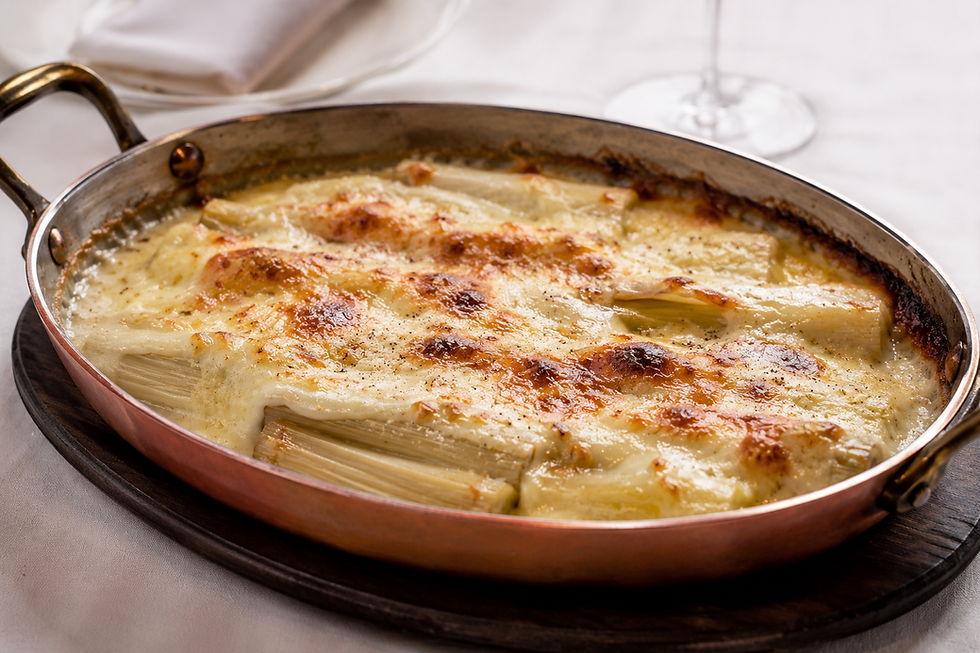
Italian Emilian Cardoon Gratin | Cardi Gratinati al Parmigiano Reggiano

The cardoon is the most demanding vegetable in the Emilian winter larder, and the only reason anybody bothers is that the reward is worth the argument. It arrives looking like a pale, oversized bunch of celery that has been in a fight. Half of it goes in the bin. What remains must be stripped of its strings, held in acidulated water so it does not blacken while you work, and boiled far longer than any tender vegetable would need.
What comes out the other side is something no other vegetable does: a stem with the faint bitterness of artichoke, a clean sweetness underneath, and a texture that stays firm through a long bake. That is why Emilia puts it under besciamella and Parmigiano Reggiano. Cardoons have enough character to hold their own against a mature cheese and enough structure to take half an hour in a hot oven.
There is no breadcrumb in this gratin and it does not need one. Parmigiano Reggiano aged 24 months is dry and low in moisture, and in a hot oven it forms its own crust, a thin brittle sheet of browned protein and fat that cracks under a spoon.
Yield: 6 side servings. Prep: 45 minutes. Cook: 1 hour 15 minutes. Rest: 10 minutes. Total: about 2 hours 10 minutes. Difficulty: intermediate. Course: contorno. Region: Emilia, from Piacenza to Bologna.
The Story
The cardoon is Cynara cardunculus, the same species as the globe artichoke, grown for its ribbed stems instead of its flower buds. In Emilia it is a Christmas vegetable and almost nothing else. In late autumn the grower bends the whole plant over and buries the stalks under a ridge of earth so they grow in the dark. Deprived of light the stems stop making chlorophyll, go ivory pale, lose much of their bitterness and turn tender. The curve the plant takes while buried is why these blanched cardoons are called gobbi, hunchbacks.
The frost matters as much as the burial. Cardoons are lifted after the first serious cold, which is chemistry rather than romance: cold shifts the balance of sugars and bitter compounds in the stem, and a cardoon pulled in mild weather tastes noticeably harsher. That is why it belongs to December in Emilia, and why it turns up beside the bollito misto and after the anolini in brodo rather than at any other point in the year.
Pellegrino Artusi, born at Forlimpopoli and the man who first wrote the cooking of this region into a single book, gave cardoons more than one entry in La Scienza in Cucina e l Arte di Mangiar Bene. His instructions are almost entirely damage control: strip the filaments, keep the cut pieces in lemon water so they do not blacken, boil them until properly soft, and only then bring in butter, besciamella and Parmigiano. A century later the sequence has not changed, because the vegetable has not changed either.
Ingredients
For the cardoons
Cardoon stalks, untrimmed, 3 lb (1.35 kg), giving about 1 1/2 lb (680 g) trimmed
Lemons, 2, for the holding water and the cooking liquid
All purpose flour, 1/4 cup (30 g), for the cooking liquid
Water, 4 quarts (3.8 l)
Coarse salt, 1 tbsp (18 g)
For the besciamella
Whole milk, 2 1/2 cups (600 ml)
Unsalted butter, 4 tbsp (57 g)
All purpose flour, 1/4 cup (32 g)
Freshly grated nutmeg, 1 small pinch
Fine sea salt, 3/4 tsp (4.5 g)
Ground white pepper, to taste
For the gratin
Parmigiano Reggiano aged 24 months, finely grated, 4 oz (115 g)
Unsalted butter, cold and diced small, 2 tbsp (28 g)
Unsalted butter for the dish, 1 tsp (5 g)
For finishing
Parmigiano Reggiano, coarsely grated, 1/2 oz (15 g)
Freshly ground black pepper, to taste
Preparation
Step 1
Set up the holding water first. Fill a large bowl with cold water, squeeze in the juice of one lemon and drop the spent halves in. Cardoons oxidise the moment they are cut, faster than artichokes, and a stalk left on the board for two minutes is already grey at the edges. Everything you trim goes straight into the bowl. Wear gloves: the cut surfaces stain fingers brown for days.
Step 2
Break down and string the stalks. Discard the dark green outer stalks entirely, with any that are hollow, woody or blemished. You want the pale inner ribs. Snap each part way at the top and pull downwards: the tough filaments come away in long threads, like celery but more stubborn. Go over both faces with a peeler, cut into lengths of about 3 inches (7 cm) and drop them into the lemon water.
Step 3
Cook them in a blanc. Whisk the 1/4 cup of flour into a cup of cold water until smooth, then stir it into the 4 quarts of water in a large pot with the juice of the second lemon and the coarse salt, and bring to a boil. This is a blanc, a white court bouillon, and the suspended flour keeps the cardoons pale by limiting the oxygen reaching their surface. Skip it and the gratin comes out grey.
Step 4
Boil until genuinely tender. Drain the cardoons into the blanc, hold a steady simmer and cook 35 to 50 minutes depending on the thickness of the ribs. Test with a knife tip: it should go through with only the faintest resistance, like a cooked artichoke bottom. A cardoon still squeaky here stays that way in the oven, because besciamella cannot soften fibre. When in doubt, cook longer.
Step 5
Drain and dry them properly. Lift the pieces out with a spider, lay them in one layer on a clean towel, cover with a second and press gently for ten minutes. They hold a surprising amount of water in the hollow of the rib, and any left will run out under the sauce and pool in the bottom of the dish. Discard the blanc.
Step 6
Make the besciamella. Melt the butter over medium low heat, whisk in the flour and cook the roux 2 minutes without letting it colour. Add the warm milk in three additions, whisking hard after each, then simmer 5 minutes until it coats a spoon. Season with nutmeg, salt and white pepper. Keep it looser than you think it should be, since the cardoons will not thin it the way a wetter vegetable would.
Step 7
Add the Parmigiano off the heat. Take the pan off the burner, wait a minute, then whisk in 3 oz (85 g) of the fine gratings until smooth. Taste before adding salt: a mature Parmigiano brings plenty of its own and the sauce is about to concentrate in the oven. Reserve the other 1 oz (30 g) for the top.
Step 8
Layer and bake. Heat the oven to 400°F (200°C) and butter a gratin dish about 11 by 8 inches (28 by 20 cm). Spread a thin film of sauce on the base, lay half the cardoons in a close single layer, cover with a third of the remaining sauce, repeat, and finish with the rest. Scatter the reserved fine and coarse gratings over the surface, dot with the cold diced butter and bake 25 to 30 minutes until deep gold and blistered. Rest 10 minutes.
Plating
Cardoons are a family dish and should reach the table in the gratin dish, uncut, with the crust intact. Serve with a spoon and fork used together, so a section is lifted with its layers stacked rather than dragged apart. Plates should be hot, around 140°F (60°C), because besciamella sets quickly and a cold plate turns a creamy gratin firm in under a minute.
This is a contorno with a specific place in a meal. In Emilia it goes beside boiled meats, cotechino, zampone or roast capon, all lean or gelatinous and better for something creamy alongside. Do not put it next to lasagne or anything else already carrying besciamella and Parmigiano, an easy mistake on a Christmas table. Grind black pepper over each portion and add nothing else: lemon, parsley or oil would all pull against a dish whose appeal is the clean line between bitter stem and mature cheese.
Professional Technique
The cooking blanc defines this preparation and most people have never used one. Cardoons are high in polyphenol oxidase, the enzyme that browns a cut apple, and once the stem is opened the reaction starts immediately and cannot be reversed. Acid slows it, which is what the lemon water does during prep, but boiling water is full of dissolved oxygen and lemon alone is not enough. Suspended flour puts a fine starch barrier between the vegetable and that oxygen. It adds nothing to the flavour and everything to the colour.
The second is choosing a 24 month Parmigiano rather than a younger wheel, which is structural rather than sentimental. At that age the cheese has lost much of its moisture and its casein has broken into free amino acids, including the tyrosine that forms the visible white crystals. Low moisture means the gratings dry and brown instead of slumping into a greasy layer, which is what builds the brittle crust. The free glutamates are also what let a vegetable this mild read as savoury with no meat or stock in the dish.
The third is restraint in the besciamella. A sauce that is too thick behaves like glue around a fibrous vegetable and makes the cardoon seem tougher than it is, because the palate reads both resistances at once. Cooked only until it coats a spoon, it stays fluid enough in the oven to run into the hollow of each rib and season it from the inside.
Texture and Moisture Control
Cardoons are mostly fibre and water, and the two behave very differently here. The fibre softens only in the boiling stage, never in the oven, which is why the doneness test before assembly is not negotiable. The water is the opposite problem: it leaves during the bake whether you want it to or not, and with nowhere to go it pools under the sauce and separates the besciamella. Pressing the boiled pieces between towels removes most of it, and close single layers rather than heaps give the rest a short route to the surface.
The crust and the interior need opposite conditions, which is what the cold diced butter is for. Scattered over the surface it melts slowly and bastes the top gratings as they dry, so they brown evenly instead of scorching, while the sauce underneath stays creamy. A hot oven does the same work: at 400°F (200°C) the surface sets and colours before the interior dries out, whereas a moderate oven cooks the dish through without ever producing a crust.
Professional Mise en Place
Almost all the work is front loaded and the trimming is slow the first time. Everything up to assembly can be done a day ahead, which is how this dish survives a Christmas service.
Equipment and tools
Vegetable peeler and a small sharp knife for stringing the ribs
Large pot for the blanc, plus a spider skimmer
Heavy saucepan and balloon whisk for the besciamella
Gratin dish, about 11 by 8 inches (28 by 20 cm)
Prepared ahead
Cardoons trimmed, strung and cut, up to 6 hours ahead, in lemon water, refrigerated
Cardoons boiled and pressed dry, up to 1 day ahead, covered and refrigerated
Besciamella without the cheese, up to 1 day ahead, refrigerated and filmed
Parmigiano grated fine and coarse and kept in separate covered boxes
Service setup
Besciamella rewarmed and loosened with milk before the cheese goes in
Cheese whisked in off the heat, never over a flame
Dish assembled while the sauce is still warm and fluid
Butter diced straight from the refrigerator and scattered at the last moment
Chef Tips
Buy roughly twice the weight you need. A 3 lb (1.35 kg) bunch yields about 1 1/2 lb (680 g) of usable rib once the outer stalks, tops and strings are gone. Choose bunches that are pale rather than green, heavy, tightly closed and firm when you press a rib.
Grate the Parmigiano yourself and grate it twice. Fine for the sauce and the first layer of the top, coarse for the surface: the coarse brown into crisp flecks while the fine melt into a sheet, and together they give a better crust than either alone. Pre grated cheese carries anticaking starch and will never do this.
If the cardoons taste aggressively bitter after boiling, which happens with stalks that were never properly blanched under earth, change the water once: 15 minutes in the blanc, drain, then finish in fresh salted water with lemon.
Cardoons are seasonal and short lived. Out of season the honest substitute is not celery, which is watery and stringy in the wrong way, but the bottoms of large globe artichokes cooked the same way in a blanc for about 20 minutes. Sweeter, less bitter, still very good, but call it what it is.
Common Mistakes
Not stringing the ribs. The outer filaments never soften, however long you cook them, and end up as threads between the teeth. Pull them from the top downwards and go over both faces with a peeler.
Cutting them without acidulated water ready. Oxidation begins within seconds and leaves permanent grey and brown streaks on a vegetable whose whole point is its pale colour. Set the lemon water up before the first stalk is touched.
Boiling them in plain water. Without flour in the blanc nothing shields the cut surfaces from dissolved oxygen and they come out dull grey. It costs nothing and changes the finished dish completely.
Taking them out of the pot too early. Besciamella cannot soften fibre, so a cardoon that is still firm at the end of the boil will be firm on the plate. Test with a knife tip and keep cooking until the resistance is almost gone.
Using young or pre grated Parmigiano. A wheel under 18 months is too moist and slumps into an oily layer instead of drying into a crust, and pre grated cheese carries starch that stops it browning. Use a 24 month wheel.
Wine Pairing
Colli Bolognesi Pignoletto DOCG: The white of the hills directly behind Bologna and the most natural match here. Grechetto gentile gives a dry wine with brisk acidity, white flowers and a slightly bitter almond finish, and that bitterness is the key: it meets the vegetal bitterness of the cardoon head on instead of sweetening it away, while the acidity cuts the butter.
Lambrusco di Sorbara DOC: In its dry form this is the most useful red in Emilia and it is built for food like this. Pale, high in acid and lightly sparkling, it works the way a sparkling white does, the bubbles lifting the dairy fat off the palate. Its sour cherry and violet fruit stays out of the way of the Parmigiano. Serve at 54°F (12°C).
Gutturnio dei Colli Piacentini DOC: From the western edge of Emilia, a blend of Barbera and Croatina, high acidity from one grape and soft body from the other. The dry frizzante version is what the Piacentini drink with rich winter food: the acidity handles the besciamella while the modest tannin sits beside the cheese crust without drying the palate.
Lambrusco Grasparossa di Castelvetro DOC: The darkest and most tannic of the Lambruschi, from the hills south of Modena, and the choice when this gratin is served beside cotechino or a roast. Taken dry it has real grip, blackberry depth and a faintly bitter finish that lines up with the cardoon, with enough structure to follow boiled meats.
Romagna Sangiovese DOC: The still red of the other half of the region, for anyone who wants no bubbles at all. Romagnolo Sangiovese is leaner and more savoury than its Tuscan cousins, with sour cherry fruit, firm acidity and a dry earthy finish. Choose a young unoaked bottling at 61°F (16°C), where it refreshes rather than weighs.
Storage & Reheating
The baked gratin keeps refrigerated up to 3 days, covered only once completely cold, since covering it warm traps steam and softens the crust. Boiled and pressed cardoons keep separately for 2 days sealed, and that is the better way to work ahead.
Reheat uncovered in a 375°F (190°C) oven, 15 to 20 minutes for a whole dish or 10 for a portion, until bubbling at the edges and crisp again. Scatter a little fresh coarse Parmigiano over first and the crust rebuilds itself. Never use a microwave, and never reheat a portion twice.
Freezing works better here than with most gratins, because the cardoon fibre survives it. Freeze the dish assembled but unbaked, wrapped tightly, up to 1 month, then bake from frozen at 375°F (190°C) for 50 to 60 minutes. Do not freeze it after baking, and never freeze besciamella alone, which separates into a grainy mass on thawing.
Nutrition
Per serving, based on 6 side servings:
Calories: 300 kcal
Total Fat: 20 g
Saturated Fat: 12 g
Trans Fat: 0.5 g
Unsaturated Fat: 6 g
Cholesterol: 55 mg
Sodium: 520 mg
Total Carbohydrates: 16 g
Fiber: 3.5 g
Total Sugars: 6 g
Added Sugars: 0 g
Protein: 14 g
Lactose: 3 g
Principal micronutrients: calcium, phosphorus, potassium, magnesium, folate, vitamin K, vitamin A, vitamin B12
These figures are estimates. Most of the salt in the blanc is discarded with the water, and the fiber figure is high for a gratin because cardoons are among the most fibrous vegetables on the winter market.



Comments