
Italian Romagna Stuffed Pasta | Cappelletti Romagnoli

Cappelletti Romagnoli are not small tortellini, and the difference is not shape. Tortellini from Bologna and Modena are filled with pork loin, mortadella and prosciutto. The cappelletto of Romagna is filled with cheese: soft fresh cheese, drained ricotta, a great deal of Parmigiano Reggiano, an egg to bind, nutmeg and lemon zest. It is a pasta of the countryside east of Bologna, where meat was scarce and the dairy was in the yard.
The name means little hat, and it is literal. A square of thin sfoglia is folded into a triangle over a point of filling, the two long corners are brought round a fingertip and pinched, and the raised edge that results is the brim. It is done with the index finger, not a mould, which is why no two are identical and why a plate of them looks handmade at a distance.
They are eaten in broth, on Christmas Day, in every house from Forli to Rimini. The broth is as much of the dish as the pasta, made from a capon or an old hen with beef and a marrow bone, skimmed for hours and served clear. Nothing else goes in the bowl except a little Parmigiano at the table.
Yield: 6 servings, about 55 to 60 cappelletti per person. Prep: 1 hour 45 minutes. Cook: 3 hours 30 minutes for the broth. Rest: 30 minutes for the dough. Total: about 5 hours. Difficulty: advanced. Course: primo piatto. Region: Emilia Romagna, the Romagna side, from Forli to Rimini.
The Story
The recipe has a documented author, which is rare. Pellegrino Artusi was born at Forlimpopoli, between Forli and Cesena, and when he published La Scienza in Cucina e l Arte di Mangiar Bene in 1891 he gave Cappelletti all uso di Romagna the seventh place in the book. His filling is ricotta or the soft raviggiolo, a little capon breast if you have it, Parmigiano, eggs, nutmeg and lemon zest. He is explicit that the meat is optional and the cheese is not.
That cheese base is a map of the land. Romagna is the flat and gently hilled half of Emilia Romagna, running from the Apennines to the Adriatic, and its farms kept cows and sheep for milk long before they kept pigs for salumi. Raviggiolo, a fresh unsalted cheese traditionally wrapped in fig leaves, comes from the same hills around Bagno di Romagna and Santa Sofia. Where Bologna had its pork butchers, Romagna had a dairy and a hen house, and the stuffed pasta of each place says so.
Christmas is when they are made, and they are made collectively. The sfoglia is rolled by the azdora, the woman who runs the house, on a wooden board with a long thin pin, and the folding is done by whoever is at the table. In Romagna the count matters: a proper portion is counted in dozens, and the old rule was that the bowl should hold as many as the eater has years. The dish survives because the making of it is the occasion, not just the eating.
Ingredients
For the broth
Capon or mature stewing hen, 3 lb (1.4 kg)
Beef shank or brisket, 1 lb (450 g)
Beef marrow bone, 1
Yellow onion, halved, 1 large
Carrots, 2
Celery stalks, 2
Whole cloves, 2
Cold water, 4 quarts (4 L)
Coarse sea salt, 1 tbsp (18 g)
For the sfoglia
Type 00 flour, 2 1/2 cups (300 g)
Eggs, large, at room temperature, 3
Fine sea salt, 1 pinch
Semola rimacinata, for dusting
For the filling
Whole milk ricotta, very well drained, 9 oz (250 g)
Raviggiolo or squacquerone, 3 1/2 oz (100 g)
Parmigiano Reggiano, finely grated, 1 cup (100 g)
Egg, large, 1
Freshly grated nutmeg, 1/4 tsp (0.5 g)
Lemon zest, finely grated, from 1/2 lemon
Fine sea salt, 1/2 tsp (3 g)
Freshly ground white pepper, to taste
For serving
Parmigiano Reggiano, grated, 1/2 cup (50 g)
Preparation
Step 1: Make the capon broth
Put the capon, beef, marrow bone and cold water in a tall stockpot and bring it up very slowly, which takes the best part of an hour. Skim the grey scum as it gathers and do not stir. When it runs clear, add the onion studded with the cloves, the carrots, the celery and the salt, and hold it at the barest tremble for 3 hours. A broth that boils turns cloudy and stays cloudy.
Step 2: Make the filling

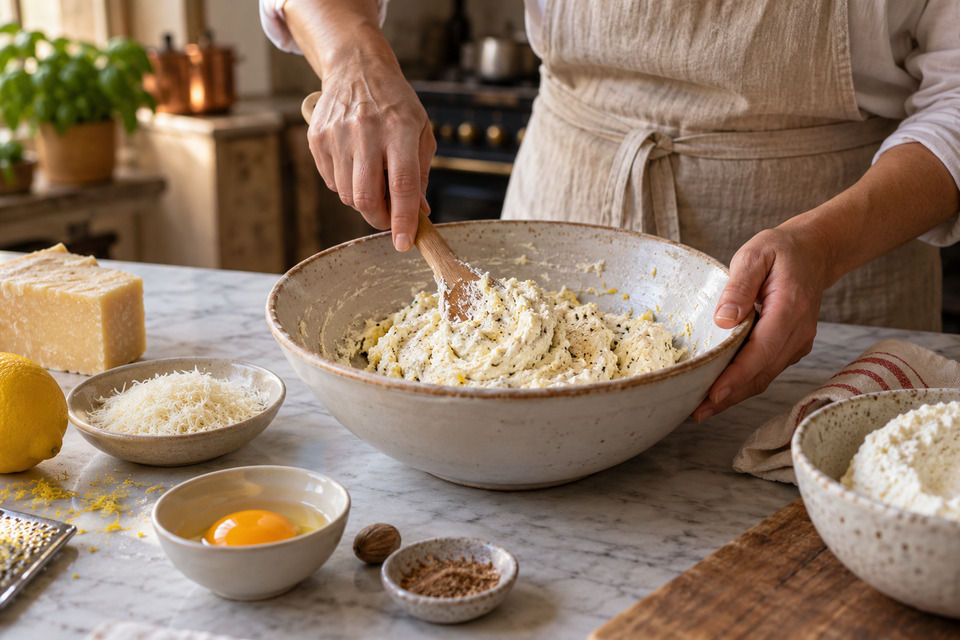
Drain the ricotta in a fine mesh sieve for at least 4 hours, or overnight in the refrigerator, then press it gently to release the last of the whey. Work it smooth, add the raviggiolo, Parmigiano, egg, nutmeg, lemon zest, salt and white pepper, and fold until completely even. Taste it: it should be clearly savoury on its own, because the broth around it will be mild. Chill it an hour before use.
Step 3: Knead the dough
Mound the flour on a wooden board, make a well, break in the eggs with the salt and draw the flour into them with a fork from the inside of the wall. When it is a shaggy mass, work it with the heel of your hand a full 10 minutes, folding and turning a quarter each time. Romagna uses no water and no oil, only eggs, so the dough starts stiff and softens as the gluten relaxes. Wrap it and rest it 30 minutes.
Step 4: Roll the sfoglia

Roll the rested dough on the board with a long pin, turning it a quarter after each pass and rolling from the centre outwards, until the sheet is thin enough to read printed type through, about 0.6 mm. Work half the dough at a time and keep the rest wrapped. A board gives the sheet a faint roughness a machine roller cannot, and that roughness is what makes the broth cling.
Step 5: Cut the squares and fill them

Cut the sheet into squares of about 1 1/2 inches (4 cm) with a wheel, working quickly before the sfoglia dries. Place filling the size of a hazelnut, roughly 1/2 tsp (3 g), in the centre of each. Resist going larger: an overfilled cappelletto splits along the seam and clouds the whole pot. Cover the squares you are not filling with a cloth.
Step 6: Fold and shape the cappello

Fold each square corner to corner into a triangle and press the edges together firmly, chasing out the air, because a trapped bubble expands and bursts the seam. Lay the long edge across your index finger, bring the two side points round the finger to meet underneath and pinch, then turn the point of the triangle upwards to make the brim. Set each on a semola dusted tray, not touching.
Step 7: Rest the cappelletti and finish the broth
Leave the shaped cappelletti uncovered on their trays 20 to 30 minutes so the surface dries just enough to hold. Meanwhile lift the meats out, strain the broth through a fine mesh sieve lined with damp muslin and let it settle so the fat rises. Lift that fat off with a ladle, or chill the broth and take the cap off solid. Taste and correct the seasoning now, not at the table.
Step 8: Cook them in the broth and serve

Bring the strained broth to a gentle simmer, never a boil, and slide the cappelletti in a few at a time so the temperature does not crash. They need 3 to 4 minutes from fresh and are ready when the sealed seam is tender and the pasta is al dente, with the faintest resistance where the fold is doubled. Cooking them in the broth is what thickens it very slightly. Serve at once in warm bowls.
Plating
Use warm, wide, shallow soup bowls with a good rim, warmed with hot water and dried, never taken hot from an oven. Ladle the cappelletti in with a slotted spoon first, about 55 to 60 per person, and let them settle in a single loose layer rather than a heap. Then pour the hot broth around them until they are just covered and no more, so the surface of the pasta stays visible.
Nothing else belongs in the bowl. No parsley, no oil, no croutons and no pepper ground over the top. Grated Parmigiano Reggiano goes on the table in a bowl for those who want it, and in Romagna many do not. If you want a flourish, serve the boiled capon and beef from the broth afterwards as a second course with salsa verde, which is exactly what the Christmas table does.
Professional Technique
The technical heart of this dish is a cheese filling that has to survive four minutes in hot liquid without weeping. Ricotta is roughly three quarters water, and any of that water still free inside the filling will move out under heat, thin the mixture, soften the seam and cloud the broth. The four hour drain is therefore not a suggestion. The egg does the rest: at around 150°F (65°C) its proteins set into a loose gel through the cheese and lock the remaining moisture in place, which is why a filling without egg leaks no matter how well drained.
The second technique is cooking the pasta in the serving liquid, which almost no other filled pasta does. Ravioli and tortelli are boiled in salted water and dressed afterwards because the sauce is separate. Here the broth is the dish, so the cappelletti go straight into it and the small amount of starch they shed is a deliberate ingredient: it gives the broth the very slight body that separates cappelletti in brodo from pasta floating in soup. It also means the broth must be seasoned before the pasta goes in, never after.
Texture and Moisture Control
The sfoglia has to be thin enough to disappear and strong enough to hold. At 0.6 mm a single layer cooks in about 90 seconds, but the folded seam is three layers thick and needs closer to 3 minutes, and that gap is the whole problem of the shape. Roll thicker and the seam stays doughy; roll thinner and the single layer dissolves while the seam is raw. Egg only dough, worked a full 10 minutes, gives the elasticity to be that thin without tearing.
Surface moisture on the shaped pasta is the next control. Straight from the hand a cappelletto is tacky and fuses to its neighbour. Twenty to thirty minutes uncovered dries the outside just enough, and that is the whole window: longer and the sfoglia turns brittle at the fold and cracks in the hot broth. Semola rather than flour on the tray matters too, since it stays granular instead of turning to paste.
The broth is a clarity problem rather than a texture one, and it is solved by temperature. Held below a simmer, fat and protein stay separate and rise and can be lifted off. Allowed to boil even briefly they emulsify, and the broth turns permanently grey. Cold water, a slow rise, patient skimming, never a stir: that is the entire method.
Professional Mise en Place
This is a two day preparation in any kitchen that serves it properly, with the broth and the filling on the first day and the sfoglia on the second.
Equipment and tools
Wooden pastry board and a long thin rolling pin, the mattarello
Tall stockpot, fine mesh sieve and damp muslin for the broth
Fluted or straight pastry wheel, bench scraper
Trays dusted with semola, clean cloths to cover the sheets
Slotted spoon, ladle, warm shallow bowls
Prepared ahead
Broth made a day ahead, chilled overnight so the fat lifts off solid
Ricotta draining in the refrigerator from the previous evening
Filling mixed and chilled, up to 24 hours
Cappelletti shaped and frozen on trays, up to 1 month
Parmigiano grated fresh, never in advance
Service setup
Broth at a bare simmer, tasted and corrected before any pasta goes in
Cappelletti counted into portions on semola dusted trays
Bowls warmed with hot water and dried
Second pot of broth held in reserve to top up the bowls
Chef Tips
Use a capon or an old stewing hen rather than a young chicken. A bird that has lived has the collagen and fat that give broth its body and colour, and a supermarket roaster does not. Failing that, add a second marrow bone and a few chicken feet, the cheapest gelatin there is.
If raviggiolo is unavailable use squacquerone, which is Romagnolo and easy to find, or any fresh unsalted cow milk cheese with no acidity. Do not reach for cream cheese: its stabilisers and its sourness both show through the mild broth at once.
Count as you shape. A portion in Romagna is a real number, 55 to 60 for an adult, and a batch this size yields around 350. Lay them in rows of ten on the tray and you will always know where you are.
Freeze the broth you do not use, in portions. It is the most useful thing in this recipe and it will improve risotto, passatelli and any braise for the next two months. Reduce it by a third if freezer space is short, and label it.
Common Mistakes
Using a meat filling. Pork loin, mortadella and prosciutto belong in Bolognese tortellini. The Romagnolo cappelletto is a cheese filling, and substituting the meat one changes the dish into something else with the same shape.
Not draining the ricotta. Undrained ricotta releases whey into the filling under heat, softens the seam from inside and clouds the broth. Four hours in a sieve, overnight if you can.
Boiling the broth. A single hard boil emulsifies the fat and the broth goes permanently grey. Bring it up slowly from cold water, skim patiently and never let the surface break.
Overfilling. A hazelnut of filling is the maximum a 1 1/2 inch (4 cm) square will hold. More than that and the seam splits in the pot and the whole batch cooks in a cloudy liquid.
Rolling the sfoglia too thick. At more than about 0.6 mm the folded seam stays doughy while the single layer is already cooked. You should be able to read print through the sheet.
Wine Pairing
Lambrusco di Sorbara DOC: The local answer, and it has to be the dry version, pale and almost rosé in colour. Sorbara is the lightest of the Lambruschi, high in acidity and low in tannin, and its fine bubble lifts the fat a capon broth always carries. It is the one sparkling red that does not overwhelm a delicate cheese filling.
Alta Langa DOCG: A traditional method sparkling from Piedmont, Pinot Nero and Chardonnay with long lees ageing. Its bread and hazelnut notes sit naturally beside Parmigiano, and mousse and acidity together cut a broth without diluting it. Choose a Pas Dosé or Brut and pour it in a white wine glass, not a flute.
Lugana DOC: Turbiana grown on the clay south of Lake Garda gives a white with unusual texture and a long saline finish, which is what a mild dish needs in order not to be washed away. Its citrus is restrained and its almond note echoes the nutmeg and the lemon zest in the filling. Serve it at 50°F (10°C) and avoid the heavily oaked bottlings.
Soave Superiore DOCG: Garganega from the volcanic hills above Soave carries white flowers, ripe pear and a bitter almond close, and that bitterness is the reason it works here: it stops a cheese filling from tasting flat by the third spoonful. The Superiore bottlings have the extra body to stand up to Parmigiano without needing acidity to do all the work.
Bardolino DOC: For a red at the Christmas table, this is the one that can sit beside a broth. Corvina grown on the moraine hills of Lake Garda gives a pale, light red with sour cherry fruit, almost no tannin and real acidity. Serve it at 55°F (13°C), cool enough that it refreshes, and it will follow both the cappelletti and the boiled meats that come after them.
Storage & Reheating
Raw cappelletti freeze better than almost any other fresh pasta and that is how to keep them. Freeze them in a single layer on a semola dusted tray until solid, about 2 hours, then bag them for up to 1 month and cook from frozen in simmering broth with 1 minute added. Refrigerating them raw is a mistake: the filling dampens the sfoglia from inside within hours.
The broth keeps 4 days in the refrigerator in a sealed container and 3 months in the freezer, and it is better after a night in the cold because the fat sets on top and comes off in one piece. Filling keeps 24 hours refrigerated and no longer, since the egg is raw and the fresh cheese is unstable. Never freeze the filling on its own, because ricotta separates irreversibly on thawing.
Cooked cappelletti do not really reheat. Keep the pasta and the broth in separate containers overnight, bring the broth back to a simmer and warm them in it for no more than 45 seconds. Left sitting in broth they swell, the sfoglia goes slack and the seams give way. A microwave bursts them outright.
Nutrition
Per serving, based on 6 servings of about 55 to 60 cappelletti in broth:
Calories: 520 kcal
Total Fat: 20 g
Saturated Fat: 10 g
Trans Fat: 0 g
Unsaturated Fat: 8 g
Cholesterol: 210 mg
Sodium: 890 mg
Total Carbohydrates: 48 g
Fiber: 2 g
Total Sugars: 3 g
Added Sugars: 0 g
Protein: 30 g
Lactose: 2.5 g
Principal micronutrients: calcium, phosphorus, vitamin A, vitamin B12, riboflavin, selenium, zinc
These figures are estimates. They depend most on how much fat was lifted off the broth and on how generous the grated Parmigiano at the table turns out to be.


Comments