
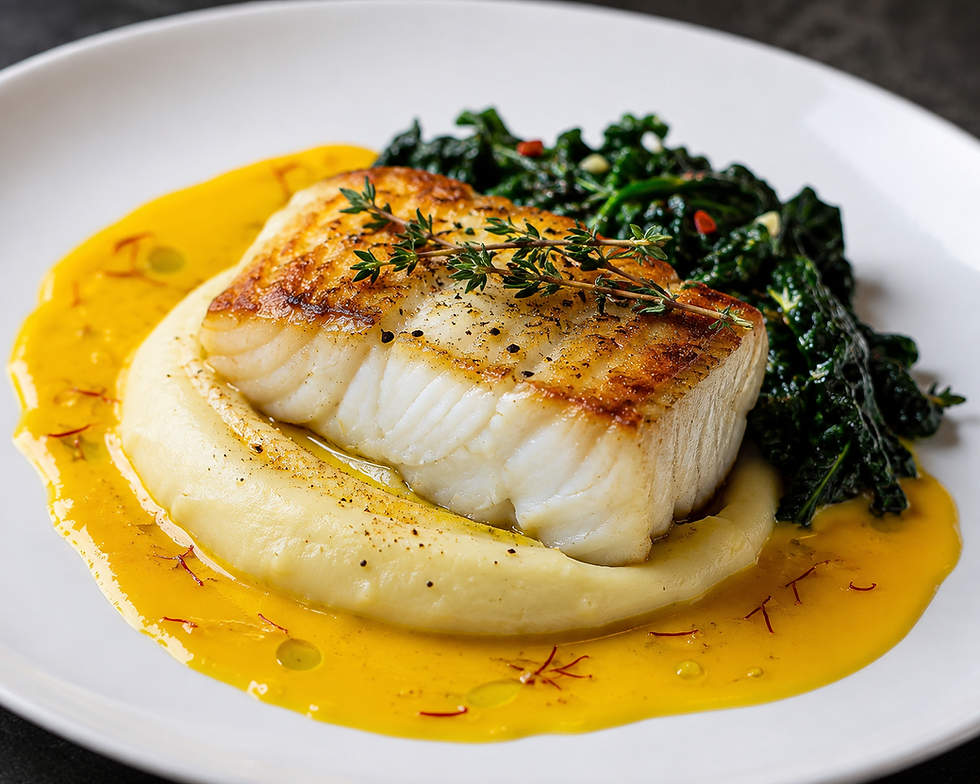
Sea Bass with Champagne Sauce and Oscietra Caviar | Branzino, Salsa allo Champagne e Caviale Oscietra

Two things here behave in opposite ways. The sauce is a sparkling wine reduction mounted with cold butter, an emulsion held by nothing but temperature and agitation. The caviar is never cooked: it goes on last, on a surface that is warm and no warmer.
The branzino asks for little: a fillet from a good fish, pin boned, cooked briefly skin side down or steamed, pulled around 122°F (50°C). Everything else is discipline around the sauce. The reduction stops early, the butter goes in off the heat, the plate stays warm rather than hot.
Yield: 4 servings. Prep: 40 minutes. Fumetto: 25 minutes. Sauce: 20 minutes. Cook: 8 minutes. Total: about 1 hour 20 minutes. Difficulty: advanced. Course: secondo di pesce.
The Story
Branzino, Dicentrarchus labrax, is the European sea bass. Wild fish taken by line along rocky coasts and at brackish river mouths were always expensive and seasonal, and the Venetian lagoon, the Orbetello lagoon and the Sardinian stagni around Cabras built fisheries on them. From the early 1980s Italian and Greek hatcheries raised the species in sea cages and branzino became the everyday white fish of half of Europe. The two are not the same fish: wild flesh is darker and firmer, farmed flesh fattier and softer, needing less cooking.
Champagne reached Italian kitchens through the grand hotels, not the trattorie. From the late nineteenth century the dining rooms of the Danieli in Venice and the Villa d'Este on Lake Como cooked a repertoire French in technique and international in ambition, run by cooks trained in the Escoffier system. A sauce like this belongs to that cucina internazionale and to no region. Italian cooks kept the method and later swapped the bottle, because the country makes superb metodo classico of its own.
Oscietra, more correctly ossetra, is the roe of the Russian sturgeon, Acipenser gueldenstaedtii. It sat between the huge pale beluga grain and the small dark sevruga, and it is the caviar most chefs prefer: medium to large eggs, colour from deep brown through olive to a rare amber, a firm shell that resists the tongue, a flavour nutty and buttery rather than saline. Caspian stocks collapsed under overfishing and dam building, and everything sold legally since 1998 is farmed.
Italy enters there. The Adriatic sturgeon, Acipenser naccarii, is native to the Po and once ran as far up as Piedmont; Ferrara and Cremona had a sturgeon trade in the Renaissance, lost to pollution and dams by the mid twentieth century. Farming replaced it: from the 1970s producers on the Brescia plain, using constant temperature spring water around Calvisano, built sturgeon aquaculture into a serious industry, and Italy is now among the largest caviar producers in the world.
Be honest about what this is. There is no village, festival or nonna behind it. It is cucina di ricerca: a Franco Italian hotel sauce, a Mediterranean fish and a farmed Caspian species, held by technique rather than tradition.
Ingredients
For the sea bass
Whole branzino, 2 fish, 1 1/4 lb (570 g) each, or 4 skin on fillets of 5 oz (140 g)
Extra virgin olive oil, 2 tbsp (30 ml)
Fine sea salt, 1 tsp (6 g), white pepper, and lemon zest from 1/2 lemon
For the fumetto
Branzino bones and heads, gills removed, from the 2 fish
Cold water, 3 cups (700 ml), and dry white wine, 1/2 cup (120 ml)
Shallot, sliced, 1, and celery stalk, sliced, 1/2
Parsley stems, 5, and white peppercorns, 4
For the champagne sauce
Shallots, very finely minced, 2 oz (55 g)
Brut Champagne or Italian metodo classico, 1 cup (240 ml)
Reduced fumetto, 1/2 cup (120 ml), and heavy cream, 3 tbsp (45 ml)
Unsalted butter, cold, cut into cubes, 5 oz (140 g)
Fresh lemon juice, 1 tsp (5 ml), fine sea salt, 1/2 tsp (3 g), white pepper
For finishing
Oscietra caviar, 1 3/4 oz (50 g) total, about 12 g per serving
Chives, finely sliced, 1 tbsp, and 8 small chervil or dill sprigs
Extra virgin olive oil, a few drops per plate
Preparation
Choosing the fish
Buy the branzino whole and judge it first. Eyes convex, clear and wet, never sunken. Gills bright red under a lifted finger, smelling of clean seawater. Flesh that springs back, and a body stiff enough to hold itself straight across your hand. Skin bright under a thin clear slime. A fresh fish smells of almost nothing.
Filleting, pin boning and trimming
Scale from tail to head, rinse and dry. Cut behind the head to the backbone, then run the knife flat along the spine in one stroke, angled down so it rides the bones. Keep the frame and head for the fumetto, gills pulled out since they carry blood and bitterness. Find the pin bones a third of the way in from the back and draw each out with tweezers in the direction it lies. Trim the belly flap and square the tail end: even thickness makes even cooking possible. Score the skin only on a thick skinned wild fish; on farmed branzino the cuts just let moisture out.
Making the fumetto
Chop the frame and head into a pan with the water, wine, shallot, celery, parsley stems and peppercorns. Bring it slowly to a bare simmer, skimming the grey foam. Hold it 20 minutes and no longer: bones give up everything useful by then and more draws out glue and bitterness. Strain without pressing, then reduce to about 1/2 cup (120 ml).
Reducing the shallot and the sparkling wine
Sweat the shallots in a heavy pan with a teaspoon of butter over low heat until translucent and uncoloured, about 4 minutes. Add the sparkling wine and reduce until roughly 3 tablespoons remain and the shallots sit in a syrupy glaze. Add the fumetto and take it to about 1/3 cup (80 ml). Taste here, every time: bright and vinous is right, and the moment it reads sharp or bitter you have gone too far.
Mounting and holding the sauce
Add the cream and simmer 30 seconds, then take the pan off the heat entirely. Whisk in the cold butter two or three cubes at a time, adding the next only when the last has gone, returning it to the lowest flame for seconds at a time if it cools too far to absorb more. It should thicken glossy and pale; thin and greasy means it has broken. Strain, season with salt, pepper and lemon juice, and hold it covered in a bain marie between 140°F and 160°F (60°C and 70°C).
Cooking the fillets to temperature
Dry the fillets and salt them five minutes before cooking. In a nonstick or heavy skillet over medium heat with the olive oil, lay them skin side down and press each flat for the first 20 seconds so it cannot lift. Cook 3 to 4 minutes untouched until the skin is crisp and the flesh has gone opaque up the sides, then turn for 30 to 45 seconds. To steam instead, set them on parchment over simmering water for 4 to 5 minutes. Probe parallel to the plate and pull the fish at 122°F to 126°F (50°C to 52°C). Rest one minute on a warm rack.
Plates and caviar
Warm the plates to hand temperature, around 104°F (40°C): a few minutes on top of the oven, not inside it. A plate too hot to hold is too hot for this dish. Sauce, then fish, and only then open the tin. Lift the grains with a mother of pearl, horn or plastic spoon onto the fish or bare porcelain, never into the sauce, and serve at once.
Plating
Use a wide shallow bowl warmed to hand temperature and no more. Whisk the sauce once and spoon about 3 tablespoons into the centre, letting it find its own shape: a thin film cools in seconds while a pooled sauce keeps its gloss. Set the fillet skin side up, on the sauce rather than swimming in it. Pan cooked fish keeps its skin bare; steamed fish can sit half submerged.
Then the caviar. Twelve grams is about two generous teaspoons, in one or two quiet mounds, on the fish toward the head end or beside it on bare porcelain, never scattered. Finish with chives, two sprigs of chervil, white pepper on the sauce only and three drops of olive oil.
Professional Technique
The champagne sauce is an unstable emulsion. Butter is roughly 80 percent fat, 16 percent water and 4 percent milk solids, and whisking it cold into a warm acidic reduction breaks the fat into droplets held in suspension by the milk proteins and the cream added first. Nothing about that is permanent: it survives on droplet size and temperature alone. Below about 122°F (50°C) the butterfat crystallises and the sauce turns pasty. Above about 180°F (82°C) the milk proteins denature, the droplets coalesce and the sauce splits into clear fat and watery reduction that no whisking recovers. The working range is 140°F to 160°F (60°C to 70°C). That is why the butter goes in off the heat and why the sauce is held over water, never over fire.
The reduction underneath it fails earlier than expected. Sparkling wine is acidic by design, carrying tartaric and malic acid plus phenolics from lees ageing, and reduction concentrates what stays on a curve: the last quarter sharpens the acids far more than the first half. Take a cup of wine to two tablespoons instead of three and the difference is not more flavour but a metallic edge and a bitter finish butter can mask and never remove. Stop at about one eighth of the original volume.
The caviar is never cooked, and it goes on last for a physical reason rather than a ceremonial one. Each grain is a cell with a thin membrane around a liquid interior rich in fat and protein. Above roughly 104°F (40°C) the proteins inside set and the shell weakens, so the grains lose their tension, slump together, release their oil and turn from nutty and saline to greasy and bitter. A sauce at 160°F (70°C) does that within seconds. Hence the plate warmed only to hand temperature and the tin opened last. The spoon follows the same rule: mother of pearl, horn, bone, wood or plastic, never metal, because base metals and silver react with the salts and sulphur compounds in the roe and leave a bitter tinny note. Lift the grains rather than scooping, since pressure breaks as many eggs as heat does.
Texture and Moisture Control
Sea bass sits in a very short window. Fish muscle is short blocks of fibre held by thin sheets of collagen that melt far below the temperature meat collagen needs, which is why fish flakes instead of pulling into strands. The myosin sets around 104°F (40°C) and the actin around 140°F (60°C), and the flesh is best in the gap. Pulled at 122°F to 126°F (50°C to 52°C) the fillet is just opaque and separates into large moist flakes. At 140°F (60°C) the actin has contracted and squeezed the water out from between the fibres.
The skin is a separate problem with one solution, dryness. Surface water has to be driven off before the skin reaches browning temperature, and while that happens the flesh underneath cooks in steam. Dry the skin on paper, salt only five minutes ahead, and press the fillet flat for the first twenty seconds. Then leave it alone: every lift cools the skin and makes it stick. If the sauce tightens while it waits, loosen it with warm fumetto, never water and never over direct heat.
Professional Mise en Place
The dish comes together in about eight minutes: a sauce to hold, a fish to bring to temperature, a tin to open at the right second. Everything that can be done ahead should be.
Equipment and tools
Flexible filleting knife, fish tweezers, fine mesh conical sieve
Heavy based small saucepan and a balloon whisk
Bain marie held at 150°F (65°C) with a thermometer in it
Nonstick or heavy skillet for four fillets, and a fish spatula
Instant read probe thermometer, and a mother of pearl, horn or plastic caviar spoon
Prepared ahead
Fumetto strained and reduced, up to 2 days ahead
Branzino filleted, pin boned and trimmed, on a rack, cold
Shallots minced very finely and butter cubed, both kept cold
Chives sliced, chervil picked, lemon zested
Caviar tin unopened, on ice at 28°F to 32°F (minus 2°C to 0°C)
Service setup
Sauce covered in the bain marie at 140°F to 160°F (60°C to 70°C)
Warm fumetto beside it, plates warming to hand temperature
Skillet on medium heat with the oil in it, fish dried and salted
Probe within reach, caviar out only once the plates are sauced
Chef Tips
You do not need Champagne for this sauce. A brut Franciacorta, Alta Langa or Trento DOC is made by the same method from the same grapes, costs less, and reduces to something with more fruit and softer acidity. Avoid cheap sweet or aromatic sparkling wine: reduction turns residual sugar into a sticky glaze and muscat aromatics into perfume.
Buy the caviar last and keep it cold all the way home. Ask to see the tin: separate, glossy, firm grains, no free liquid, no dull film. Store it at 28°F to 32°F (minus 2°C to 0°C), colder than most domestic refrigerators run, so a bowl of ice helps.
Common Mistakes
Putting the caviar in the sauce. Warm butter sauce destroys it in seconds: the membranes weaken above roughly 104°F (40°C), the grains slump and release their oil, and a fifty gram tin becomes a greasy film.
Reducing the sparkling wine too far. The acids concentrate faster than the aromatics, and the last quarter of the reduction is where a bright vinous base turns metallic and bitter. Stop at about one eighth of the original volume.
Adding the butter over direct heat. The sauce climbs past 180°F (82°C) without warning, the milk proteins denature and the emulsion splits. Take the pan off the flame and whisk cold butter in two or three cubes at a time.
Using a metal spoon for the caviar. Silver and base metals react with the salts and sulphur compounds in the roe and leave a bitter tinny note. Use mother of pearl, horn, bone, wood or plastic.
Wine Pairing
Franciacorta DOCG: The Italian answer to the bottle in the sauce, and the most complete match here. Made by the same method from Chardonnay and Pinot Nero in the Brescia hills, its fine persistent bubble scrubs butterfat off the palate, while long lees ageing leaves bready hazelnut notes running alongside the nutty side of the ossetra. The finish is saline.
Trento DOC: The mountain metodo classico, from steep Dolomite slopes where cool nights hold the acidity high. Leaner and more mineral than Franciacorta, with green apple and a chalky bite, and that leanness is what five ounces of butter need: it cuts rather than accompanies.
Alta Langa DOCG: Piedmont's metodo classico, vintage dated and aged at least thirty months, which gives a savoury breadth younger sparkling wines lack. More Pinot Nero than most Italian bottles, bringing a smoky maturity that suits the caramelised skin of a pan cooked fillet.
Etna Bianco DOC: The volcanic still white, and the one that does most for the fish rather than the sauce. Carricante from the black sand of the north eastern slopes gives searing lemon and green almond acidity over an almost salty core that meets the caviar head on. Enough extract to stand up to butter, with no oak.
Verdicchio dei Castelli di Jesi Classico Riserva DOCG: The still white with the most structure to offer. A Riserva from the Jesi hills has weight, glycerol and a long bitter almond close, with enough lees time to gain a creamy texture that matches the mounted butter. Serve at 52°F (11°C) rather than cold.
Storage & Reheating
Never store this assembled. The fumetto is the one component that keeps properly: 2 days refrigerated, 3 months frozen in ice cube portions, reduced after thawing rather than before.
The champagne sauce is a service item, not a leftover. Held covered in a bain marie at 140°F to 160°F (60°C to 70°C) it is good for about 2 hours. Refrigerated it sets into a block of seasoned butter and reheating splits it. To salvage some, warm a tablespoon of cream off the heat and whisk the cold sauce into it in small pieces. Never freeze it.
Cooked branzino is best within minutes of the pan and does not reheat in any way that respects it. Cool leftover fillets quickly, refrigerate them covered up to 24 hours and eat them cold, flaked over dressed leaves. Raw fillets keep 1 day on a rack in the coldest part of the refrigerator.
Caviar is strictest. An unopened tin keeps for weeks at 28°F to 32°F (minus 2°C to 0°C), on ice rather than on a shelf. Once opened, finish it the same day, pressed flat with the lid back on. Never freeze it: the membranes rupture as the water inside expands.
Nutrition
Per serving, based on 4 servings:
Calories: 620 kcal
Total Fat: 47 g
Saturated Fat: 25 g
Trans Fat: 1 g
Unsaturated Fat: 19 g
Cholesterol: 245 mg
Sodium: 780 mg
Total Carbohydrates: 3 g
Fiber: 0 g
Total Sugars: 2 g
Added Sugars: 0 g
Protein: 34 g
Lactose: 0.6 g
Principal micronutrients: omega 3 fatty acids, vitamin B12, vitamin D, selenium, iodine, phosphorus, potassium
These figures are estimates. Most of the fat comes from the mounted butter rather than the fish, so the number moves with how much sauce is spooned.




Comments