
Italian Marche Stuffed Calamari | Calamari Ripieni alla Marchigiana
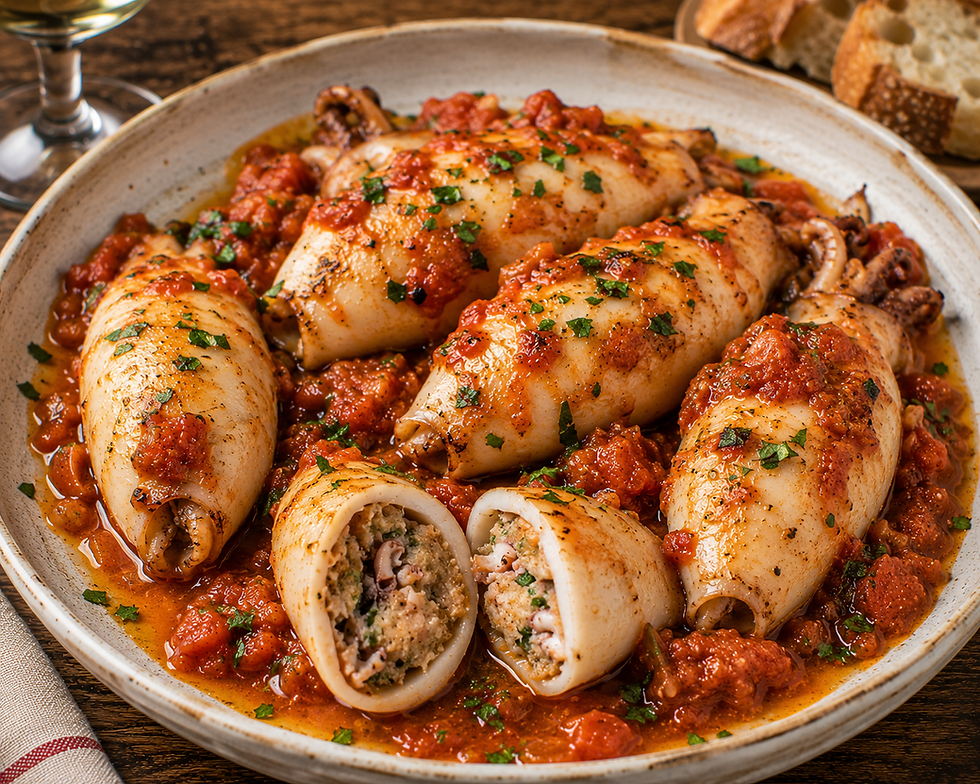
Calamari ripieni alla marchigiana is what the Adriatic coast does with a cheap and abundant catch. The bodies become their own cooking vessels, the tentacles go into the filling, and nothing is discarded. What separates a good version from a mediocre one is not the bread or the cheese. It is the handling of the tentacles, which are a different tissue from the tube and will never cook in the same length of time.
The sauce is a potacchio, the Marche base of garlic, rosemary, dry white wine and tomato crushed by hand that the region uses on rabbit, on lamb and on fish alike. It stays short and concentrated, enough to coat the calamari and no more. The Pecorino in the filling is the inland half of the region speaking to the coastal half.
Everything below is built around one decision: cook the tentacles before they ever reach the filling. Get that right and the stuffing has bite and marine depth. Get it wrong and every mouthful carries small rubbery fragments that no amount of braising will soften.
Yield: 6 servings. Prep: 40 minutes. Cook: 50 minutes. Rest: 10 minutes. Total: about 1 hour 40 minutes. Difficulty: intermediate. Course: secondo di pesce, main course. Region: Marche, the Adriatic coast between Fano and San Benedetto del Tronto.
The Story
This dish belongs to the fishing towns strung along the Marche coast: Fano, Senigallia, Ancona, Porto Recanati, Civitanova Marche and San Benedetto del Tronto. Calamari come off the Adriatic trawlers in quantity through autumn and winter, and for generations they were not a luxury but the ordinary end of the catch, sold cheap on the quay or kept back by the crews for their own tables. The same kitchens produced brodetto, the coast's mixed fish stew that changes recipe every few miles. Stuffed calamari came out of exactly that economy: a whole animal, a handful of stale bread, and one pan.
The Marche stuffs things. Olive all'ascolana, the fried stuffed olives of Ascoli Piceno, are the most famous proof of the habit, but the region fills vegetables, birds and squid with equal confidence. The binder is almost always bread, because bread was the staple and stale bread was never thrown away, and the seasoning is almost always parsley, garlic and Pecorino. That sheep cheese comes from the hills behind the coast, from the flocks of the Sibillini foothills, and its presence in a seafood dish surprises visitors who have been told that cheese and fish never meet in Italy. On this coast they have met for centuries.
Other coasts bind their stuffing differently: with rice, with potato, or softened with raisins and pine nuts in the deep south. The Marche version uses bread, Pecorino, parsley and the chopped tentacles, and almost nothing else. Then it braises them in potacchio, which is the region's signature wet base and the reason the dish tastes of Ancona rather than of anywhere else on the peninsula. It was and still is a Sunday plate, cooked in one wide pan, brought to the table in that pan, and eaten with bread to clean the sauce.
Ingredients
For the calamari
Whole medium calamari, cleaned, bodies kept intact, 3 lb (1.35 kg), about 12
Fine sea salt, for the tentacle water
For the filling
Reserved tentacles from the calamari above, cooked and chopped
Stale country bread, crust removed, torn, 3 oz (85 g)
Whole milk or light fish stock, 1/3 cup (80 ml), for dampening the bread
Pecorino, finely grated, 2 oz (55 g)
Garlic cloves, minced, 2
Flat leaf parsley, finely chopped, 1/3 cup (20 g)
Egg, large, 1
Finely grated lemon zest, from 1/2 lemon
Extra virgin olive oil, 2 tbsp (30 ml)
Fine sea salt, 1/2 tsp (3 g), and freshly ground black pepper
For the potacchio sauce
Extra virgin olive oil, 1/4 cup (60 ml)
Garlic cloves, lightly smashed, 3
Rosemary sprig, 1
Crushed red pepper flakes, 1/4 tsp (0.5 g)
Dry white wine, 3/4 cup (180 ml)
Peeled plum tomatoes, crushed by hand, 2 cups (480 g)
Light fish stock or water, 1/2 cup (120 ml), only as needed
Fine sea salt, to taste
For finishing
Flat leaf parsley, chopped, 2 tbsp
Extra virgin olive oil, a thread per plate
Wooden toothpicks, about 12
Preparation
Clean the calamari and separate the tentacles
If the fishmonger has not done it, pull the head from the body, draw out the transparent quill and the innards, and press out the beak and the eyes. Cut the tentacles off in one piece below the eyes. Rinse the bodies, then dry them thoroughly inside and out, because a wet tube will not brown. Set the tentacles aside: they are the next job, not the last one.
Cook the tentacles first, on their own
Bring a small pan of lightly salted water to a bare simmer and add the tentacles. Cook them 8 to 10 minutes, until a piece cut across gives way cleanly under the knife instead of springing back. A covered pan with a tablespoon of oil and no water does the same work in the same time. Lift them out, spread them on a board to cool, and keep 2 tablespoons of the liquid.
Chop the tentacles by knife and build the filling
Chop the cooled tentacles with a knife into pieces the size of a grain of rice. Do not use a food processor. Dampen the torn bread with the milk, squeeze it lightly so it is moist but not saturated, and crumble it into a bowl. Add the tentacles, Pecorino, garlic, parsley, lemon zest, oil, salt and pepper, then the egg, and fold until it just holds. It should feel loose and open, never pasty.
Fill and close the bodies
Spoon the filling into each body with a small spoon or a piping bag with no tip, easing it down without pressing, so the mixture stays relaxed rather than compacted. Close the opening with a wooden toothpick threaded across it, taking a small bite of flesh on each side. Do not stitch it shut tightly: steam has to escape. Wipe the outside dry once more.
Brown the calamari and start the potacchio
Heat the olive oil in a wide heavy skillet over medium heat with the garlic, the rosemary and the pepper flakes until the garlic is pale gold and fragrant, then lift the garlic out. Raise the heat, lay the stuffed bodies in without crowding and colour them 2 minutes on each side. You want light golden patches, not a hard crust. Work in two batches if the pan is tight.
Deglaze, add the tomato and braise
Return all the calamari to the pan, pour in the white wine and let it bubble hard for 2 minutes so the alcohol goes. Add the crushed tomatoes and the reserved tentacle liquid, season lightly and lower the heat until the surface barely moves. Cover and cook 35 to 40 minutes, turning the bodies gently twice. Add stock a few tablespoons at a time only if the pan threatens to dry out.
Reduce the sauce and rest
Uncover for the last 8 to 10 minutes and let the sauce tighten until a track drawn through it with a spatula holds for a second. A knife should slide into a body with almost no resistance. Take the pan off the heat, discard the rosemary, and rest everything 10 minutes with the lid sitting loosely on top. The filling firms in that time and slices cleanly instead of spilling.
Plating
Serve on warm plates, not hot ones: the sauce is short and a scorching plate dries it to a smear within a minute. Pull the toothpicks out before the calamari leave the pan, never at the table.
Two bodies make a portion. Either serve them whole, as they arrive on a family table in the Marche, or cut each one across into three thick rounds so the filling shows as a pale cross section against the tomato. Cut with a thin sharp blade in one pull, without sawing, and only after the rest has let the egg set.
Spoon the sauce around the calamari and never over them, so the browned surface stays visible. Scatter the parsley, add a thread of raw olive oil, and put good bread on the table. Nothing else belongs here: no basil, no lemon wedge, no garnish for its own sake.
Professional Technique
In a calamaro the tube and the tentacles are not the same tissue, and treating them as one ingredient is the single most common failure in this recipe. The mantle is a relatively thin sheet of muscle with its fibres running in ordered circular and longitudinal layers and a modest amount of connective tissue holding them together. The arms are dense by comparison: a far higher concentration of collagen, fibres wound helically around a central axis, and a tough outer sheath carrying the suckers with their hard rings. Put both in the same pan for the same time and the tube is ready while the tentacles are still rubbery.
That difference has a direct operational consequence in the marchigiana version, where the tentacles are chopped into the filling rather than braised whole beside the bodies. Inside a stuffing they sit insulated by bread, cheese and egg, so they take up even less heat than they would sitting in open sauce. They have to be cooked separately and cooked first: 8 to 10 minutes in barely simmering salted water, or the same time in a covered pan with a little oil, until a cut piece yields cleanly under the knife instead of bouncing back against it.
Then chop them by hand, with a knife, once they are cool enough to hold. A food processor is the wrong tool for collagen rich tissue: the blade tears it into a grey paste and drives out the water it was holding, and that water leaves the filling later, during the braise. A knife leaves discrete pieces you can feel between your teeth. Expect the stuffing to shed some liquid regardless, and account for it in advance by using stale bread that has been dampened rather than soaked, so it still has absorbent capacity left when the pan gets hot.
Texture and Moisture Control
The braise is long and low because the filling has to reach temperature without the mantle being driven past it. Over 35 to 40 minutes under a lid at a bare simmer the connective tissue in the tube softens into gelatin and the flesh turns yielding, while the egg in the stuffing coagulates at around 160F (70C) and binds the bread, the cheese and the tentacles into something that holds a cut. Rushing the same dish over high heat gives you a tight tube around a loose, wet centre.
Density inside the tube is what you control at filling time. A loosely spooned stuffing has room to swell as the bread takes up moisture; a firmly packed one has nowhere to go and splits the body along its seam. The toothpick closes the opening without sealing it, so steam can leave. Keep the lid on for the main braise to hold moisture in, then take it off at the end to drive it out and concentrate the sauce, adding stock by the tablespoon only if the pan runs dry before the calamari are tender.
Professional Mise en Place
Tentacles and filling are both done ahead, leaving browning and braising as the only work at service.
Equipment and tools
Wide heavy skillet or sauteuse with a tight lid, big enough to hold the bodies in one layer
Small saucepan for cooking the tentacles
Sharp chef knife and a clean board kept for the tentacle chopping
Small spoon or a piping bag with no tip for filling the bodies
Wooden toothpicks, tongs and a thin bladed slicing knife
Prepared ahead
Calamari cleaned, bodies dried and refrigerated on a rack, same day
Tentacles cooked, chopped and refrigerated, up to 1 day ahead
Bread dampened and squeezed, cheese grated, garlic and parsley chopped, same day
Tomatoes crushed by hand and held in a bowl, same day
Filling mixed and the bodies stuffed, up to 4 hours ahead, kept covered and cold
Service setup
Stuffed bodies on a tray, patted dry again just before they go in the pan
Wine, tomato and stock measured and standing beside the stove
Plates warm, parsley chopped, finishing oil open
Bread sliced and ready, because the sauce is meant to be mopped
Chef Tips
Buy the calamari whole if you can, and if the fishmonger cleans them insist on keeping the tentacles. Without them the filling is bread and cheese, and the dish loses the one ingredient that makes it taste of squid.
Taste the filling before it goes into a single body. It is the last moment you can correct the salt, and Pecorino varies enormously: a young sweet one needs seasoning, an aged sharp one may need none.
Choose calamari of roughly equal size, around 4 oz (115 g) each. A pan holding one giant and five small ones cannot be timed, and the small ones overcook before the big one is ready.
If the sauce is still loose when the calamari are done, lift them onto a warm plate and reduce it hard on its own for two or three minutes. Boiling the pan with the bodies in it costs you everything the slow braise gained.
Common Mistakes
Putting raw tentacles into the filling. This is the mistake that ruins the dish. Buried in bread and egg they never get enough heat, and the stuffing ends up studded with rubbery bits. Cook them separately first, always.
Chopping the tentacles in a food processor. The blade shreds collagen rich tissue into grey paste and squeezes out water that then floods the filling during braising. Use a knife and accept the two extra minutes.
Packing the bodies tight. A densely stuffed tube has no room for the bread to swell and splits along the seam, dumping the filling into the sauce. Spoon it in loosely and close with a single toothpick.
Braising at a hard boil. High heat tightens the mantle long before the centre is set, and no further cooking will relax it again. Keep the surface barely moving for the full 35 to 40 minutes.
Cutting the calamari straight out of the pan. Without the 10 minute rest the egg has not fully firmed and each round collapses as the knife passes through it. Wait, then cut in one clean pull.
Wine Pairing
Verdicchio dei Castelli di Jesi Classico Riserva DOCG: The regional answer and the best one. Riserva bottlings carry real body and a saline, almond edged finish that stands up to the Pecorino in the filling instead of being erased by it. The acidity is firm enough to cut the olive oil in the potacchio, and the weight is there to sit under a braised squid.
Verdicchio di Matelica DOC: Grown inland in a cool valley, so it comes out tighter and more mineral than its coastal cousin. That extra tension is useful against the tomato: the sauce brings its own acidity, and a wine with less of it tastes flat beside it. The stony finish picks up the marine flavour of the chopped tentacles.
Offida Pecorino DOCG: From the south of the region, near Ascoli, and the most aromatic choice here. It brings ripe pear, aniseed and a faintly bitter herbal close that runs alongside the parsley and the rosemary rather than fighting them. Its fuller texture and slightly higher alcohol handle the fried garlic and the browned surface of the bodies without turning heavy.
Conero DOCG: The red for anyone who wants one, made from Montepulciano on the limestone of the Ancona headland, a few miles from where this dish is cooked. Serve it at 59F (15C). Its soft tannin has enough grip for the cheese and the browning, and its dark sour cherry fruit meets the tomato directly. A heavier, more tannic red would flatten the squid.
Storage & Reheating
This is a dish that improves overnight. Keep the calamari whole and submerged in their sauce in an airtight container, refrigerated, for up to 2 days, and slice them only after reheating. Raw stuffed bodies keep no more than 4 hours and must stay cold.
Reheat slowly, covered, in a wide pan over the lowest heat with a splash of water or fish stock, turning the bodies once, until the sauce loosens and the centre is hot. Fifteen minutes is about right. A microwave turns the mantle rubbery in seconds. The cooked dish freezes for 1 month, whole and in its sauce, and should be thawed overnight in the refrigerator before it is warmed the same way.
Nutrition
Per serving, based on 6 servings of two stuffed bodies each:
Calories: 430 kcal
Total Fat: 24 g
Saturated Fat: 6 g
Trans Fat: 0 g
Unsaturated Fat: 17 g
Cholesterol: 330 mg
Sodium: 620 mg
Total Carbohydrates: 20 g
Fiber: 2 g
Total Sugars: 4 g
Added Sugars: 0 g
Protein: 33 g
Lactose: 0.4 g
Principal micronutrients: selenium, copper, vitamin B12, phosphorus, zinc, iodine, calcium
These figures are estimates. They shift with the size of the calamari and with how sharp and salty the Pecorino is.


Comments