Piedmont Boiled Capon with Green and Red Sauces | Cappone di Morozzo Bollito con Bagnet Verd e Bagnet Ross

The capon of Morozzo, a village near Cuneo, is one of the most prized birds in Italy, and in Piedmont it belongs to the Christmas table. The classic way to honor it is the simplest: a long, gentle poaching with vegetables, which gives tender, juicy meat and a golden broth at the same time. The meat is carved and served with the two great sauces of the Piedmontese bollito, the green bagnet verd of parsley, anchovy and garlic and the sweet and sour bagnet ross of tomato and peppers, with a cup of the broth on the side. This recipe follows that festive tradition and brings to it the control of a restaurant kitchen: an exact poaching temperature, a clear broth and sauces balanced to the richness of the bird.
Yield: 8 servings. Prep: 1 hour. Cook: 3 hours. Rest: 20 minutes. Course: main course. Region: Piedmont.
The Story
Morozzo is a small farming village between Cuneo and Mondovì, in the south of Piedmont. For generations the families of this area raised poultry in the open, in farmyards and orchards, and the capon was their most valuable bird: a young rooster castrated when still young, then raised for many months, free to roam and fed on grains, above all maize. Every December Morozzo holds a capon fair, where breeders bring their birds before the holidays, a tradition that has made the village name a synonym for the best capon in Piedmont.
Caponizing is an ancient practice. Without the hormones of a mature rooster, the bird grows calmer and heavier, and its meat becomes tender, finely marbled with fat and delicate in flavor, far from the lean, firm meat of an ordinary rooster. A story often told says that the practice spread in ancient Rome after a law limited the fattening of hens, but the habit of raising capons for feasts has been part of European farm life for many centuries, and in northern Italy the capon has long been the bird of Christmas.
The Cappone di Morozzo is protected by a Slow Food Presidium, which supports the small breeders who still raise the birds in the traditional way: outdoors, slowly, with a long finishing on grain. The capons are not industrial birds, and they are available only in the weeks before Christmas, which is part of what makes them a festive dish.
In Piedmont the capon is most often boiled, as a member of the great family of the bollito. Its broth is the classic base for agnolotti and tajarin at the holidays, and its meat arrives at the table with the same sauces that accompany the bollito misto: bagnet verd, bagnet ross, sometimes mostarda. This recipe is built on that tradition. Outside Piedmont, a well raised capon from a specialty poultry farm, cooked with the same care, gives a dish of the same character.
Ingredients
Order the capon from a specialty butcher or poultry farm well before the holidays, and ask for a bird of 7 to 9 lb (3.2 to 4 kg), with the skin intact and the fat a pale, creamy yellow. A true capon has a much thicker layer of fat under the skin than a chicken and a heavier breast. For the green sauce, use salt-packed anchovies if you can find them; they are firmer and more flavorful than those in oil.
For the capon and the broth
Capon, 1, about 8 lb (3.6 kg), trussed
Cold water, about 6 qt (5.7 L)
Yellow onion, 1 large, halved, studded with 2 whole cloves
Carrots, 2, peeled and halved
Celery, 2 stalks, with leaves
Flat-leaf parsley stems, 1 small bunch
Bay leaves, 2
Black peppercorns, 1 tsp (3 g)
Coarse sea salt, 2 tbsp (30 g)
For the bagnet verd
Flat-leaf parsley, leaves only, 2 packed cups (60 g)
Salt-packed anchovies, 4, rinsed and filleted (8 fillets), or 8 oil-packed fillets
Garlic, 1 clove, green germ removed
White bread, crustless, 1 oz (30 g)
Red wine vinegar, 2 tbsp (30 ml)
Hard-boiled egg yolk, 1
Capers in salt, rinsed, 1 tsp (5 g)
Extra virgin olive oil, mild, 2/3 cup (160 ml)
For the bagnet ross
Ripe tomatoes, 1 1/2 lb (680 g)
Red bell pepper, 1 large, seeded and chopped
Yellow onion, 1 small, chopped
Carrot, 1, chopped
Garlic, 1 clove
Dried chili, 1 small
Red wine vinegar, 2 tbsp (30 ml)
Sugar, 1 tbsp (12 g)
Fine sea salt, 1/2 tsp (3 g)
Extra virgin olive oil, 2 tbsp (30 ml)
For serving
Small carrots, peeled, 8
Small potatoes, waxy, 16, about 1 1/2 lb (680 g)
Flaky sea salt, for the table
Preparation
Step 1

Prepare the capon. Remove the capon from the refrigerator 1 hour before cooking. Pull out any large pads of fat from the cavity and keep them aside. Singe any remaining feathers over a flame, wipe the bird inside and out with paper towel and truss it firmly with kitchen twine, legs tied together and wings tucked, so that it keeps a compact shape in the pot and cooks evenly. A bird at room temperature cooks more evenly and needs less time at the bone.
Step 2

Start the broth. Put the water, the onion studded with cloves, the carrots, the celery, the parsley stems, the bay leaves, the peppercorns and the coarse salt in a stockpot large enough to hold the capon covered by liquid, at least 12 qt (11 L). Bring to a boil and simmer for 15 minutes to flavor the water. The Piedmontese rule for the bollito says that meat meant to be eaten goes into boiling water, so that its surface seals and it keeps its juices, while meat meant only for broth starts in cold water.
Step 3

Poach the capon. Lower the capon into the simmering broth breast up; the liquid should cover it by at least 1 inch (2.5 cm), so add boiling water if needed. When it returns to a simmer, skim the foam carefully, then lower the heat until the surface barely trembles, at 185 to 190°F (85 to 88°C). Cook, uncovered, for 2 hours 30 minutes to 3 hours, skimming fat and foam every 20 minutes. The capon is ready when the thigh registers 175°F (80°C) at its thickest point, the leg moves freely in its joint and the juices run clear. Poultry is safe at 165°F (74°C), but the higher temperature in the thigh melts the connective tissue of the legs.
Step 4

Make the bagnet ross. While the capon cooks, put the tomatoes, cut in quarters, the pepper, the onion, the carrot, the garlic and the chili in a saucepan with the oil and cook covered over low heat for 20 minutes, until the vegetables collapse. Uncover, add the vinegar, the sugar and the salt and simmer for 40 to 50 minutes more, stirring often, until thick. Remove the chili, pass everything through a food mill or blend and press through a sieve. The sauce should be dense, glossy and sweet and sour, about 1 1/4 cups (300 ml). Long cooking concentrates the sugars of tomato and pepper so the vinegar is rounded, not sharp.
Step 5

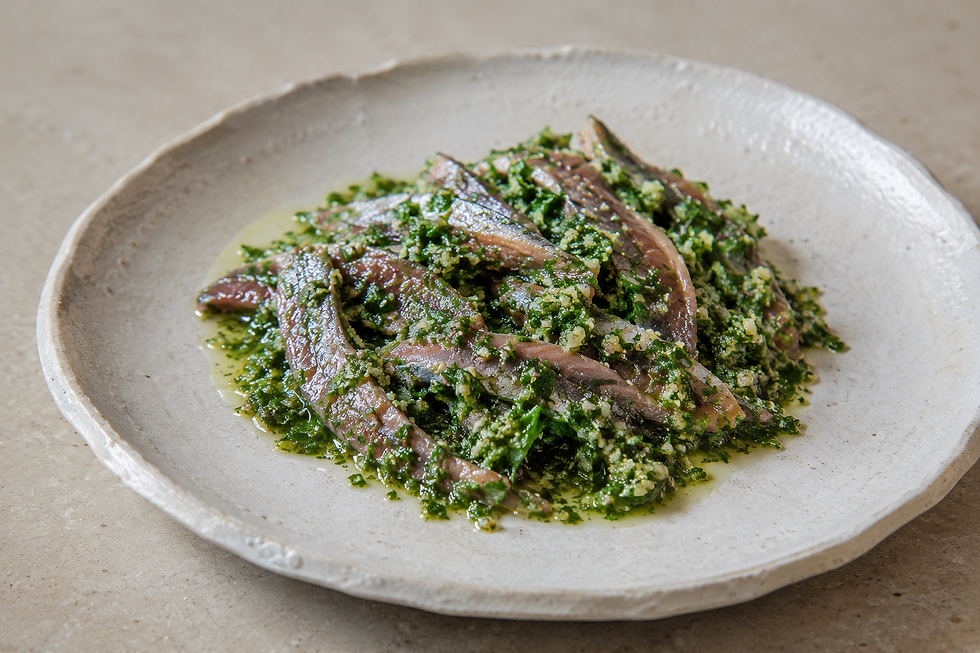
Make the bagnet verd. Soak the bread in the vinegar for 10 minutes, then squeeze it lightly. Chop the parsley, the anchovies, the garlic, the capers and the soaked bread together with a large knife, or with a mezzaluna, until very fine. Transfer to a bowl, crumble in the egg yolk and stir in the oil gradually until you have a thick, glossy sauce. Let it rest for at least 1 hour at room temperature. Chopping by hand keeps the parsley bright green and gives a lively texture; a blender heats and bruises the leaves and turns the sauce dark and pasty.
Step 6

Cook the vegetables for serving. About 40 minutes before the capon is ready, ladle 2 qt (1.9 L) of the broth into a separate pot. Cook the potatoes in it for 20 to 25 minutes and the small carrots for 12 to 15 minutes, until tender to the tip of a knife. Cooking them in the broth gives them the flavor of the capon, and cooking them apart keeps the main broth clear.
Step 7

Rest and strain. Lift the capon out of the pot onto a tray, cover it loosely with foil and let it rest for 20 minutes. Strain the broth through a fine sieve lined with a damp cloth, let it settle for 5 minutes and skim off the fat with a ladle. Taste it for salt. Keep 3 cups (720 ml) hot for serving and keep the rest for agnolotti, risotto or soup. Resting lets the juices settle back into the meat, so it stays moist when carved.
Step 8

Carve the capon. Remove the twine. Cut off the legs at the joint and separate thighs and drumsticks. Lift off each breast in one piece, cutting along the breastbone, and cut it across the grain into slices 1/2 inch (12 mm) thick. Cut the thigh meat away from the bone in large pieces. Dip the carved meat briefly in the hot broth before plating, so every slice is hot, moist and shiny.
Plating
Warm large plates in a low oven at 150°F (65°C). On each plate, arrange two slices of breast and a piece of dark meat from the leg, slightly overlapping, with the skin on. Place two small potatoes and a carrot beside the meat. Moisten everything with a spoonful of hot broth, then add a pinch of flaky salt on the meat.
Serve the bagnet verd and the bagnet ross in small separate bowls or as two neat spoonfuls on the side of the plate, so the guest can choose with each bite. Pour the clear, hot broth into small cups and set them next to the plates: in Piedmont a cup of broth often opens the meal or accompanies the bollito, and it is the best proof of a well cooked capon.
Professional Technique
The key number is the temperature of the poaching liquid. At 185 to 190°F (85 to 88°C) the meat cooks slowly, the proteins contract gently and the fat melts into the meat instead of escaping into the broth. At a rolling boil the meat shrinks, the skin tears and the broth turns cloudy with emulsified fat. Keep a thermometer in the pot and adjust the heat often.
The hidden variable is the difference between breast and legs. The breast is lean and is perfectly cooked at about 155 to 160°F (68 to 71°C), which then rises during resting; the legs need 175°F (80°C) to become tender. A capon helps, because its marbled breast stays moist longer than a chicken's, but the bird must be large and the bath gentle. If the breast reaches temperature far ahead of the legs, lift the capon, cut off the breast in one piece, keep it warm in a little broth, and return the legs to the pot.
The doneness test is the leg. Grasp the end of the drumstick with a towel and turn it: it should move freely and the skin should start to pull back from the bone. Pierce the thickest part of the thigh with a skewer: the juices must run clear, without a trace of pink.
Broth and Sauce Control
A clear broth depends on three habits: never boil hard, skim often, and strain through a cloth. Much of the cloudiness in a broth comes from fat and proteins that a strong boil breaks into tiny particles and suspends in the liquid. A capon releases a great deal of fat, so skim it faithfully during cooking and again after straining. The result should be golden, transparent and full of flavor.
The two sauces are the second control point. They exist to balance the richness of the capon, and each does it in its own way. Bagnet verd brings herbs, salt and acidity; bagnet ross brings sweetness, tomato and a gentle sour note. Both should be well seasoned, because boiled meat is mild: taste each sauce with a piece of meat and a pinch of salt before serving.
Texture finishes the balance. The bagnet verd should be dense enough to sit on the meat without running, and the bagnet ross smooth and thick, like a good ketchup made at home. If the green sauce is too thick, add a little oil; if the red sauce is too thin, reduce it a few minutes more over low heat.
Professional Mise en Place
The sauces can be made a day ahead, and the broth is ready when the capon is. Plan for the bird to be cooked about 30 minutes before service, so it rests while you strain, carve and plate.
Equipment and tools
Stockpot of at least 12 qt (11 L), probe thermometer, skimmer and ladle
Kitchen twine, fine sieve and cheesecloth
Food mill or blender and sieve for the red sauce
Large chef's knife or mezzaluna for the green sauce, carving knife and board
Prepared ahead
Bagnet ross cooked and passed, up to 3 days ahead, refrigerated
Bagnet verd made, up to 1 day ahead, covered with a thin film of oil, refrigerated
Capon trussed, aromatics cut, egg hard-boiled
Service setup
Capon resting under foil, broth strained, skimmed and hot
Sauces at room temperature in small bowls
Potatoes and carrots warm in a little broth, cups for broth heated
Plates warmed, flaky salt and carving station ready
Chef Tips
Keep the capon fat that you pulled from the cavity. Rendered slowly over low heat, it gives a golden, aromatic fat that is excellent for roasting potatoes or for starting a risotto with the leftover broth.
If you plan to make agnolotti or tajarin in brodo for the same meal, cook the capon a day ahead and refrigerate it in its broth. The next day the fat sets on top and comes off in one piece, and the meat reheats gently in the broth without drying.
Make the bagnet verd with only the leaves of the parsley. The stems are bitter and fibrous in a raw sauce; they belong in the broth, where they add flavor without harshness.
If you cannot find a capon, use a large free-range roasting chicken of about 6 lb (2.7 kg), and reduce the cooking time to 1 hour 30 minutes to 1 hour 45 minutes, always checking 175°F (80°C) in the thigh. The meat will be leaner and the broth lighter.
Common Mistakes
Boiling hard. A rolling boil dries the meat, tears the skin and clouds the broth. Keep the surface barely moving, at 185 to 190°F (85 to 88°C).
Starting the capon in cold water. Cold water draws flavor out of the meat into the broth. To eat the meat, put it into liquid that is already simmering.
Not skimming. The fat and foam of the capon stay in the broth and make it greasy and gray. Skim every 20 minutes and again after straining.
Carving straight from the pot. The juices run out onto the board and the slices dry. Rest the bird for 20 minutes under foil, then carve.
Making the green sauce in a blender. The parsley darkens and turns bitter, and the sauce becomes a paste. Chop by hand and stir in the oil.
Under-cooking the red sauce. A short cooked bagnet ross tastes raw and sharp. Cook it until thick and sweet, so the vinegar is rounded.
Over-cooking the vegetables in the main pot. They fall apart and cloud the broth. Cook them separately in a ladle or two of broth.
Wine Pairing
Barbaresco DOCG: Nebbiolo from the hills of the Langhe near Alba, elegant and aromatic, with notes of rose, cherry and spice and fine tannins. Its depth honors a festive dish, and its acidity cuts through the rich capon skin and the anchovy of the green sauce. Serve at about 63°F (17°C).
Barbera d'Asti DOCG: The Piedmontese red of everyday celebrations, with ripe cherry fruit, low tannins and lively acidity. It is the ideal partner for the sweet and sour bagnet ross and for the tender dark meat. Serve at about 61°F (16°C).
Dolcetto di Ovada Superiore DOCG: A dry red with dark fruit, a note of almond and a firm but gentle structure. Its fruit and its slightly bitter finish suit the herbs and garlic of the bagnet verd and the delicate meat of the breast. Serve at about 61°F (16°C).
Alta Langa DOCG: Piedmont's traditional method sparkling wine, from Pinot Nero and Chardonnay grown on the high hills of the Langhe. Its fine bubbles and acidity clean the palate between bites of capon and make the meal a celebration, from the cup of broth to the last slice. Serve at about 46°F (8°C).
Storage & Reheating
Refrigerator: keep the carved capon covered with broth in an airtight container for up to 3 days, and the broth on its own for up to 4 days. Keep the bagnet verd for up to 2 days and the bagnet ross for up to 5 days, both covered. Freezer: the broth freezes very well for up to 3 months, and the meat, covered with broth, for up to 2 months. The green sauce should not be frozen, because the parsley darkens. Cool everything for no more than 1 hour at room temperature before refrigerating.
Reheat the meat slowly in its broth, covered, over low heat for 10 to 15 minutes, until it reaches 165°F (74°C) at the center, without letting the broth boil. Leftover capon is also excellent cold, sliced thin and dressed with bagnet verd as an antipasto, or shredded into a salad with celery, as many Piedmontese families do in the days after Christmas.
Nutrition
Per serving, based on 8 servings:
Calories: 740 kcal
Total Fat: 46 g
Saturated Fat: 11 g
Trans Fat: 0 g
Unsaturated Fat: 33 g
Cholesterol: 210 mg
Sodium: 1,050 mg
Total Carbohydrates: 26 g
Fiber: 4 g
Total Sugars: 8 g
Added Sugars: 2 g
Protein: 54 g
Principal micronutrients: vitamin A, vitamin C, vitamin K, niacin, vitamin B6, selenium
These figures are estimates, calculated on the quantities listed, with the meat and skin, one cup of broth, the vegetables and the two sauces, and rounded to the nearest whole number. They vary with the size and fat of the capon and with how much sauce each guest takes.




Comments